An Insider Guide On How to Get Your First WSK Podium
Podium at WSK? You need more than raw speed. Here's what actually separates winners from the rest.

- You need both maxed-out pace and strong racecraft to compete for a WSK podium, neither alone is enough.
- Equipment matters, but the driver’s feedback and work ethic affect performance more than you’d think.
- Testing before every WSK event is essential, without it, competing for a podium is nearly impossible.
- Stay consistent in qualifying heats by avoiding unnecessary risks; crashes cost you far more than one position gained.
- A growth mindset focused on performance, not results, separates podium drivers from the rest.
- Experience builds pattern recognition and confidence, but obsessive work ethic and determination are what truly separate winners.
- What Makes WSK Championships So Competitive?
- Pace vs. Racecraft: What Matters More?
- How Important Is Equipment in WSK Races?
- What Role Does Testing Play?
- How Does the WSK Weekend Look?
- What Separates Podium Drivers From the Rest?
- How Important Is Consistency During Qualifying Heats?
- What Mistakes Prevent Drivers From Reaching WSK Podiums?
- What Mindset Helps Drivers Perform at the Top Level?
Stepping on a podium at a WSK race is something very special, and not many drivers have been able to achieve it, even less so standing on the top step of the podium and winning the race. But in this guide, I will explain what I suggest you do in order to increase your chances of stepping on the WSK podium for the first time, and ideally for many more times.
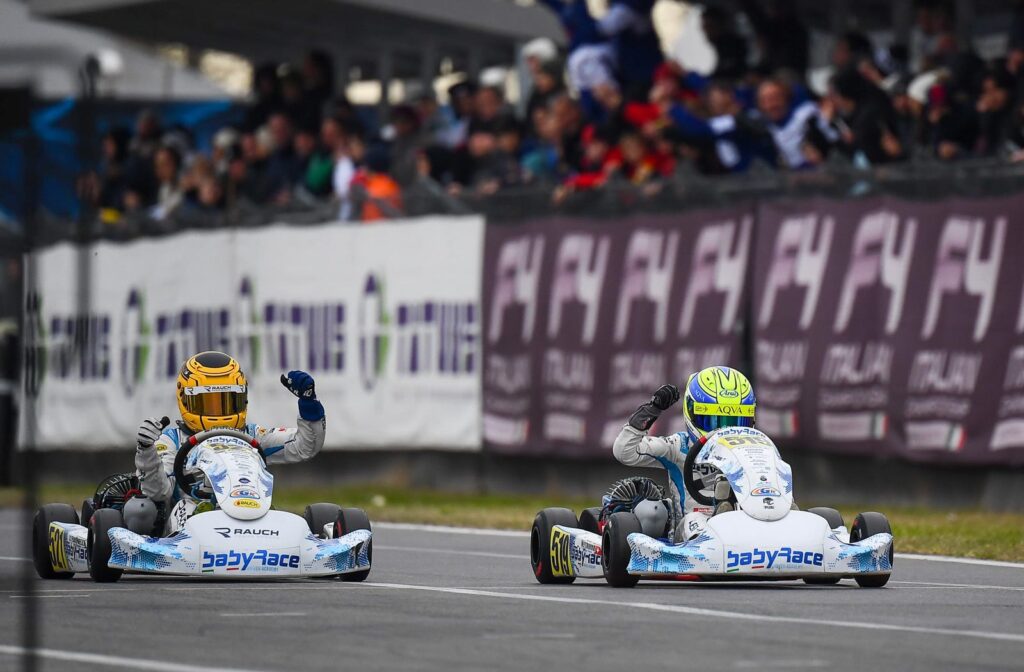
With our team at Baby Race, we’ve been able to win 29 WSK championships over the years and had countless drivers on the podium, more than 100 for sure. So I’m really confident in what I’m telling you here. I’ll also reply to some of the most frequently asked questions that I receive all the time. So let’s get into it.
So First Things First: What Makes WSK Championships So Competitive?
The WSK series has been around since 2010 or so, that’s already 16 years of WSK history. The reason they’ve been so prestigious and competitive over the years is simple: it’s probably the most competitive international karting championship you can race in.
The name WSK stands for World Series of Karting, and it has a lot of prestige and history behind it. Drivers like Max Verstappen, Leclerc, Norris, and Russell have all been WSK race winners. Now that they’re in F1, they still recall those WSK moments, and there have been a lot of pictures posted recently from F1 drivers showing their WSK days. So of course, it’s a very prestigious championship, and that prestige obviously brings competitiveness.
It’s the number one championship to race in, together with Champions of the Future and CIK events like the European Championship and the World Championship. If you want to compete internationally and you’re between 12 to 15 years old driving juniors or seniors, the full program is going to include:
- 11 rounds of WSK
- 4 rounds of the European Championship
- 4 rounds of Champions of the Future (which anticipates all the European Championship races)
- The World Championship at the end of the year
For the full season, that’s 20 international races between WSK, Champions of the Future, and CIK events. The Champions of the Future is a little bit more prestigious nowadays than WSK, but WSK still holds a special place in the heart of many drivers. Winning a WSK title is still a very good thing that can help you progress in your career.
There are many F1 scouts at WSK rounds, McLaren scouts, Mercedes scouts, and others. So for sure, it’s a very prestigious championship where drivers try to do their best and excel.
The reason WSK is so competitive is because it’s probably the most competitive international karting championship you can race in.
Pace vs. Racecraft: What Matters More?
You need to get both maxed out. Ideally, you want to be perfect in terms of pace and amazing in terms of racecraft. You need to be maxed out on both ends.
If you have no pace but amazing racecraft, yes, you will progress through the field in the races. But you’ll probably start in P20 in all of the heats instead of P1 in every race. And if you have amazing pace but no racecraft, even if you may start P1 in every single heat, you’ll probably lose positions and go backwards. Maybe in the first lap someone will just pass you, run you wide, and you’ll lose positions. Then you won’t be able to recover, even mentally.
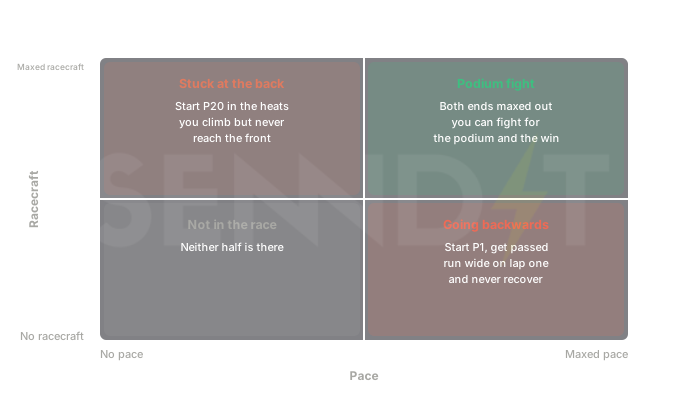
You need to have everything. Once you have both maxed out, you can really fight for the podium and even for the win.
How Important Is Equipment in WSK Races?
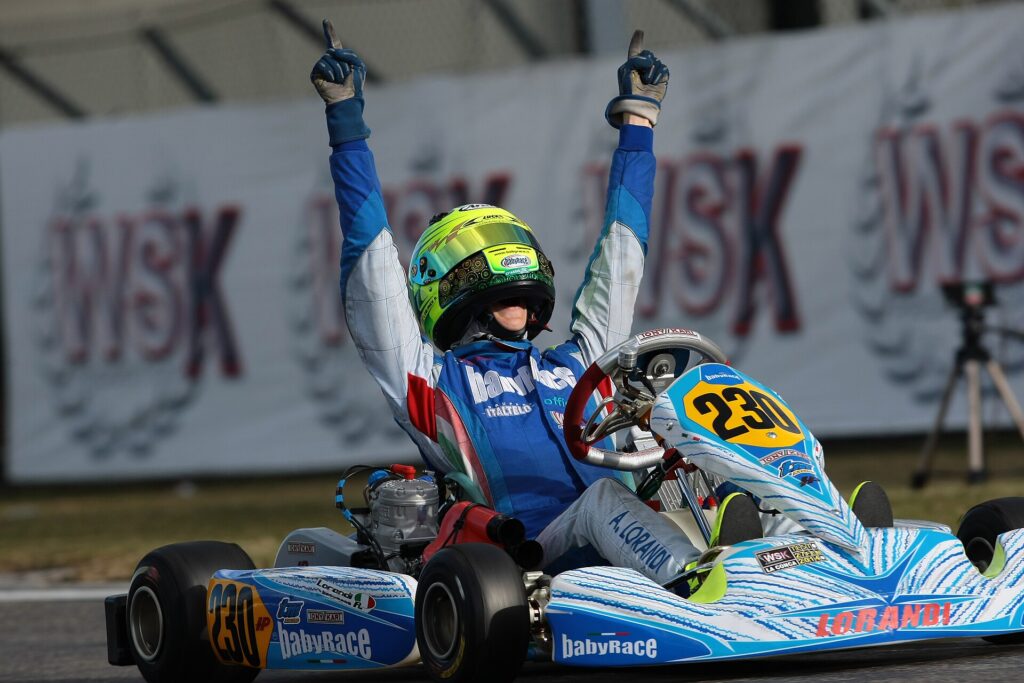
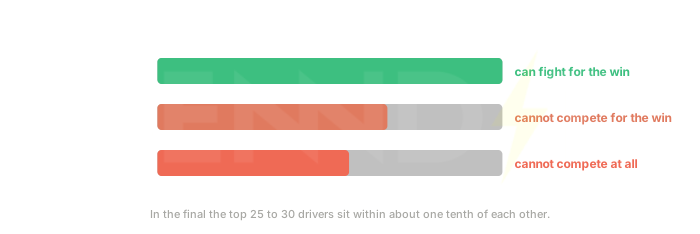
Obviously it’s very important, as in any championship, the kart side has to be maxed out. You can be a 10 out of 10 driver, but if you have a six out of 10 package between chassis and engine, you cannot compete for the win.
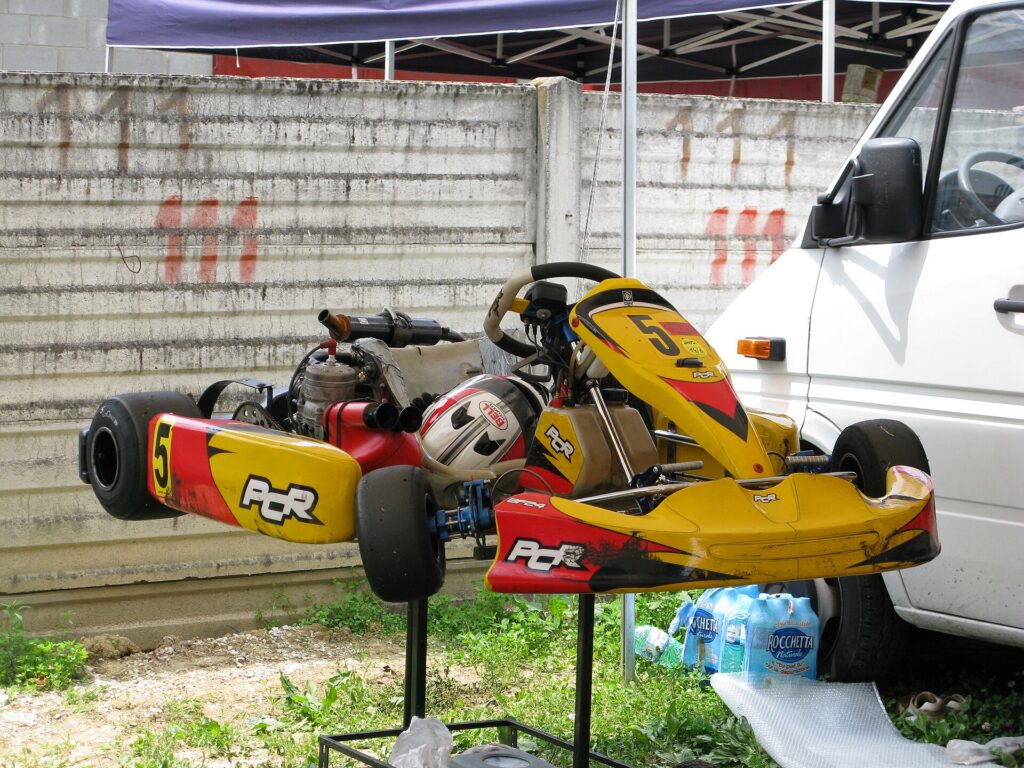
Here’s the reality: if you have a nine out of 10 package and a 10 out of 10 driver, you can still compete and fight for the win. But if it’s a five or a four out of 10, you cannot compete at all. You need to have strong equipment.
The top 25 to 30 drivers that will be in the final all have very similar equipment. There’s a maximum of maybe 1/10th of a second difference between engines and chassis among all those drivers. I would not say there are big differences in material in WSK at that level.

Maybe the number one driver on the track, the one with the most experience and highest skills, might receive like a half 1/10th extra in engine because they want to win and have the highest chances of winning. But I don’t think it’s more than that. You cannot expect half a second of difference in engine. If you see drivers being two tenths quicker than everybody else, maybe they have like half a 1/10th advantage, but the rest is just the driver.
Remember: you can always make your kart better. You can always make your chassis better. You can always make your engine better by giving proper feedback. You have a strong responsibility in affecting the performance of the kart. If you want to win more than anybody else, you’re going to do the work required to win and understand not only how you can go faster as a driver, but also how to go faster as a kart overall.
Try to tune up the chassis with your mechanics, looking at data and videos, describing your feedback, and reading the tires. If you want to improve the engine, tell your tuner your needs. Do you need more bottom end? More top end? Does the carbonation need to be a little leaner or richer? Tell your feedback, and they’re going to work out what needs to be done. You’ll find the pace after a bit of iteration, and your team will help you. But it always starts from you. If you want to win, you need to give proper feedback. There’s no other way around it.

What Role Does Testing Play?
Testing plays a major role. We’re heading up to the final round of the WSK SuperMassive series, and we just won the last four races out of five in the under 10 Year Three categories. Next week we have a five-day race, and we’re preparing with four days of testing leading up to it.
The more testing you do, the more knowledge and information you build, and you’re able to simply go faster and faster thanks to that. Testing is extremely important not only from the driver’s side, because the driver gets better with more laps, but also from the equipment side.
When you have more laps, you get better lines, better braking points, and better racecraft. Everything improves. As in any sport, the more repetition you do, the better. In terms of equipment, you can improve the chassis, understand what works best, optimize collaboration, improve the engine, and work on many other things. Testing is vital.
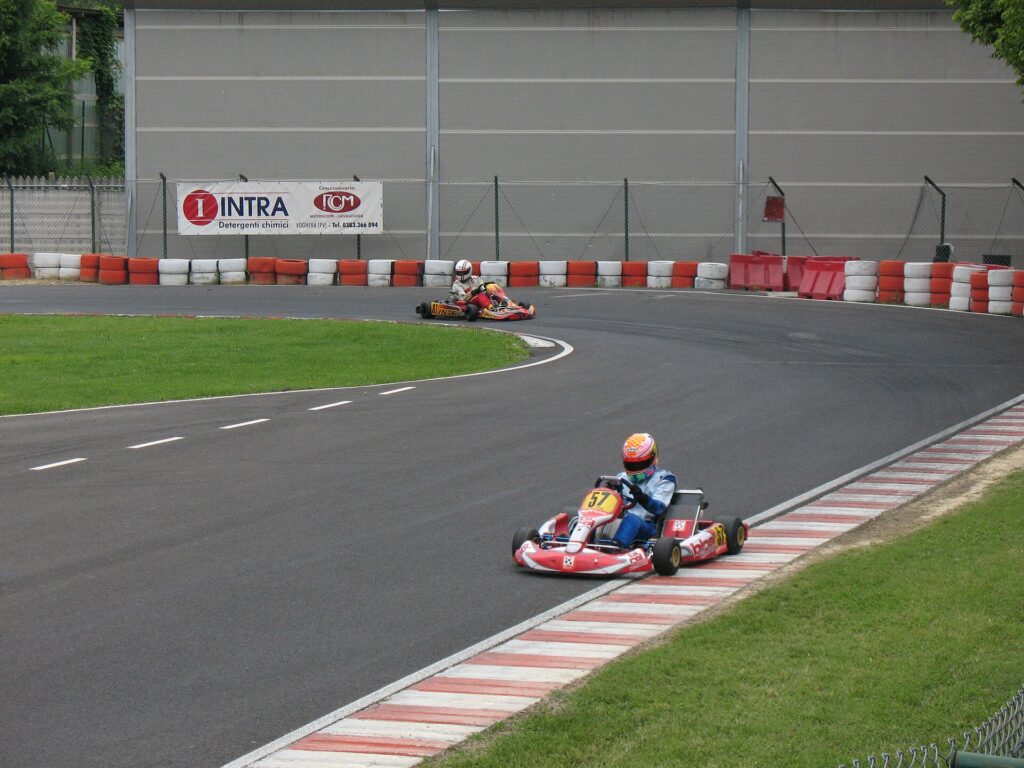
If you have no testing days, you cannot compete for the win. I mean, there’s just no point in racing at the WSK level if you are not testing.
I know testing costs money and time. In an ideal world, you’d have all the testing available. But in the real world, you have to trade off the financial side and time commitments. Try at least to get one or two days of testing before every WSK event. Otherwise, it’s almost useless to go.
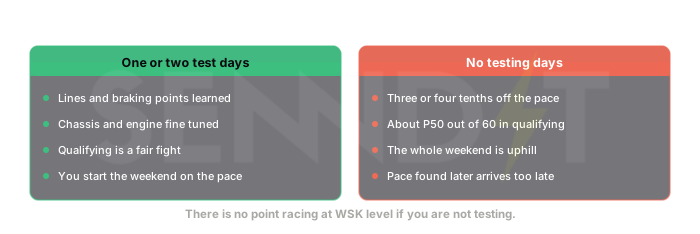
I say to my drivers: there’s no point to race at the WSK level if you are not testing. It’s just silly. The driver may be exceptional, the equipment may be exceptional, but it’s going to be hard to fine tune and find those last couple of tenths in both the driver and the equipment.
If you’re lacking three or four tenths leading up to the WSK race in qualifying, then you’re basically P50 out of 60 drivers. You don’t want to be off from qualifying because then the whole weekend is uphill, and even if you find some pace during the weekend, it’s too late.
How Does the WSK Weekend Look?
A WSK weekend normally includes two days of testing on Wednesday and Thursday. Wednesday is actually optional, it’s not mandatory. Most teams and drivers do both days.
On Thursday’s last two sessions, you already have the transponder, so you can see on your laptop how the drivers are doing. Then on Friday morning, you have a warm-up session, and then right into qualifying. In the final session of Friday, you have a qualifying heat.
On Saturday, you get the warm-up again, and you have other qualifying heats. Then you go into Sunday, where you have the warm-up, the super heat (called the pre-final), and then the final.
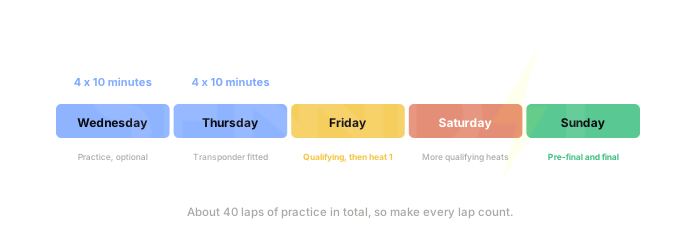
Wednesday and Thursday are just for practice days, you get four sessions of testing about 10 minutes each on both days. Friday is when everything gets serious and the real weekend begins. You need to try to perform at your max in any given day and any given session. But everything really starts from the testing you do the weekend before, at least Saturday and Sunday, the week before.
You cannot drive on Monday or Tuesday during the racing week. You can only start from Wednesday, when everybody’s allowed to start. Since you don’t get many laps during the day, a maximum of about 40 laps if you do every single minute of practice, you need to try to maximize track time and learning.
If you do only five laps per session, you will not learn as much. It’s a waste of time. Make every lap count.
What Separates Podium Drivers From the Rest?
Experience level plays a massive role. If you have a driver who has done 50 WSK races in their life compared to a driver who has done zero, it’s not a fair comparison. You’re not comparing apples to apples.
The first part is obviously experience. Through experience, you learn, you build patterns, and you develop pattern recognition. You’re going to be not only quicker overall in terms of pace, but you’re also going to make better decisions in racecraft. Drivers on the podium are most often more experienced or have at least the maximum experience they can get. They know their tracks very well, like it’s their living room, and they know the kart very well. So they go into the track with full confidence, not only in their kart but also in the track and in themselves.
But it’s not just that. You’ll have many drivers with equal experience, but some won’t perform as well as the few who end up on the podium consistently. Those drivers probably have a better mindset and overall better skills. But they weren’t born with them, they actually developed them through experience and by building those skills intentionally.
At the end of the day, you’ll find drivers who have done the same amount of laps, let’s say hypothetically 100,000 laps in their careers, but they won’t be on the same pace. Some will be quicker, some slower. The ones who are quicker are normally the ones with more determination and desire to win. That desire actually allowed them to improve their skills and make a gap on the others.
The drivers who want to win are the ones who are going to win. But one thing is not enough, it’s the actions you take that result from wanting to win that actually makes you win.
There’s a big difference between wanting to win and really doing absolutely everything you can to win, which is, for sure, more than what anybody else does on the track. It’s very important to keep that in mind.
If you want to win a WSK race or finish on the podium at least, you need to be that kind of driver. You cannot get lucky and finish on the podium. Yes, you can get lucky and gain positions, but you cannot rely on luck for a podium finish. The reality is that if you wish to become a WSK podium finisher, you need to become a driver that is capable of achieving that consistently.
How Important Is Consistency During Qualifying Heats?
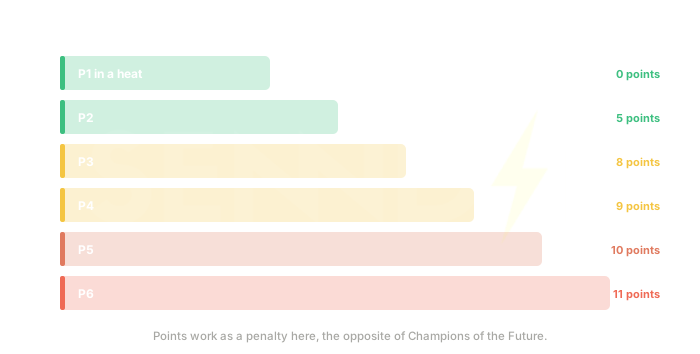
That’s very important. It’s fundamental that a driver nails every single heat. It’s important that you’re not taking too many risks because you want to ideally arrive in the pre-final with no crashes. You want to keep your points very low in the qualifying heats.
You might think that more points are better, but it’s actually the opposite. Here’s how it works:
- P1 in a heat = 0 points
- P2 = 5 points
- P3 = 8 points
- P4 = 9 points
- P5 = 10 points
- P6 = 11 points (and so on)
This is the opposite of Champions of the Future, where higher finishes get more points. But in WSK, the goal is to arrive in the pre-final with as few
Send your onboard footage. Alessio reviews it corner-by-corner and tells you exactly what's costing you time, and how to fix it. Back within 48 hours.
Get My Onboard Reviewed → Reviewed personally by a CIK FIA World Champion, never an assistant.I promise I'll not spam you with repurposed shitty AI content but real experiences that only I, Alessio Lorandi, experienced. Written in my funny English-Italian tone of voice 😂
Alessio Lorandi is the former CIK FIA World Junior Champion, winning against Lando Norris in 2013 & F3 multiple race winner. He's helped 200+ karting drivers worldwide get faster & win WSK titles with BabyRace Driver Academy & now through Senndit, his online karting coaching platform.