
Best Beginner Kart Classes Explained
Choose the wrong kart class, and you're burning money. Here's what actually matters.

- Age is the primary factor determining which kart class you should start in, but once you’re an adult, you can choose based on your goals and experience level
- The safest beginner classes are direct drive, single-speed karts like 60 Mini (for kids) or Senior categories (for adults)
- Shifter classes (KZ2, DD2) are the most expensive due to higher maintenance, engine rebuilds, and tire wear
- The jump from 60 Mini to Juniors is the biggest category shift you’ll experience in karting
- Don’t skip steps, choosing a category above your current level builds frustration instead of skills
- Your choice depends on three things: age, goals (recreational vs. racing to F1), and budget (local vs. international racing)
- What Exactly Determines Which Kart Class You Should Start In
- Is a Faster Category Always Better?
- What’s the Main Difference Between Mini, OKJ and KZ?
- What Class is Most Beginner Friendly?
- What Kart Class is Most Expensive?
- What Class Teaches Driving Fundamentals Best?
- Can Adults Start Directly in Faster Classes?
- What Mistakes Do Families Make Choosing Categories?
- How Hard is it to Switch Classes Later?
- The Safest Starting Class
With so many car classes to choose from, how do you know exactly which one is right for you or your child? Now, I guess you have already seen different races. You have maybe even taken part in different races, but if you are total beginner, I wanted to get an idea of what each kart class represents and who is supposed to be for. I will explain everything in this detailed guide.
Now, of course, you’ll have to notice that most of the categories are going to be related to age, but only on that, because once you are an adult, you can then choose what category to get in, and each category will have different regulations and different specs from other categories. So let’s dive right into the guide. I will answer to some common questions so that you’ll have a clear idea by the end of this guide exactly which kart class to join.
What exactly determines which kart class should someone start in
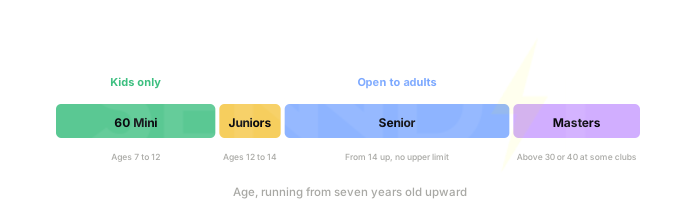
The major aspect of it is age. Of course, if you are eight years old, you are going to be driving 60 Mini, whereas if you are 14 years old, you’re not allowed to drive in 60 Mini.
There is a minimum age or maximum age for 60 Mini and OKJ and there’s a minimum limit for OK Senior, but there is not a maximum limit. So you can even drive in your 30s at the end of the day. There’s no major rule that says you’re not allowed to drive above a certain age in OK Senior, for example, or even in X30 Senior, or even in Rotax Senior. You are only going to have a minimum age there. And then it’s up to you to choose until when you want to drive.
So it’s basically that the major aspect, of course, is the age that separates each class, but also the category itself. If you want to be in the Iame X30 series, then you can choose between Mini X30, Junior X30, or Senior X30, the main categories. Whereas if you are in a Rotax series, then you’re going to choose among Mini Rotax, Junior, Senior, and there’s also DD2.
Whereas if you are in the ROK series and championship, you’re going to again, choose among the Mini, among the Junior, and among the Senior. So yeah, there’s many different categories with different series you can choose in the world of karting. And that’s why it makes it so great, because it’s very wide. There’s a lot of variety, especially if you are in different countries. For example, in the US, there may be different categories that you don’t even have in Europe. So yeah, that makes it quite variable.
Is a faster category always better?
Well, I mean, if you have the skills and experience to take on a faster kart, well, probably it will be. But if you’re not experienced enough, probably the best decision is to stick to a slower kart and a slower category until you get ready to get onto the faster kart.
What’s the main difference between Mini, OKJ and KZ?
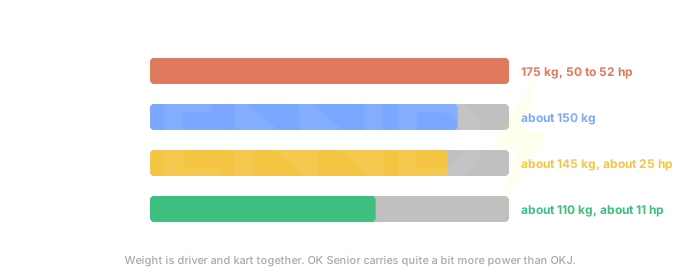
Well, the main difference between these classes, of course, is the horsepower and the weight relationship. So with more power comes more weight and vice versa, basically.
- Mini has the lowest power, just about 11 horsepowers and about 110 kilos of minimum weight between driver and kart
- OKJ has got about 145 kilos and I’d speculate about 25 or so horsepower
- OK Senior is a bit heavier at about 150 kilos, and it’s also quite a bit more power
- KZ2 is 175 kilos and there’s about 50-52 horsepowers
Of course, depending on the weight as well as on the power, between Mini and bigger karts, there’s also a difference in tires. So Mini has smaller tires, whereas Juniors, Seniors and KZ have wider tires, which makes it more grip. And of course, yeah, it’s in relation to the fact that the kart has higher weight and more power. So yeah, they are not power limited by very small tires.
What class is most beginner friendly?
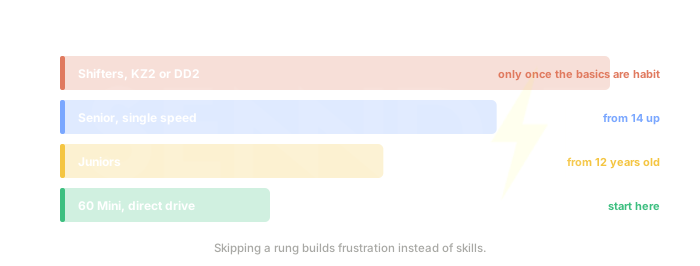
I believe the most beginner friendly class, of course, if you are starting out as a kid, is a direct drive class as 60 Mini. I mean, of course, we cannot expect you to get straight into shifters as KZ. So that’s the straightforward path.
You know, from when you start out, you just get into 60 Mini as the first and most reasonable option. Then once you move up above 12 years old, you get into Juniors, and again, a way that you’re competing in Europe in OKJ, which is basically the international level karting Junior series for WSK, CIK and Champions of the Future races. But if you’re planning to do instead, like X30 or Rotax, then you are going to still, still be doing Juniors. But in that respective series.
If you are starting out as an adult at like 15, 18, 20 years old or 30 years old, even the most beginner friendly class is probably the direct drive class, again, and that, if you’re about 15 years old, is going to be the Senior category. And yeah, that’s going to be the most straightforward category to get into if you’re starting to get into karts later on in your life.
And once you get more familiar with it, and once you upgrade and try to do something more special and more powerful, then I would suggest you to get into shifters, KZ2, or DD2, if you’re into Rotax, and that is very fun. But of course, it requires basic skills that you need to develop from when you’re young in karting. And of course, you can’t expect yourself to get straight into shifters. I mean, there’s people who’ve done that, but I would not recommend it. The jump from not being a karting driver to straight into shifters, I think it’s quite shocking.
So I would take it step by step, and I will get my feet wet into karting by getting into direct drive karts. And then get into single speed karts, of course, just like single gear, and then getting to gearbox classes like KZ2, or shifters for ROK and DD2 for Rotax.
What kart class is most expensive?
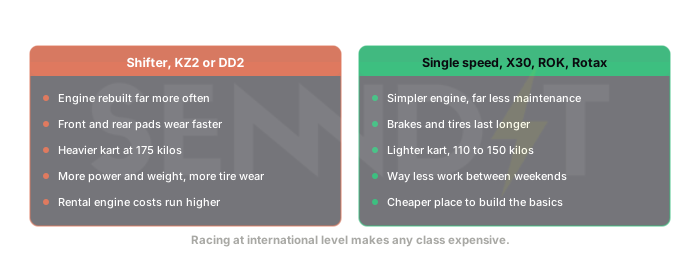
The most expensive class is the shifters class. So the KZ2, the gearbox classes, basically. Why? Well, because the maintenance of the kart is quite a bit more expensive.
You’ll have to rebuild the engine way more often. You’ll have to change brake pads in the front and rears a bit more often, because the kart is quite a bit heavier. The tires will need to be replaced quite a bit more often, because with more power and more weight comes more tire wear.
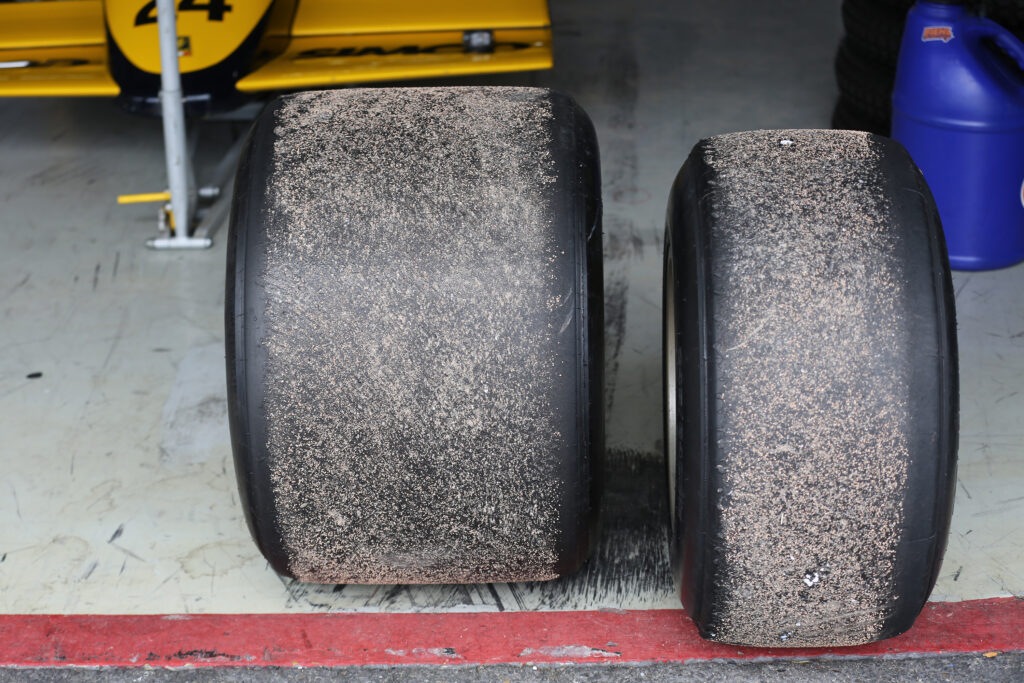
Whereas for the single speed karts classes, it’s a lot less maintenance, a lot less work. But of course, it depends if you are into, for example, Iame series X30, or Rotax, or ROK. The maintenance is way lower, way way lower, because the engines are way simpler and require just less maintenance overall. So I just believe that, yeah, it’s gonna be a clever decision to just get started in there. And then once you progress and feel like your skills are getting better and better and your lap times improve, then I would get myself into more expensive classes.
Of course, it depends on the size of your wallet and your expectations and your ambitions. But yeah, the most expensive class is definitely the gearbox class.
But also you can make any other category expensive by simply increasing the level of the category you are competing. For example, if you’re competing at international level, like WSK, CIK, or Champions of the Future classes, basically international races, you are going to be spending quite a lot. The maintenance may be quite reasonable, but just because you have to compete in those very, very high competitive championships, you’ll have to spend more money on tires, more money on engine rentals, etc, etc. So it’s going to be quite a bit more expensive overall.
But yeah, as just pure category, the most expensive one is the shifter class. So KZ2, simply because the maintenance costs and the rental engine costs are quite a bit higher.
What class teaches driving fundamentals best?
The kart class that teaches fundamentals the best, I think, is the direct drive single speed class of Juniors and Seniors, for example. So as I said, depending on what’s your age right now, if you are between 12 to 14, or if you’re above 14, then you should be into Seniors. But if you’re below 14 and you want to get the best fundamentals driving skills, I would get into Juniors.
But of course, if you’re above 14 and you want to get yourself into karting, I would drive a Senior kart that will be very, very fun you will see. So they’re going to teach fundamentals very, very well, because you basically have to make the corners as round and as wide open as possible in order to keep up the RPMs and the minimum speed in a way that you can really get higher minimum speeds, higher exit speeds, and at the same time trying to get the entries to be as late as hard as possible, to stop the car and try to just to be nice and late and hard on the brakes.
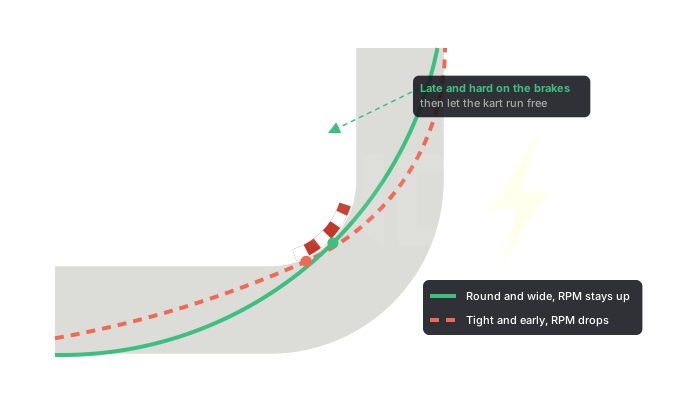
And, yeah, I mean, overall, it’s the best driving fundamental tutor. I would say, if you want to get starting karting and move up into GPs later on in your career, or other formula car series.

Can adults start directly in faster classes?
Well, they can for sure. I mean, if you’re starting out at 25 years old, you cannot go through 60 Mini, for example. I mean 60 Mini is reserved between the age of seven to the age of 12. So, I mean, if you are starting late in life, you are not allowed to race in those categories unless you make a fake license and pretend that you are 12 years old. But I think it’s going to be quite unrealistic and hard to believe.
But yeah, also, between 12 to 14, you cannot join the Junior classes, so in that case, you will only be left to join the Senior classes or the Masters classes. Sometimes there’s categories that are reserved for the elderly, that are, let’s say, above age of 30 or 40 or so. Depends a lot on most countries, some club races, championships that they all create different categories and their own different series. So of course, you should check your local tracks and local clubs to see what kind of categories feeds your needs.
But for sure, yeah, adults can start directly in faster classes. I mean, you cannot start in the slower classes of Mini and Juniors. So yes, they can definitely start into Seniors and into shifters. And yeah, it’s just up to them. Of course, shifters a bit more of a traumatic experience to get straight into that, even though you may be familiar with gears, because you may have been driving a road car with gears. I mean, of course, probably like a manual car, but still, it’s very, very different, very, very far from an actual driving experience of a shifter kart.
So yeah, I normally recommend to just drive a single speed direct drive kart first, such as a Senior kart from either OK or from Rotax Senior, or from X30 Senior or ROK Senior.
What mistakes do families make choosing categories?
I believe one of the major mistakes parents make when choosing a category for their son or daughter is choosing a category that’s actually above their current level. So getting them into a category that’s beyond their current level of driving, kind of cutting the steps and prematurely joining a category that’s not meant for them. So I think that’s one of the most common mistakes.
The problem is that you need to first start from building the foundations, the basics, and how you do that, by starting small, by starting slow, by starting simple.
And of course, you’re not able to do that if you are getting yourself started in the most challenging categories, for example. So let’s say if a kid is 12 years old, and he is, for example, just starting out, even though it may be considered late for modern standards. But anyways, parents may have the choice of either starting the kid into the small karts, so in 60 Mini or getting them right into Juniors, so the bigger karts. So OK Jay Rotax Juniors, or X30 Juniors. So that’s the choice.
But if they make the choice of getting them prematurely into Juniors, into the big karts, I think that’s not a great decision overall, because the kid first needs to learn the
Send your onboard footage. Alessio reviews it corner-by-corner and tells you exactly what's costing you time, and how to fix it. Back within 48 hours.
Get My Onboard Reviewed → Reviewed personally by a CIK FIA World Champion, never an assistant.I promise I'll not spam you with repurposed shitty AI content but real experiences that only I, Alessio Lorandi, experienced. Written in my funny English-Italian tone of voice 😂
Alessio Lorandi is the former CIK FIA World Junior Champion, winning against Lando Norris in 2013 & F3 multiple race winner. He's helped 200+ karting drivers worldwide get faster & win WSK titles with BabyRace Driver Academy & now through Senndit, his online karting coaching platform.