
Can Adults Start Karting Late in Their 30s, 40s, 50s?
Age is just a number in karting. Here's what actually determines if you'll be competitive starting at 30, 40, or 50.

- Adults in their 30s, 50s can absolutely get very good at karting with proper coaching, discipline, and commitment, especially at national and club levels
- You won’t match a 15-year-old who started at five, but you can compete fairly in Masters and Senior categories designed for drivers 30+
- Adults have real advantages: life experience, better coachability, financial stability, and a road license (you’re not starting from zero like kids)
- Success depends on track time, aim for 15,000 laps (~100-150 days of driving) to reach competitive lap times; more laps = exponentially faster progress
- The biggest mistake is thinking age matters more than total hours driven; you need to train 3-5x more than younger competitors to close the gap
- The biggest mental barrier is self-doubt; belief combined with a structured action plan and proper coaching makes it absolutely achievable
- Are Adults at a Disadvantage Compared to Kids?
- What Advantages Do Adults Have?
- Realistic Goals for Adults 30-50
- Fitness and Training at That Age
- Can Adults Race Competitively?
- How Long to Reach Good Lap Times?
- Common Mistakes Adults Make
- The Mental Barrier
- The Smartest Approach to Improvement
- Is It Too Late to Start After 30?
Can adults start karting late in their 30s, 40s, 50s?
I actually get asked this question a lot.
If someone is in their 30s, 40s or 50s, is it too late to start karting seriously?
Is he too old?
In this guide, I believe I will be able to provide some clarity and break down some myths so that you can get started in karting, even though you may not be the youngest on the grid.
Are Adults at a Disadvantage Compared to Kids? Or is that a myth?
Well, this is, of course, kind of true, in a way, that kids have the luxury of having more time ahead of them, so they are going to have more practice time, given that they started young, and that, of course, is going to make it easier for them.
But at the same time, adults can still get very good results and get very good even though they may not have started young. So yes, at the same time you cannot be fooled by believing that starting at 40 can get you faster than a kid that started at five years old, that, of course, it’s 99% of the time not going to be possible.
But of course, if you put a lot of commitment, dedication, high quality coaching and high quantity of track time, and you decided to go in your 40s to spend all that time on the track, and of course, also money, then, yes, you would definitely be able to still get very good and perhaps not an international level, but at a national or local club level, you will still be able to get very good.

If you’re able to, of course, put a lot of track time, as well as high quality coaching being received. And of course, if you have to drive against a 15-16 year old that has been driving for 10 years already, and you are just beginning at 40, then, of course, not only he has much more experience, but he’s obviously got better reaction times. And you know, he’s naturally going to be quicker.
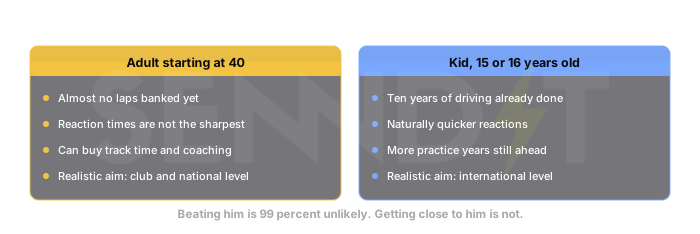
But again, don’t get discouraged, because with enough track time and proper coaching, you can definitely get as close as possible to his level.
What Advantages Do Adults Have That Younger Drivers Don’t?
Well, of course, one of the major advantages that adults could have is life experience in a way, and knowing that normally they are more mature, they are going to probably be more coachable. They’re going to listen more, and I think that’s going to be a good thing.
You know, normally kids or teenagers may have a lot of talents, may have a lot of skills, but maybe they are not as coachable as someone who is, you know, has got some more decades on their back. And so all life experiences bring some point of views, and I guess, yeah, will give you better clarity, and probably you become more coachable.
Adults have several distinct advantages:
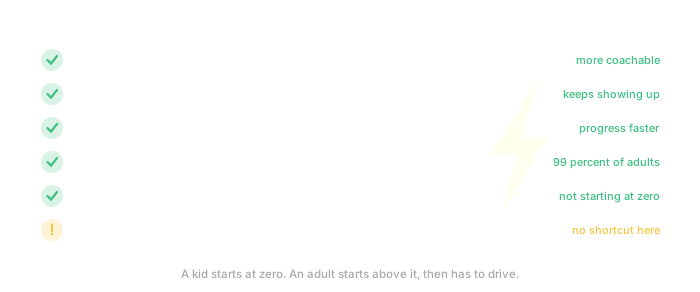
- Life experience and maturity, more coachable and receptive to feedback than young drivers
- Discipline, life experience normally brings more discipline than you find in kids and teenagers
- Financial stability, if you’re in your 30s or 40s with a strong net worth, you can allocate the budget and time needed to progress faster
- Road license and prior driving experience, you’re not starting from zero like a child who’s never driven anything; you already have a road license, maybe rental kart experience, or prior track time
Adults have the road kart license in almost 99% of cases, so they already know what it means to kind of drive. They are not literally starting from zero, as kids do, because they have never been driving anything in their life when they just start.
So they have that kind of driver license, maybe they already have got some prior experience on rental karts, or maybe they have prior experience on GT cars, etc., so I guess they will still be able to start from a level that is not zero, as kids do, but again, of course, they then need to put in the track time needed and the quality track time with coaching.
Realistic Goals for Adults 30-50
Well, of course, it always comes down to the time available. If they don’t have that much time available, it’s very unlikely that they can compete for the same races at the international level as kids do when at 15 after starting at five years old.
So for sure, it all comes down to their time available, their financial commitments, and their current financial situations. Because, of course, that’s going to cost a lot of money.
If you want to go full-time karting competitively, budget about €100,000, €200,000 per year. If you just want to do it at an amateur hobby level, you can do it with much less, even as little as €10,000 per year for local club races and fun with friends.
Senior and Masters categories are your friend. There are categories for drivers above 30 years old in most countries. For example, in Italy, the shifter class for drivers above 30 is called KZ Masters. This is a huge advantage, you get to compete against people of your own age instead of against 18-year-olds who may have better reaction times and physical advantages.

You get to compete at a fair level against people of your age, and you can absolutely have a blast doing it while fighting for race wins.
How Much Does Fitness Matter at That Age, and Can Normal Training Compensate?
Well, fitness matters a lot. Of course, the adults that want to take on this challenge will need to get super fit, but not for the gym. They need to get sport-specific fit.
So they need to literally train as well as they can and follow a specific training regime specifically for race drivers. They want to be super light on the karts, so they want to do lots of cardio and endurance exercises with maximum body weight exercises, they don’t want to be bulky and heavy. They want to be super light and fit.
And so they need to really change their training regimen, diet, and nutrition in general, because, of course, you may have to lose a lot of kilos in order to be super fast on the kart, and not many people will be able to take that commitment.
That, of course, requires a lot of discipline regarding the normal training, whether it compensates. Well, driving on the track, of course, helps you to get sport-specific fit.
Of course, there’s nothing quite like it. If you drive every single day for a full year, for sure, you can take a complete beginner into being a very good driver by the end of the year. And of course, it’s going to get very fit because you’re going to train all the muscles related to that sport, like the neck, forearms, the rib cage, the core stability, etc.
But of course, you need to also supplement it with specific exercises that are required for karting drivers.
Can Adults Race Competitively?
They can race competitively. Of course, it really depends on their goals and ambition based on the time they’re able to allocate and the money they’re able to allocate.
If they’re able to spend a lot of time and money, they can definitely compete at a national level. It again depends on the categories they’re going to be choosing to compete in.
Now there’s going to be masters categories in most of the countries above, for example, 30 years old. That’s the thing here in Italy. But I’m not sure for every country if it’s exactly the same. But anyways, you can check, there’s most of the times categories specifically for adults above, like 30 or above like 40, so that they can compete at a fair level against people of their age.
But yes, even if you just start out super late in your life, and you get to practice a lot and practice in a high quality way, for sure, you can get yourself fighting for top positions in pretty competitive national level championships.
International is quite difficult, because, let’s be honest, the international ones require lots of training, lots of time and money. Of course, not everybody will be willing to do that. But if you really want to do it, you can do it.
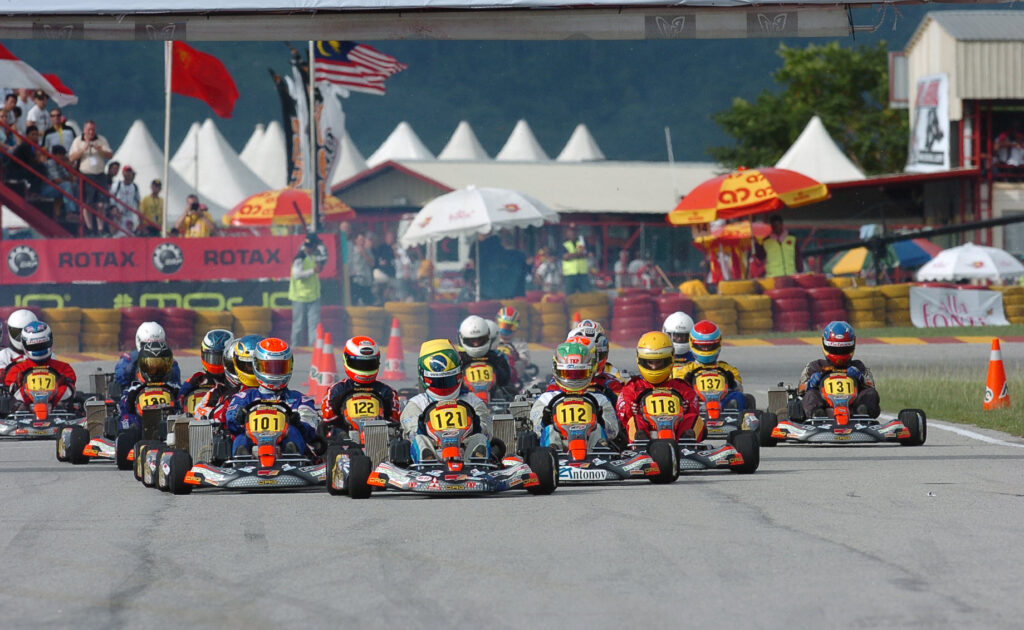
I mean, as long as you train few times per week, that’s a life choice. You need to really change completely your routine and your life. So you need to kind of engineer your life around that. But as in any sport, especially if you want to start late, you need to put two times, three times, four times the effort as someone who started early.
But again, it’s still possible to make it. You just need to double down, triple down, quadruple down, and really put almost like all in in your life.
How Long Does It Take for an Adult Beginner to Reach Good Lap Times?
Well, of course, it all comes down to the number of laps they are doing. It’s not just about time passing, you are not going to get better by simply the passing time.
So the most laps you do, the most you improve. If you do 1000 laps in a year, you improve an X amount. If you do 2000 laps in a year, you do 2x almost the improvement. If you do 10,000 laps in a year, well, you can guess you’re going to be so much quicker than if you did only 1000 laps in a year.
If you do 150 laps in a day, reaching 15,000 laps takes 100 days of driving. In a calendar year of 365 days, that means you need to be on track almost once every three days. By the end of the year, you will have accumulated 15,000 laps, a very good chunk that will make your level skyrocket.
To reach good lap times, aim for 10,000-15,000 laps, which roughly equals 100-150 days of driving on track in total.
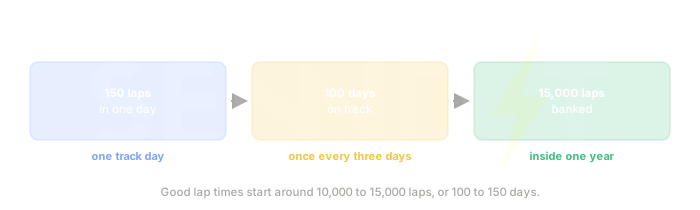
And for sure, your level is going to skyrocket and you’re going to be right away fighting for the top positions, even though you may need a lot more than 15,000 laps in your career to get you fighting for the international level races as World Championships, European Championships.
So the earliest you can get those number of days and laps, the sooner you’ll be able to achieve great lap times.
Common Mistakes Adults Make When Starting Late
Well, I believe the major mistake is not trying to compensate the kind of lack of track time they’ve had by simply driving as much as the other drivers are doing right now.
So for example, if they start at 35 years old, and somebody has started at 15 years old, and they want to race against that driver that maybe now they’re both the same age, 35 years old, but they cannot expect to have the same lap times, because that guy may have been practicing and racing for 20 years already.
And so you will have naturally so much more skills behind their back, and so much more experience.
One of the most common mistakes is just thinking about age. So we are both 35, so we should both be fast the same. No, it’s not true at all.
What you need to consider is the amount of laps and days of driving done leading up to that moment, and so you need to kind of plan for the same amount of laps.
It’s very hard to track those numbers, I know, but you need to be like, Okay, if this guy is now practicing once a week, if I want to close the gap, I need to practice like five times a week for 10 years, five years or something, and I will close the gap roughly by the time if I practice five times more than he does, you know what I mean.
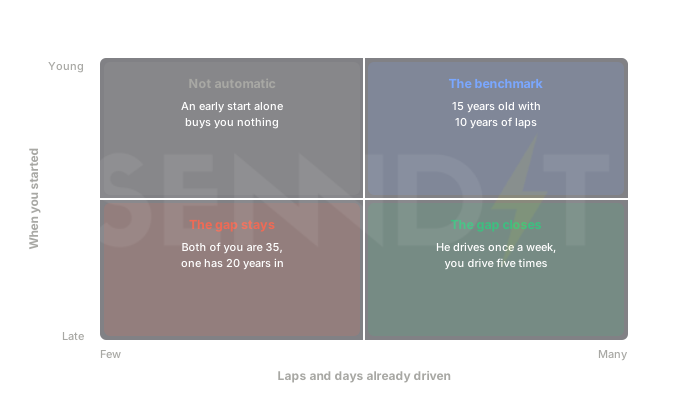
So it’s really like that.
I think that is the major mistake. And of course, another big mistake is just expecting too much, honestly, just like not realizing that it takes time, and they need to respect the fact that, as in any skill and is any sport, you cannot expect to get good overnight, you need to put the effort and the practice time, which is required in any sport and in any skill.
The Biggest Mental Barrier
Well, I believe the biggest mental barrier is the self belief, the self confidence. You know, your inner voice telling you, Oh, you’re too old or you’re too slow, you’re too heavy, or you’re starting too late stuff like that.
I think the mental side is huge
Send your onboard footage. Alessio reviews it corner-by-corner and tells you exactly what's costing you time, and how to fix it. Back within 48 hours.
Get My Onboard Reviewed → Reviewed personally by a CIK FIA World Champion, never an assistant.I promise I'll not spam you with repurposed shitty AI content but real experiences that only I, Alessio Lorandi, experienced. Written in my funny English-Italian tone of voice 😂
Alessio Lorandi is the former CIK FIA World Junior Champion, winning against Lando Norris in 2013 & F3 multiple race winner. He's helped 200+ karting drivers worldwide get faster & win WSK titles with BabyRace Driver Academy & now through Senndit, his online karting coaching platform.