EVERYTHING Starts On The Entry
Corner entry kills more lap time than you think. Master these three fundamentals and watch your mid-corner speed transform.

- 90% of mistakes in any corner start from the entry, if your entry is wrong, everything else falls apart
- Focus on three things at entry: the racing line, optimal speed, and your driving inputs (brakes, throttle, steering)
- Most drivers brake too early or too soft, causing them to turn too early and miss the apex
- Keeping throttle on the brakes is a subconscious habit that prevents proper rotation and forces you to brake earlier than necessary
- When you see low mid-corner speed in your data, the problem almost always traces back to entry technique, not mid-corner execution
- Always analyze your entry first, both video and data, when troubleshooting any corner issue
Your entries are the most important thing.
If you want to have a good corner, you need to have a good entry. If you want to have a good lap, you need to have all corners with good entry.
90% of the mistakes in the corner start from the entry. So if your entry is not ideal, you will likely make a mistake I’ll explain to you.
If your entry is not ideal, you will likely make a mistake. 90% of the mistakes in the corner start from the entry.
Let’s imagine we create a corner. Let’s say this is the way you approach. This is the corner. You’re coming from here, and let’s say there’s like a curb here. We’ve got our nice little corner.
The point being is that if 90% of mistakes start from the entries, we need to prioritize the entry so much. So it means we have to have the most, the highest focus on the entry in terms of three things.
The First Thing is the Line
The first thing you have to think about at entry is the line. You either place your kart one way, or you can place it another way. Which one is going to be better?
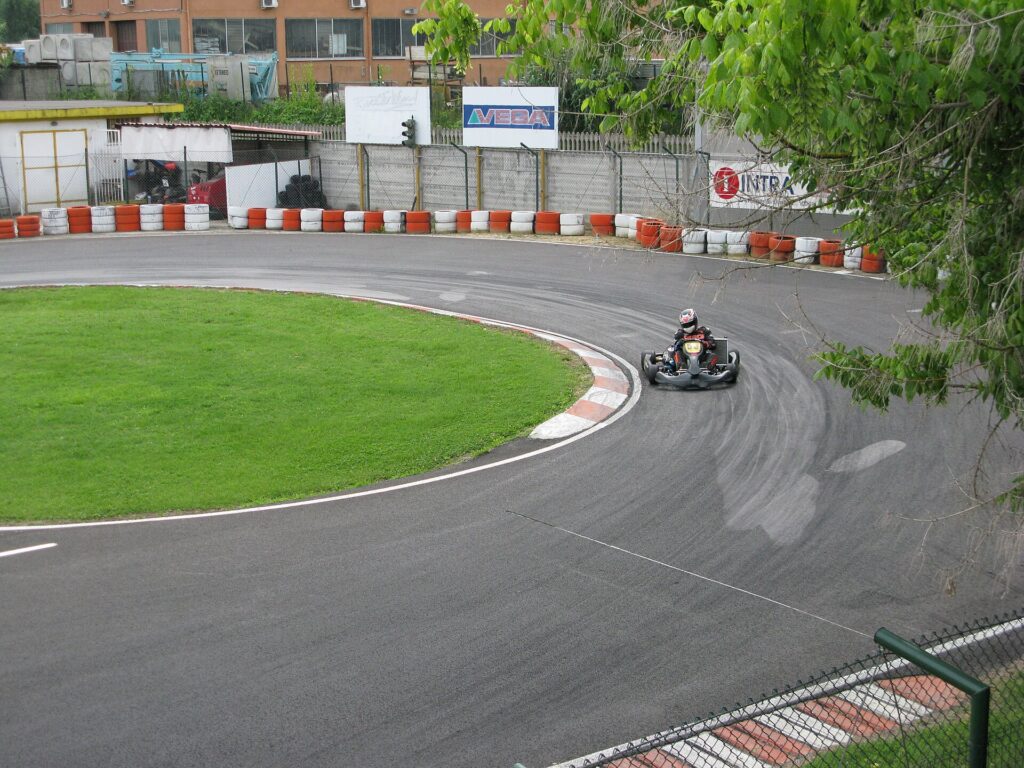
If you’re in the optimal position, you’re going to have the proper line, you’re going to have the great apex, and you’re going to use everything properly. If you’re in the wrong position, you’re going to be too tight on the entry, you’re going to miss the apex, and the middle and the exit are going to be where the mistakes happen.
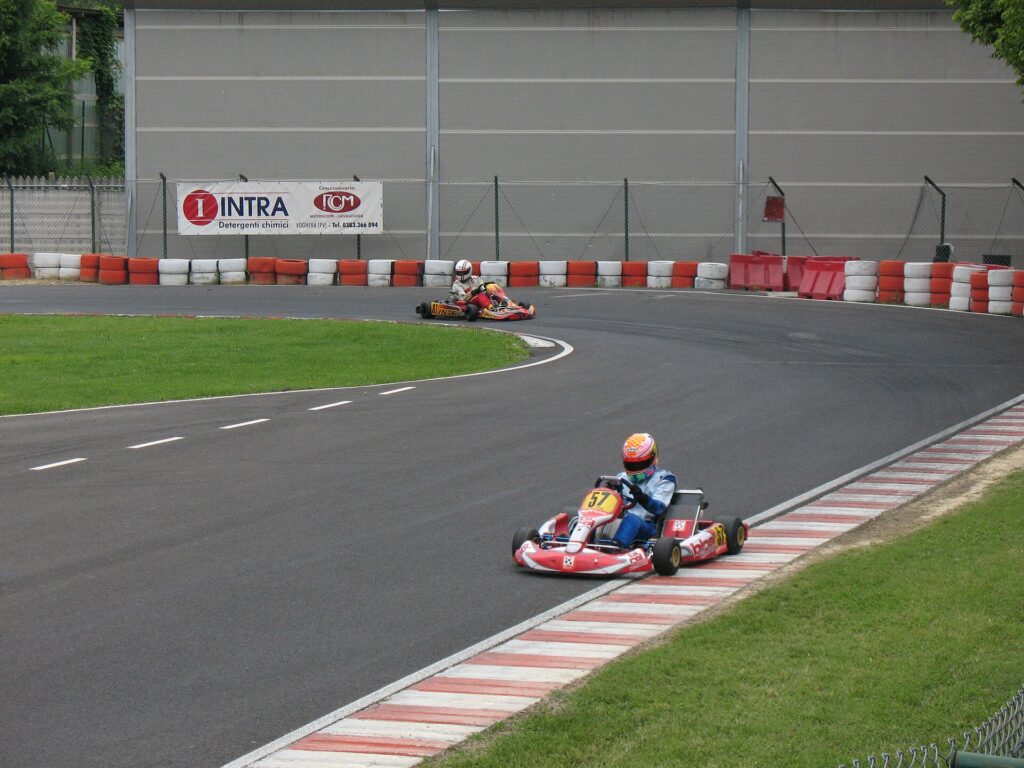
Here’s what I cringe about: when a coach or parent tells you “you’re going too wide on the exit,” that’s pointing at the symptom, not the cause. The actual problem is that you worked too tight on the entry. That is the real mistake.
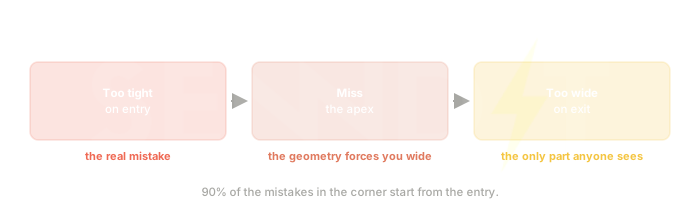
When someone says you’re going too wide on the exit, the actual problem almost always starts at entry. You placed the kart too tight, and now the geometry forces you wide. Fix the entry, and the exit fixes itself.
The first goal is to get the optimal racing line.
The Second Goal is the Speed
You can either arrive too fast or too slow at the entry. Let’s say you have the optimal racing line correct, and you have the optimal speed, that’s perfect.
But if you arrive too fast, you’re just going to go wide. People standing from the outside say “you’re going too wide,” but they don’t see the real problem: you arrived with too much speed.
Sometimes, when drivers miss the entry and go too wide, they slow down in the mid-corner. This is the less bad mistake, because if you keep going wide, you make more distance and end up on the dirt. So normally, the least bad mistake is to slow it down in the mid-corner and try to fix it next lap.
But here’s the thing: from the outside, people will say “you are too slow in the mid-corner. You slowed it down too much.” They don’t realize the actual problem starts from the entry being too quick.
The Third Reason: Your Inputs
The three main things you have to think about in the entry are your driving inputs. Your inputs basically are your left foot, your right foot, and your steering wheel.
- Left foot = brake control
- Right foot = throttle control
- Steering wheel = line control
Your steering wheel affects the line. Your pedals affect the speed. But it goes much deeper than that.
The Braking Problem
Let’s say you’re in a hairpin. You can either brake not enough, or you can brake properly. When you brake not enough, you don’t create the same rotation or pitch as if you brake properly.
When you brake hard and properly, several things happen:
- You can brake later
- You’re able to stop more
- You generate more temperature on the tires
- You create more pitch on the kart
- You’re more likely to get the apex because the kart has more rotation
The entry is highly affected by your braking speed, distance, and technique. If you brake in a certain way properly, you will rotate the kart like you want. If you don’t brake enough, you’re going to go straight, or you have to brake so early that you lose time.
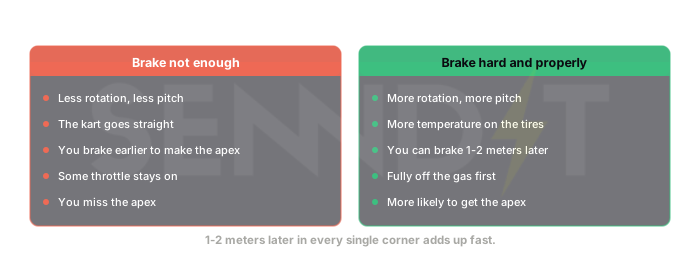
If you brake properly, you will rotate the kart like you want. If you don’t brake enough, you’re going to go straight.
The Early Brake Problem
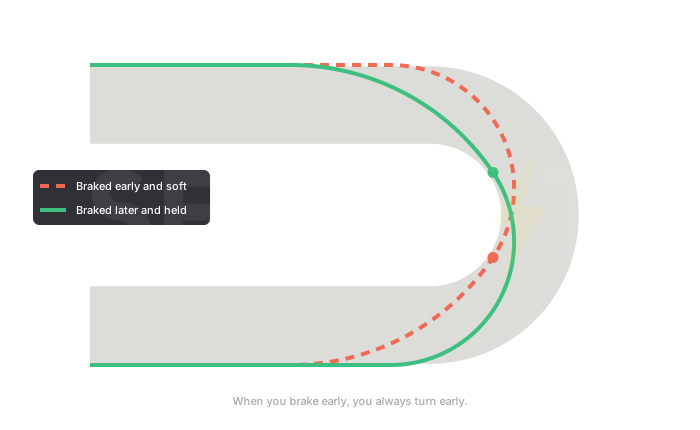
Here’s what happens most of the time: drivers brake too early. Because they brake early, they feel like they’re too slow, and on the entry, they get back on the gas too early.
Instead of getting on the gas at the optimal point (which is at maximum peak rotation, just a tiny bit before the apex), they get on the gas way too early. Because they’re too slow on the entry (because they braked too early and too soft), they go on the gas early, and they’re going to get pushed out wide.
When you brake early, you always turn early. That’s the problem.
The Throttle-on-Brakes Mistake
Another mistake: drivers are keeping the throttle on while on the brakes. Maybe they brake hard, but then they come off too early. You should brake much later, hold the brakes, trail-brake through the corner, and then come off later.
Here’s the biggest issue I see with 90% of drivers: when they brake, they’re not coming fully off the gas. They keep a little bit of throttle on.
So they go from full throttle, and they come off, but they keep 20% throttle, and then they go back on the gas fully. This is so bad because the kart is not stopping enough.
What they should do is take off the gas later, take it off fully, and then they can put the gas back on.
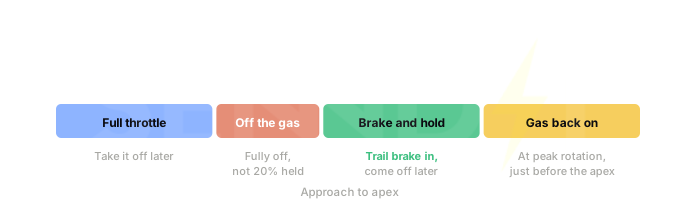
If you keep some throttle on the brakes, you’re going to go a little bit straight. When you use proper technique, you’re going to have the optimal line because the kart is actually stopping.
Most drivers carry this bad habit of keeping throttle on the brakes from karting all the way through to Formula cars, because they don’t think about it, it’s subconscious. But it’s the difference between braking 1-2 meters earlier or later in every single corner. That adds up fast.
If you have this technique and you want to make the apex, you have to brake earlier. But if you use the proper technique, you can brake 1-2 meters later. Well, I don’t know about you, but if I could brake 1-2 meters later in every corner, I would take it, wouldn’t you?
If you keep some throttle on the brakes, the kart is not stopping. You have to brake earlier. With proper technique, you can brake 1-2 meters later in every single corner.
What the Data Shows
If you go to the data and look at an average driver compared to a pro driver on the same track, you can see everything.
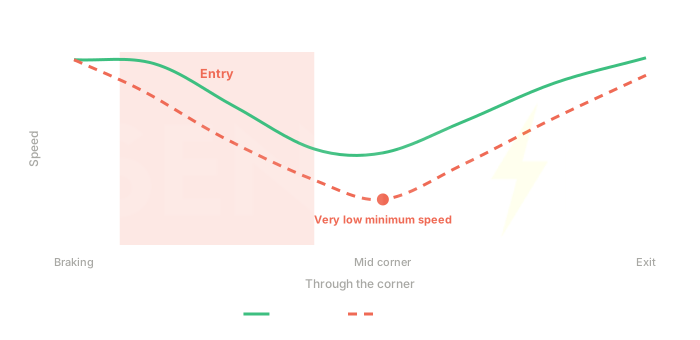
You see very low minimum speed in the mid-corner. Low speed, very low speed, very low speed. You’re like, “Why is the kart having such low speed in the mid-corner?” 100%, not even 90%, 100% of the times, when a kart has too low speed in the mid-corner, it’s because the entry was wrong.
Look at the track map. We have major speed differences. Look at what it does: completely different line. Look at the dots. The green line is too tight, and of course, it misses the racing line completely. It’s just too slow, and then it keeps it out again, disaster.
We look at another corner with low minimum speed. Here I don’t know exactly what’s happening, but I have a guess. The entry is not quite right. Why did he miss the grip? I think it didn’t stop the kart enough.
You can see from here, look, it didn’t brake in the right place. But the worst part is, they didn’t stop the kart enough. It just goes too quick in the entries. Again, it’s the same problem as we mentioned before: the inputs are wrong.
The speed was too fast, but because the inputs are wrong, it’s not stopping the kart enough, the kart is going straight with too much speed. We were looking at the first corner and the line was too tight on the entry. Almost the same speed. It’s a recipe for disaster. You’re gonna go straight automatically.
Looking at the last corner: we have such low minimum speed. Not only is the line horrible, you can see it’s too tight, but also the braking is so bad. The driver is coming off the brakes way too early. It’s not holding the brakes properly.
You see it: very tight line, coming off the brakes early. It’s a recipe for speeding too much in the mid-corner, and you will have very low speed. Of course, if you’re too tight, you go too fast in here. And with the kart stopping due to the brakes, you’re going to get too low speed in the mid-corner.
Remember What We Just Said
Keep this in the back of your mind: the entry is everything. It affects 90-100% of the time. It affects all the problems that you will have in the mid-corner and exit.
If your entry isn’t quite right, and you’re looking at your data and you see there’s a problem in a specific corner, always go back to the entry. You will see that 90% of the times the problem will be in the entry, either in the line, the approaching speed, or your inputs.
Maybe the line is correct and the approaching speed is correct, but because your steering is abrupt or not smooth, or because you’re shaking the steering wheel to feel the kart on the brakes, you’re offsetting the kart and going straight again.
Or maybe you’re just not holding the brakes properly. Or you’re keeping some throttle on the brakes. All of these affect the speed and make you go straight.
Always go back to the entry. 90% of the time, if there’s a problem in a corner, it started at entry.
Entry affects everything in the corner. The rest of the corner is going to be affected by the entry. If you have something going on in a corner, always go back to your entry and look at what happened, both in the data and in the video.
Send your onboard footage. Alessio reviews it corner-by-corner and tells you exactly what's costing you time, and how to fix it. Back within 48 hours.
Get My Onboard Reviewed → Reviewed personally by a CIK FIA World Champion, never an assistant.I promise I'll not spam you with repurposed shitty AI content but real experiences that only I, Alessio Lorandi, experienced. Written in my funny English-Italian tone of voice 😂
Alessio Lorandi is the former CIK FIA World Junior Champion, winning against Lando Norris in 2013 & F3 multiple race winner. He's helped 200+ karting drivers worldwide get faster & win WSK titles with BabyRace Driver Academy & now through Senndit, his online karting coaching platform.