Here’s What Braking By Feeling Looks Like
Master braking without markers, the technique that separates consistent drivers from dependent ones.

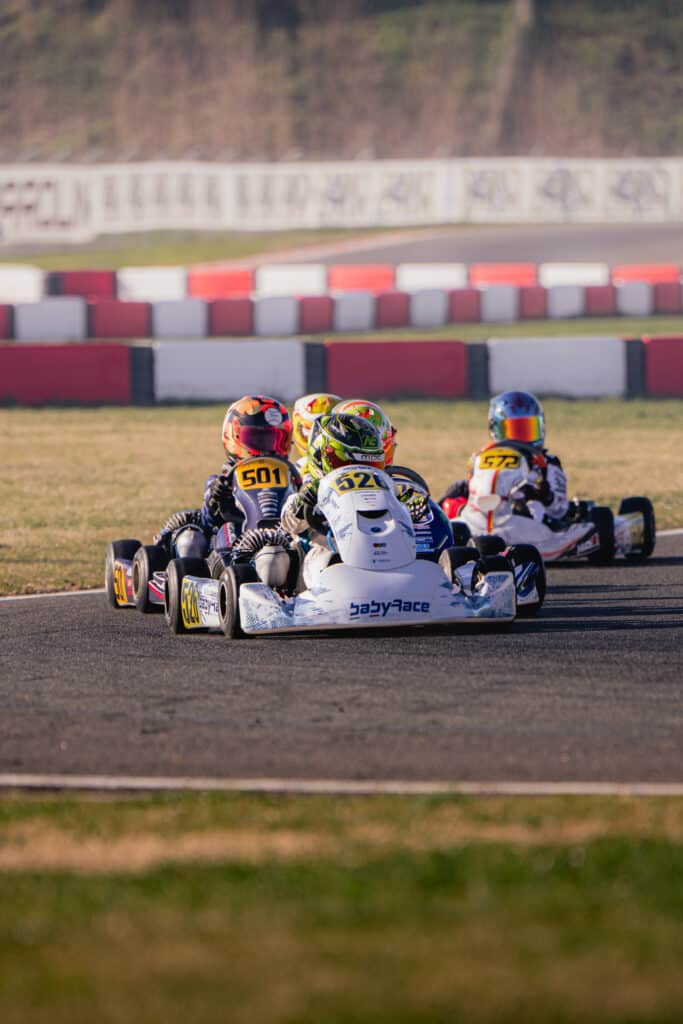
- Braking by feeling means relying on muscle memory and speed sensing rather than visual reference points
- Placing temporary cones as reference points creates dependency that hurts race performance when they’re removed
- Most karting tracks lack clear reference points, making feeling-based braking essential for consistency
- Visual targets should focus on entry positioning, apex hitting, and exit positioning rather than braking markers
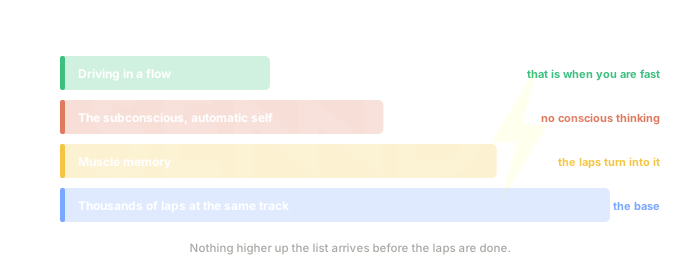
- Breaking by feeling requires thousands of laps to develop the subconscious muscle memory
- Only use reference points when they’re obvious and permanent, like in specific corners at Lonato
So as promised, here we are at Franciacorta. My onboard video before driving the KZ world championship last year, 2025 it was a really great experience.
But anyways, let’s not talk about that. In this video, I want to show you exactly what I mean by breaking, by feeling, by sensing the speed, by sensing the grip and also just using some memory, like visual memory, rather than just relying on breaking points.
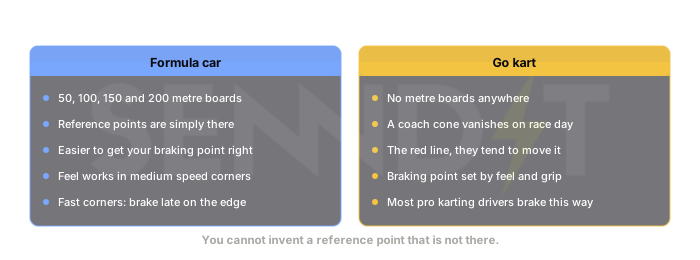
To be honest, reference points are very good when they are there. I love reference points, don’t get me wrong. But when you don’t have reference points, when you don’t get any reference points, it’s just simply impossible to use them, right? You can’t invent them.
Some coaches will place a cone on the curb to signal where you should brake. The problem is that you won’t have that cone in the race. While it may temporarily make you quick in one session or day, when you go to the race and the cone is not there, you’re going to feel lost.
You can see we have a little bit of a reference point here at the last corner. We have a cone. But again, the cone is not going to be staying there for the race. There’s going to be the red line here, but they tend to move it.
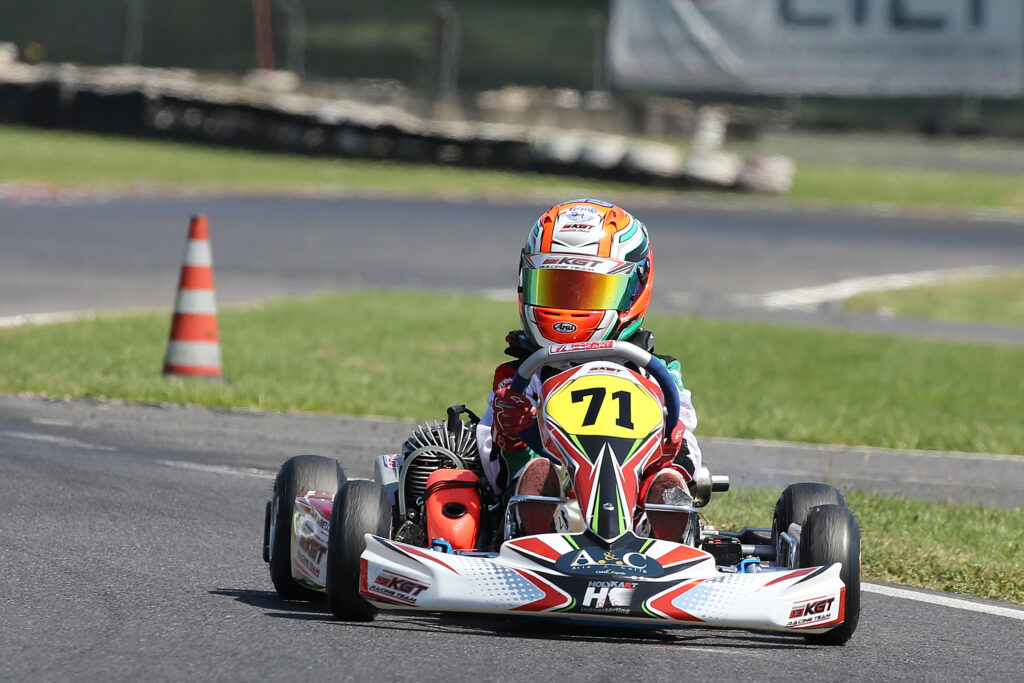
So this is just to say that we don’t have any clear reference points to break in this corner. The only way you break is just by feeling as most pro karting drivers do.
If we were in Formula car, it would be much easier, in a way, that you would have all your reference points. You would have 50 meters board, 100 meters board, 150 meters board, 200 meters board. So it’s gonna be much easier to get your breaking point right, compared to karting.
Obviously the difficulty of cars, when driving GTS or Formula cars is that you ride with way more speed than in karting. In speed in karting you get 250 or sometimes 160, if you’re driving tracks like Sarno or Zuera in a shifter karts.
- KZ: 150-161 km/h max
- Juniors/Mini: 105 km/h (now limited to 100 for 2026 regulations)
- Formula Two: 300+ km/h at Monza or Spa
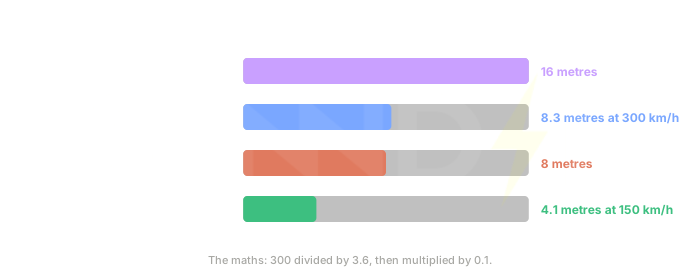
There’s a big difference between 300 and 150 or 100, so it’s literally twice the speed. In 1/10 of a second, the distance that you travel at 150 is half the distance you travel at 300.
To calculate: 300 divided by 3.6 and then multiply by 0.1. At 300 km/h, you’re gonna travel 8.3 meters in 1/10 of a second. At 150 km/h, it’s gonna be 4.1 meters.
In a blink of an eye (two tenths), you’re gonna make 16 meters in a Formula car, whereas in a go kart, in a KZ, you’re gonna make eight meters. It’s still quite a bit, but it’s way more manageable.
When you’re driving cars, you’ve gotta have these reference points. Otherwise it’s gonna be super unpredictable for the driver and super hard to be consistent.
It’s very hard to drive by feeling and brake by feeling in cars. You can do that in the medium speed corners, yes, but in the very fast corners where you arrive with really high top speed, you arrive at 300 and have to break super late on the edge.
This is a clear example to you what it means to break by feeling here at Franciacorta. We don’t have any reference point. And to be honest, I kind of enjoy it like that.
What does it mean to break by feeling?
Some drivers may say you have reference points to the left, but I don’t find any real reference points. What I think, though, is that I can sense the breaking point by my memory, by visual memory.
What I did on thousands of laps in this track, and what I can tell now is that once I turn for that corner, I know and like, it’s muscle memory, basically. I know that as soon as I straighten up the car, that’s pretty much the moment I will hit the brakes.
Of course, depending on the grip level, the tires, etc. And then as soon as I’m here, I’m not looking anymore at the breaking reference. I’m breaking and I’m already pointing myself at the apex. That’s where I’m looking with my eyes, and that’s what I’m pointing my car to go towards.
I want to give like 5-10 centimeters of gap from the white line here, because I know it just helps me set up a bit more straight for the braking. If you can say, well, this is probably the only breaking reference I have in the whole track.
To be honest, I’m not really looking at it. I know that when I watch my cameras, I can see that I’m breaking there, but I’m not consciously thinking about it and looking at that when I’m driving. It comes with my muscle memory, with my subconscious, with my automatic self.
I’m not really forcing it. That’s when you feel like that’s when you’re fast, by the way, when you’re driving in a flow, when everything is happening to you.
What are my targets into the corner?
Here’s my sequence if I’m going to this corner. My first target is this little area. That’s where I want to place my car. I want to place it right there. And I want to be like, exactly 10 centimeters on the white line.
Why not on the white line? Because it helps me to get a little bit better angle for the braking, even though I end up making a little bit more distance.
- First target: 10 centimeters from the white line
- Second target: Where I want to place my kart perfectly
- Third target: The apex – perfectly on the white line
- Fourth target: Double apex and exit positioning
Then, of course, on the exit, I’m already thinking of my next target, which is the next apex.
Please tell me if you think there is any reference point in this corner, if I can use any reference point to break, because I don’t know about you, but to me, there is none.
The only way for me to break there is by feeling, by sensing the speed, by just being courageous, by being brave.
The only goal I have is to open up the entry as much as possible, and placing my outside tire here on the white line. Just try to use up as much space on the entry as possible, to maximize the corner, to make the corner a little bit wider.
To get this sort of line, instead of being here and getting that sort of line, which would give me less mid and exit speed. So that’s my only goal going there.
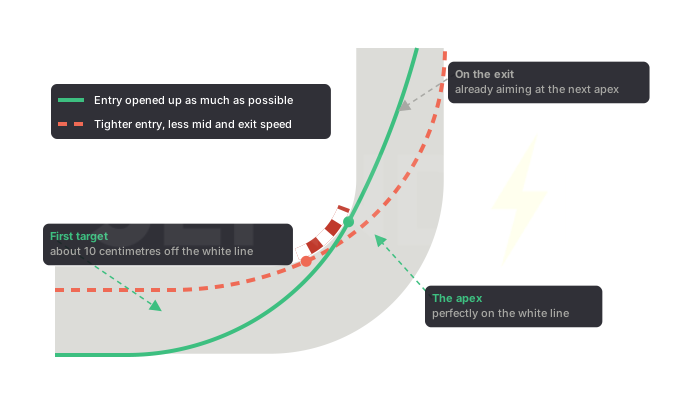
My goal is just to break as late as possible. And you see I end up using up the whole white line in a nice way, and almost actually dipping the wheel onto the grass.
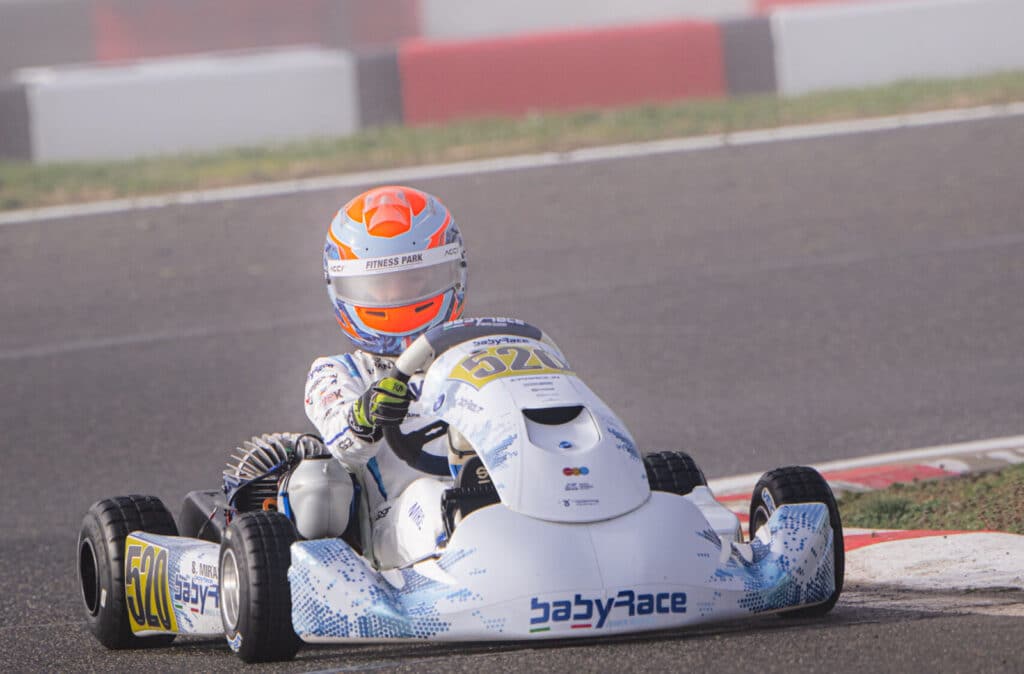
What should karting drivers really do with braking points?
Here’s a clear explanation with some practical examples of what it means for me to drive breaking on the limit. Breaking by feeling on the limit and sensing the speed without really consciously thinking, oh, I need to break at that reference point.
Just be aware of everyone who tells you that you should break by reference. “What is your breaking point?” or “push your breaking point” – it’s one thing to say you have to break three meters later, according to data. Another thing is trying to find another reference point three meters later. It’s just nonsense, in my opinion.
I believe that karting drivers should always break by feeling, by sensing the speed. Of course, unless you have some unbelievably clear and obvious reference points, like you do in Lonato.
You have a couple of corners like the braking for the mechanics and the breaking for the chicane, which are very clear. And of course, it’s just obvious.
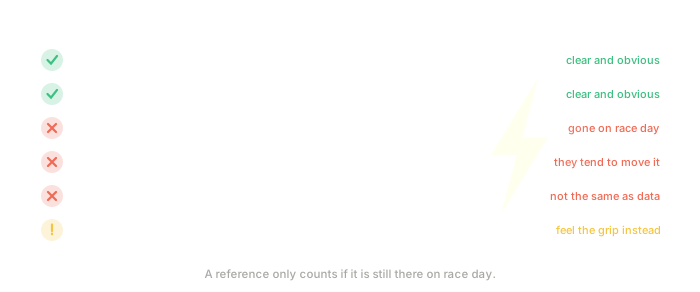
But in KZ, most of the rest of the corners will be just you breaking by feeling and just feeling the grip, feeling the speed, and then just pushing. Trying to break as late as possible, and being latest on the brakes than everybody else, that’s it. Nothing else.
That’s when you’re fast – when you’re driving in a flow, when everything is happening to you and not really forcing it.
Send your onboard footage. Alessio reviews it corner-by-corner and tells you exactly what's costing you time, and how to fix it. Back within 48 hours.
Get My Onboard Reviewed → Reviewed personally by a CIK FIA World Champion, never an assistant.I promise I'll not spam you with repurposed shitty AI content but real experiences that only I, Alessio Lorandi, experienced. Written in my funny English-Italian tone of voice 😂
Alessio Lorandi is the former CIK FIA World Junior Champion, winning against Lando Norris in 2013 & F3 multiple race winner. He's helped 200+ karting drivers worldwide get faster & win WSK titles with BabyRace Driver Academy & now through Senndit, his online karting coaching platform.