Inside the Mind of a Driver During Braking
Master three micro-decisions under braking: when, where, and how hard. Most drivers hold back, real speed demands 100% commitment.

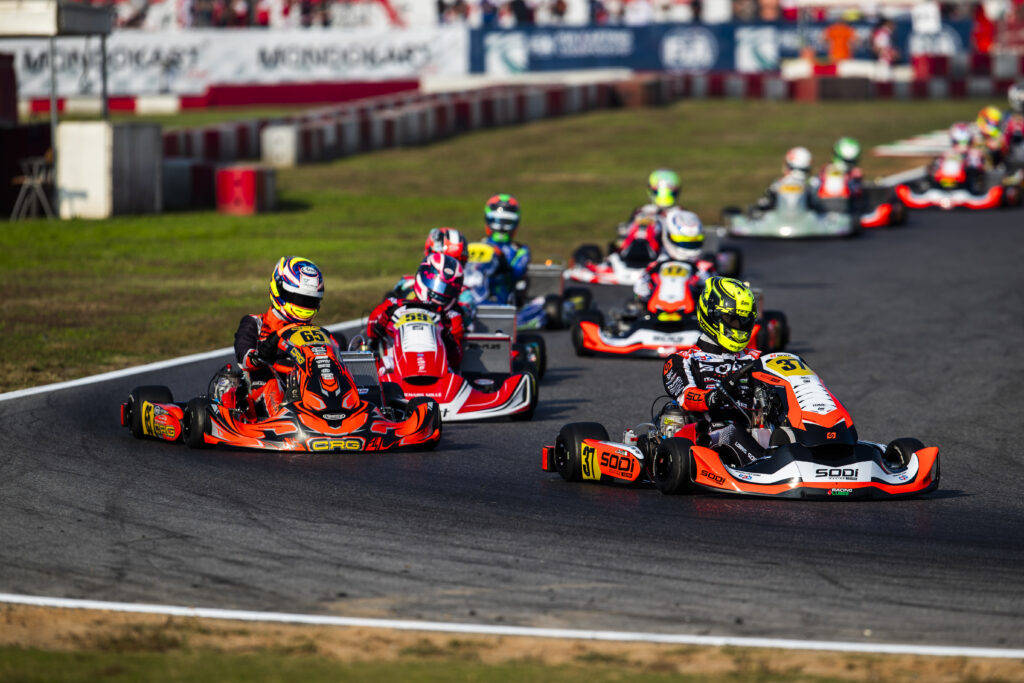
- Every time you brake, your brain makes three micro decisions: when to brake, where to position the kart, and how much pressure to apply
- Most drivers brake too conservatively – you need to use 100% of the track, not 95%, to find real speed
- Braking timing is mostly instinct and feeling, not visual reference points like in Formula cars
- Hard braking confidence comes from car control training – practice in rain and sliding conditions
- The best drivers brake later, use the full track width, and brake harder with total confidence
- Master these three decisions until they become muscle memory and you stop thinking about braking
Braking Is More Than Just Stopping
Everyone thinks braking is just about slowing down for the corner. It’s not.
It’s about control, timing, and confidence, all happening in fractions of a second.
Every time you hit the brake pedal, your brain makes three micro decisions, so fast you don’t even realize it.
Get them right, and you’re fast. Get them wrong, and you’re losing tenths without even knowing why.
So let’s break them down.
1. When to Brake | The First Instinct
Alright, this is the first decision your brain makes: “When do I brake?”
It sounds simple, but it’s not.
It depends on your speed, your grip, your confidence, and your gut feeling. In karting, you rarely have clean reference points like in Formula cars. There’s no 100-meter board, 50-meter board, 150-meter board.
It’s mostly instinct.
Sure, sometimes you’ll have a white line or a curb you can use as a cue, like the mechanics corner in Lonato.
There, you might brake right as you see the edge of the curb with your peripheral vision.
But 95% of the time, you’re doing it by feeling.
I remember when I started in Formula racing, I thought I was braking at 50 meters. I’d ask my teammate, “Where do you brake for Turn 1?” He’d say, “Around 50.” And I’d go, “Same!” Except… I wasn’t. When I looked at the data, I was braking at 55-60. My perception was wrong.
I wasn’t lying, I just felt like it was 50 because of the speed and the fact that I was getting closer and closer to it.
That’s when I realized: braking isn’t just about seeing (using your vision); it’s about training your brain to feel the right moment.
If you want to improve, start by pushing your “when” a little later every session. Miss a corner? Fine. That’s how you find the limit.
2. Where to Brake, Track Position
The second decision your brain makes, often unconsciously, is “Where do I place the kart under braking?”
It sounds obvious, right? “On the track.”
Duh!
But the difference between using the whole track and leaving 10 centimeters of space at the edge can be the difference between pole and P5.
Most drivers are too conservative. They brake 10 or 20 centimeters off the white line, every corner, every lap. That adds up. Massively!
I always tell my drivers:
“Be aggressive with how much track you use. Max out every centimeter.”
At street circuits, you’d be brushing walls on entry, apex, and exit. In karting, you don’t have walls, you have white lines. Use them.
Push until you touch the edge, even go over once in a while. Drop a wheel, spin once or twice, that’s how you find the limit.
Once you find it, pull back slightly.
If you stay conservative forever, you’ll never know how much you’re leaving on the table.
And trust me, I’ve seen so many talented drivers stay “good” instead of “great” because they’re too scared to touch that limit.
3. How to Brake, Pressure and Feel
This is the third and final micro decision: “How hard do I brake?”
Do you smash the pedal, or do you squeeze it? Do you trail brake deep into the corner, or release early?
This is the technical side, the how.
In some corners, you need to hit the pedal hard and fast: maximum pressure, straight away. In others, like medium-speed turns, you just tap the brakes to settle the kart.
The best drivers are the ones who can adjust instantly.
If the corner demands a strong brake, they’re not afraid to go all-in. If it needs finesse, they can modulate perfectly.
If you’re afraid to brake hard because you’re scared the kart will snap or lock, that’s not a braking problem. That’s a car control problem! You need to train that.
Go drive in the rain. Do ice karting. Practice sliding. Learn to feel the grip.
Once your hands and feet understand what the kart is doing, you’ll stop fearing hard braking.
Confidence in braking comes from trust: in your control, not just your reflexes!
Why the Best Drivers Brake Differently
The difference between a good and great driver often comes down to these three things:
- When: The best brake later, always flirting with the edge.
- Where: They use 100% of the track, not 95%.
- How: They brake harder, smoother, and with total confidence.
That’s the holy trinity of braking.
You can’t get there by just reading data. You need to feel it. You need to train your instincts through repetition until it becomes second nature.
As I always tell my drivers:
“When you stop thinking about braking, that’s when you’re doing it right.”
My Favorite Example: The “When, Where, How” Combo
Let’s say you’re approaching the mechanics corner at Lonato.
- When: You brake just after the beginning of the kerb to the left.
- Where: You’re right on the edge of the kerb, maybe even brushing the grass.
- How: You hit the pedal hard, feel the tyres locking, and keep trailing until turn-in.
You do that right, and you’ll feel it, the perfect weight transfer, the kart rotating naturally, the flow. That’s the sweet spot every driver chases.
Final Thoughts
Braking is an art built on 3 micro decisions: when, where, and how.
They happen so fast you don’t even think about them consciously. But the best drivers train them until they become muscle memory.
If you want to be faster, stop focusing on “lap time” and start focusing on these moments.
And once you master these three micro decisions, you’ll realize that karting, and driving in general, is all about small margins, repeated over time, that make a big difference.
Send your onboard footage. Alessio reviews it corner-by-corner and tells you exactly what's costing you time, and how to fix it. Back within 48 hours.
Get My Onboard Reviewed → Reviewed personally by a CIK FIA World Champion, never an assistant.I promise I'll not spam you with repurposed shitty AI content but real experiences that only I, Alessio Lorandi, experienced. Written in my funny English-Italian tone of voice 😂
Alessio Lorandi is the former CIK FIA World Junior Champion, winning against Lando Norris in 2013 & F3 multiple race winner. He's helped 200+ karting drivers worldwide get faster & win WSK titles with BabyRace Driver Academy & now through Senndit, his online karting coaching platform.