Karting Shoes Buying Guide: Everything You Need To Know
Thin sole, tight and narrow fit, low weight, rigid heel. What really matters in a karting shoe, what to pay, and the brands I have used in my career.

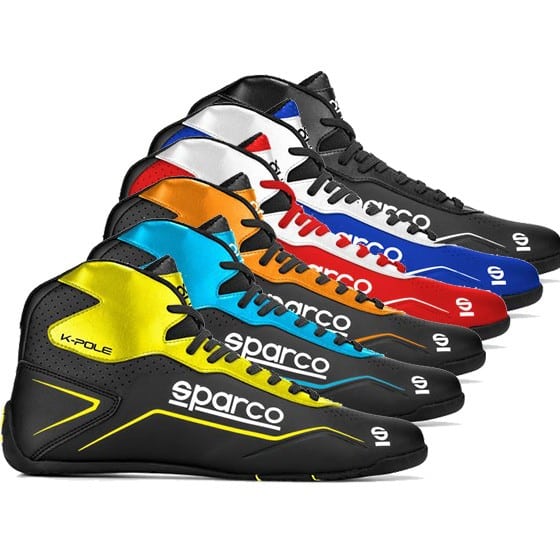
- Karting shoes are thin, narrow and light so you feel the brake and the throttle. With two centimeters of sneaker foam you drive almost blind.
- Around 2 to 3 mm of sole is best. Half a centimeter or one centimeter is too much.
- Tight, just on the edge of being too tight, and narrow. No extra centimeter at the end of your toes.
- Light shoes matter if you are on the edge of the minimum weight. Every 100 grams you save is weight you can place low and in the center of the kart.
- A rigid heel gives you more control on the brake and on the throttle. Laceless designs are a bit of marketing.
- 150 to 300 USD buys a good pair for a beginner and for a pro.
- Take your race shoes off for the track walk so the sole stays clean and thin.
- Between good shoes the difference is small. A sneaker or a running shoe can cost you up to a second.
- What makes karting shoes different from normal sneakers?
- How much lap time can the wrong shoes cost you?
- Do you need homologated karting shoes?
- What are the must-have features in 2026 for karting shoes?
- Does shoe weight actually make a difference in karting?
- How thin should the sole be for proper pedal feel?
- High top or low cut, which is better for beginners?
- How tight should karting shoes fit?
- Do laceless karting shoes make a difference?
- Do expensive karting shoes really improve performance?
- What is the typical price range for karting shoes?
- Where do shoes rank when you buy your karting gear?
- Do you need different karting shoes for the wet?
- When should you replace your karting shoes?
- What buying mistakes should you avoid?
- Which karting shoe brands do I recommend the most?
- Frequently asked questions
Most beginners think karting boots are just for style, comfort and safety. But do they actually improve your driving performance?
Do they really make a difference?
In this guide I answer the questions I get asked the most about karting shoes, so you can get the best shoes for your needs, improve your lap times and win more karting races. So let’s get into it.
What Makes Karting Shoes Different From Normal Sneakers or Racing Shoes?
Karting shoes are very small, narrow and have a very small thickness, so that you can feel the pedal perfectly, both the brake pedal and the throttle pedal. You want to have the best feeling you can.
Because if you want to win races and set fast laps, you need to have the best feeling when you drive. If you drive instead with sneakers where you have like two centimeters of foam thickness, you’re not going to feel it. You’re not going to feel anything.
- You’re not going to feel the bumps
- You’re not going to feel the proper braking
- You’re not going to feel the proper throttle response
So you’re going to be driving almost blind. Without proper feeling you will not have the proper responses, and you will not do a good job. So keep that in mind: karting shoes are special, and you should buy those. Not only because of the homologation requirements, but also because it’s just quite silly to drive with a shoe that is not designed for karting. And if it’s not designed for karting, it’s just going to be worse.
Please do not make the mistake of driving with sneakers or any other kind of shoe. Even running shoes are terrible, because simply, you will not feel the kart, you will not feel the brakes, you will not feel the throttle.
If you cannot feel the brakes and throttle, I tell you, you’re gonna give up so much lap time.
Now, rental karts are one thing. In rental karts, even if you use sneakers, you may not lose that much performance. But when you do professional karting, it’s quite silly. It’s like shooting yourself in the foot by driving with inferior equipment. In that case, the shoes will make you lose a lot of lap time.
How Much Lap Time Can the Wrong Shoes Cost You?
Let me be honest with you. If you are choosing between good karting shoes, you’re not going to gain half a second, or lose half a second, because of a shoe. For sure not.
But if you have a very bad shoe, like a sneaker or a Nike running shoe, then for sure you’re going to lose even more than that. You may lose even up to a second.
That’s why I keep saying it. If you get the best shoes, you get the best feeling. And if you get the best feeling, you’re more likely to drive faster. Which is what we want, right? We are here for that.
Do You Need Homologated Karting Shoes?
For racing, yes. You need homologated gloves and homologated shoes. You cannot go and drive with random gloves and random shoes. If you have not got a homologated shoe, you cannot drive international races.
At international level you’re actually going to get checked at scrutineering, that your race suit is properly FIA homologated, as well as your gloves, shoes, neck protector and helmet. At national club level the checks are not as frequent, but it’s still a common practice. More on that in my kart suit buying guide.
For rentals it’s different. In rentals there’s no major rule about equipment, not that I know of at least, in most countries. You could drive without gloves, you could even drive barefoot if you wanted to. Of course you still want to drive with a helmet.
But I believe it’s always a plus to use proper race boots even for rentals. You have a better feeling, you have better confidence, you feel a bit safer overall, and for sure it allows you to push the limit more.
What Are the Must-Have Features in 2026 for Karting Shoes?
One of the key features for karting shoes is to have very low weight. The weight is super important.
Then the thickness has to be as low as possible.
And you also want to make sure that the shoelaces are not too long, so they’re not going to fly around when you drive. I’ve seen that happening, unfortunately.
So you want to have these three things. And also the comfort and the heel of the shoe have to be good. I like to have heels that are very rigid, because then you’re gonna feel the kart a little bit more.
For example, the Sparco “Super Leggera” ultra lightweight are quite costly, but what I like from them is that they have a carbon heel protector. That provides a lot of support and a lot of rigidity, which actually gives me a better feeling when I drive. And since my feet are sitting on the floor tray, having a really nice, resistant and robust heel makes it much nicer and much better.
Does Shoe Weight Actually Make a Difference in Karting?
Totally. I mean, it’s not as important as the karting suit and the karting helmet, but the shoes still make a major difference in weight from brand to brand, or from model to model. Of course, the lightest shoes are going to cost more.
The Sparco Super Leggera are super lightweight, and quite more costly than all the other shoes on the market. It’s about 500 euros or so, but I believe they give a good return on investment.
In my case, lighter shoes allow me to save what, like 100 grams. And those 100 grams allow me to place that weight strategically where I want to. If I can place it nice and low and at the center of the kart, that’s going to create a lower polar moment of inertia. And that’s very good for a kart which is very reactive, and just faster overall when you need a quick change of direction.
So I like to have a kart like that, and everything in my safety equipment that can allow me to have a lighter weight is going to give me more playing room to place the weight wherever I want in the kart. So yes, short answer, lightweight shoes do make a difference if you are looking at the details.
Of course, if you are so much lighter than the minimum weight, and you need to place like 20 to 30 kilos on the kart, then it’s not going to make a big difference. But if you are overweight, or on the edge of being overweight, because maybe you’re too tall like in my case (I’m one meter eighty), and you need to place the weight as low as possible, then placing the weight nice and low is going to allow you to gain lap time.
And having less weight on your shoes, or your helmet, or your suit, is going to allow you to place it strategically where you want.
But listen, the shoes are a detail. The bigger part of the lap time is in how you drive. If you want to work on that with me, look at my six month training program.
How Thin Should the Sole Be for Proper Pedal Feel?
There is not a specific number you can aim for, but I believe that around two to three millimeters of sole thickness is best. Sometimes I feel that used soles are actually better, because they get less and less thick.
In fact, when I go for a track walk, I remove my race shoes. Because if I do the track walk with my race shoes, I pick up all of the marbles and all the stones, and they get stuck on my shoes. Then when I drive, my sole becomes, you know, a little bit larger, because it picked up a bit of rubber.
And being larger, I have a worse feeling when I drive, and that’s just not good overall. I feel like I cannot drive as well. That’s, you know, sensitivity at its purest.
I remove my race shoes anytime I get off my kart, and I just wear my sneakers. I noticed that in general my race boots are still better off after a few races, and I don’t pick up any dirt that would in turn increase the thickness of the sole. Because I want to have the sole as narrow and as small as possible.
I clean my helmet and visor every session, and sometimes I even clean my shoes, when the tire pick up collects below the sole. Because it reduces my feeling on the pedal.
I hope that was clear. It’s almost like I want to always be touching with my bare foot. Even though, again, barefoot is not good. You want to have a firm, rigid sole. You don’t want it to be soft. You want it to be as rigid as possible. But at the same time you don’t want it to be thick. You want it to be thin, very thin.
How much, exactly? I’m not sure. Two to three to four millimeters, I think that’s the right amount. If it becomes half a centimeter or one centimeter, I think that’s too much.
High Top or Low Cut, Which Is Better for Beginners?
There are different models from different brands. Some are high top, some are low cut. I noticed that it doesn’t make too much of a difference.
For sure, the height of the heel makes a difference. Recently I’ve experimented with the Sparco “Super Leggera”, which are pretty high in the area of the ankle, and I have been getting a nice feedback from those, to be honest. They keep my ankle a little bit more firm, as well as my heel.
But of course, you don’t want to go too, too big in that direction. You just have to find the right amount.
If you just go with the best shoes that most racing drivers use, then you’ll be good to go. You don’t have to reinvent the wheel.
You don’t want to go with something which is exaggerating in one or the other direction, being either too, too high or too low.
How Tight Should Karting Shoes Fit?
They should feel pretty tight. Honestly, you don’t want your shoes to be loose, otherwise your ankle and your heel are going to move inside of them. So you should really feel them nice and tight.
And to be honest, the smaller they are in terms of lateral size, so the narrower, the better. Because think about it: you have to have your feet quite close. Of course they’re not going to be that close, but having pretty narrow shoes gives you just a better feel overall. You don’t want shoes that are a bit too bulky.
You need to feel like they’re pretty tight. Of course not too tight, just on the edge of being too tight. You know what I mean? You do not want to bleed from how tight they are. But you equally don’t want to have like one centimeter of extra gap at the end of your toes, otherwise you’re basically driving with oversized shoes, and that’s not good.
Sizes are different between brands, so try them before you buy them. If you can go to a local karting shop and try them on, that’s the best advice I can give you, instead of purchasing them blindly and then having to send them back because the size or the model is not correct.
I’m very picky about this. Same as with my gloves, I pick lightweight race boots and I stick to the ones that I forget I’m wearing.
Do Laceless Karting Shoes Make a Difference?
There are some shoes, like some OMP ones or even some Sparco ones, that have a system so you don’t have to tie the shoelaces. That’s fine. I mean, that’s a bit of marketing. It’s not that important, not that useful.
If you want to go with that for extra comfort, fine. But it’s not going to change the performance. So don’t put more weight on that in your decision. Put more weight on the weight, and more attention on the fit and on the sole.
The only thing I care about with laces is that they are not too long, so they don’t fly around while you drive.
Do Expensive Karting Shoes Really Improve Performance or Just Comfort?
I feel that expensive karting shoes can give you superior value and performance, especially if the price is justified by a lower weight and overall better features.
For example, like I mentioned, the Sparco Super Leggera has a very nice heel protection in carbon. And yes, it protects a lot, but it’s not really about safety. It’s actually more about control. I’ve noticed that the harder the heel area, the more stable and more controlled your heel is. And just overall, it’s quicker.
So I tend to go with that. But of course, you want to spend that money to get more performance. Otherwise you’re just overpaying.
If you go with the top brands, you will go with the right solution. They’re going to be pretty low weight, which is very important, and the fit will be great.
Is the extra 30, 40, 50, 60 euros for the best model worth it? Maybe in one tenth of a second. Again, that’s very, very unlikely. But remember, the best karting shoe isn’t necessarily the most expensive one. It’s the one that gives you the best feeling: the weight, the pedal feeling, a thin sole, and a narrow fit that follows the shape of your foot.
What Is the Typical Price Range for High Performing Karting Shoes?
I feel it’s between 150 and 300 USD. So you should find different options within this price range.
If they’re too cheap, typically they may be a bit lower quality. If they are too expensive, you may be spending too much for probably not enough extra quality.
But again, there are some cases where the extra price justifies extra performance. And this is nothing beginners should look into. It’s just for me, because I’ve been in this world for so many years and I want to get every single millisecond I can out of the kart and out of myself.
Getting the best shoes on the market in terms of weight for sure helps to get those few thousandths of a second in such a competitive world. But you don’t want to overthink it. Just go for that price range and you’ll be good enough, either as a beginner or as a pro racing driver.
Where Do Shoes Rank When You Buy Your Karting Gear?
If I had to choose only three things to prioritize, they would be number one the rib protector, number two the helmet, and number three the race suit. If we had a number four, I would choose the shoes, because the shoes give you a very good feeling, or a bad one, when you drive.
In a crash, the shoes and the gloves are not what protects you. The helmet, the suit and the rib protector do. So the helmet and the rib protector need to be right from the beginning, while the shoes, the gloves and the suit you can always upgrade later.
That means for the shoes you could go cheap right away. I would not recommend it, because you still want the best feeling when you drive. But they are among the least important pieces, so you can save there and upgrade later.
When I budget a full kit for a beginner, I put somewhere between 100 and 150 euros for the shoes. The whole picture is in my guide to karting gear, and if money is tight, read the cheapest way to start kart racing.
Do You Need Different Karting Shoes for the Wet?
No. I wouldn’t get wet shoes, or wet gloves. That was not in my DNA, and it worked for me.
What I did was this. I used the best shoes for the dry and the second best shoes for the wet. When I got new gloves it was the same: the new ones for the dry, the old ones for the wet.
What makes more difference in the rain is the grip between your shoe and the floor tray. Add some scratch tape on the floor tray, or on the pedal kit if you use one, so your foot doesn’t slip when the shoe is wet, or when there’s some lube on the tray after cleaning. In the rain it gives you the feeling of a firmer pedal. More on driving in the rain in my wet karting tips.
Sure, with the scratch tape you’ll have to replace your shoes a bit more often, because the heel gets consumed more. But at least you have a better feeling overall.
When Should You Replace Your Karting Shoes?
A good pair should give you good performance and lap times over a few years. And like I said, a sole that is a bit used can even feel better, because it gets thinner.
But once they start to break, and they start to consume the sole and the heel area, I think you should change them and invest in a new pair of shoes.
To make them last, take them off when you go for the track walk or when you’re just walking around the paddock.
And if you take karting seriously, have two pairs of shoes, the same way I would have two helmets, two rib protectors and two pairs of gloves. If you lose one, break one, or someone steals them (very unlikely, but it has happened), you have a backup and you don’t compromise your weekend.
What Common Buying Mistakes Should Drivers Avoid When Purchasing Karting Shoes?
I think one of the common mistakes is getting the cheapest ones. I mean, you don’t want to be cheap on karting shoes. You want to make sure you get a good quality option that you’re going to use, that is going to do you good and give you good performance and lap times over a few years.
Another big mistake I saw drivers doing in the past, and they still do it to this day, is getting shoes with very thick soles. That is not good, because you have a worse feeling, almost like driving with sneakers or with running shoes. So avoid that. Get very thin shoes that are very narrow overall.
The third one is putting too much weight on features that don’t change the performance, like the laceless systems. Look at the weight, the fit and the sole first.
And the last one is buying blindly. Different brands have different measurements, so test them before you buy them.
Which Karting Shoe Brands Do I Recommend the Most?
I really like the Sparco shoes, they’re very good. The Alpinestars ones are great as well, and the OMP too. These are all great options.
The Freem ones I used for all my career, up until I moved up to formula cars. I used them for about 10 years, so I’ve had amazing experience there too.
Now I’m using the Sparco Super Leggera, as I already mentioned, because I feel the lower weight gives me a little bit of extra performance. But I mean, that’s something quite extreme. You don’t need to do it. Make your own decision.
There are different models from these brands, so check them out and find the ones you like the most. I would spend a little bit more to get the best model from each brand.
I’m not here to sponsor anybody. My advice is simple: go for the brands that the world champions, the European champions and the drivers winning races are using. If they’re using them, it’s because they think they help them win more.
So if you’re aiming to do international races, use common sense. Choose a really good shoe that gets you good lap times, not anything amateurish that is going to give you worse lap times.
Frequently asked questions
Can you wear normal sneakers for karting?
For rental karts you may not lose that much. For racing, no: sneakers have about two centimeters of foam, so you don’t feel the brake, the throttle or the bumps, and a sneaker or running shoe can cost you up to a second.
How thick should the sole of a karting shoe be?
Around 2 to 3 mm, up to 4 mm. Firm and rigid, but thin. Half a centimeter or one centimeter is too much.
How should karting shoes fit?
Tight, just on the edge of being too tight, and narrow. Your heel and ankle should not move inside, and there should be no extra centimeter at the end of your toes.
How much do good karting shoes cost?
Between 150 and 300 USD for a high performing pair, good enough for a beginner and for a pro.
Do you need homologated shoes for karting?
For races, yes, and at international level they are checked at scrutineering. For rental karts there is usually no rule, but proper race boots still give you a better feeling.
Send your onboard footage. Alessio reviews it corner-by-corner and tells you exactly what's costing you time, and how to fix it. Back within 48 hours.
Get My Onboard Reviewed → Reviewed personally by a CIK FIA World Champion, never an assistant.I promise I'll not spam you with repurposed shitty AI content but real experiences that only I, Alessio Lorandi, experienced. Written in my funny English-Italian tone of voice 😂
Alessio Lorandi is the former CIK FIA World Junior Champion, winning against Lando Norris in 2013 & F3 multiple race winner. He's helped 200+ karting drivers worldwide get faster & win WSK titles with BabyRace Driver Academy & now through Senndit, his online karting coaching platform.