What Equipment Do You Need for Karting? The Full Kit List
The karting kit list: helmet, rib protector, suit, shoes, gloves and neck protector. What I would never buy cheap, what you can upgrade later, and …


- The kit is six things. Helmet, rib protector, race suit, shoes, gloves, and a neck protector if you choose to use it.
- My order of priority is rib protector, helmet, race suit. If I had a number four, I would choose the shoes.
- Racing needs homologated equipment, rentals don’t. For casual rentals there are no rules that I know of, apart from the helmet, which is quite obvious.
- Never be cheap on the helmet and the rib protector. They need to be right from the beginning. If you buy cheap, you end up paying twice.
- Shoes, gloves and suit you can upgrade later. They matter for the feeling, but they are not going to make a big difference in a big crash.
- My full gear cost about 3,500 euros. A bit closer to 4,000 because of my custom rib protector.
- What equipment do you need for karting?
- Do you need your own gear for rental karts?
- What should you wear to go karting?
- What helmet do you need for karting?
- Do you really need a rib protector?
- Why do you need a proper karting suit?
- Can you drive a kart in sneakers?
- Do you need karting gloves?
- Do you need a neck protector?
- What should you never buy cheap?
- How much does a full set of karting gear cost?
- Can you share gear with another driver?
- Frequently asked questions
If you show up at a kart track tomorrow, what do you actually need?
This is a question that I get asked a lot. There are many, many options on the market right now. Some accessories are not that useful at the end of the day. Others are super useful and actually mandatory. So let’s look together at exactly what you need, one piece at a time, and for each piece I link you to the full guide.
What equipment do you need for karting?
When you drive your own kart you need a helmet, a rib protector, a race suit, race boots and gloves. And a neck protector, if you use it.
Now, they are not all equally important. If I had to choose only three things to prioritize, number one is the rib protector, number two is the helmet and number three is the race suit. Right after, at number four, I would choose the shoes.
| Piece | Where I put it | Buy it right from day one? | Full guide |
|---|---|---|---|
| Rib protector | Number one | Yes | Rib protectors |
| Helmet | Number two | Yes | Your first helmet |
| Race suit | Number three | You can upgrade later | Kart suits |
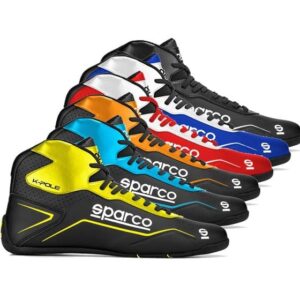
| Shoes | Number four | You can upgrade later | Karting shoes |
| Gloves | The least important of them all, but still important | You can upgrade later | Karting gloves |
| Neck protector | Your choice | Not mandatory in most categories | See below |
Helmet, suit, gloves. Before you go out, everything has to be on and has to fit.
Do you need your own gear for rental karts?
No. For racing you need to have homologated equipment, which is not the case for rentals. If you just want to do casual rentals, there are no rules at all that I know of for rib protectors, gloves, shoes or neck protectors. Of course you still want to drive with a helmet. I mean, that’s quite obvious.
So there’s a big difference between rentals and professional kart racing. It can be different if you drive outdoor at a really high rental kart level, so check with your track.
But listen, I believe it’s always a plus to use proper race boots, proper gloves and a rib protector even for rentals. You have a better feeling, you have more confidence and you feel a bit safer overall. And for sure it allows you to push more on the limit.
If you are still deciding how to begin, I wrote about the cheapest way to start kart racing.
What should you wear to go karting?
For a rental or indoor track, normal clothes. On day one, if you go to a rental kart facility, you don’t have to have any equipment. They’re going to provide everything for you, so there’s nothing for you to worry about.
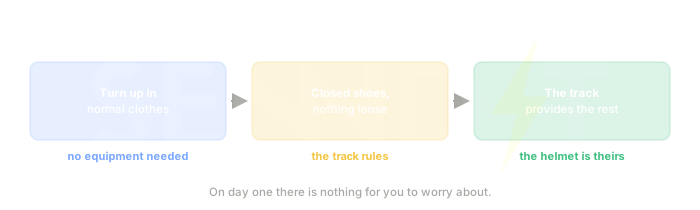
With normal clothes the tracks do have a few rules. This is what three operators ask for (K1 Speed and TeamSport indoor, Buckmore Park outdoor, checked on 4 October 2026):
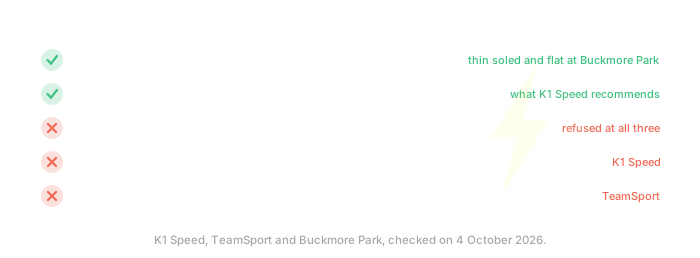
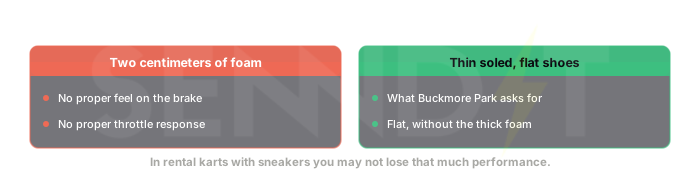
- Closed shoes. All three refuse sandals and open-toe shoes. Buckmore Park asks for thin-soled, flat shoes.
- Nothing loose. K1 Speed says no loose-flowing garments such as dresses, and recommends a shirt with pants or shorts. TeamSport treats vest tops and loose clothing as unsuitable.
- The helmet is theirs. All three supply it. Buckmore Park supplies a race suit too, and so does TeamSport, except at Brent Cross and High Wycombe.
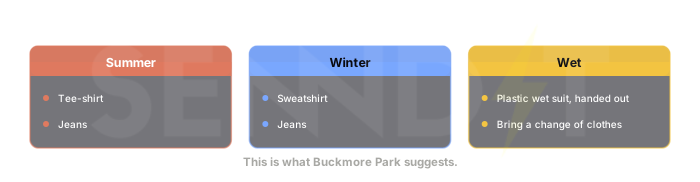
- Cold, heat and rain. Buckmore Park suggests a tee-shirt and jeans in summer and a sweatshirt and jeans in winter. In the wet it hands out plastic wet suits and says to bring a change of clothes.
And the shoes? In rental karts, even though you may use sneakers, you may not lose that much performance. But if you drive with sneakers where you have like two centimeters of foam thickness, you’re not going to feel the proper braking and you’re not going to feel the proper throttle response.
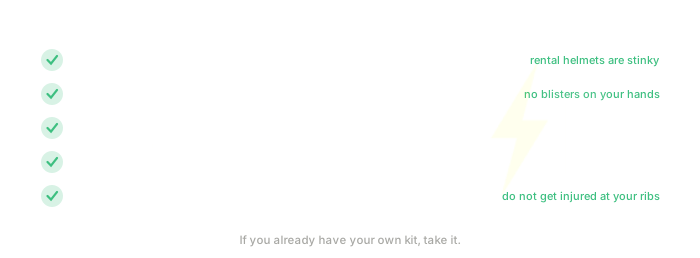
If you already have your own kit, take it. You can go about using their helmets, but they normally kind of suck, and they’re stinky. I’d just suggest you take your full safety kit, in order to not get injured at your ribs or get blisters on your hands. Helmet, gloves, boots, balaclava, rib protector.
What helmet do you need for karting?
The very first thing you need is a helmet that is homologated for karting, with a homologated visor. You cannot drive with a bike helmet or a motorcycle helmet. You may still get away with it in testing, but I do not recommend it.
I think beginners usually underestimate the helmet. They feel like whatever helmet you use is basically the same. That couldn’t be further from the truth. A motorbike helmet is made to protect motorbike riders, so for sure it protects. But you need something that is sport specific, a proper helmet designed for karting.
There are many good brands: Arai, Schuberth, Stilo, Bell. They all protect pretty well. Some of them are lighter, some of them are heavier, and the lighter it is, the better. Schuberth is my number one go-to option. Bell and Arai are also really good.
One thing before you pay. Check that the homologation is not expired. The fit, the weight and what to look at in the shop are all in my guide on how to choose your first helmet.
Related: best karting helmets, the ones I have raced with.
Do you really need a rib protector?
Yes. For me the rib protector is the most important thing.
Why? Because in karting the seat is very stiff, you don’t have seat belts, and you get up to 2.5 lateral g from left to right. So you are thrown into the seat very aggressively. If you don’t wear a rib protector you are very, very likely going to damage your ribs and crack them.
This is actually the most common injury among karting drivers. And you can still get rib injuries despite wearing one, because sometimes the grip level is insane and it puts so much load on the ribs.
It also matters in a crash. If somebody goes straight into you laterally and you have no rib protector, you’re going to destroy your ribs. With a rib protector on you are a lot better protected.
I advise a high quality one, from Tillett or from Bengio. The Bengio has a carbon fiber protection in the centre, which is a very good thing. The Tillett has a bit more of a flexible protection at the centre, so it’s probably a bit more comfortable. I prefer a bit more the Tillett, but the Bengio is great as well.
The best one I ever had is a custom made Tillett, molded around my ribs. I got one when I was 15 years old and one again last year, because my ribs were hurting a bit. I use it in testing and practice days. When the race comes I use the homologated one, always from Tillett.
How it should fit and what happens when it doesn’t, I explain in karting rib protectors, do you really need one.
Why do you need a proper karting suit?
So that if you get out of your kart and you scratch the ground, you scratch the ground with the suit and not with your skin.
I made this mistake one time. I drove with a suit for racing cars, the fireproof one. It was homologated, but it’s a lot less thick than a proper karting suit. And I flipped over with that suit. I scratched the ground for so long that, besides breaking my collarbone, I completely scratched my legs and arms. I was bleeding quite a lot.
Thankfully it was just scratches, nothing serious. But if I had a karting suit, which is thick, I would not have had all of those scratches.
The homologation is not mandatory for training and testing. It is mandatory when you want to do races. In my experience I have always been checked at international races, and I have never been checked at national or club level. Still, I guess it’s a no-brainer to just drive with a properly homologated suit.
One more thing. Do not buy an oversized suit. It works like a parachute on the straights. The rest is in my kart suit buying guide.
Can you drive a kart in sneakers?
In a rental kart you may not lose that much. In your own kart, please don’t.
The shoes are super important because they give you the feeling on the pedals. If you drive with running shoes, there’s so much foam under the shoe that you are not going to have any feeling at all. You don’t feel the brake, you don’t feel the throttle. You’re driving almost blind.
You actually need the thinnest shoes possible. Thin sole, narrow, and tight on your foot. And for the races they need to be homologated too.
That’s why the shoes are my number four. Good ones give you a better feeling, not so good ones give you a worse feeling. More in my karting shoes buying guide.
Do you need karting gloves?
The gloves are probably the least important of them all. But they’re still important.
You cannot expect to be fast by driving with winter gloves, like the ones you use for skiing. The feeling is so limited. You want proper gloves that are very thin.
For the races you need them homologated. For testing there’s no need, even though I still recommend it, because you get used to them for the race and because they give you the best feeling. I really like the ones from Alpinestars, from Sparco and from Minus 273. At BabyRace we use Sparco.
In a crash they protect your hands if you scratch them, but not much. Where they help you is on the steering wheel. Fit, grip and stitching are in my karting gloves buying guide.
Do you need a neck protector?
It’s not mandatory in most categories, in most countries. In some countries it is. So in most places you can freely choose, and you should check the rules where you race.
Some drivers feel it costs them a bit of freedom, because it limits how much you can move your head.
When you go up to juniors, seniors and shifters you see drivers using it less and less. The ones who use it the most are in Mini.
So where it is not mandatory, it is your choice. Make it with your eyes open, and with the rules of your series in front of you.
What should you never buy cheap?
The helmet and the rib protector. They need to be mega right from the beginning.
Your head is the most important asset, I would say. And if you hurt your ribs you cannot drive for months. Just for saving, what, 200 euros? I think that is not a good trade.
If you try to be cheap, you end up paying twice. Later on you realize you still need to switch to a proper one. Then you double spend, and you spend more than if you went for the right option right away.
The suit is important, but less than those two. And the shoes, the gloves and the suit you can always upgrade later. For gloves and shoes you can even start with cheap ones. I would not recommend it, because you still want the best feeling when you drive, but those are where you can save up at the beginning.
Let me say one thing to the parents, because most of the time it’s the parents who are purchasing. I understand you’re trying to budget, maybe to spend more on training days or on a better team. But you cannot be cheap on the safety gear.
And how do you choose the brand? I’m not here to sponsor anybody. Just go for what the drivers who are winning races are using. That’s exactly what I did for myself.
Comfort matters as well. If a piece of equipment is good on paper but it distracts you when you’re driving, that is a big red flag. But safety comes above comfort. A very soft rib protector may be comfortable, and because it’s so soft it may not protect your ribs.
How much does a full set of karting gear cost?
My full gear cost about 3,500 euros. Actually a bit more, close to 4,000, because of my custom rib protector. That one alone is about 1,000 euros.
The biggest piece is the helmet. Between the helmet and the painting you are at about 2,000 euros if you go with a Schuberth. With a Bell it’s more like 1,700 or 1,800.
Then the rib protector. For a very, very good one from Tillett or Bengio you end up spending not more than 500 euros.
The suit, the shoes and the gloves come on top, and you can go for cheaper options there.
I don’t want to be rude. But if you cannot afford a full gear of about 3,500 euros, I don’t think you’re able to fully fund your karting dream, because you will have to spend many more thousands of euros than that. If the budget is your worry, read the cheapest way to start kart racing before you buy anything.
Can you share gear with another driver?
Technically you can. But do you really want to?
I feel that safety gear is very personal. I would never let anybody drive with my helmet, even just to try for a session. I don’t want them to scratch it and I don’t want them to sweat inside of it. Same thing with my rib protector, my gloves and my shoes. Somebody uses your gloves and they make them a little bit larger.
And if you want to do karting seriously, you should have doubles. I would use two helmets, two rib protectors, two pairs of gloves, two pairs of shoes, and two or even three visors.
Why? Because if you lose one, or you break one, at least you have a backup and you’re not going to compromise your weekend.
- All my equipment articles are in the karting gear guides.
- Start with the two you should not be cheap on: the rib protector and the helmet.
- Once the gear is sorted, send me your onboard and I go through your laps in an onboard review.
- I teach the driving side in my six month training program.
So if you’re just getting started, buy the rib protector and the helmet first, and buy them properly. Safety comes first. The performance you look for after.
Frequently asked questions
What equipment do you need for karting?
For your own kart you need a helmet, a rib protector, a race suit, race boots and gloves, plus a neck protector if you choose to use it. My order of priority is rib protector first, helmet second, race suit third, and then the shoes.
Do you need your own gear for rental karting?
No. Homologated equipment is for racing. For casual rentals there are no rules that I know of for rib protectors, gloves, shoes or neck protectors, and of course you still drive with a helmet. I still believe proper boots, gloves and a rib protector are a plus even in rentals.
Can you use a motorcycle helmet for karting?
Not for racing. You need a helmet and a visor that are homologated for karting. You may get away with a motorcycle helmet in testing, but I do not recommend it.
What is the most important piece of karting equipment?
For me it is the rib protector, and right after it the helmet. Cracked ribs are the most common injury among karting drivers, so these are the two things I would never buy cheap.
How much does karting gear cost?
My full gear cost about 3,500 euros, closer to 4,000 with my custom rib protector. A Schuberth helmet with the painting is about 2,000 euros, and a very good rib protector is not more than 500 euros.
Send your onboard footage. Alessio reviews it corner-by-corner and tells you exactly what's costing you time, and how to fix it. Back within 48 hours.
Get My Onboard Reviewed → Reviewed personally by a CIK FIA World Champion, never an assistant.I promise I'll not spam you with repurposed shitty AI content but real experiences that only I, Alessio Lorandi, experienced. Written in my funny English-Italian tone of voice 😂
Alessio Lorandi is the former CIK FIA World Junior Champion, winning against Lando Norris in 2013 & F3 multiple race winner. He's helped 200+ karting drivers worldwide get faster & win WSK titles with BabyRace Driver Academy & now through Senndit, his online karting coaching platform.