The Common Mistake Of Holding Some Throttle Under Braking
Throttle under braking kills your lap time. Here's why most drivers do it and how to stop.

- Holding throttle while braking is one of the most common mistakes in karting – it prevents the engine from “breathing” and getting the fuel it needs
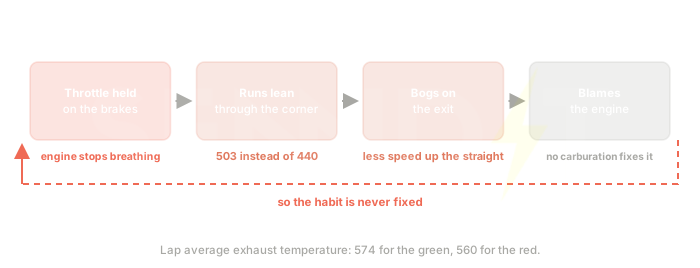
- This habit costs you performance both in corners AND on straights, with exhaust temperatures running 60+ degrees too lean
- The only exception is shifter karts in wet conditions where you need small throttle blips during downshifts
- Target exhaust temperature minimum should be around 440°C – anything above 500°C means you’re running too lean
- Fix this by adjusting pedal position and practicing complete throttle release for multiple sessions, even if you’re 10 seconds off pace
- This problem gets worse in Formula cars where it locks the differential and creates understeer
There’s one mistake so many drivers do – nearly everyone I met at the beginning of their career in mini – and that is holding some throttle on the brakes. Subconsciously, they’re not doing that because they want to, as they do it in cars, as I used to do sometimes in cars, because in some times in cars, you may need to kind of keep a little bit by the end to stabilize a little bit rear.
No, in karting, there’s absolutely no need, I would promise you. In karting, there is absolutely zero reason in any category to keep the throttle on the brakes, unless you’re driving shifters in the wet where you have to blip a little bit to make sure it doesn’t lock up the rear tire so much because of the downshifts.
There’s nothing more harmful, more performance affecting in a negative way than doing that. And if you do that in mini, it’s even worse.
You make a small blip of like 10% just to downshift in the wet, in KZ, but in all the other categories, there’s no need. And I cringe so much when I see this. And again, it’s one of the major mistakes. I mean, there’s very few mistakes that are more common than this.
It’s so hard for me to be honest, because I try to teach them that, listen, you don’t – it’s really bad for the engine. You shouldn’t be doing it. But they still keep on doing it, because it’s subconscious. So it’s a habit that you build up, maybe because you drive some karts that may kind of reward this.
You know, if you drive some go-karts that have very, very rich carburation, or like I know a lot of kids in Rotax, they do these kind of things to try to get a little advantage, because in Rotax there’s a bit of delay. So you kind of do that to preload so you get a better exit.
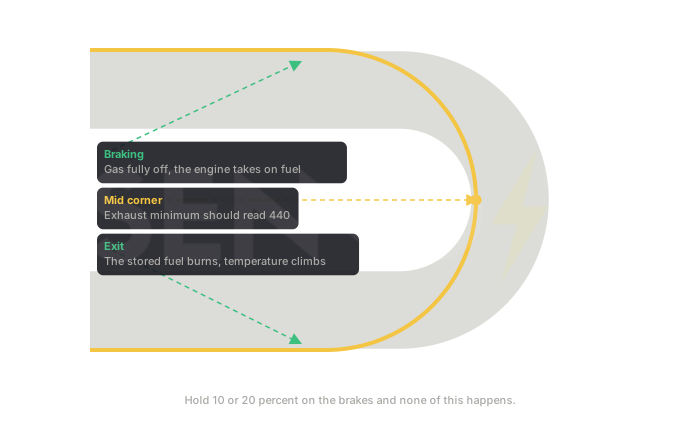
You don’t just lose in the corner – you’re losing down the straights too, because the engine is not breathing. It’s not getting the fuel. Remember, where the engine picks up the most fuel is when you’re off the throttle.
In juniors and seniors, you lose a lot, but in mini, you lose a ton. And the thing is that you don’t really lose in the corner. This is the important bit. You’re not just losing in the corner, but you’re losing down the straights, because the engine, when you do that, is not breathing, as I like to call it, it’s not getting the fuel.
Remember, every time the engine is full throttle, it’s burning the fuel. Of course, it’s still injecting fuel from the carburetor to the engine when you’re flat out – it’s the main jet working and still sending fuel. But where the engine picks up the most fuel is when you’re off the throttle.
That’s the reason why, when you’re making the start, you know, the formation lap with the rolling starts, and everybody’s going slow in the last sector, then when you start again, it’s so delayed, and it’s like bogging, because there’s so much fuel, and you can see all smoke coming off the exhaust from all the drivers. It’s like a big cloud of smoke.
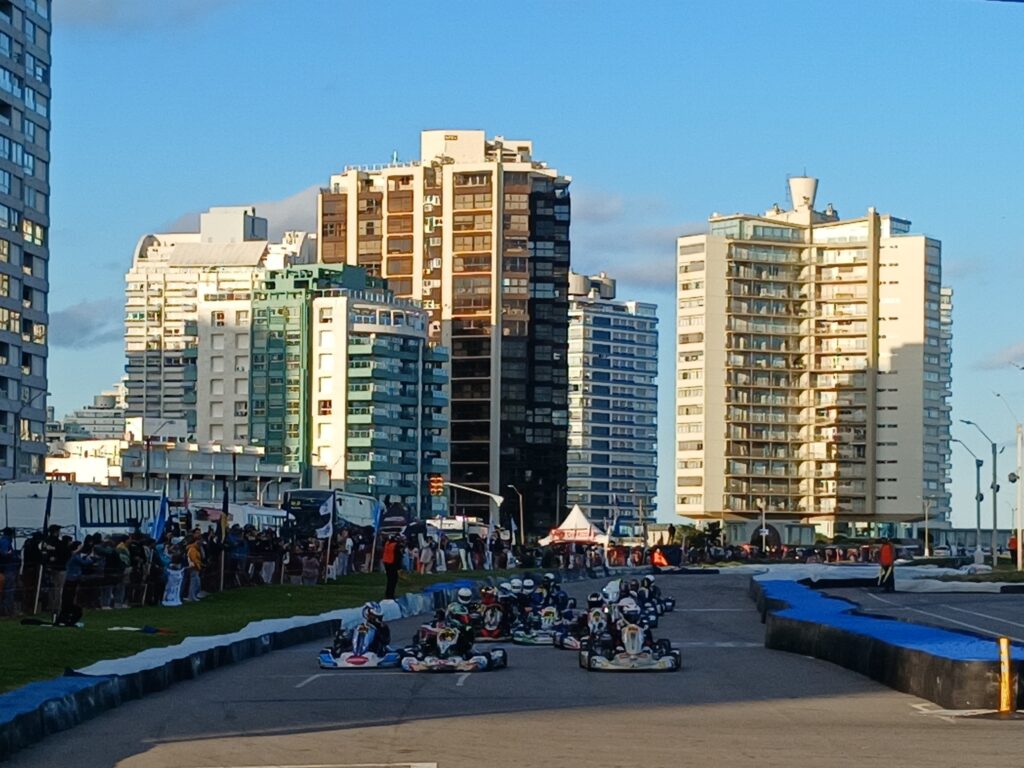
And the reason is that when you go on the gas, it’s kind of like, you know, it’s full of fuel because you have spent so long off the gas, and it got so much fuel that was not burned, so it got so rich and delayed.
You should let the engine breathe. You should let the engine get and absorb like a sponge all the fuel you need when you’re on the brakes.
And of course, that’s the other opposite. You shouldn’t be driving like that with so much rolling time, but you should let the engine breathe. You should let the engine get and absorb like a sponge all the fuel you need when you’re on the brakes.
And if you don’t do that, you’re gonna always suffer with the engine. You’re always gonna be like, “Oh, my engine is not good.” Yes, it may be not good, but it’s your fault. It’s not the tuner’s fault. If the engine is not delivering the power, it’s your fault.
Data Analysis From Sarno
You can see this driver in Sarno – the green. In this case, forget about the line (the red actually does a better line). I just care about this throttle trace. And you can see very well, it needs to be a parallel line. It needs to be like that.
When you brake, you come off the gas, it has to be an absolutely parallel line like that. The red isn’t perfect at the beginning either, but it needs to be a parallel line like this. It’s still way better than what the green does, which is absolutely awful – he’s not coming off the gas at all, except the last phase.
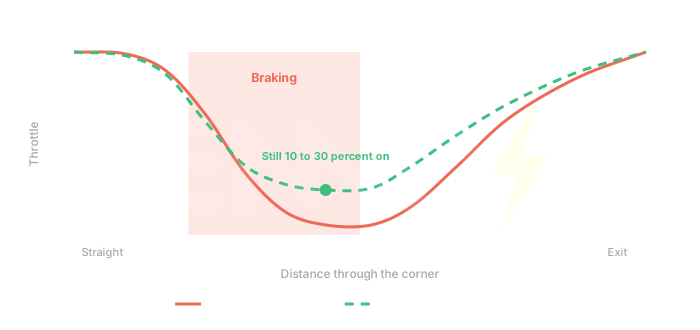
So it’s not full throttle on the gas, guys, but it’s keeping enough throttle – basically like 10%, 20%, 30% – that is not letting the engine breathe. And of course, that is really, really bad. And it happens so often.
When the driver arrives in the mid corner, his exhaust temperature minimum is 503°C and it’s too lean. The other kid is 437°C and he’s got almost the perfect temperature, because it should be 440°C.
This is, by the way, the exhaust temperature sensor you can see here. And what happens at the end of the day is that when he arrives in the mid corner, his exhaust temperature minimum is 503 and it’s too lean. And the other kid is 437, and he’s got almost the perfect temperature, because it should be 440.
And you can see when he does that, then the engine is burning way better because he has collected the fuel. You see his acceleration slope in terms of exhaust temperature, how steep it is at the beginning? Because he has received the fuel in the engine and it has burned it.
You know, because he received it. If you don’t receive enough fuel, you’re not able to burn it. So you don’t have a steep exhaust temperature curve.
You cannot expect your mechanic, your team, your coach, anyone – you cannot expect them to fix this for you.
So basically, this is the case. You need to get the driver to come off the gas all the time. And I get so upset, of course, but this is happening so much. You’re gonna get the worst performance in the engine, and that is exactly what happens.
The driver in green will always complain about the engine. But the reason why he had that feeling like an illusion and sensation he was having worse speed on the straights, it was because of his driving. And there was nothing we could do with the carburation to fix that.
Because if we put the carburation too rich, basically to make it go lower, then it would be too bad overall. It would lose the mid-range and the top. So we cannot fix that. It has to be the driver that fixes that.
So everything is – the slope is really terrible there, and there’s nothing we can do about it. You cannot expect your mechanic, your team, your coach, anyone – you cannot expect them to fix this for you. You can just move the pedals forward if you need. But it’s your job to fix this.
And of course, when I see this, I normally put the pedals a bit further, either starting from the footrest, or both – also the position and the inclination of the footrest. But you need to always monitor this in the data.
If you see something like that, where you have the exhaust temperature not going down, you need to get it to go down. Because the target, by the way guys, depends from category to category, but the target temperature in the bottom is like 440 in mini. I guess it’s very similar to other categories – when I was driving the other categories, still the same: 440-430.
Whereas in this case, the kid we just saw, he is 500. So if he’s 500, he’s so above that line. And of course, he’s just too lean. The target is way above. He’s never going to have the power. He’s going to feel like bogging on the exit, and nothing we can do about it.
His minimum is 503 – that’s 63 degrees higher than the recommended one. So of course, you can imagine how bad it is for the carburation. And if we zoom out, we see this problem pretty much everywhere. And it’s not just one corner.
Look, you have the same issue here. It’s got a minimum of 488, or 484, against the 415. Now the red is almost on the rich side as well, but I mean, it’s still way better than the green being too lean. I prefer to be a little bit too rich in the bottom than a little bit too lean.
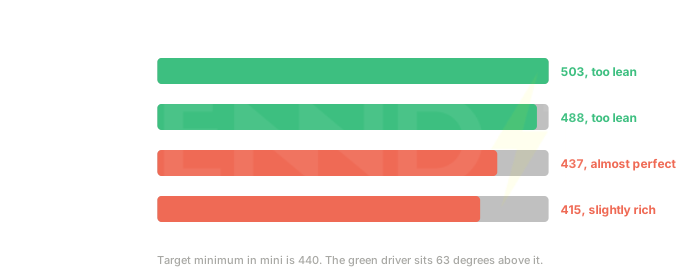
If we didn’t explain that yet: being too rich means being with lower temperatures. Being too lean means being with too high temperatures. So basically, same problem here – the slope is not going down enough, and same problem in the other hairpin.
You see this is very frequent happening. And again, this is the bad way, and this is the good way. You see the big difference there, and it helps massively. Big, big difference over there. Actually, this is the first time he does it quite similar. So you see there’s nothing wrong in the kart, because if here is quite similar and in the other places it’s not – it’s just 100% the driver.
So it’s very upsetting when I see this. It happens to 80% of the drivers. Really, some drivers have a little, some drivers a lot. But it’s very, very rare to find drivers that do not do this mistake.
And if we go to the channels report and we add the average exhaust temperature, you know how we do it? The average exhaust temperature over the lap for the red is going to be 560, whereas for the green is going to be 574. So it’s 14 degrees leaner overall.
But I promise you, it’s highly dependent. Because the red is actually a little bit leaner than the green at the end of the straights – 640 against 629. But the reason why the average is so much higher for the green is because it keeps it too high all the way through, as we just mentioned.
You see, it keeps it too high here, it keeps it too high here, it keeps it too high here. Well, here not that much, but here it’s huge. You see all of this compared to the red – the red is letting the engine breathe way more and all the time.
Look at that, by the way – you see the red is going with more speed all the time up the straights. And you can complain, “Oh, the engine is not good.” Listen, if you do not do the driving inputs correctly, there’s not a single chance that engine can compensate for that, unless you have an illegal engine.
The goal as a racing driver is to improve ourselves, and your goal is to improve yourself. And my goal is to improve myself.
How To Monitor And Fix This Issue
Monitor this all the time, guys! Because it may happen in one track. It may happen because you may start to get older, and you may start to grow up. You may start to get too close with the pedals, so you may have to get a bit further.
Because, as I said, 90% of the times this happens subconsciously – like 95% of the times it’s very rare that someone does it on purpose. No, it’s almost 100% of times it’s going to be subconsciously, and you don’t really recognize that.
You have to go out and do one session and two sessions and three sessions in a row, just thinking – even if you’re 10 seconds off the pace, it doesn’t matter. You just have to focus on braking and completely coming off the gas.
So you have to go out and do one session and two sessions and three sessions in a row, just thinking, even if you’re 10 seconds off the pace, it doesn’t matter. You just have to focus on braking and completely coming off the gas.
The pedal – the foot – has to literally do like that. You know you have to focus not on just like, you’re literally almost like taking off your leg. So adjust the pedals, adjust the heel position, and then of course, maybe put them a bit further if you have this.
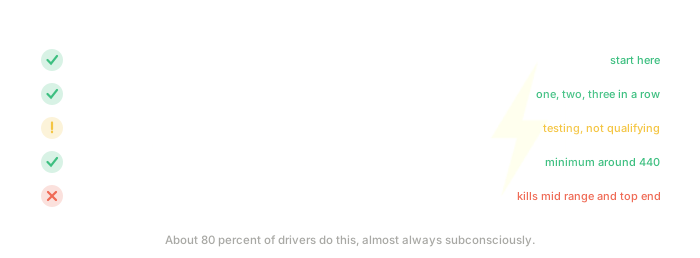
But then again, focus: one session, two sessions, three sessions, every corner, even if you’re 10 seconds off. You got to focus on that, and you’ll see you build up these nice and good habits, and you will be able to do it then subconsciously.
But before you do it subconsciously in a positive way, you got to make sure you are doing it consciously, forcing yourself, for many laps, few sessions. Give up those sessions. I don’t care about lap time for sure. You don’t learn how to do that in the final race or in qualifying – that’s why we have testing. That’s why we have practice.
But remember, if you have all these little things put together, you will be a mega racing driver.
And in cars, this is super bad in Formula 4, Formula 3, unless you do it in the fast corners, as I said, to stabilize the car. If you do it in the slow corners, it’s going to lock the differential, and it’s going to create so much push understeer.
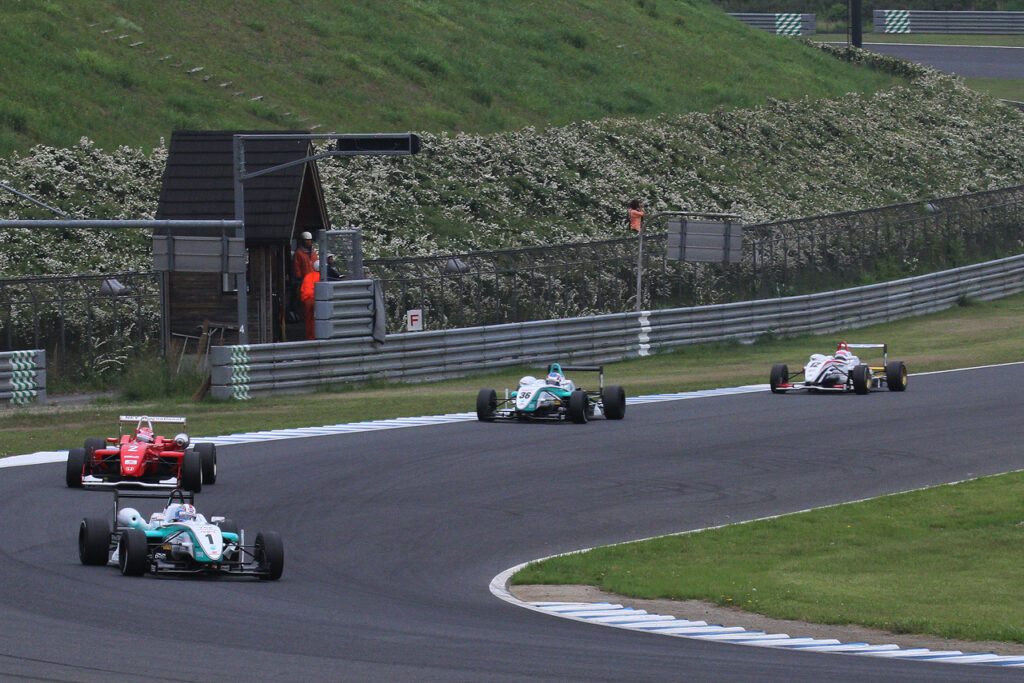
And I was talking the other day to an F4 engineer, and he’s telling me that so many kids coming from karting – which are all of them – like 80% have this problem, and they cannot fix it. And if you cannot fix it now, you will not fix it later in Formula cars, and it’s very urgent.
That’s why you need to fix these things now, and not in Formula 4. So I hope this was clear.
Send your onboard footage. Alessio reviews it corner-by-corner and tells you exactly what's costing you time, and how to fix it. Back within 48 hours.
Get My Onboard Reviewed → Reviewed personally by a CIK FIA World Champion, never an assistant.I promise I'll not spam you with repurposed shitty AI content but real experiences that only I, Alessio Lorandi, experienced. Written in my funny English-Italian tone of voice 😂
Alessio Lorandi is the former CIK FIA World Junior Champion, winning against Lando Norris in 2013 & F3 multiple race winner. He's helped 200+ karting drivers worldwide get faster & win WSK titles with BabyRace Driver Academy & now through Senndit, his online karting coaching platform.