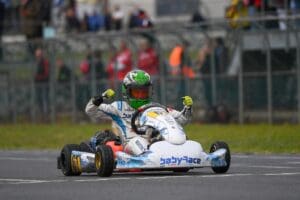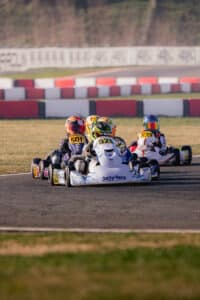
Why Going On The Throttle Too Early Is Bad (The Earlier Isn’t Always The Better)
Throttle early, lose time. Learn when to actually hit it, and watch your lap times drop.

- Earlier is not faster. Going on the gas too early is one of the most common reasons a kart understeers on the exit.
- The rear sits and the front pushes. You end up holding too much steering on the exit, and you scrub speed all the way down the straight.
- It feels like the kart, not like you. So you blame the setup or the engine, and you give your mechanic the wrong feedback.
- If your foot wants the gas very early, check your entry. Most of the time you braked too early and went in too slow.
- Wait for the rotation. Hold the brakes, a small transition of about 0.1 of a second, then roll into power.
- Sometimes early is right. In some corners, in a fight around the outside, or to lean out a rich engine.
- You can fix it by feel, lap by lap. You don’t have to wait for the next session to find out.
- Why does the kart understeer when you go on the gas?
- What happens to the kart when you go on the gas too early?
- Is going on the gas earlier always faster?
- What does going on the gas too early feel like in the seat?
- Why does your foot want to go on the gas early?
- How do you fix going on the gas too early?
- Why does a kart with little front make you wait for the throttle?
- Should you be gentle on the gas in the first laps?
- When is going on the gas early the right call?
- How do you know if you are going on the gas too early?
- What do you ask yourself when you are off the pace?
- When should you go on the gas in a corner?
- What do drivers ask about going on the gas too early?
Let me ask you something.
Have you ever thought you nailed the perfect corner, only to see your lap time still suck?
You tell yourself:
“I was early on the gas. That must’ve been quick.”
But what if I told you that going on the throttle early could be the very reason you’re slow?
Yep. It happened to me. And it might be happening to you.
Why does the kart understeer when you go on the gas?
I still remember a race weekend at Lonato (South Garda Karting) when I was around 13 or 14 in Juniors.
There was this one corner where I just kept losing time.
Every time I went full throttle, I’d feel the front push.
Understeer. Every. Single. Lap.
I told my mechanic:
“I don’t get it. The kart feels fine everywhere else. But in this corner? It just doesn’t turn.”
So what did I do?
- I blamed the kart
- Blamed the setup
- Blamed the engine
- You name it
How is that possible?
I was creating understeer by throttling exaggeratedly too early.
And listen, the way you drive massively affects the balance of the kart. The driver with a very aggressive style will report that he has oversteer. The driver with a very smooth style will report that he has understeer. Same kart.
So before you change the setup, look at your right foot.
By the way, it was not the only time I blamed the kart for something my foot was doing. The other one was in 60 Mini, in the rain, and I told it in how to become strong in the head.
What happens to the kart when you go on the gas too early?
Simple:
By getting on the gas too early, I was unbalancing the kart.
- The rear would sit
- The front would push
- I’d get understeer
- And I’d have to hold too much steering angle mid-exit
That meant I was scrubbing speed all the way down the straight.
Why does the rear sit? Because a kart rotates best on three wheels, with the inside rear lifted. When you go on the gas, traction picks up and you get both rear wheels back down. And when you get both rear wheels down you have, let’s say, double the grip at the rear. It’s almost like it’s pushing you out on the exit, and you don’t get the rotation.
It kind of makes no sense, right? We would want as many wheels as possible on the track. But believe me, in the mid corner it works out better to be on three wheels rather than on four.
It looked fast.
It felt aggressive.
But it was killing my corner exit.
Is going on the gas earlier always faster?
Let’s break it down simply:
If you go on the gas too early:
- You force the kart to understeer
- You scrub speed at mid-corner
- You run out of track at the exit
- You carry less speed onto the straight
It’s like breaking your own momentum.
Instead of building speed naturally, you drag down the kart by asking too much, too soon.
But I’m not telling you to be late on the gas everywhere. It changes corner by corner.
When I drive Franciacorta on the KZ2, I have what I call mental sticky notes for every corner. A few of them:
- Turn 2: get early on the gas, but make sure you can get back to turn 3 flat out.
- Turn 9: don’t be too early on the gas, let the kart grip and rotate, to get a better exit while not running wide. If you’re wide on the exit, you’re done for turn 10 and you’ll have to go down to 2nd gear. You don’t want to do that.
- Turn 12: get on the gas early in 2nd, without running too wide, which would hurt turn 13.
Same track. Same kart. Same lap. Early in one corner, patient in the next.
That’s why there is no such thing as “the earlier the better”.
What does going on the gas too early feel like in the seat?
You feel the front push. You add steering, and the kart keeps going wide. If you still try to go on the throttle and carry the same speed, it’s going to push you off. You have to back off on the exit, or you probably end up in the grass.
And here is the tricky part.
It doesn’t feel like a driving mistake. It feels like the kart. Like the engine is not pulling out of the corner.
On top of that there is an illusion. On the exit of a hairpin, the driver in front always seems to pull away from you, like he has a better engine in the bottom. It’s not true. He simply went on the throttle earlier in time, because he is ahead. As speed expands, distance expands. I call it the concertina effect, or the rubber band effect.
So imagine you come back to the awning and tell your tuner: “I’m losing in the bottom, I’m struggling on the exits.” If that feeling is wrong, he changes the wrong thing, and you go slower instead of faster.
Be objective with your feelings. Separate the illusion from what the kart is really doing.
Why does your foot want to go on the gas early?
Most of the time, because of the entry.
I know this feeling very well. I could feel that I had to almost get on the throttle very early, because I just braked too early and I went too slow. Or I made no minimum speed in the mid corner, so I had no rotation, because I didn’t carry enough speed.
So your foot goes down early to make up for it.
Does it work? It kind of puts a bandage on the problem, let’s say. But it doesn’t compensate properly for the mistake.
Because everything starts in the entry. The mid and the exit are pretty much a consequence of what you do on the entry.
So take that urge as a message. Next lap, fix the entry of that corner. I explain why braking early is the wrong habit in 3 reasons why I hate slow in, fast out.
How do you fix going on the gas too early?
The next day on track, I changed my approach.
I waited a little more at the apex.
Focused on rotating the kart before hammering the throttle.
Kept the steering angle cleaner on exit.
Result?
Boom. I dropped 1.5 tenths, instantly.
So what does waiting feel like?
For me, in the mid corner I need to hold the brakes, yes. But then I need a 0.1 transition where the kart loads, literally loads laterally, kind of flexes and then springs me out.
It doesn’t have to be one second. It has to be 0.1.
If you’re on the brakes and then right away on the gas, with not even a 0.1 transition, believe me, you’ll probably end up being too early on the gas. And if you roll for a long time, that’s what I call a dead zone. The momentum is going to kill you.
And what if the kart doesn’t want to rotate at all? Then waiting longer is not the answer. Create more rotation on the entry. Use the brakes a little bit harder, a little bit more aggressive, and trail them more. When you trail the brakes you shift the weight more to the front, and you create more pitch and more rotation.
Remember, you also generate rotation by carrying more speed.
Why does a kart with little front make you wait for the throttle?
I was fortunate enough to be raised with lots of front in my driving. Full caster style, and a seat pretty far forward to free up the rear.
Give me a kart with lots of front, and I can confidently make the moves stick.
Give me a kart with little front, and it’s a different story. If the front isn’t there, not only won’t I manage to overtake, but the lap time will also be super slow, having to wait for the rotation to be completed before getting back to the throttle.
Same thing in the wet, raised to the power of ten.
And the funny thing is how it looks from outside. You’ll seem to lose a lot on the exit, because the other drivers were able to open up the steering and get on power earlier than you. But the time was lost on the entry to mid corner.
So if your kart has no front, going on the gas earlier won’t save you. It will push you out even more. Fix the front, with the setup or with your driving on the entry.
Should you be gentle on the gas in the first laps?
Yes, especially in a shifter.
On a formation lap or a preparation lap, I try to be smooth on the throttle. If I push too much on the gas, the rears are going to be ready and the fronts are not. And then you have understeer. I just hate having understeer.
So I’m very calm on traction in the first two laps, but I attack a lot the entries, so the fronts get hurried up a little bit. The goal is to get the front and the rear tyres to their peak at the same time.
If you just drive instinctively, the rears are ready super early and the fronts are not. The first two, three laps you have understeer. Then when the fronts arrive, the rears are gone, you start to pick up some oversteer, and the lap times just won’t be there anymore.
It’s not much you can do on the setup for this. You do it with your driving.
When is going on the gas early the right call?
There are a couple of moments where I want it early on purpose.
In a fight around the outside
If someone’s being extra smart and tries to pass you, or resist the overtake around the outside, you can power early and open up the steering. He’s gonna end wide, over the exit kerb or beyond, and at some point he’ll have to lift up the gas and give up the position.
One of the corners I see this happening the most is turn 13 in Franciacorta, the last really wide hairpin, 10 metres wide.
But don’t be a fool. Turning into another driver purposely and visibly past the apex is dangerous behaviour, and it gets rightfully penalized.
And if you are the one going around the outside in a wide hairpin, you want to power up early, get super close to the sidepod of the driver at the apex, and gamble it all by staying full throttle around the outside, over the full exit kerb or even two wheels on the grass.
But if the grass is wet and there’s a water puddle, back off the gas earlier than that. Otherwise, ciao ciao.
When the engine is too rich
You can’t pit for a setup change in a race. But you can drive one. If the engine is too rich at the start of the race, you can pick up the throttle a little earlier to lean it out a bit.
How do you know if you are going on the gas too early?
Here’s how to tell:
1. Check your video
Do you look planted? Or does the kart wash out on exit?
On the video I can quite easily tell the kart behaviour. I can see if I’m using too much steering input and I have understeer.
2. Look at your steering input
If you’re holding too much steering mid-exit, you’re probably scrubbing.
I wrote about what aggressive hands do to the kart balance in mastering smooth inputs.
3. Don’t judge it on one lap
You may have picked up the throttle a bit too early once and gone on the grass on exit, and the first thing your mechanic tells you is “stay tight on exit”.
But if you look at every lap on the onboard video, you may see that on average you’re using too little track on exit, with just a bit of kerb, compared to your teammate who always gets to the limit of dropping a wheel off of it.
4. Write it down
Take a track map and list entry, mid and exit of every corner, from one to five, how much understeer or oversteer you have. If the understeer is always on the exit of the same corners, look at what your right foot is doing there.
5. Review your lap time
You might be faster into the corner, but losing it all (and more) on exit.
And if you log data, I show what this looks like on the screen in good vs bad throttle trace.
What do you ask yourself when you are off the pace?
That day changed how I approach racing.
Now, every time I’m off the pace, I ask myself:
- What am I doing wrong?
- Where am I over-driving?
- Where am I rushing the throttle?
And I ask it in the seat, lap by lap. If you can feel and sense the speed really well, you will be unstoppable. You can adjust your driving lap by lap, corner by corner, instead of having to wait for the data in the next session.
Data analysis is really good. But it’s backward looking.
At the end of the day, you are alone inside the track. Inside the kart, inside your head. And it’s just you that needs to choose where to hit the brakes and where to take off the gas.
This mindset turned me from a kid making excuses
into a driver who won championships.
When should you go on the gas in a corner?
Remember this rule:
It’s not about how early you go on the gas.
It’s about going on the gas at precisely the right point.Not too early and not too late.
So next time you’re tempted to punch the throttle just because it “feels fast”, think again.
Wait for the rotation.
Smooth out the wheel.
Roll into power.
Your kart will thank you.
And your stopwatch will too.
If you want me to look at your exits with you, send me your onboard for an onboard review. And if you want to work on your driving, corner by corner, for good, that is what we do in the 6 months transformation.
What do drivers ask about going on the gas too early?
Is it faster to go on the gas earlier in a kart?
Not automatically. Too early and both rear wheels come back down, the front pushes, and you carry less speed onto the straight. Go on the gas when the kart has rotated.
Why does my kart understeer on the exit?
Very often it’s the throttle, not the setup. If you go on the gas before the kart has rotated, the rear sits, the front pushes and you hold too much steering. Before you change the setup, look at your right foot.
How long should the gap between the brakes and the gas be?
Very small, about 0.1 of a second, where the kart loads laterally, flexes and springs you out. No gap at all usually means you are too early on the gas. A long roll is a dead zone.
Is going on the gas early ever the right thing to do?
Yes. In some corners it is, and in racecraft you can power early and open up the steering on a driver who tries to resist around the outside. If the engine is too rich at the start of the race, picking up the throttle a little earlier leans it out a bit.
How do I know if I’m going on the gas too early without data?
Watch your onboard video and your steering. If the kart washes out on exit and you’re holding a lot of steering, you’re probably too early. And if your foot wants the gas very early, check your entry first.
Send your onboard footage. Alessio reviews it corner-by-corner and tells you exactly what's costing you time, and how to fix it. Back within 48 hours.
Get My Onboard Reviewed → Reviewed personally by a CIK FIA World Champion, never an assistant.I promise I'll not spam you with repurposed shitty AI content but real experiences that only I, Alessio Lorandi, experienced. Written in my funny English-Italian tone of voice 😂
Alessio Lorandi is the former CIK FIA World Junior Champion, winning against Lando Norris in 2013 & F3 multiple race winner. He's helped 200+ karting drivers worldwide get faster & win WSK titles with BabyRace Driver Academy & now through Senndit, his online karting coaching platform.