How Parents Should Support A Young Driver
Your kid's potential is being sabotaged by pressure. Here's what actually works.

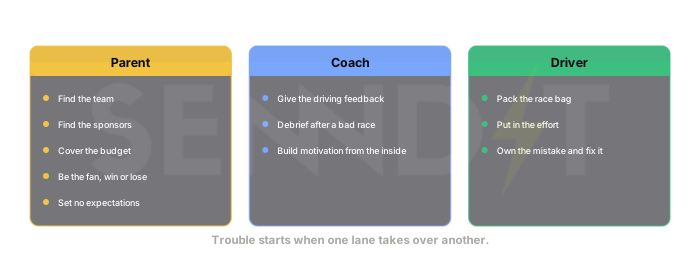
- Parents wear many hats. Mentor, manager, looking for sponsors, dealing with teams and coaches. You just cannot expect the kid to deal with everything himself.
- Setting expectations is the worst thing a parent can do. There are so many variables. The only thing to be happy about is the kid putting in the effort.
- Let the coach be the coach. If the parent tries to be the coach, then what’s the coach there for?
- Fear of letting you down is a handbrake. The kid brakes early and does not overtake, because he’s afraid of making mistakes.
- Want to know if he really loves it? Stop mentioning karting for a few days or weeks and see if he begs you to go back. My dad did it with me.
- Race when he’s ready, not before. A kid who is three seconds off the pace needs more training first, not a race.
- The kid packs his own race bag. My mum would clean my stuff, but I was the one putting it in the bag.
- The best relationship: the driver feels supported, safe, and like he has nothing to lose.
- What is the most important role parents play in a child’s racing journey?
- How can parents support without adding pressure?
- How do you know if your kid really loves karting?
- When is a young driver ready to race?
- What should parents say after a bad race?
- Should you ask your kid if he wants to quit?
- How can parents help kids stay motivated after mistakes?
- What behaviors from parents help drivers improve the fastest?
- What behaviors hurt a child’s development?
- Does paying for the season mean your kid should win?
- How can parents work well with coaches and teams?
- How involved should parents be in race preparation?
- How do you balance encouragement with realistic expectations?
- What mindset should parents adopt during races?
- How can parents help kids learn from setbacks?
- What does the best parent driver relationship look like?
- What do parents ask most about supporting a young driver?
A young driver’s success in karting often depends as much on parent support as on raw talent. I’ve seen this over and over and over again.
That’s why parents have a massive role in the driver’s development and in their overall career. Why? Well, simply because we cannot expect kids of that age to look after themselves or to find their own teams or to find their own sponsors. I mean, that simply hasn’t happened yet that I know.
So the parents will need to provide the highest quality support to the kids in order to give them the highest shot at succeeding. So in this guide, I’ll answer the questions parents ask me most about supporting a young driver in karting. Some of it comes from my own parents, some from the parents I work with every week at BabyRace.
We simply cannot expect kids of that age to look after themselves or to find their own teams or to find their own sponsors.
What is the most important role parents play in a child’s racing journey?
The reality is that parents of racing drivers are going to wear many different hats along a driver’s journey. Well, think about it, they will need to be their mentor, they’ll need to be their manager, they’ll need to be looking for their sponsors.
They’ll need to be, you know, dealing with teams and dealing with coaches. So there’s going to be many things involved for the parents of a racing driver. You just cannot expect the kid to deal with everything himself.
I mean, my father had to look after my career all the way up until I got into formulas. And even there, of course, they had to provide for the budget required to compete in all the seasons of Formula cars. So it was impossible to do anything without my parents, and that’s the same that’s going to happen with your kids.

So if you want to have a shot at getting your kid to succeed, then it’s vital that your guidance and your actions are on point and that you’re able to provide the optimal support that kid needs.
How can parents support without adding pressure?
That is a very important point. Most of the time parents are trying to support the kids and trying to be helpful. Generally, they’re trying to really help him succeed.
But sometimes they do it in an obstructive way, which affects the driver’s performance negatively, because he just feels under more pressure. And what I’ve noticed over the years is that when parents are struggling to deal with all the financial commitments in racing, they are going to naturally put a lot more pressure on the kid. The kid is going to naturally feel that pressure. And most of the time, the kids are going to crack under that pressure, and that’s just going to make things worse.
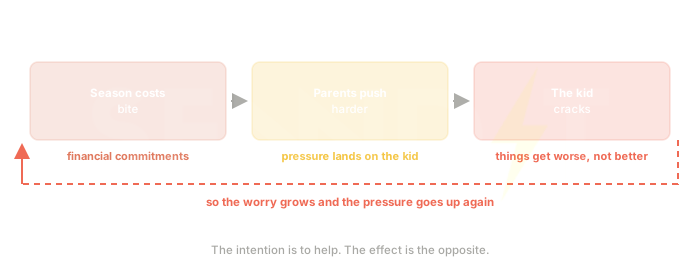
And it’s not only the money. Think about the moment right before the kid gets in the kart. You may be a parent trying to be helpful, and by trying to be helpful you end up being a bit too obstructive, trying to overprotect him and stuff like that. It doesn’t work well. It’s going to feel like pressure, it’s going to feel like expectations to the kid, and believe me, it’s not going to help him.
I would say 80% of the parents do this mistake. Of course, there are some kids who are able to deal with pressure and cope with it without any problems. They are totally fine. But others are not.
So it’s very important that the parents realize it and find a way to be supportive, but taking a step back. Letting the team do their job, letting the coach do their job, and letting the kid breathe and deal with it himself. I went deeper into the over controlling side, and into how my father handled the money, in the driver parents relationship.
How do you know if your kid really loves karting?
Let me tell you what my father did after I tried the kart for the first couple of times.
He intentionally didn’t mention karting anymore. He obviously didn’t say “We’re never going karting anymore”. He just omitted it. He didn’t do it because he was evil. It was actually a very smart thing to do at that time.
He was racing in shifters back then, on the weekends, after working all week long. If you’re asking yourself if that’s who I got the passion from, yes, it’s from my dad.
So he was carefully monitoring our reaction, never pressuring me or my brother Leo. Quite the contrary.
In his head it was something like this: how can I tell if my son has the same passion as I do? I can’t take it for granted. If he wants more, it means he’s in love with it. If he doesn’t ask about going again, then he hasn’t got the passion, so there’s no point to force it on him. He could stick to football. (Yes, I started playing football very early and continued until I was 12, while racing at the same time.)
What do you guess I did?
I begged my dad to take me again. I fell in love with it. I got bitten by the bug.
I must have insisted so much that my little brother, 2 years younger than me, got intrigued by it, asked to try it, and shortly after he jumped on the kart for the first time at just 4 years of age.
To this day, when parents at BabyRace ask us for advice about their kid, to understand whether he’s passionate or not, my dad tells them to try the same trick. Don’t mention karting for a few days or weeks when you head back home. Watch the kid’s reaction. Does he beg you to get back on track, or not?
It works very well.
Because the desire has to come from the kid. It’s not like you’re supposed to do it. He needs to crave it, as any kind of passion.
When is a young driver ready to race?
At BabyRace our philosophy is simple. Make sure you are ready to race, and then go racing.
Of course, I believe the earlier you start the better. The more track time you get, the more experienced you are, and therefore the earlier you can race. But if a driver has just started and he’s three seconds off the pace, you can understand that it doesn’t quite make sense to get him to race right away. It would be better to do more training and more development first.
The most common mistake I see is throwing the kids into competitive races too soon. They cannot compete with drivers that have maybe three times more experience than them. Or they are 8 years old and they’re racing against kids that are 11. That creates massive frustration. And it’s also a bit of a waste of time and money, because you cannot expect him to perform. You have to give him the time.
Same with the category: the right class at the right time builds skills, whereas the wrong class builds frustration. I go through this age range in karting for 8 to 12 year olds.
And the higher the level, the more this matters. In a summer camp a kid does about 100, 120 laps per day. In a WSK, if you’re lucky, you get to do 30, 35 laps per day, and from the Friday it’s more like 15 to 20. So in WSK you’re not expecting to learn that much how to drive. You’re supposed to be knowing how to drive already.
That’s why I normally do not recommend drivers to join a WSK until they’re ready, even though it’s against my interest. Otherwise the drivers are going to lose the confidence in themselves. It doesn’t have to be a reality check so shocking for the kid that it becomes a confidence breaker.
And the same is true at the very start. The biggest mistake is taking the kid too soon, when he’s maybe still a bit afraid of speed. Even if he just crashes a bit and gets a traumatic experience out of it, for sure that is going to affect him for the rest of his career.
What should parents say after a bad race?
The thing that I believe is that the parents should not directly interfere with the drivers, especially if they have zero prior karting or racing knowledge themselves. So I just feel that the feedback should come from a proper coach that has been there, done that, and just knows what to say to the driver.
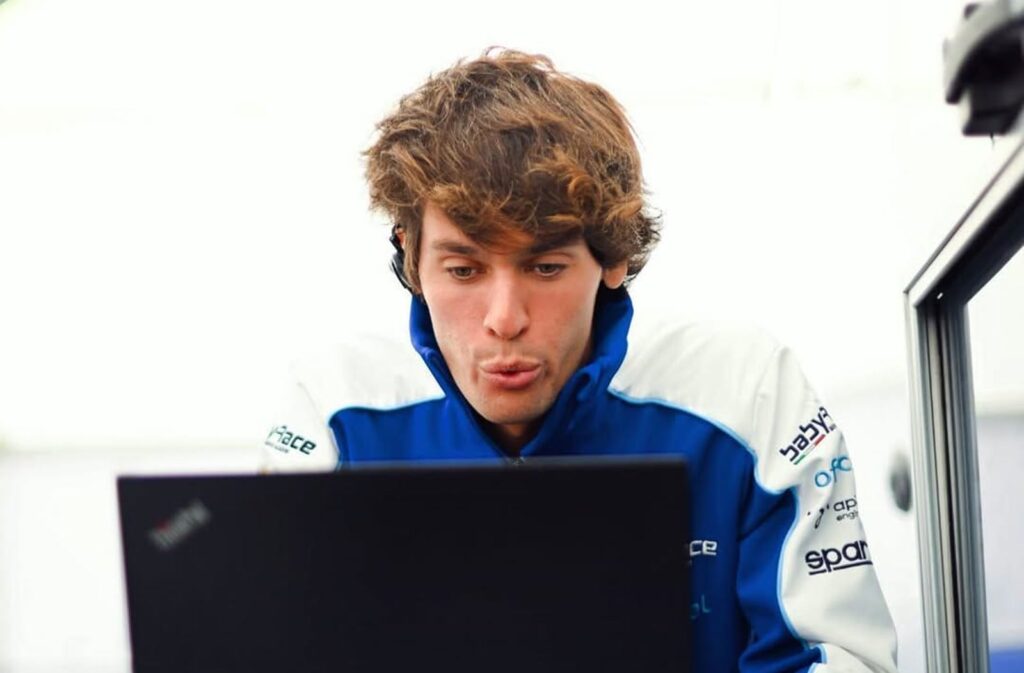
And if the parent is going to interfere, it’s going to create some problems, because he’s not going to know exactly what to say. And if he doesn’t know what to say, most of the time he’s going to say a bad thing, right? So that’s just really bad.
Of course, you don’t want to have a scenario like that, where the kid is actually receiving bad coaching, because instead of improving he’s actually going to go worse. So after a bad race, I just feel like the parent should stay away from it. Let the kid talk with his coach, try to understand what went wrong and try to fix it for the next race.
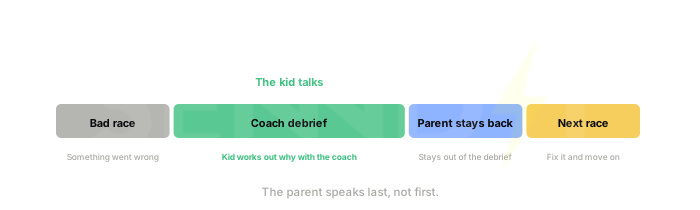
And the parent just needs to, obviously, let the coach do his job. Because if the parent tries to be the coach, then what’s the coach there for?
If the parent tries to be the coach, then what’s the coach there for?
By the way, parents beware. Hot feedback after a session is precious for problem solving. Let the kid explain his feedback to the team first, using his own words, even if not fully correct. Don’t paraphrase it yourself upfront, putting your words into his mouth. I see this happening so many times, unfortunately. I told the story of a dad who did exactly that at a WSK weekend in how to tell if your driver is fast or just well funded.
Should you ask your kid if he wants to quit?
Do you know how many times my dad asked me if I wanted to quit? After major setbacks, when I was crying and suffering so much in the back of the car driving home.
But he wouldn’t say, “Alessio, do you want to quit?”.
He’d say instead something like, “Come on Ale, let’s quit, you can continue playing football” (so you don’t have to suffer that much, I guess).
It was very very subtle, but it forged me. Oh boy, it forged me.
I would reply crying, something like “No! I want to win the next race”.
Look at what he did there. He never told me to keep going. I was the one saying I wanted to keep going. I felt I had that passion for racing and that burning desire to win deep inside me. And I have to thank my dad for subtly channelling me towards my passion.
How can parents help kids stay motivated after mistakes?
Well, I think this is an important point. Parents can help as facilitators, as supporters, as fans, as motivators, basically. So I feel that the coach should do his own work and his own job with the kid, and then the parent should act as a facilitator, as a motivator, I would say. But then again, it should be that role only. You should not interfere with the coach.
Because I feel like internal motivation from the kids is way more powerful than external motivation from their parents. So what a coach should work on with a kid is to get the kid to be motivated by himself, and not to get motivated externally. He needs to want it more than anybody else, and only then he will realize, okay, I need to do this in order to win.
What behaviors from parents help drivers improve the fastest?
I feel that a totally relaxed behavior and fully supportive approach is going to help the drivers so much more than trying to put pressure and trying to set expectations on the kids.
I feel that the kids need to know what to do to improve. They need to know that, of course, they are expected to at least put the effort. And of course, if they put a lot of effort, they are going to perform. But if they’re not putting in the effort, then, I mean, they are not going to perform.
That’s one of the things that kids need to be aware of. But the parents should be relaxed, chilled back, and let the coach do his job. And of course, the kids then don’t have to take advantage of that and be like, oh, my parents are relaxed, I can still underperform and I’ll be okay, I’m just here for fun.
No. That should just be a way of taking the pressure off the kids, and the kids should be like, okay, my parents are going to love me regardless whether I win or not. So they are going to have that in the back of their mind, and they’re not going to have the fear of making mistakes.
And the fear of making mistakes happens so often, and parents are not aware of it. They feel that putting the pressure on the kids is going to help, but actually it’s going to hurt the relationship between parents and kids, because the kids are going to drive with fear of making mistakes. And that’s just very bad. Because when the kids drive with the fear of making mistakes, the driver is going to brake early, because he’s afraid of making mistakes and losing time.
The driver is not going to overtake, to avoid making a mistake or crashing. So all these sort of things, when drivers drive with fear, fear of not being approved by their parents, that is going to be a massive handbrake to their performance.
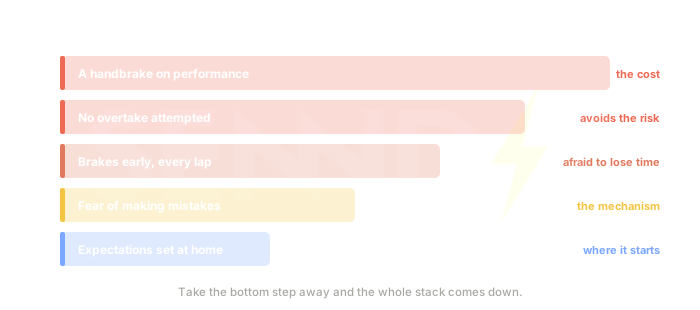
When drivers drive with fear of not being approved by their parents, that is going to be a massive handbrake to their performance.
What behaviors hurt a child’s development?
I just feel that setting expectations is just the worst thing that the parent can do. And really, realistically, you cannot set any expectations, because there’s going to be so many factors related to that. It’s just foolish to set expectations. There’s so many variables.
The only thing that a parent would want is to see the kid putting in the effort and just trying his best. And once that’s in place, then, of course, the parents should be happy about that. That’s the only thing I think the parents should be happy about.
Another very bad thing for a parent to do is to try to coach the kid and to teach the kid how to drive. If the parent has no racing experience of his own, that’s clear. But even if he does have racing experience, sometimes it’s better to actually have someone in between to communicate to the kid, so that the kid feels safe with, let’s say, the father and son relationship.
Whereas if the father is trying to teach the kid driving techniques, sometimes the kid might feel like, if he’s not going to listen, he may let down his father, or his mother.
And that’s something he does not want. Because every kid does not want to be not loved by his parents. It’s something people need to remember more.
Also, comparing your kid to other drivers can be one of the worst things you can do, as any driver is going through a different journey, with more or less experience than others. And being scolded or overly advised right before a race can be a big distraction. The driver will have too many thoughts during the race, and that slows down his decision making and hurts his performance.
Does paying for the season mean your kid should win?
Do you know what one of the biggest dangers for a young talented driver is?
A parent who believes that since they’re paying, they should always be expected to have the superior performance to win.
There couldn’t be any worse mentality than this, as it’s then transferred back to the driver at the dinner table, and it ends up ruining the kid’s learning curve.
And think about it. Everyone’s pretty much paying to drive in karting, some more and some less. So everyone would have to have this entitlement. But by definition, it’s literally not possible for everybody to have superior performance over the others.
You will never find any karting team, or any racing team in the world, being number one in their class every year, at any race. It just won’t happen. Past performance doesn’t guarantee future performance. If in a 20 races season your team gives you a 1 or 2 tenths edge for 5 races out of 20, that’s a luxury, because it doesn’t happen very often.
So with this mindset, some parents, despite good intentions, end up shifting the blame to the team and the equipment too easily, instead of looking inward to find that final tenth. And the best drivers I’ve ever raced with or coached are the ones who blame themselves first.
How can parents work well with coaches and teams?
I feel that parents can work with coaches, for example, in understanding the areas of improvement of their son or daughter. And also in giving the kid the optimal track time, and the quality of track time as well, with the proper team, etc.
So understanding exactly the requirements that the kid needs, and giving him all the tools to succeed. Because sometimes we’re expecting the most from the kid, but if he doesn’t have the right situation, if he’s in a wrong environment, he’s not going to be able to succeed. So we cannot expect anything from him in that case.
But the most important thing, as I already mentioned, is to not set any expectations.
How involved should parents be in race preparation?
I feel the parents should not be too involved in that. The kids need to be involved in preparing for the race. The kids need to prepare their bags. The kids need to make sure everything is ready. Yes, the parents can sometimes double check, but it’s the driver’s responsibility.
I feel like if you want the kid to mature and to become a man, he needs to take care of those things himself, and not just rely on his mother and father. My mum, yes, would clean the stuff, but I would take care of it, and I would make sure it was placed in the racing bag, and not just simply given to me.
How do you balance encouragement with realistic expectations?
Yeah, I mean, that’s one of the points. Sometimes the kids get confused between genuine encouragement and actual pressure, increasing the expectations.
Sometimes parents are trying to cheer you and encourage you, like, oh, come on, try to go and win, go for it, stuff like that. And sometimes you may misunderstand that and feel like, oh, that’s my father asking me to win. What if I don’t win? If I don’t win, is he not gonna love me? Is he not gonna want me anymore as a kid? Stuff like that.
So these are the things going on in the kid’s brain. It happened to me. I remember, I didn’t want my dad to set expectations. I didn’t want anybody to set expectations. I was just like, you know what? I’m just gonna go out and give my best. And whatever happens happens.
I didn’t want my dad to set expectations. I didn’t want anybody to set expectations. I was just like, you know what? I’m just gonna go out and give my best. And whatever happens happens.
People telling the kid “Let’s get a top 5”, or “See you on the podium”, or worse “The win is yours”. These are simple words, yet they can mess up his focus and create a ton of frustration if the result doesn’t seem to be there halfway through the race. That’s why I learned to never set myself any expectations, just telling myself and the people around me, “I’m just gonna give everything I have”.
And if you’re the driver reading this: if people try to put an expectation on you, even if that’s your parents, just do not listen. You can just reply, “I’m gonna do my best”. That’s it.
If you want realistic expectations, do not look only at the lap time on the screen. I explain how to tell if your driver is actually fast.
What mindset should parents adopt during races?
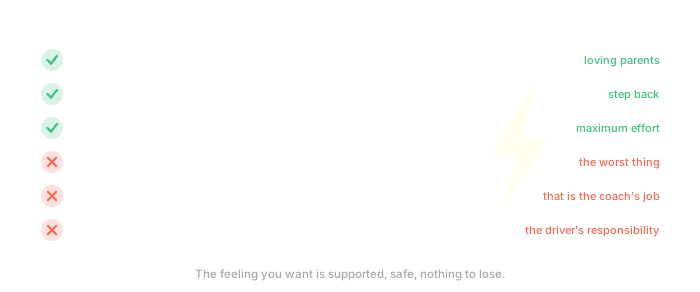
I feel that parents should just be their kid’s fan. They just want to be encouraging. They need to be loving parents.
And of course, they want to make sure that the kid is not distracted and is putting in the maximum effort. They need to take care of that. But at the same time, the parent needs to step back and let the coach do his work, let the team do their job. And once that’s in place, I’m sure the kid is going to get great results.
But let’s be honest. The parents maybe do the perfect job. The coach maybe does the perfect job. At the end of the day it’s the driver who needs to access the right mental state.
I’ve seen it at BabyRace, even recently. We gave drivers the perfect guidance and the proper package, the parents literally left the kids alone, sometimes they didn’t even come to the races. And the kid maybe would be starting on the front row, but instead of blocking out distractions he would seek them out, messing around with other drivers right on the grid. Then the first thing you see on the first lap is a lot of mistakes and wrong decisions. So I think 90 percent of the responsibility is still on the driver.
How can parents help kids learn from setbacks?
I generally feel that kids are going to naturally learn how to deal with setbacks themselves. Over time they will understand it’s just part of the process. It just happens in life. It’s impossible to avoid setbacks.
But of course, yes, parents can help the kids understand that the goal is not to have no setbacks. The goal is to bounce back from setbacks. Everybody makes mistakes. The goal is to rise back and learn from those mistakes. So I feel it’s important that the parents educate the kids in this way.
And it’s important that the parents do not excuse the kids all the time and try to protect the kids too much. Yes, they need to be encouraging and supportive, but they need to acknowledge when the kid makes mistakes. They don’t want to put all the blame on the kart or on the team, and they don’t want to take away the responsibility from the driver. The driver needs to take his responsibility, and it’s correct that the parents acknowledge that.
So it’s a balance. Not putting the blame on the kart every time, but also not putting the blame on the kid every time. It’s a great balance that the parents need to respect.
What does the best parent driver relationship look like?
I feel that the best relationship is where the driver is feeling supported, he feels safe, but at the same time he feels super motivated, and he feels like he has nothing to lose. He has nothing to worry about. The driver has nothing to fear. He’s just super committed. He has internal motivation.
He feels like his parents are going to love him regardless, even if he does badly. And all these things are going to massively boost the kid’s performance. And I feel the parents are going to appreciate those benefits themselves, and they’re also going to enjoy the racing side more.
So the best parents in karting create an environment where kids feel supported, not pressured. Of course, it is not easy. Nobody is born with this kind of attitude. It’s something parents also need to learn. Drivers feel the effect of their parents massively. So if the parents learn how to cope with their child and how to behave, they are much more likely to increase the chance of their child to succeed.
And the kid builds his strength in the head the same way, with what he does every day and who he surrounds himself with. I wrote about that in how to become strong in the head.
What do parents ask most about supporting a young driver?
Should parents coach their kid in karting?
No. Even if the parent has racing experience, it’s often better to have someone in between, so the kid feels safe in the father and son relationship. If the parent tries to be the coach, then what’s the coach there for?
What should a parent say after a bad race?
As little as possible. Let the kid talk with his coach, understand what went wrong and fix it for the next race. Let him give his feedback to the team first, in his own words.
Should parents set result goals for a young driver?
No. Setting expectations is the worst thing a parent can do, because there are so many variables in racing. The only thing to be happy about is the kid putting in the effort and trying his best.
How do you know if a kid really loves karting?
Stop mentioning karting for a few days or weeks after a session and watch his reaction. If he begs you to get back on track, the passion is there. If he never asks, there’s no point to force it on him.
When should a kid start racing instead of just training?
When he’s ready to race. If he’s three seconds off the pace, more training makes more sense than a race. Throwing kids into competitive races too soon creates massive frustration and wastes time and money.
Who should pack the race bag?
The driver. Parents can double check, but it’s the driver’s responsibility. That’s how he matures.
If you need some remote coaching to get your kid improving his lap times and winning races, send me his onboard for an onboard review. I send you back a video review of the driver with all the advice on how he can improve. And if you want him to learn everything step by step, with the pre-recorded lessons and the Zoom classes with the other drivers, that is what we do in the 6 months transformation.
Send your onboard footage. Alessio reviews it corner-by-corner and tells you exactly what's costing you time, and how to fix it. Back within 48 hours.
Get My Onboard Reviewed → Reviewed personally by a CIK FIA World Champion, never an assistant.I promise I'll not spam you with repurposed shitty AI content but real experiences that only I, Alessio Lorandi, experienced. Written in my funny English-Italian tone of voice 😂
Alessio Lorandi is the former CIK FIA World Junior Champion, winning against Lando Norris in 2013 & F3 multiple race winner. He's helped 200+ karting drivers worldwide get faster & win WSK titles with BabyRace Driver Academy & now through Senndit, his online karting coaching platform.