Why Hire a Go Kart Coach? 5 Reasons It Pays Off (2026)
Is a karting coach worth it? The 5 reasons, what a day with a coach costs, when you don't need one, and why the parent should not be the coach.


- A coach points, the driver drives. He shows you where you are losing time. You still have to go out and brake five meters later yourself.
- Video is about 40% of the story. It shows where you put the wheels. The data shows how fast you go, how late you brake and how soon you pick up the throttle.
- I start from the biggest loss. I look at the three biggest areas of time loss across the lap. I don’t go from turn one to turn two.
- A good on track coach is north of 500 euros per day. About 250 to 350 euros for the coaching, then hotel, travel and food.
- You don’t need him every day. If you drive 10 days in a month, 2 days with a really good coach is enough. The other 8 you work alone on what he gave you.
- A bad coach is worse than no coach. He must have raced himself. Do a background check before you pay.
- The parent is not the coach. Unless the parent has raced. I’d say 90% of parents get this one wrong.
- If no very good coach is near you, go remote. My onboard reviews are 99 or 249 euros per month. The six months program is 299 euros per month.
- What does a go kart coach actually do?
- Why does a coach start from your onboard video?
- What does the data show that the video can’t?
- What does a coach look at first in your data?
- Can a coach get you ready for the 8 AM session?
- How does a coach talk to you in a race with no radio?
- Can a coach teach you to give better setup feedback?
- How much does a go kart coach cost?
- Is a karting coach worth the money?
- How many days with a coach do you need?
- You hired a coach and your kid is not winning. Why?
- When do you not need a karting coach?
- Can a parent be the coach?
- How do you choose a go kart coach?
- On track or remote coaching, which one do you need?
- Frequently asked questions
- How can I coach you if you are not at my track?
You keep seeing driver coaches at the track and you wonder if you should get one for yourself. For every race? Just for some practice days? And the bigger question: is a coach even worth it? Can you coach yourself? Is it enough to use your mechanic, or your dad?
These are the questions drivers and parents ask me all the time.
Listen, first I tell you where I come from. I never really had a coach. I learned by myself, and by being around my mechanic Piero and my dad. My mechanic had one advice for me every time: brake later, brake later. I only had a coach for one race, in Formula 3, at the Pau Grand Prix. I really enjoyed that, and I won that race. I wish I could have had a really good coach all the other days.
Today I’m on the other side. I run the BabyRace team, and at the big races I’m mostly taking care of performance and coaching. So here are the 5 reasons a coach pays off, what he costs, and when you don’t need one.
What does a go kart coach actually do?
He watches all of your videos, most of the time with you. He watches the data from your sessions, recorded on your logger, whether it’s a MyChron, an Alfano or a Unipro. Most of the time he comes with his own cameras. Then he looks at you from the side of the track, gives you signs, and sometimes he stops you in the middle of the session to tell you what to fix.
And he has two eyes looking at you. He can look at your posture. He can look at your movements. From your body language he understands your mood, what you are thinking and feeling when you are driving. He has to help you with that too, because it’s not just about the technique. Most of the time it’s mostly about the mindset.

So here are the 5 reasons, one by one:
- Video analysis
- Telemetry analysis
- Pre session warm up
- Racing communication
- Better kart setup feedback
After the five I go into the money, the parents, and how to choose one.
Why does a coach start from your onboard video?
The first reason to hire a coach is that he has tons of experience with video analysis. He has watched hours and hours of onboards. His own, his teammates’, the drivers he has worked with. And as the saying goes, you can’t buy experience.
I’ve been focusing so much on this single aspect. I remember coming home from school and just watching video onboards all day instead of studying for the upcoming exam. I tried to be as objective as possible, praising myself when I was really on the limit and hitting myself when I was missing an apex.
But the magic happens when you start watching other drivers’ onboards. That’s when you learn the new tricks. When I was racing in Formula 3 and Formula 2 I was eager to watch my teammate’s video if he happened to be faster in the session.
What do I look at in an onboard? The lines first. How much of the track you are using, specifically on the entries. Then the hands: are you pushing nicely with the outside hand, or pulling with the inside one? Then the moment you hit the throttle. Before the apex, at the apex or after it? And the kart behavior. I can tell quite easily from the steering input if you have understeer, or a massive snap of oversteer as soon as you turn in.
Your coach prepares and records the videos, so you get a proper analysis of your lines and your driving style.
What does the data show that the video can’t?
So after having carefully watched the videos, are you ready to improve your lap times in the next session?
Nope.
Why? Because you’re missing the other side of the story. Videos can just tell you where you’re putting the wheels of the kart, and that’s about 40% of the story. The video doesn’t tell you how fast or slow you’re going through the corners, how late you are braking, or how soon you go on the throttle.
The video gives you a perception. The data gives you the real number. And there are no excuses on the data. It’s the same thing I say to my drivers: remember mate, data doesn’t lie. They tell me they have no top speed. Then they see the data of their teammates, and maybe the teammates have even less.
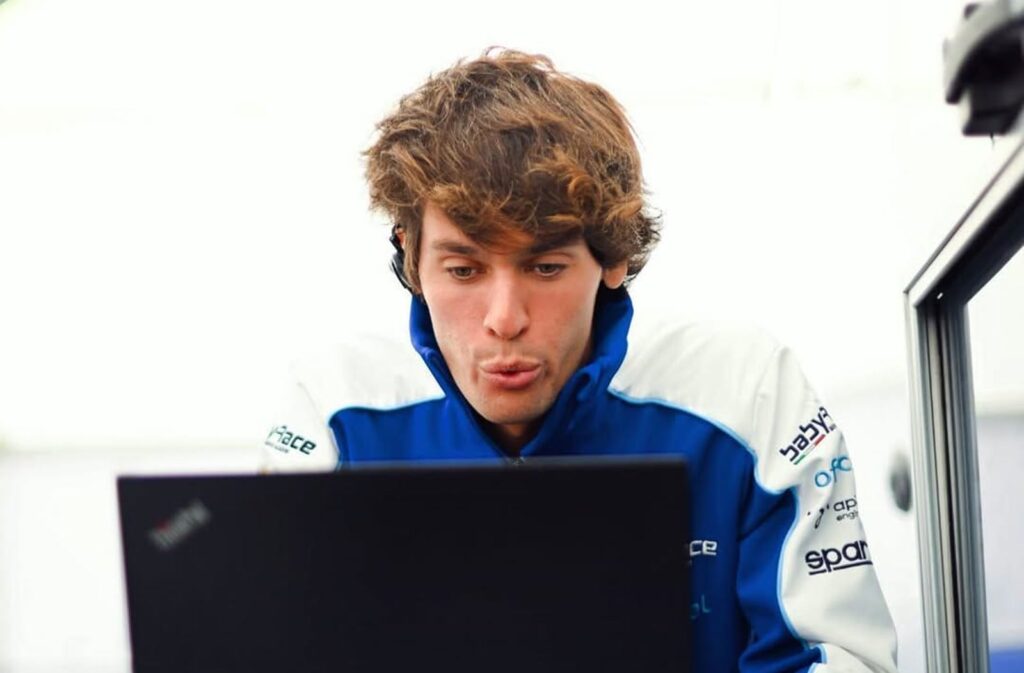
That’s why you really need the data to be analyzed. You can let the team do it for you in just 5 or 6 minutes. Or you can have your coach go through it thoroughly with you, so you know exactly what to do next time you get back in the kart.
Telemetry analysis is really what you need if you want to get faster, because it highlights the areas you need to focus on with your driving and the areas where you can maybe work on the setup.
If you want to read your own data, start from the telemetry guides.
What does a coach look at first in your data?
I can only tell you what I look at. Other coaches go in order: turn one, turn two, turn three. I used to do that too.
Now my standard procedure is different. I look at the three biggest areas of time loss across the lap. I start from the area where the driver is losing the most. Then the second. Then the third.
Why? Because when a driver has too many corners to focus on, he ends up in information overload and he can’t fix the ones that really need it. If he is six tenths off the pace, I focus on the corners where he loses two or three tenths. Not on the ones where it’s two or three hundredths. And when there is not so much time, it’s better to go straight to the point.
Let me give you a real one. In the double left at Lonato, the same driver was at 10,200 RPM in the final against 10,900 RPM in qualifying. About 700 RPM, which is 3 km/h. One sprocket is worth about 200 RPM, so you would need three teeth to get that back. But you can’t gear for one corner. So that one is a driving fix.
The full order I use on the screen is in what a coach looks at first in AiM Race Studio 3.
One more thing. Data is backward looking. It looks into the past. If the track gets more slippery in the next session, you may have to drive differently. So the coach gives you the areas, and then you still have to adapt to the grip you find.
Can a coach get you ready for the 8 AM session?
Getting yourself mentally and physically ready to drive at 8 AM is definitely not an easy task. Even for go kart world champions and Formula 1 drivers.
That’s why you need someone to help you with physical exercise and reaction training before the session. Those exercises help you a ton. Especially warming up your reaction times.
Because let’s be honest. Karting might not be that physically demanding, but it surely is one of the most mentally demanding sports, where concentration and reaction times play a big role in the final performance.
And it gets harder when you move up. When you start doing lots of simulator work in Formula 4 or Formula 3, you discover how challenging it is to keep the focus to the max for 30, 40 or even 60 minutes straight without a rest. That’s quite a big difference compared to a 12 or 15 minute go kart race.
So make sure you hire a coach that can help you be fit for the sessions in the morning.
How does a coach talk to you in a race with no radio?
What is one of the biggest differences between F1 and karting? The big wheels, the weight, the horsepower, the aerodynamics? Well, yes but no. I’m talking about race communication.
When people drive a Formula car for the first time, the first thing they notice is the earplugs and the microphone. You don’t have a team radio in a karting race.
But to win you need to know what is going on around you. If you’re leading, you need to know if you’re pulling away from the group or if they’re catching you. Your mechanic can give you a sign, but the mechanic stand is pretty crowded, so most times you will struggle to see your mechanic. Especially if the stand is on the outside of a corner.
So your coach goes around the track and gives you the signals that can define a race, or a championship.
- If you’re pulling away from the group, he tells you to just look forward and not look back.
- If they’re catching you, he asks you to push a bit harder or to drive smoother to pick up the pace.
- In qualy he can get you a really good slipstream, by telling you to back off and wait for the guy behind to pass.
By the way, I see some coaches now giving live coaching tips with a radio. For me it’s not a good choice at all. It’s like trying to grow something with steroids. The kid gets told what to do every corner, and then in the race, where he can’t have it, he feels lost.
Can a coach teach you to give better setup feedback?
Last but not least, you can get tons of setup advice from your coach.
He can train you to give the best and smartest feedback to the team, so they can improve the setup of the kart. That’s a huge amount of value. If you can help the team with your feedback, they will find the way to make you faster, whether the problem is the chassis or the engine.
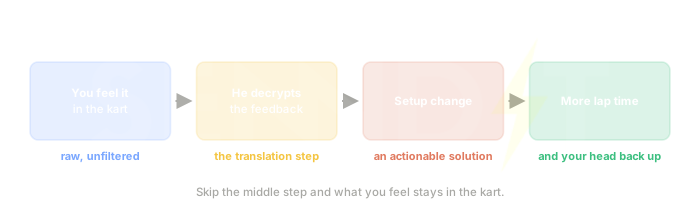
Of course, if everything is good on the kart but you are just not braking late enough, or not picking up the throttle early enough, then the one who needs to improve is you and not the kart.
But sometimes both the driving and the setup need to get better to improve the lap times. And a coach who has raced can tell you which one it is.
Giving great kart feedback is super important, and you should really get the help of a top coach if you want to become the next WSK or European champion.
How much does a go kart coach cost?
A good coach in one day is going to cost you roughly between 250 and 350 euros, only for the coaching.
Then you have the expenses. If he stays for a race, it’s at least 100 euros for the hotel. Then travel, dinner, breakfast, food in general. So you look at 300 to 350 euros a day for him, plus about 100 to 150 a day of expenses. You will be spending north of 500 euros per day on a coach, between his fees and his expenses.
And there is the distance. The world class coaches are probably not living in your city, maybe not even in your country. Most of the best ones are in Italy and in the UK, and I guess some in the US. In Italy the highest density is here at Lake Garda, around South Garda Karting, then Franciacorta and Cremona, because here is where we have the most races. All three are on my list of the best karting tracks in Italy.
And one limit from me. You want a really good coach, but you don’t want to overspend there either. You don’t want to spend more on him than the race fee.
For what the whole season costs, I wrote how much karting costs per year. And the prices of the other ways of getting coached, remote, courses, sim and data, are in karting coaching compared.
Is a karting coach worth the money?
It really depends on what coach you’re working with.
If the coach is outstanding, the thousands of euros you spend in a year create a return in results. Say you get a coach for two or three days and he upgrades your driving, and you become a one tenth per lap faster driver. Everyone would take that trade, every day.
It’s sometimes hard to quantify, I know. But if you ask me which expenses actually improve performance and which ones waste money, I feel the money spent on coaching improves it the most. A private coach, or a team that really provides proper coaching. Driver development is key.
Now put it next to the season. A national championship is 30,000 to 60,000 euros per year. Two coached days a month are north of 1,000 euros a month. And a remote program like my six months one is 1,794 euros in total.
And does it stop being worth it when you get good? Think about the tennis players. They all have a coach, even the number one in the world.
How many days with a coach do you need?
Not every day. You can’t expect to have that coach everywhere you drive.
I think about it with the Pareto principle, the 80-20. With 20% of the effort you get 80% of the outcome. So if you have 10 days of driving in a month, you can do 2 days of really high level coaching. The other 8 days you drive by yourself and you focus on the areas your coach assigned you. It’s a bit what I do at BabyRace.
So I would pick and choose the days. A couple of days a month, on a really good track, with a really good coach. Use them to detect the areas where the driver is losing. Then go and fix them.
And always have your own camera with you. The coach’s camera may be broken, or out of battery. I like one that clips on the visor, like an Insta360 Go 3S, because you need to see the inside of the corners. A GoPro normally sits on the left hand side, and you can’t really see the apexes of the right handers.
You hired a coach and your kid is not winning. Why?
Many parents come to me like this: “I got that coach, but my kid hasn’t won yet. He hasn’t been the fastest. He hasn’t set any pole position.”
Listen. The coach is going to help the kid, but he is not going to drive for the kid.
The coach points out the things he has to work on. Before, he was probably guessing around, following the other drivers to get an idea of where he was losing time. Now he has a clear idea. But he still needs to do those things.
If he’s braking five meters earlier than everybody, he needs to take that courage and brake five meters later. If he needs to make turn one flat, he needs to make turn one flat. It’s not because he got the best coach in the paddock that he automatically becomes the best driver.
At the end of the day it’s the driver’s responsibility. I remind the parents of this all the time. And I remind the drivers too.
And he has to be coachable. That means he listens to the feedback, he leaves his ego aside, and he goes out and applies it. With the hundreds of drivers we have seen at BabyRace over the years, the ones who end up winning are the fearless ones and the highly coachable ones.
If the same mistake keeps coming back, read how to correct bad driving habits.
When do you not need a karting coach?
There are a few cases. I’m not going to tell you everybody needs one.
If you are tight on budget. With the money for a coach you could maybe do the double of your track time in a month. So you are probably better off without him. Get yourself a really experienced mechanic, or some remote or group coaching on the off days, and then go to the track and apply it.
If you drive in a top team. Most of the time they already provide the coaching, with data and video analysis. And if you are looking for one, here are the best go kart racing teams.
If the only coach you can get is a bad one. Then you are better off with no coach at all. It’s better to not learn anything new than to learn bad things from a bad coach. The kid can figure it out by himself, by driving and by being around fast drivers. The track is always the best teacher.
And even with a coach, I don’t want the driver to depend on him. I prefer to leave my drivers alone on the track. I want them to self-assess their mistakes and fix them the next session. At BabyRace I give them access to my PC, so they can find their errors themselves on the data and in their own videos. Once the kids learn it, it becomes almost a game for them. They climb from level to level.
Can a parent be the coach?
In my opinion, most of the time, no.
I know a private coach is an extra expense and some parents want to avoid it. But think about it from the kid’s side. Somebody tells you how to take a corner, or a start, and he has never done it himself. It’s like taking piano lessons from somebody who has never touched a piano.
I listened to my dad. But my dad did a few years of karting, semi-professionally, and he won a bunch of races. I could feel that the advice was real. If my mom had told me something about racing, and she had never been in a go-kart, I would have forgotten it right away.
Jos Verstappen didn’t need to hire a coach for Max, because he was an ex Formula 1 driver. Not all parents have that background. And you can’t go now and manufacture a racing career so that your son listens to you.
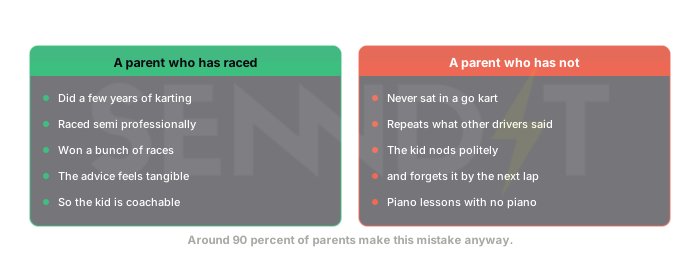
I would say 90% of parents make this mistake. So leave the ego aside. After a bad race, stay away from it and let the kid talk with his coach. Because if the parent tries to be the coach, what is the coach there for?
More on this in the driver-parents relationship and in how parents should support a young driver.
How do you choose a go kart coach?
15 or 20 years ago there wasn’t really such a thing as a karting coach. Now there are many. Some have done a few races here and there. Some have never raced at all. I see mechanics becoming coaches out of nothing.
So my prerequisite is this: he must have been a racing driver himself. If you pick a coach who has never driven, it’s like picking a personal trainer who has never hit the gym once in his life. He needs to have felt the high pressure races and the driving on the limit. How can he teach it otherwise?
Do a background check on him. And your kid is going to listen way more easily to a coach who has successes in his own background.
Second, coaching is a skill of its own. You may be a really fast driver and not a good coach, because you don’t know how to translate your thoughts into words. With full transparency, I wasn’t that great when I started. The experience helped me a ton.
Third, it’s subjective. You may get along with one coach and another driver may not.
And why do I insist? Because you only raise to the level of the coaching you receive.
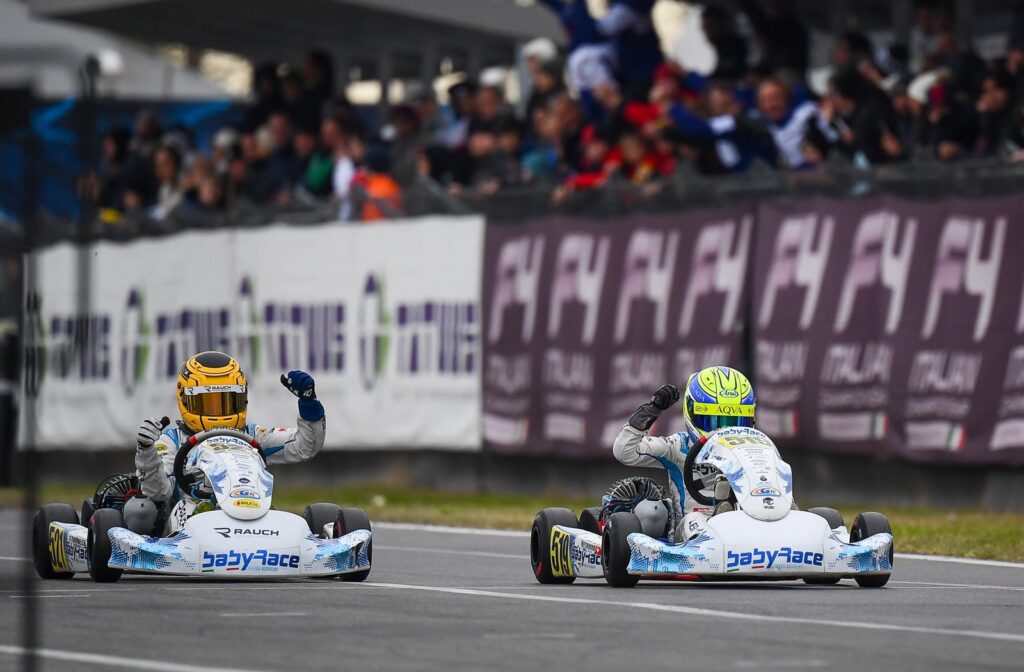
So do the check on me too. I won the CIK-FIA World Championship in KF-Junior in 2013. My head to head with Lando Norris in karting was 18-7. BabyRace took 29 WSK titles and 10 ACI CSAI titles in the last 5 years. And I have coached more than 200 drivers.
On track or remote coaching, which one do you need?
If I started again today, proper coaching is one of the things I would get, because you can really shortcut your learning curve by getting coached by a pro rather than trying to do it all yourself. Either in person or remote.
In person he sees things no logger sees. If you are leaning too far out or too far in. If you grab the steering wheel in the wrong way. Plus the overtaking and the race strategy.
But it’s difficult to get a proper in-person coach. You don’t need just a coach, you need a very good one. So if you can’t find him near you, it’s better to rely on a remote one.
The way I see it working: the remote work goes on the off days from the track, Monday, Tuesday, Wednesday. There you get the knowledge. Then you go to the track and you try to apply those lessons.
You need to know one limit. A video shows the lines and the turning points really well. You can’t really see the braking points. For those you send the data too.
I compared all the ways, on track, remote, courses, sim and AI, in karting coaching compared. And if you are at the very beginning, the beginner guides are free.
Frequently asked questions
How much does a go kart coach cost per day?
A good on track coach costs about 250 to 350 euros per day for the coaching only. With his hotel, travel and food you will be spending north of 500 euros per day.
Do I need a karting coach at every race?
No. If you drive 10 days in a month, 2 days with a really good coach is enough, as long as you use the other 8 days to work on the areas he assigned you.
Can my mechanic be my coach?
Sometimes. Some mechanics are experienced enough to give good coaching, and mine pushed me with one advice every session: brake later. But bad coaching is worse than no coaching, so judge if he knows what he is talking about.
Can a parent coach their own kid in karting?
Only if the parent has raced. A kid does not listen to driving advice from somebody who has never done it. In my experience about 90% of parents make this mistake.
Is online karting coaching worth it?
Yes, when you can’t get a very good coach in person. An onboard video shows your lines and turning points well. It does not show your braking points well, so send the data too if you can.
How can I coach you if you are not at my track?
I do it remote, in two ways. Both are mine and both are paid, so you know.
Onboard reviews. You send me your onboard video, any track. Within 48 hours I send you back a full video breakdown, corner by corner. It’s 99 euros per month for one video review. With the telemetry on top, from an AiM, an Alfano or a Unipro, it’s 249 euros per month.
The six months program. One live group call of 60 minutes with me every week, plus a library of more than 550 lessons. Maximum 25 drivers at a time. It’s for drivers who already compete at regional or national level. It’s 299 euros per month for 6 months, so 1,794 euros in total.
The coach is not going to drive for you. But you will know what to work on.
If you want me to look at your driving, send me a video for an onboard review. If you want the weekly call, join the 6 months transformation.
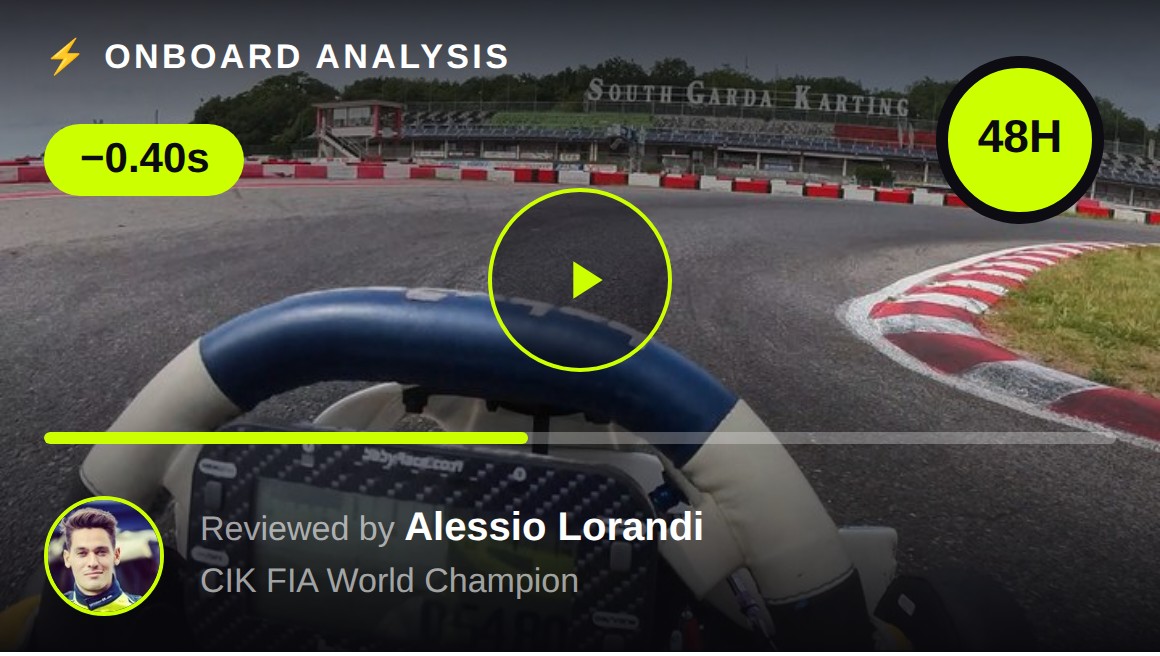
Send your onboard footage. Alessio reviews it corner-by-corner and tells you exactly what's costing you time, and how to fix it. Back within 48 hours.
Get My Onboard Reviewed → Reviewed personally by a CIK FIA World Champion, never an assistant.I promise I'll not spam you with repurposed shitty AI content but real experiences that only I, Alessio Lorandi, experienced. Written in my funny English-Italian tone of voice 😂
Alessio Lorandi is the former CIK FIA World Junior Champion, winning against Lando Norris in 2013 & F3 multiple race winner. He's helped 200+ karting drivers worldwide get faster & win WSK titles with BabyRace Driver Academy & now through Senndit, his online karting coaching platform.