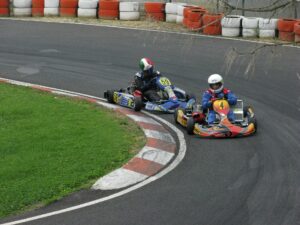
Kart Hand Position: Where to Hold the Steering Wheel
Where I keep my hands on a kart steering wheel, why more effort gives you more control, and why I want the steering wheel tilted forward.

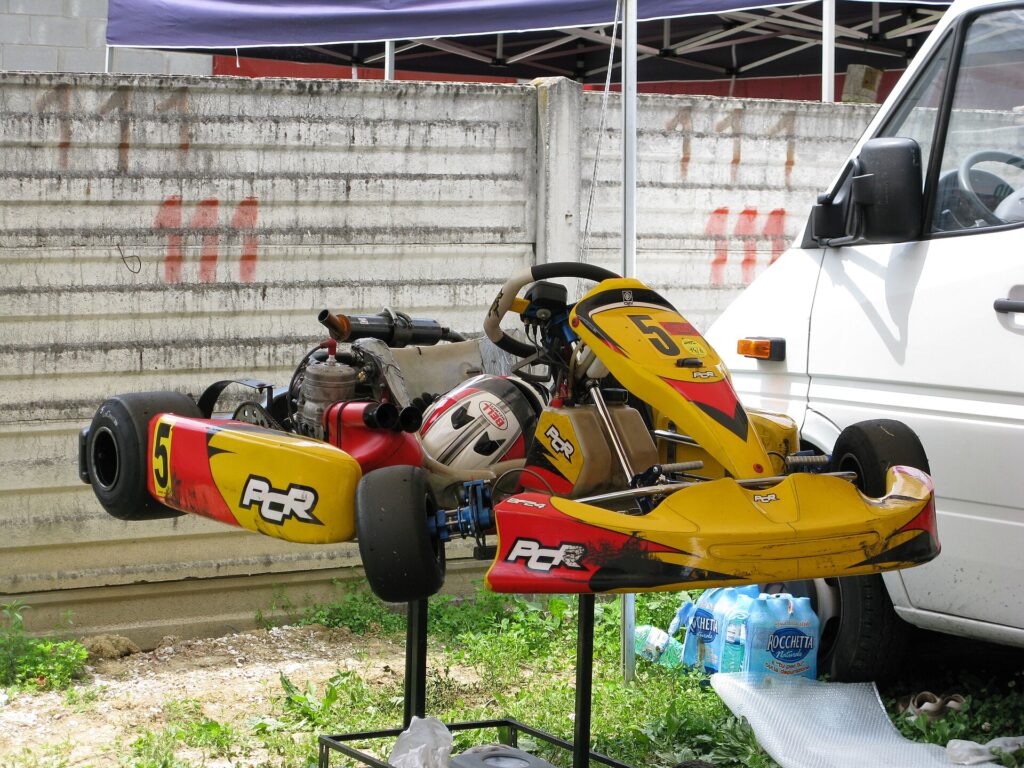
- Hands at the centre of the wheel. In height, I mean. 9 and 3, not too high and not too low. That is also where your hands are the furthest away from each other.
- Less effort is not what you want. With the hands too high or too low the steering asks for less force, and a small force is very hard to control. The kart gets twitchy.
- Tilt the steering wheel forward. With a wheel that is perfectly straight you cannot push with the outside hand. You can only pull with the inside one.
- Beginners keep the hands too high. Mostly adults, because that is what they were taught on a road car.
- Give it more than one session. A new position feels weird at first and asks more from your arms. Don’t try it before a qualifying.
- Check it on the onboard. I look at my hands on video to see if I push with the outside hand or pull with the inside.
- What is the ideal hand position on a kart steering wheel?
- Why do beginners hold the steering wheel too high?
- Why is less effort on the steering a bad thing?
- Where did I keep my own hands?
- How does the steering wheel inclination change your driving?
- How long does it take to get used to a new steering position?
- How much should you turn the steering wheel in a kart?
- Does the grip level change how you steer?
- What do aggressive hands do to the kart balance?
- How do you check your hands on video?
- Do the grip on the wheel, the gloves and your fitness matter?
- Frequently asked questions
Does it matter where you put your hands on the steering wheel?
I get asked this all of the time. And a lot of drivers don’t know what each position does, or if it does anything in the first place.
It does. Where you hold the wheel, and how the wheel is inclined, decide how smooth you can be with it. So in this guide I go through both, and through a few steering habits you can check by yourself.
I already wrote about why the kart steering is so sensitive, and about pushing with the outside hand, in smooth is fast. I will not repeat that here. Read it first if you haven’t.
What is the ideal hand position on a kart steering wheel?
You are probably not going to like the answer, because it is a boring one. The most ideal hand position is the central one.
What do I mean by central? In terms of height. You don’t want your hands too high and you don’t want them too low. 9 and 3, like on a clock.
Why there? Because at the centre you have a balance between too much feedback on the steering and too little feedback on the steering.
And it is also where your hands are the furthest away from each other. That is a good thing. You don’t want them close. The further out they are, the more control you have.
If you are a beginner and you don’t have a favourite position yet, start there. Perfectly centred in height.
Where you hold the wheel and how it is inclined both change how smooth you can be with it.
Why do beginners hold the steering wheel too high?
Most drivers who get started keep their hands too high. Especially adults who have been driving a road car for years.
Because when you do your driving licence they tell you to keep the hands fairly high. I still remember that day. I was like, are you serious? I felt like a truck driver. During the practical exam I just did as he said. After that I went back to my hands nicely centred, on the road as well.
But it’s not only beginners. Look at a grid. You will see that the drivers of one team often keep the same hand position, almost like the team wants them to. Some teams have their drivers with the hands very high. Some have them very low. It’s quite funny when you see it.
So who is right? In my opinion none of them. The ones who are right are the ones who keep the hands at the centre.
Why is less effort on the steering a bad thing?
This is the part that sounds wrong when you hear it for the first time.
In my experience, when your hands are too high or too low, you need less effort to turn the steering by a certain amount. When they are at the centre you need more.
And you would think, great, less effort, that must be a good thing. I believe it’s the opposite. You want the position that asks for more effort.
Think about it. If very little force is needed, then every little bit of force from your arms moves the steering a lot. Maybe you correct a slide. Maybe you are just a bit too strong in that moment. And the steering input is already too much, and with it the weight transfer.
Let me make an example. I don’t know how many newtons of force you put on a kart steering, so the numbers are random. If the steering only asks you for 2 newtons, it’s very difficult to control the difference between 2 and 3. If it asks you for 20, you can work between 20 and 25 much more easily.
So with more force you have a larger window of control. With very little force the window is narrow, and it’s very easy to make mistakes and to be inconsistent.
And karts don’t like that. They don’t want fast and sudden weight transfers. A twitchy and unstable kart is something nobody wants.
| Where your hands are | What the steering asks from you | What you get |
|---|---|---|
| Too high or too low | Less effort from your arms | A narrow window of control. Every small force changes the steering a lot. |
| At the centre, 9 and 3 | More effort from your arms | A larger window of control and the hands the furthest away from each other. |
The second reason is the hands themselves. You want them symmetrical and as far away from each other as possible. That is what gives you less rotation on the steering, and so a smoother steering.
Yes, more force is more tiring. Then it’s just up to you to hit the gym more often.
Where did I keep my own hands?
In KZ I placed them perfectly at the centre, 9 and 3.
In juniors and seniors I was not perfectly there, to be honest. And I don’t really know why. Maybe it was better for me in that moment.
Nowadays when I drive a shifter I use my hands perfectly at the centre and it just feels great. I would never try to keep them at the top. It would not feel natural to me, and I feel it would not be fast.
So I’m not saying this is one size fits all. In some tracks and in some conditions another position can work better. And a lot of drivers have their own favourite position and they will stick to it.
But where does it matter the most? At international level, where the grip is very high and you have to be very smooth on the steering. There you want the lowest rotation possible on the steering and, counter-intuitively, the highest amount of force from your arms.
How does the steering wheel inclination change your driving?
It affects it massively. And it’s the part almost nobody thinks about.
Imagine a steering wheel that is perfectly straight. I mean perpendicular to the ground. How can you push with the outside hand? You can’t. It’s impossible.
And that is a problem, because the best drivers are the ones who control the kart by pushing with the outside hand rather than pulling with the inside one. When you pull with the inside hand it’s so hard to keep the steering smooth through the corner. It makes the rear overreact.
So my priority number one is to have the steering inclined to the front. Quite a lot. You almost feel like a truck driver. Yes, the same truck driver I didn’t want to be on the road.
It may feel funny. But it lets you push much more with the outside hand, and the inside one barely does the work.
There is a trend nowadays. A lot of drivers run the steering very straight. I understand why. It may feel good in the moment, because you need less effort from your hands. You see others doing it, you try it for one session and it feels good. In the long run I feel it’s a bad decision.
When I look at pictures from the past, mine as well, the steering was so inclined to the front.
And you may say, but a Formula 3 or a GT3 car has a perfectly straight steering wheel. True. But there you cannot push with the outside hand. You can only do 50 and 50, left hand and right hand. The car has been designed that way, and the chassis dynamics of a car and of a kart are completely different.
We are not reinventing the wheel here. This has been tried and tested by many drivers, and it’s how we work at BabyRace.
How long does it take to get used to a new steering position?
More than one session. That is the mistake. Drivers try it once, it feels weird, and they give up on it.
And it will feel weird. Once you tilt the steering forward you need more force from the outside hand and less from the inside one. I don’t know exactly the physical theory behind that, I have to be honest. I only know what it feels like.
Stick to it. After enough laps and enough days on track it becomes automatic.
But choose the moment. If you considerably change the steering position, or even only its inclination, right before a qualifying session, you pay for it. No matter how good and experienced the driver is, he will lose some time compared to when the steering was in his usual place. The steering position has zero direct effect on the performance on track. But the drivability is not the same anymore, and you don’t change your driving style that fast.
So this is how I would do it.
- Put your hands at the centre of the wheel in height, 9 and 3.
- Tilt the steering wheel forward, so that you can push with the outside hand.
- Do it on a practice day. Not before a qualifying or a race.
- Expect it to be more tiring for your arms, and give it more than one session.
- Check the onboard to see if the outside hand is pushing.
The steering also has to fall where you would place your hands naturally. Not too far, not too close. I talk about that in how to become one with your kart.
How much should you turn the steering wheel in a kart?
Very little. Much less than you think.
Being too aggressive with the steering wheel is one of the major mistakes I see from beginners. Adults more than kids. Most adults drive a road car, and that makes them feel like they should turn the wheel as much as they do there. Kids don’t have that idea in their head, so they adapt a bit earlier.
And how long does it take to learn to drive smoothly? I believe it takes a lot of time, because drivers normally overreact with the steering wheel.
There is also a sign you can use. If you need a lot of steering angle in a corner, you are probably not carrying enough speed into it. Because the more speed you carry, the more rotation you get. And if the kart is not rotating, you end up turning more.
The why behind all of this is in smooth is fast, and the rotation part is in go kart weight transfer.
Does the grip level change how you steer?
Yes. The more grip there is, the smoother you have to be.
On an owner kart you need even less steering than on a rental one. The frame is stiffer, the kart is lighter and more powerful, and the grip level is higher.
And at international level, where the grip is very high, the steering has to be very, very smooth.
In the wet it goes the other way. You see how much more steering wheel you have to use compared to the dry, because you are struggling for front all the time. I go through that in driving in wet conditions.
What do aggressive hands do to the kart balance?
They make you blame the setup.
You want to be super aggressive with the brakes in the slow corners, and super smooth with the steering. Many drivers get it the wrong way round. They are very smooth with the brake pedal and very aggressive with their hands.
What happens then? Oversteer. The kart feels like it’s sliding, and it feels like it is set up badly. But most of the times it’s the driver who makes it slide.
There is a big but subtle difference between a kart that is sliding and a driver who is making the kart slide. So before you ask your mechanic for a change, look at your hands.
If the balance really is the problem, read understeer vs oversteer. And the throttle is its own topic. I wrote about it in why going on the gas too early is bad.
How do you check your hands on video?
When I review my own onboard I start from the lines. If my lines are right, then I look at my hands.
I try to see if I’m pushing nicely with my outside hand or if I’m pulling with my inside hand. And of course I try to fix that too.
On video I can also see if I’m using too much steering input and I have understeer, or the opposite, if I have a snap of oversteer as soon as I turn in.
And here is something you can try. Put two drivers in the same kart, each one with his own hand position and his own steering inclination. On the data, and even on the video, the hands and the balance look totally different. And you cannot say it’s the chassis. It’s just where they place their hands.
Where they place them comes from who taught them. So I feel teams, coaches and mechanics have a massive responsibility in that.
Do the grip on the wheel, the gloves and your fitness matter?
They do. My hands and feet need to feel planted all the time.
It takes 2 minutes and about 10 dollars to add a tennis grip on your steering wheel. Make sure it doesn’t create too much thickness, and keep it clean. Once it’s worn out and doesn’t feel sticky anymore, replace it.
Same thing for your gloves. Once their grip is gone they are basically useless. And they should fit quite tight. Not so tight that they block your blood flow, but not so loose that you have no feeling on the steering wheel. More on that in the karting gloves guide.
Then your body. Lean back on the seat, nicely relaxed. A lot of drivers lean forward, almost like they are on a motorbike. It’s not comfortable, and it creates so much tension on your body and so many mistakes in your driving.
And fitness. What is the number one mistake I notice when a driver is not fit and starts to get tired? He gets abrupt and dirty on the steering wheel, because he cannot control it very well anymore. Maybe by the third or fourth session of the day. So if your hands get worse through the day, the answer may be in endurance training.
- More on driving technique: the technique guides.
- Want me to look at your hands? Send me your video for an onboard review.
- If you want to go all in: the 6 months transformation.
Next time you are on track, look at where your hands are before you leave the pits. Then look at how your steering wheel is inclined. And if you have any tip on hand position, let me know. I would like to learn something new every day.
Frequently asked questions
Where should my hands be on a kart steering wheel?
At the centre of the wheel in terms of height, 9 and 3. Not too high and not too low. That is also where your hands are the furthest away from each other, which gives you the most control.
Is it bad to hold the kart steering wheel high?
In my opinion yes. With the hands too high you need less effort to turn the steering, and that makes it very hard to be precise. Every small force from your arms changes the steering a lot, and the kart becomes twitchy.
Should a kart steering wheel be straight or tilted?
I want it tilted forward. With a perfectly straight steering wheel you cannot push with the outside hand, and pushing with the outside hand is what keeps the steering smooth through the corner.
How long does it take to adapt to a new hand position?
More than one session. It feels weird at first and you need more force from the outside hand. After enough laps and enough days on track it becomes automatic. Don’t change it right before a qualifying.
Why do I use so much steering angle in a kart?
If you need a lot of steering angle, you are probably not carrying enough speed into the corner. The more speed you carry, the more rotation you get, and the less steering you need.
Send your onboard footage. Alessio reviews it corner-by-corner and tells you exactly what's costing you time, and how to fix it. Back within 48 hours.
Get My Onboard Reviewed → Reviewed personally by a CIK FIA World Champion, never an assistant.I promise I'll not spam you with repurposed shitty AI content but real experiences that only I, Alessio Lorandi, experienced. Written in my funny English-Italian tone of voice 😂
Alessio Lorandi is the former CIK FIA World Junior Champion, winning against Lando Norris in 2013 & F3 multiple race winner. He's helped 200+ karting drivers worldwide get faster & win WSK titles with BabyRace Driver Academy & now through Senndit, his online karting coaching platform.