Smooth Is Fast | How To Become The Smootheest Driver On The Grid
You probably heard quotes like smooth is fast or useless steering wheel. I mean, all of these things are correct technically, and they all reflect …

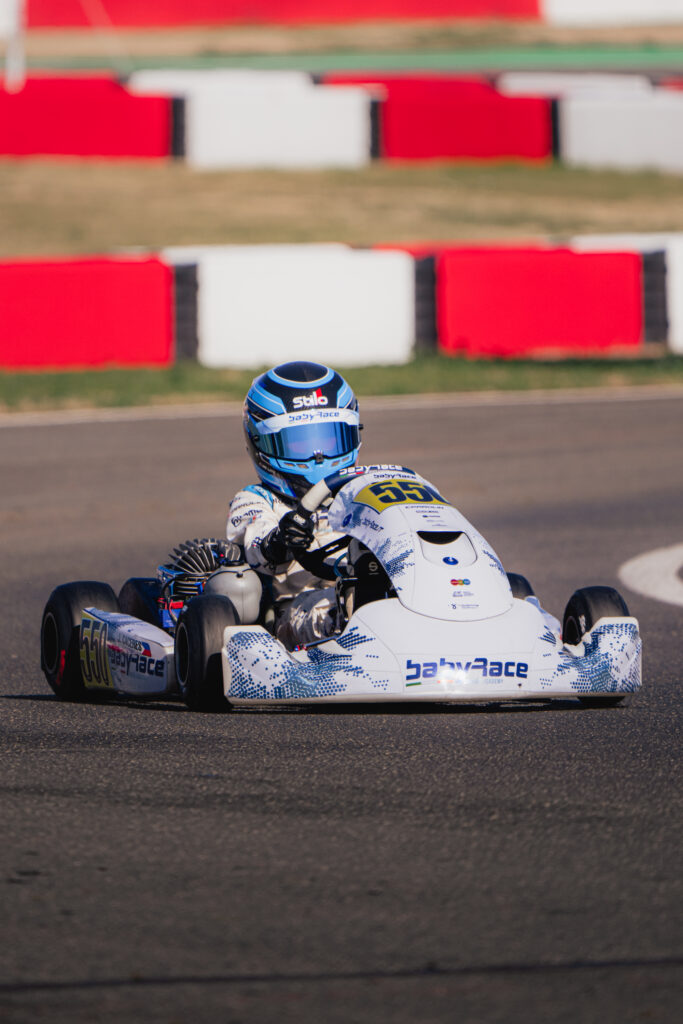
You probably heard quotes like smooth is fast or useless steering wheel. I mean, all of these things are correct technically, and they all reflect the fact that steering inputs are essential. I mean,
- A kart steers 1:1. A road car is 12:1 or worse. Every degree you add arrives instantly.
- Steering angle is a brake. Waiting on the exit with lock applied costs speed even in a 52 horsepower shifter.
- Never reach maximum lock — past a point Ackermann turns the outside wheel the wrong way.
- Fix it on entry, not exit. A later apex and proper rotation mean less lock when it matters.
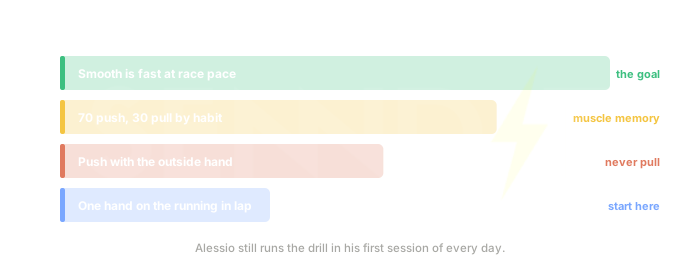
- Push with the outside hand, roughly 70/30. Pushing is controllable; pulling is not.
- Use the running-in lap as a drill — one hand only, pushing. It rebuilds the habit every session.
- Every degree of steering moves weight diagonally across the kart. That is why smooth is fast.
- Why steering matters more in a kart
- Why a car can never be this sharp
- What a road car feels like after a kart
- One to one versus twelve to one
- Every input is amplified
- Never use maximum lock, even in the wet
- But you said rotation was good?
- Steering angle is a brake
- I felt it in a 52 horsepower shifter
- What the setup can do about it
- Front geometry is the real lever
- Steer ratio and Ackermann are not the same thing
- The golden rule
- Push with the outside hand, do not pull with the inside
- Seventy percent push, thirty percent pull
- The one-hand running-in drill
- Put the kart on scales and turn the wheel
- Weight transfer works diagonally
Why steering matters more in a kart
in karting, it’s way more important than in cars, I would say, because the point about karting is that the steer ratio and like front geometry, it’s so aggressive on the front, it’s so sensitive. That’s the right word. The steering of the kart, it’s so sensitive. I mean, it’s crazy. If you think about the road car. I mean, when you drive a road car, you are using a lot of steering input, you know, from you know, especially when you have to park or when you have to take tight hairpins, you have to use basically maximum steering input, right?
So you have to basically turn the wheel so much in order for the car to turn. So the steer ratio is just completely different. In karting. You have so much sensitivity, so much responsiveness from the front. Because, yeah, just the steer ratio, by the way, the steering column and steering rods and Ackermann effect, which comes from the position of your steering column as well as the position from your spindles.
So all of this from geometry, again, connected by your steering column, your steering rods and your spindles. They all have a huge effect on the reactivity that you know you cannot get on a road car or even on a Formula car.
Why a car can never be this sharp
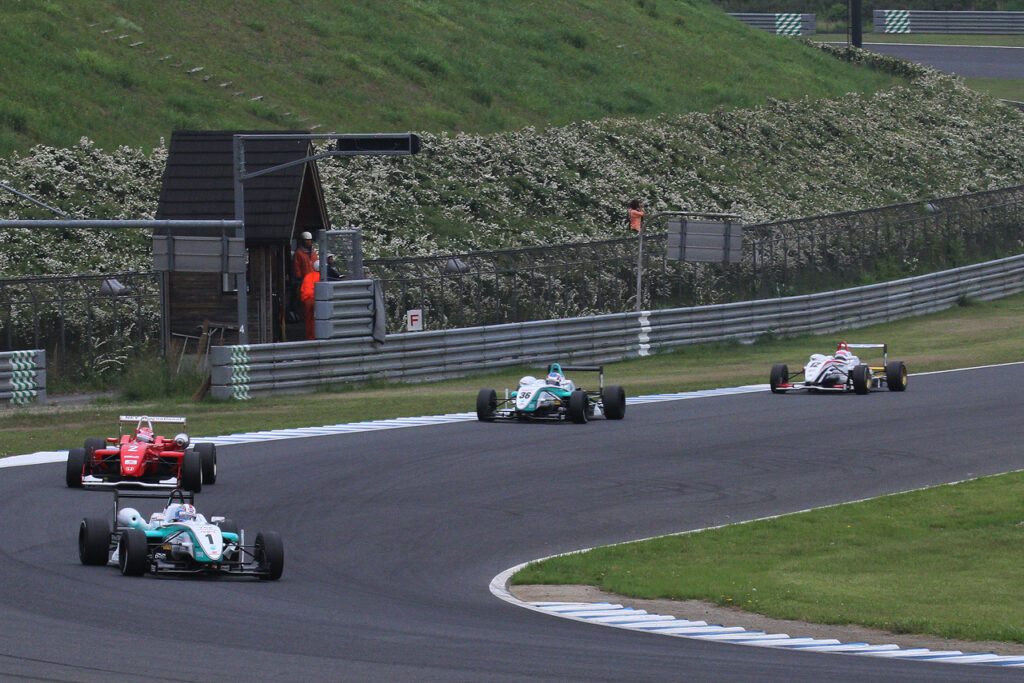
Now you may get setups in cars that can give you a very pointy front but sometimes, well, most of the times, it’s not even that useful. Because, you know, if you try to drive a car with that much preciseness as a go kart, you will probably spin more than than not. And imagine driving a road car, even imagine right driving a road car with the same sensitivity on the front steering inputs that you have on a go kart.
I mean, it would be crazy, right? For sure, somebody should make an experiment about that. Maybe we should ask Mr. Beast to do that. But, you know the for sure. I mean, the sports cars, like, you know, Lamborghini, Ferrari, etc, they have a very, you know, sporty version, where it’s, you know, very stiff where, you know, there’s a lot of aerodynamics, but also the front is quite nice and sharp.
What a road car feels like after a kart
The other day, I was driving the car of my girlfriend, and it was, Oh, my God. I mean, the front was completely zero compared to my car. I mean, I mean, I have a 2013 Land Rover. And, I mean, it’s not bad, but it’s not like he has the most responsive front. But her car, it’s like a very, very old Mercedes, but like a very, very old one.
Like, I can’t remember the model, but yeah, the whole point was, like, when I tried her car, I was like, Wow, this car is no front at all. Like, there’s no precision. There’s no front. I mean, it just felt like, really, the steer ratio was wrong. I mean, it just felt like the whole steer ratio was just like, tuned down and, I mean, it was obviously, it makes a car safer to drive, in a way.
I mean, until there’s a certain limit, of course, because if you have to change direction really quickly, because you have to avoid something on the road, it’s going to be more actually unsafe than, more than more safe. So Well, I mean, that’s also another thing. But let’s get back to the karting world.
One to one versus twelve to one
Did you know that the steer ratio of a go kart is 1:1, so one degree of steering input equals one degree of wheel turn, whereas for road cars, it is about 12 to one, or even 15 to one. So for 12 degrees of steering input, you get one degree of turn from the wheels. So it’s massive difference. 12 to one, basically compared to one to one.
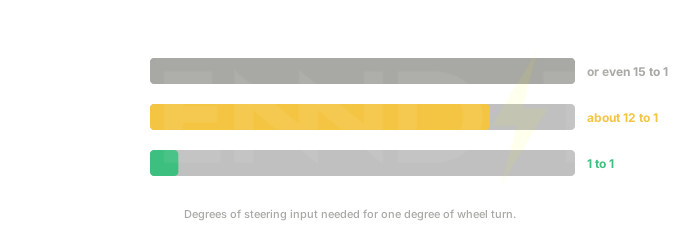
And you can affect that in setups. You know, on iRacing, or on any sim, of course you can change that. In real karting, there’s, there’s a way to kind of affect that again, to to change the position of your steering column, and again, from your spindles. But again, I don’t want to make today a master class on setup tuning for your steering what I wanted to really talk to about today is how and why steering inputs are so crucial in karting, and how you can set faster lap times and win races in karting by learning how to take advantage of these very, very precise steer ratio, which is one to one again, compared to the 12 to one from cars.
So that’s the thing you have to remember, whenever you’re driving a go kart,
Every input is amplified
every single input is amplified massively. So especially if you are, you know, coming back from cars, and you’re driving a road car, and, you know, you can’t apply the same sort of, same sort of steering angle on a go kart. It’s just impossible. If you get to have that steering angle that you have on the road car. There’s something wrong.
I mean, even in the wet, which is required way more steering than in the dry,
Never use maximum lock, even in the wet
you still don’t want to turn Max, because there’s like, you know, with the Ackermann effect, at some point when you turn too much, the outside wheel actually, instead of turning in the right direction, starts to turn in the opposite direction. So it’s actually going to make you turn less rather than more. So you never really want to get to max steering in the wet, let alone in the dry.
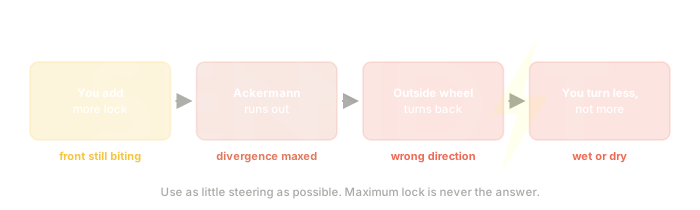
So the goal is to really use as little steering as possible. You don’t want to end up using too much steering, because that’s yeah, just going to, first of all, I mean, make the the car very snappy, very overreactive, and it’s going to create unnecessary slides. And you said, Oh, Alessio, but. You know,
But you said rotation was good?
in other in other episodes or articles you talked about the importance of creating rotation. Yes, it’s very important to create rotation, but there’s a limit. You know, if you have too much steering in the middle of the corner, you’re just gonna keep sliding the rear, and you’re just gonna start to induce, like, like a vicious cycle of corrections of oversteer slides, and that’s gonna make your basically, corner more and more of a nightmare than if you were super smooth.
So, yeah, it’s super important to be extremely, extremely smooth with your inputs and karting. That’s just the principle. I mean, just super smooth, the smoother the better. And ideally, your kart is set up in a way that there’s a lot of rotation and there’s a lot of front rotation and rear rotation that allows you to not use too much steering wheel.
Because, again,
Steering angle is a brake
the point is that the front is acting as a brake. Remember, every time, even in shifters with 52 horsepower, I have the same experience. You know,
I felt it in a 52 horsepower shifter
I was racing at Franciacorta last year for the world championship, and I was preparing myself in the testing. But also when I was racing, I remember that whenever I had understeer, I could see that the speed was picking up less in the exit of the corners. I could see that if I had to wait with more steering in the exit of the corner, my my speed, my exit speed, wouldn’t pick up as well as if I had, you know, way better rotation and way better, you know, yeah, rotation in mid corner, essentially, and less steering angle.
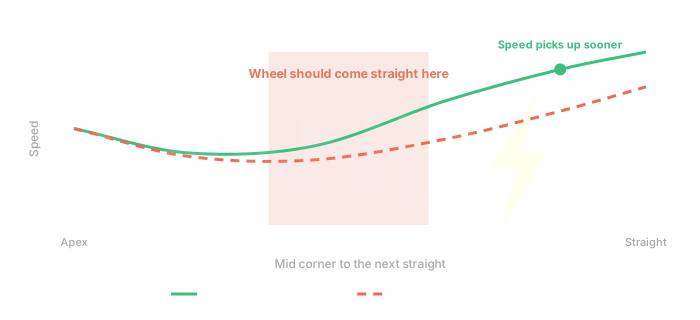
And even in a shifter kart with 52 horsepower, I was feeling like, you know, with gears, and I was having gears, and I could still feel that effect of understeer, the deadly effect of understeer. And so when I saw I was like, Wow. I mean, it’s really so bad to to have understeer, even in in a KZ like that.
So I was like, you know, if that’s again, with a 52 horsepower, the fact I feel it and I see that I lose speed on the data whenever I have too much steering angle on the exits because I have understeer, then it’s really a priority for all the other categories as well, especially for the lower power cars like mini or juniors, that the steering angle on the exit has to be straight back as soon as possible.
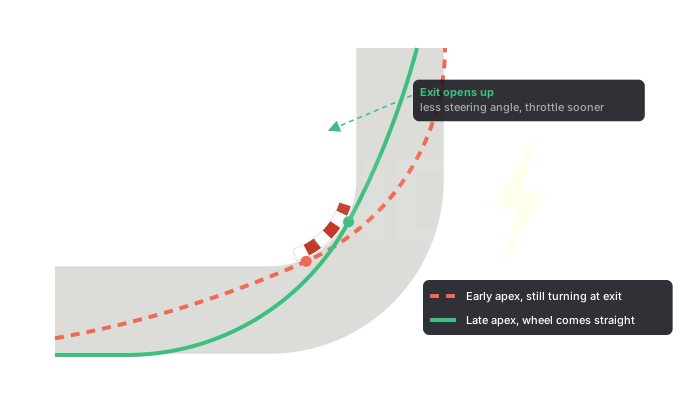
But again, you do that by make sure that you do a proper con on the entry and making sure you get the proper rotation on the entry. But also in terms of setups, it’s not just what you can do with the car in terms of driving, it’s also what you can do with the setup. And so yeah, that’s the number one thing you know, you can affect the kart with, with your driving for sure, making sure you get later apex.
If you want to have less understeer on the exit, you got to have a later apex. And you got to have, you know, a driving style that rotates the car nicely on the entry to mid corner, so on the exit you have less steering angle.
What the setup can do about it
But obviously the second thing you can use is the setup. You can change the setup with your mechanic, with your team manager, and making sure that you have more front rotation and more rear rotation as well, The simplest thing is to move the seat forward by 1.5 centimetres – that alone dramatically affects the rotation of your kart by doing so and, and so, yeah, that’s one thing, but remember that
Front geometry is the real lever
the front geometry is really what’s going to make a difference. So it’s not just the seat or just, you know, where you can change the axle, yeah. Well, those are important, but the front geometry is very, very important. And remember, yeah, as we said, the steer ratio is very direct, but you can affect the steer ratio. You know, you can change the steer ratio by tuning the steering column.
In 60 Mini with BabyRace, we have found a solution to basically tune the the steering column exactly as we want it. We can make it extremely aggressive, or we can make it extremely smooth, and we can really fine tune the steer ratio and the Ackermann as much as we want, even down to half a millimetre. And, you know, by the way,
Steer ratio and Ackermann are not the same thing
steer ratio and Ackermann are not the same thing. They, you know, I’m going to explain them in a different in a different article or episodes. But basically, the Ackermann basically control more the behaviour of the two wheels, and not just the steer ratio. The steer ratio is just how direct the front is based on the the input of your steering from the input to your wheels.
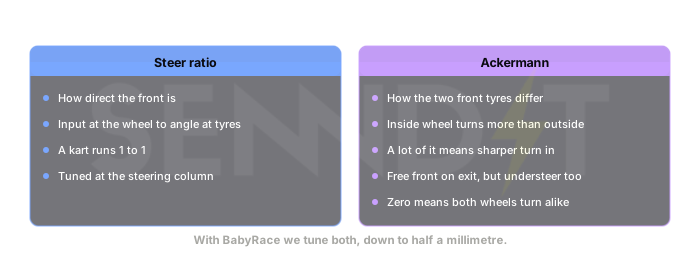
But the Ackermann effects basically controls whether the two front tyres act together, or whether there is more divergence. So if there’s a lot of Ackermann effect just I’ll tell you real quick, so that’s at least you have an idea with the Ackermann effect, basically, you are creating more divergence between the fronts. So for example, when you’re turning to the right, let’s say the inside wheel is going to turn more than the outside wheel.
If you have a lot of Ackermann, if you have zero Ackermann, let’s say the two wheels are turning exactly the same way. So okay, if you have a lot of Ackermann, the initial turning in is more but on the exit it’s more smooth. So there’s like, it’s like, yeah, it’s less scrubbing. Okay, let’s say there’s like the outside wheel is not really pointing the same direction, as well, as much as the inside wheel.
I don’t want to make it too complicated, but yeah, that’s really it. You know, if you have a lot of Ackermann, you get more initial turning in, but then the exit is very free. Let’s say the front is very free exit, but equally, you may have quite a bit of understeer in the exit if you have a lot of Ackermann.
So that’s why we like to play around with it. And we like to tune it based on the session conditions and and also on the track and the driver’s style. So you can always tune that up with the setup. And you should ask your mechanic or your team to give you the option to change that Ackermann effect as well as the steer ratio.
I just want to remember
The golden rule
the golden rule of karting, which is smooth is fast. You just have to stamp it, print it, tattoo it on your arm, whatever. Just make sure that you remember this. Smooth is fast, and you need to remember it. Also, another very important thing. If you want to be smooth in a corner, you need to make sure you you are
Push with the outside hand, do not pull with the inside
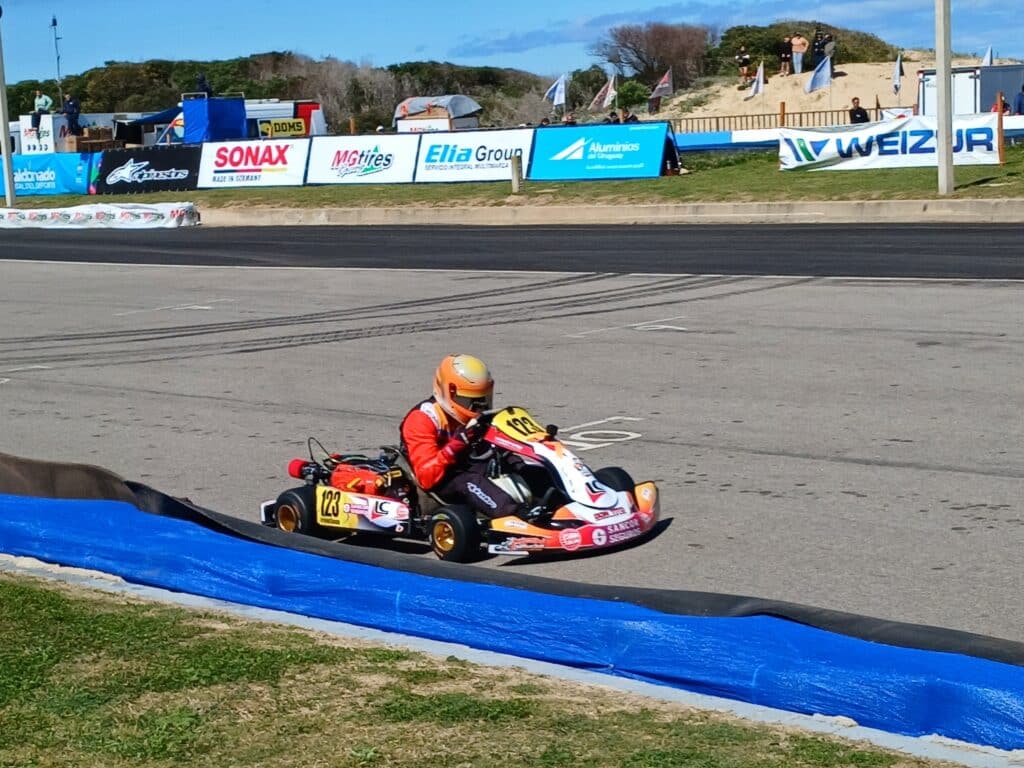
pushing more with your outside hand, rather than you’re pulling with your inside hand. So this is a very important concept. You don’t want to pull with the inside hand. You have to push with the outside hand. So if you’re going, for example, to a right hander, okay, it’s a fast corner, let’s say, let’s say, Turn one at La Conca.
If you know that track, it’s in South of Italy, and we, by the way, going to race literally next week, for a championship round with BabyRace. And I was re watching the videos, and the fastest drivers, you can tell they’re pushing with the outside hand rather than pulling on the inside. So it’s basically you are trying to push and put more effort with the outside hand.
So let’s say, if you’re in a right hander turn one, let’s say at La Conca. It’s a flat out right hander. So essentially, instead of pulling with the inside hand, which would be the right hand, you are pushing with the outside hand, which is the left hand. And you would basically try to push and try to keep the steering straight and use as little steering as possible.
Because again, if you drive with a high front grip and rotation, because again, there’s a difference between front grip and front rotation, but I’ll talk about this another day. But if you drive with a lot of front, let’s say, and the rear is nice and loose. You are going to need very little steering input, especially at the fast corner, because there’s not like the weight transfer on the rear.
We have to wait for that. No, it’s like, very smooth. You got to be very, very smooth. And you have to push with the outside hand. This is very important. So if you want to be smooth,
Seventy percent push, thirty percent pull
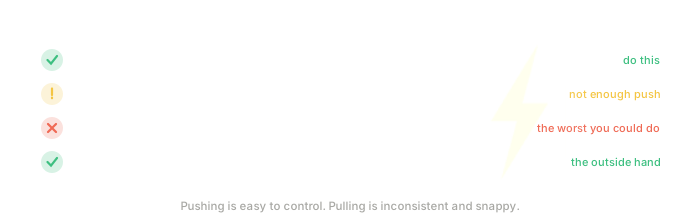
instead of doing 5050, let’s say, use the hands in the same way, or worse, 6040, you know, 60 pulling and 40 pushing, which is the worst you could do. The best thing to do is to do, like, 70 push and 30 pull. So you have to, like, try to push with the outside hand and pull 30% with the inside hand.
And to do so,
The one-hand running-in drill
I’m gonna give you a secret right here. I probably shouldn’t be doing it because it’s really very effective, and I feel it is something I should probably keep to myself at BabyRace. But you know what? I’m gonna reveal everything here. So if you want to become very smooth and do this push instead of pull technique, you gotta when you are running in the engine, you gotta basically learn how to just drive with one hand.
So essentially, you need to swap. This is a drill. This is an exercise. You gotta make sure you do it okay. And every time you’re running in the engine. Next time, I instruct all the time my drivers to do this. So basically, I get the drivers to go out, and instead of pulling with the inside hand, I tell them to push with the outside hand when they’re running in the engine.
So they’re going around the track and they’re just going slow because they have to run in the engine. And instead of just like driving clueless, I ask them, instead to make this exercise, which is helping them so much, and again, which is push with the outside hand. So they go, for example, to return one again, which is a right hander.
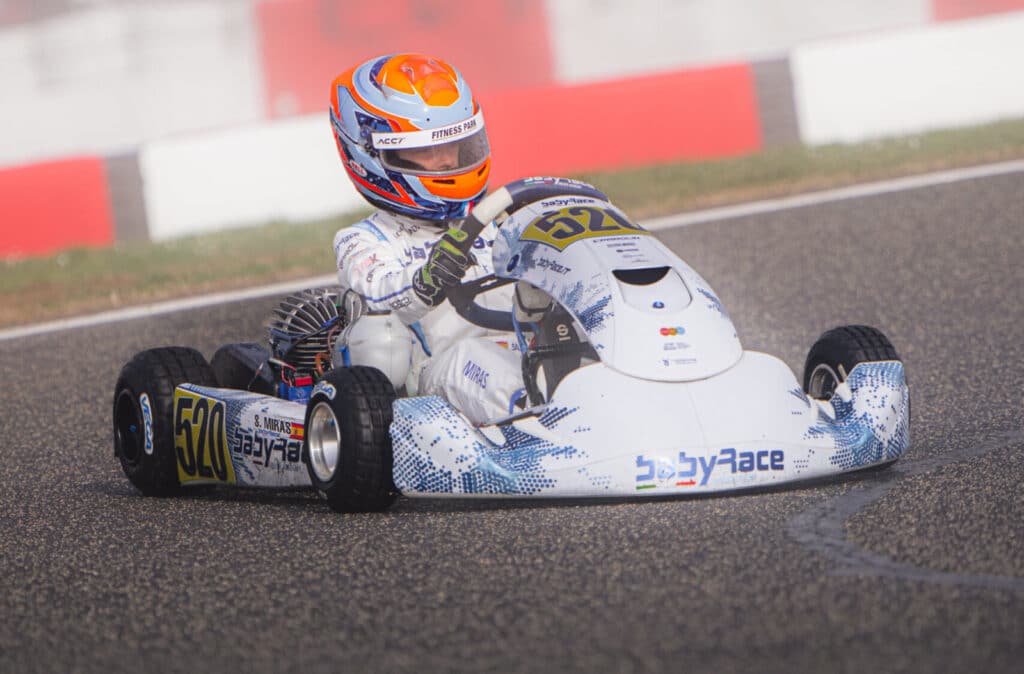
And they go, and they just use one hand. They are not even using the other one. They just use the hand that they need to push. So I call it the one hand running in technique. And it, I’m telling you, works wonderfully well. I still do it every day, every time I do my first session in the morning when I have to running the engine, or maybe I have to, like, just bed in the new pads or something.
So when I go out, I just use one hand. When I go through the corners, of course, I still have to change the gears, but then I go into the middle of the corner, and I just use one hand. And you will notice how little the kart is going to turn, because you are so used, you know, to pull with the inside one.
And so you’re like, Oh, the car is not turning. But that’s why you you want that. You want basically, the outside hand to do most of the work, because the outside hand, when you push, it’s way easier to control the steering than when you pull, when you pull, it’s going to be very inconsistent, and it’s going to create too much response on the wheels, and there’s going to be too much response.
And you don’t want that. You want to have the correct response which is balanced, so you have to do this. And I see really a massive benefit, even in myself, because, you know, you never have to stop doing this. It’s not something you do it once or twice and then you’re done. No, it’s something it works so well for me, like I am 27 years old, and I still feel the need to do it, because it’s muscle memory, and it’s just a very good exercise, just a very good thing you can do, and it just trains you to and reminds you to just be smooth and pushing with the outside hand rather than pulling with the inside.
So if you want to be smooth on the track and have very smooth inputs, which makes your driving smoother. Because remember, you have to think that whenever you turn the wheels, whenever you are essentially turning wheels, you are effectively changing the weight transfer from, you know, the fronts to the rears, the inside ones to the outside ones.
Put the kart on scales and turn the wheel
Have you ever tried to put the kart on a scale? So if you ever put the kart on a scale, on four scales, basically, you will see that if you put the car on the scale, and then you put the driver, and then you turn the steering wheel, you’ll see that the first weight, okay, goes to the inside wheel.
So if you’re turning to the right, the first like the major like, the weight shifts on the inside for a little bit. Okay, the weight shift on the inside like, so you’d say, instead of having, let’s say 30 and 30 kilos, you get a little bit more kilos on the inside right. So let’s say it goes up to 35 and the outside one is losing some but just for the first few degrees.
Then once you turn more. Okay, the weight shifts to the outside. The weight shift to the outside so you but the thing is that it works diagonally. So when you are basically turning to the right, okay, you are essentially the first few steering angle degrees. You are loading the inside tyre with more weight, but also in diagonal, you are loading the outside left tyre right, and you are unloading the inside rear, and you’re unloading the outside front.
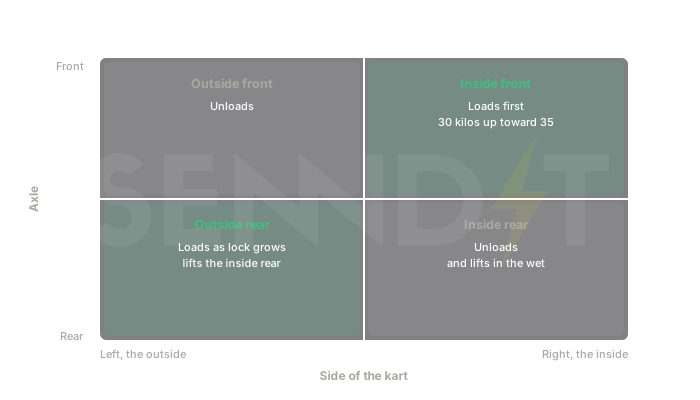
It works like that and and
Weight transfer works diagonally
that’s why, in the wet, when you are turning a lot and there is a lot of leverage on the front, you’re basically, yeah, you just like shifting the transfer from the outside, the inside to the outside, especially you’re loading a lot the rear outside tyre, which again, is going to lift up the inside rear wheel easier. But again, this all starts from how much steering angle you apply.
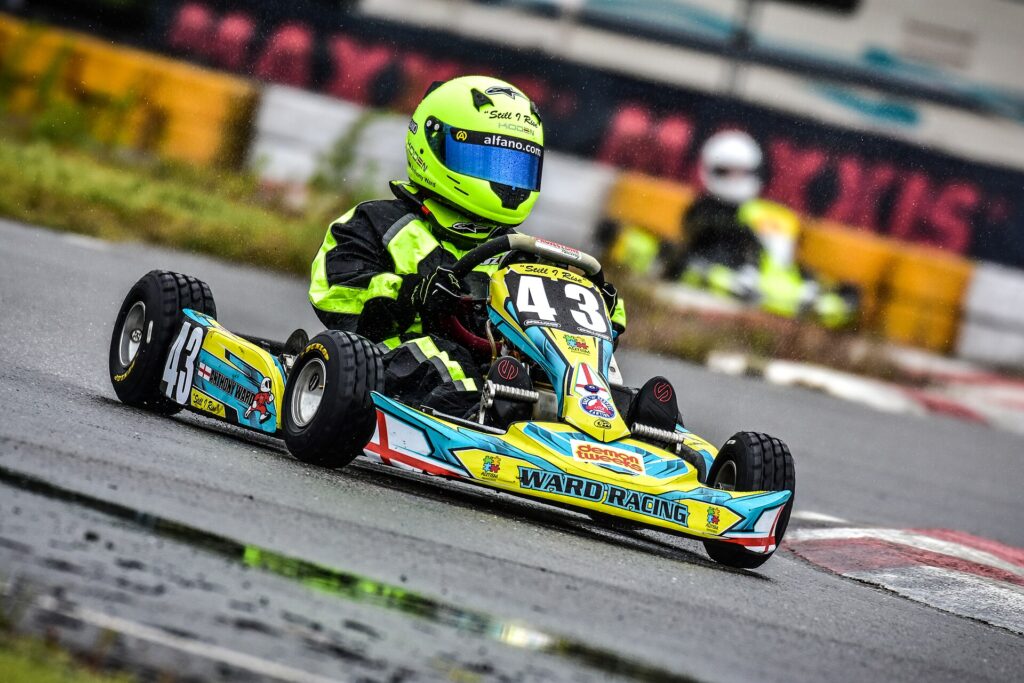
And you don’t want to apply too much steering angle, because you’re gonna massively affect the the weight transfer from, you know, inside to outside, from front to rear, etc. So remember, every time you turn the wheel, you’re not just turning the wheel, you’re you’re essentially massively exchanging the weight transfer from one side of the car to the other, from one axle to the other, so from front to rear and from left to right massively.
And remember, it works diagonal. It really works diagonal. And this is something you have to remember and take into account. So if you want to learn how to get smoother inputs, make sure you do that exercise. I revealed it’s I’m telling you very powerful. You will see it’s just something that I got told and I got taught, and ever since I started doing it, I just became super smooth, and that worked amazingly well.
And now I’m transferring that same knowledge to drivers of BabyRace. Nobody else in the track is doing it. Nobody else in other teams or paddocks I heard are doing it. And now I hope I can spread the word about a new habit that is going to create the next generation of Formula One drivers. And make sure you DM me on Instagram with your progress.
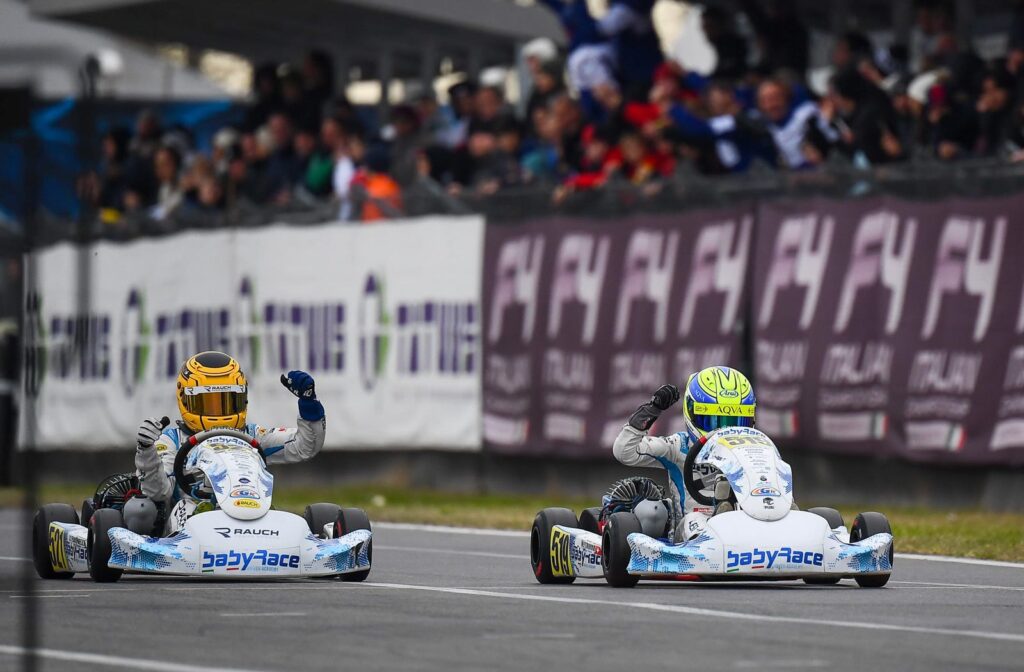
I’ll be very happy to hear from you. So make sure you ping me there. But also, if you want to find lap time for your next race coming up, make sure you sign up to my onboard video analysis service, where I can really help you to find lap time by analyzing your onboard videos and send it back to you with a full analysis.
If you instead, want to have like some one on one, mentoring and counseling, for whatever reason, you can sign up to that as well. Make sure you keep sending it and I’ll see you. Ciao.
Related: mastering smooth inputs, understanding weight transfer, and the rotation masterclass.
Send your onboard footage. Alessio reviews it corner-by-corner and tells you exactly what's costing you time, and how to fix it. Back within 48 hours.
Get My Onboard Reviewed → Reviewed personally by a CIK FIA World Champion, never an assistant.I promise I'll not spam you with repurposed shitty AI content but real experiences that only I, Alessio Lorandi, experienced. Written in my funny English-Italian tone of voice 😂
Alessio Lorandi is the former CIK FIA World Junior Champion, winning against Lando Norris in 2013 & F3 multiple race winner. He's helped 200+ karting drivers worldwide get faster & win WSK titles with BabyRace Driver Academy & now through Senndit, his online karting coaching platform.