Karting Setup Masterclass | Beginner to PRO
Imagine you’re fighting for a championship. You are at the last race. Perhaps you’re second in the championship, and you just need that…

Imagine you’re fighting for a championship. You are at the last race. Perhaps you’re second in the championship, and you just need that extra bit of points to clinch the title, whatever title you may be. But let’s suppose that you’re heading into the final after doing the qualifying the heat, and you feel like you are struggling with a little bit of understeer.
And yes, you may be like, okay, you know, I’m gonna let my mechanic do the magic. I’m gonna let my team manager do the magic. But the reality is that if you the driver, don’t have a clue about what setup is going to affect on your kart, what kind of setup adjustments are going to affect on your kart, you are always going to be, let’s say, betting on your team and betting on your mechanic.
But again, the reality is that
- The driver has to understand setup too. Otherwise every change is a bet you are placing blind.
- No front? Caster first, then front track width. Both help lift the inside rear.
- Grip and reactivity are different things. Reactivity lives at the front; the rear only has more grip or less.
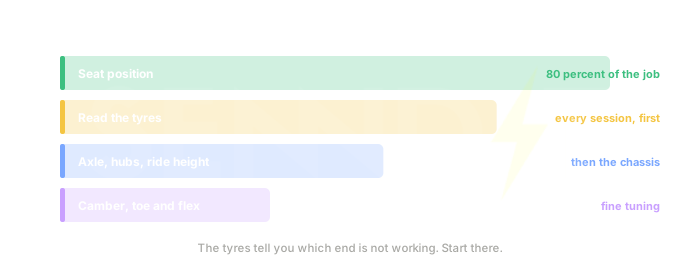
- Seat position is 80% of the job. Get it right and everything else is fine tuning.
- Slightly forward beats slightly back. Harder to drive, faster, and it teaches car control.
- A kart has no suspension. The frame is the spring, and the tyres are the only thing touching the ground.
- Always start with the tyres. Graining, temperature and wear tell you which end is not working.
- Half the paddock will tell you the opposite about axles. Test it yourself and trust what you measure.
- Why the driver has to understand setup too
- What my mechanic taught me to notice
- Missing front? Start with caster and track width
- Grip and reactivity are not the same thing
- Setup is your responsibility too
- Piero, and three years of trying everything
- Karting is full of myths
- The axle debate
- Soft axles in the wet, or not
- When the counterintuitive answer is the right one
- Can AI set up your kart?
- Seat position is 80% of the job
- Why I always sit slightly forward
- A kart has no suspension – the frame is the spring
- Start with the tyres, always
- Reading graining
- Camber and toe
- Ride height, front and rear
- Seat stiffness and floor tray flex
Why the driver has to understand setup too
if you knew what every single component of your car did, or in terms of setup at least, you wouldn’t, for sure, be able to increase your chances of success by giving the right feedback to your mechanic, but also to already have an idea of what kind of setup adjustments you would need to do. And this is really what helped me a lot.
What my mechanic taught me to notice
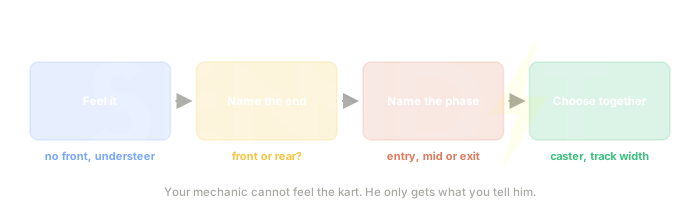
My mechanic didn’t just ask me what I needed from the car. He also taught me how to, you know, change setups in terms of, like, what I needed to do, what we needed to do whenever we had a specific setup issue. Let’s say, if I was struggling with understeer, it wouldn’t just ask me to tell him where slow corners or fast corners, entries, meets or exits.
He wanted me to be very specific, and, you know, actually help him understand, oh, is it like a front related issue, or is a rear related issue? Because, you know, most of the times the driver needs to feel that it’s hard for the mechanic to understand exactly whether the issues on the front, which maybe, in this case, if you have understeer, you may have too little front, or the rear, which you may have too much rear if you have understeer.
So the driver needs to really have an idea of what each of the components do to the car. I just really generally feel that, and while the driver has to do his own driving exercises and really try to figure out ways to unlock lap time, which is, again the key, what the driver has to work on. But the reality is that the driver also needs to really understand what the setup you know of the car is doing, and how he can change the setup together with the mechanic based on his feedback.
Missing front? Start with caster and track width
For example, if you feel like the front is missing and it’s just not enough front grip and not enough rotation, there’s few things you can tell your mechanic. Well, first you can tell him, Hey, mate, I just don’t have enough front and and if you have a high collaboration relationship with the on with your mechanic, where you take the responsibilities together with him, and not just let him take the responsibilities, you could be like, You know what?
Let’s try to, you know, add more caster, all right? And that’s the first thing you could do. I mean, if you don’t have many shots, and you have to just go for it in the race, and you just have to take one decision, and hopefully that’s gonna make you win the championship. Well, I mean, you better know exactly what you’re talking about, and that’s why you need to practice in the in the training sessions and training days on figuring out also what sort of setup adjustment is going to do to your balance, to the grip level.
So if you’re again, in that scenario where you’re like, oh, I need to take a some I need to take a decision, to find the way to find lap time by, you know, in this case, we had understeer. So what we’re gonna do, if the driver knew exactly what the issue was, it would be like, you know, okay, let’s add more front caster.
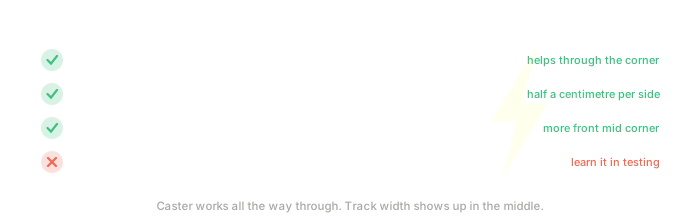
Well, you can only add casting the front. What am I saying? Yeah, let’s add caster. And also we could, for example, widen the front track width. So instead of, let’s say, being 98 centimetres, I’m talking about mini numbers. Instead of going from 98 centimetres, we go to 99 so we go half a centimetre wider per side, there you go.
Send it. For sure, you’re going to have more front in the middle of the corner, and the caster is normally going to help you all the way through the corner. And by doing so, you will have normally more likelihood of lifting up the inside rear wheel, both with caster, more caster and with, yeah, with front, a wider front track width.
But then there’s many other things. For example, if you talk about fronts, you know,
Grip and reactivity are not the same thing
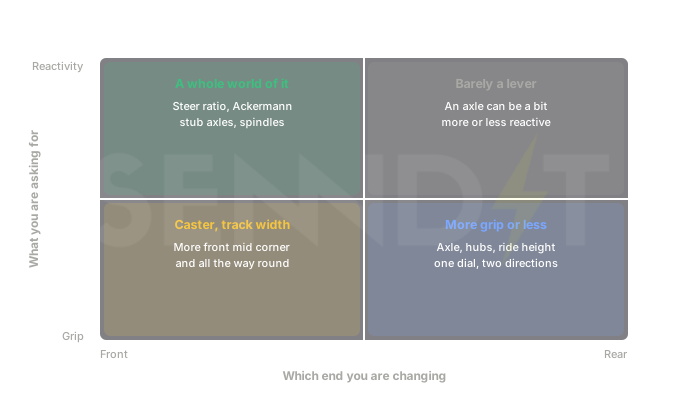
there’s a whole world of things you could do to the front to increase the reactivity or the grip, because there’s nothing you know, when you talk about setup, there’s not just about grip, but there’s also reactivity, especially in the front. I mean, you can’t really have reactivity on the rear. In the rear, you can have either more grip or less grip.
Yes, you can have a an axle that is either more reactive or less reactive. But the reality is that the reactivity that you can find is on the front, and that is derived from the geometry of the of the front, so in terms of steer ratio from the steering column, but also from the Ackermann effect from the steering column, and the stub axles, the spindles, you can alter the reactivity with, with all of these things.
And yeah, I have experimented a lot of myself, and I’ve seen many cool hacks to find lap time whenever I needed it. So I now just need to do that whenever I feel X.
Setup is your responsibility too
But my goal for you today is to get you interested in setup tuning, first of all, and understanding that the setup is a responsibility that not only the mechanic and team manager and just generally the team has to take care of, but. Driver too, also in terms of tyre pressures, also in terms of the rear axle. So like you are the driver.

You are feeling it like I remember, I had such a great collaboration relationship with my mechanic,
Piero, and three years of trying everything
my historic mechanic, Piero, from 2012 till 2014 those two, well, three years, actually, we did really good. We won a lot of races and championships. And I remember that we knew each other very well, and he knew exactly what I needed. And I if I felt understeer in the exits of the corners, you would know that I probably had a bit too much front camber, or that every time we tried the front, the front bar of, you know, OTK, and every time we tried to put a round bar, the solid round bar, it would always put me wide on the exits.
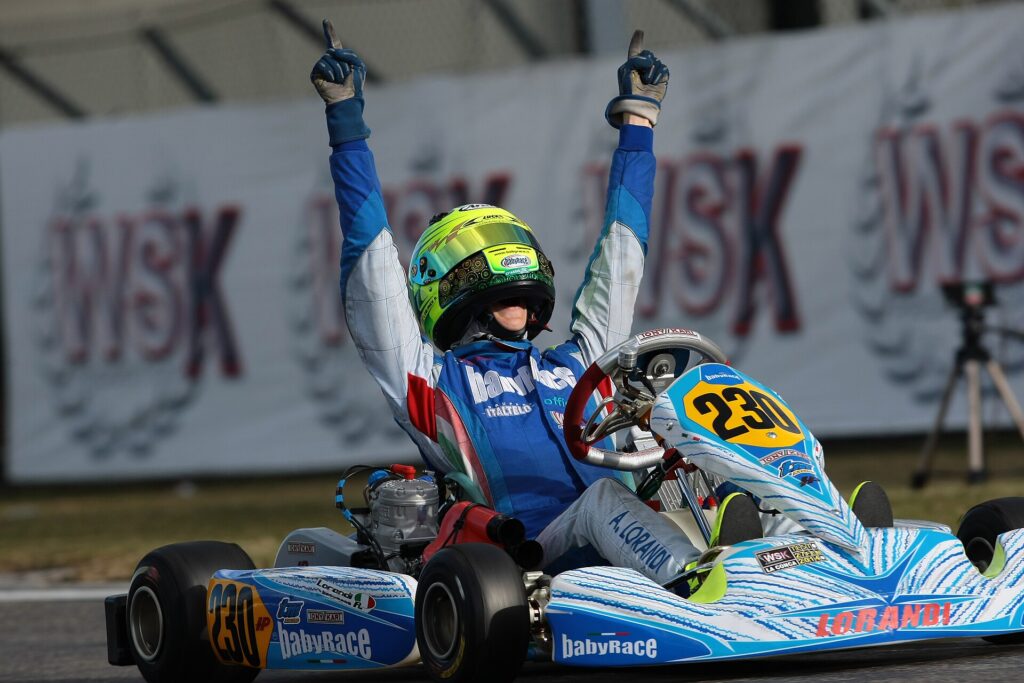
I’d never, never really liked that and, and, yeah, so I just like, I remember I kept telling him, No, I don’t like it. And then it’s like that. Or, you know, we would play around with with the caster. We play around with the rear hubs, with the axles. I remember there were days we would just try axles back and forth, up and down, up and down, from softest to hardest, hardest to softest middle, etc.
So we would try a lot of things, and I developed a lot of, yeah, proficiency with setup tuning. And it helped me ton, and I think that it could help you too, massively, if you just go out there and even generally ask your mechanic, Hey, mate, can you teach me this? Can you explain the how it’s worked? What happens if we change this?
Just like asking, what happened? What happened if you put a bigger hub? What happened if you put a smaller hub? What happens if we change a softer axle? What happens if we go to a harder axle? So I mean, not all the mechanics will be so knowledgeable to teach you that and tell you proper things, because, again,
Karting is full of myths
there’s a lot of myths in karting, to be honest. And I feel, even with our kids at BabyRace, sometimes I am afraid that mechanics may give them some bad information, because, you know, sometimes you grow up with some sort of ideas, with some sort of myths, and unfortunately, in racing like I’ll give you one example, for example,
The axle debate
like the axle debate, there’s many drivers and mechanics that think that a softer axle is going to give you more grip in the rear. And there are other mechanics, coaches and drivers who think the opposite – that it gives you less grip in the rear. So that’s one of the things you’re gonna have. 50% of the mechanics telling you that it’s more grip.
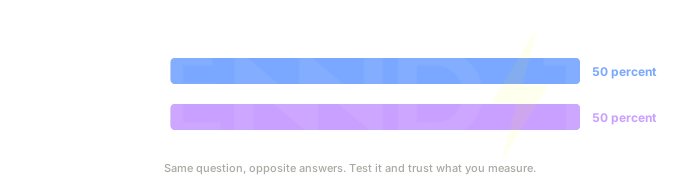
50% telling you it is less grip. Now the reality is that what I felt on myself is that normally, like harder axle has more grip just in the mid corner, middle to the exit, whereas the softer axle has more stability on the entry. Call it stability. I don’t necessarily think it’s grip. I think it’s the grip is coming more from a harder axle overall through the corner.
I’ll be honest with you. But you know, in the wet, you would like,
Soft axles in the wet, or not
Why do you always run with the soft axle in the wet? You know? Because in the wet you don’t care too much about, I mean, yeah, you care about grip. Let me reframe this. But the reality is that in the wet, it’s more about the flexibility, because you want the rear inside rear wheel to lift up and to twist and to go.
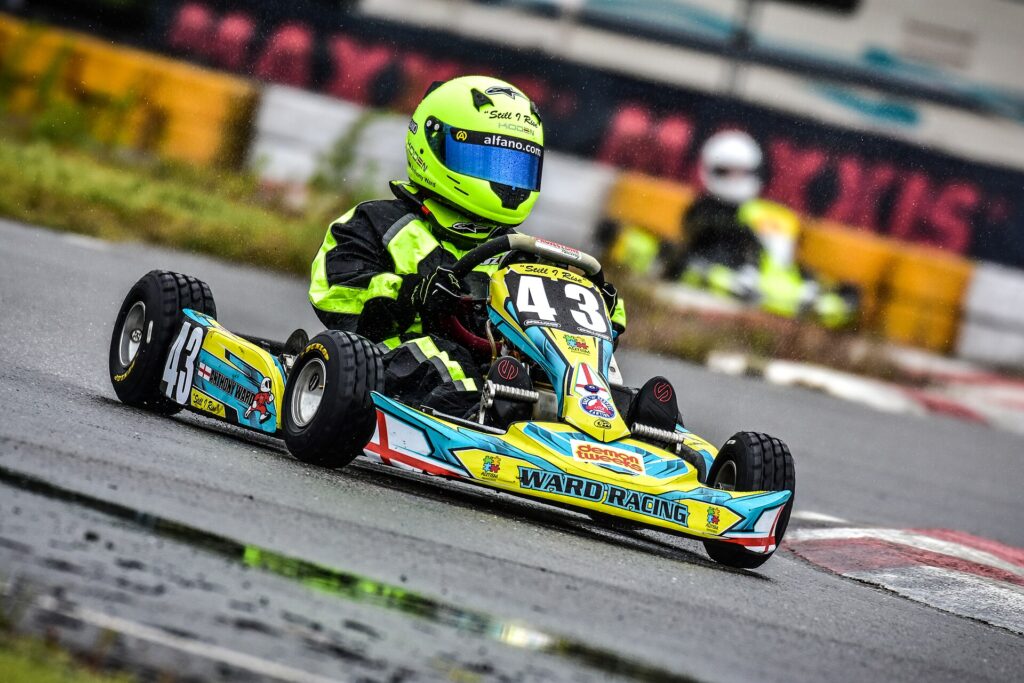
When you go through the kerbs, you know, you want it to twist and lift up. So whenever you go through a, you know, just in the in the wet, for example, you want to make sure that, yeah, the the rear wheel is lifting up, and then you’re able to absorb the shocks over the kerbs, especially with bigger karts like Junior seniors and shifters.
And that is why you go with the softest axle. But I’ve done like, I’ve tried back and forth, soft, too hard in the wet. And I’ll be honest with you, I mean, I just feel like there’s not a huge difference between those. And many times, I’ve been preferring to drive with a harder axle, actually. And I mean going against the common belief, but I won many races in the wet with very hard axles, in some of the biggest races in the world.
So I’ve had that. And I think at the end of the day in the wet you have to be a very, very good racing driver. But still, the setup is very important. But again, you know the goal of what I said about the axles, just to give you an example of why you shouldn’t listen too much about your mechanics, even though, again, you may find a very, very knowledgeable mechanic that gives you the proper feedback and is just telling you the right things.
But yeah, there are many things that, unfortunately, are a bit of a myth and a bit of a down to the ideas of of the mechanic that you are working with. And, hey, I may tell you some something wrong. And there’s also a thing about tyre pressures. There’s also a thing about rims. There’s a bit of a myth in karting.
I have my own ideas, and they’ve been working really well, not only on myself, but also on the team, on BabyRace, but, but, yeah, there’s a lot of myths and setups tuning, but there’s some which are kind of like, yeah, common knowledge, which, of course, as we said, the caster, the seat position, the hubs, the rear, these kind of things, the camber, the front geometry, those kind of things are fixed.
And I mean, not fixed, but, like, we all kind of agree on those things. But yeah, I mean, at the end of the day, it depends a lot from tyres to Tires also, and from track to track. But again, it’s sometimes you may have to do something completely opposite to what you believe. So I know I’ve seen this happening in mini where, example,
When the counterintuitive answer is the right one
when you drive with MGS, it feels like, oh, we should go super high grip everywhere, like front, rear and everything. But the reality is that it seems like it’s worse, because, like, you need to let the car be, Nestle free, all the way through, through the corner, even though it’s quite counter intuitive, because you are driving with very hard tyres.
It is quite strange. But again, it’s coming down to the tyre. If the tyre doesn’t, doesn’t like to be stressed too much when, again, when you put, for example, too much load on it, then it’s actually going to be counter intuitive to put more grip, even though you feel like you’re sliding and everybody is sliding on the track. Sometimes, in karting, it is not really a science as it could be in cars, single seaters, formula, GT3s, etc.
But in karting, sometimes, really, you got to do something that is almost against the theory of what you should be doing. But yes,
Can AI set up your kart?
if you try to do setups with ChatGPT, Claude and AI, it’s going to be not so easy, I would say, to set up the car properly. Yeah, for some things, it will be good, you know, for tyre pressures, for, you know, sit position, and for, you know, some basic things. But when you go in depth and you ask about, I tried it, by the way, and you try to ask about, you know, like the effect of the axles, of the rims, etc, for some of those things, I just feel that, yeah, I think karting is still not, not such a good exact science.
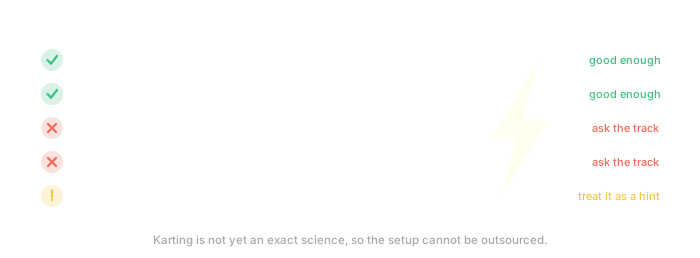
That is going to be very, very easy to just, like, outsource to AI and say, like, tell me what to do with my setup. I have this, this and that I got, you know, no front the rear is pushing. What should I do if you try to do that with AI, maybe sometimes it’s going to give you some good signals and some good advice.
But I feel like, in general, I feel like, unfortunately, karting is still a bit of a myth, and it’s not. You always have to learn something new, for sure, and sometimes, yes, it’s quite upsetting and frustrating because you have to do something opposite of what the theory says. But again, it’s, it’s, it’s just that. I mean, we love racing and karting also for this, right, don’t we?
But remember, yeah, kart setup tuning is just super important. And
Seat position is 80% of the job
the things that affect the setup the most, as I said, is, is, I would say the seat position. I mean, if you are getting the seat position right, you are done 80% of the work. If you are too far in the front, you got probably, like, zero stability in the rear. And while, yeah, you probably have really high minimum speeds, you will probably struggle on traction and on braking, especially.
Why I always sit slightly forward
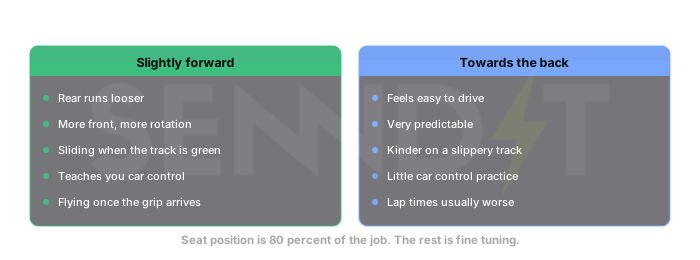
But again, I prefer it to be slightly tilted forward, like, in terms of, like, not tilted, but like, slightly towards the front then slightly towards the rear. I always prefer that. I always say that because it just makes the rear more loose. And you pick a bit more front, and the driver just gets used to drive with a car that’s very, very reactive and has a lot of rotation.
If you are too much in the back with the seat, it feels easy to drive. The car feels very predictable. And the reality is that the lap times are going to be worse, most of the times, unless the track is very slippery or like very green, most of the times, lap times are just going to be slower, man. And the reality is that, yeah, you don’t really learn and practice car control when the seat is too much towards the back.
But yeah, there are many things related to the chassis and setup in terms of chassis dynamics that you have to consider. For example,
A kart has no suspension – the frame is the spring
you have to remember that there’s no suspensions, there is no differential as in cars, and no dampers or springs. So it’s just, it’s just a tube that is flexing, and it’s connected to an axle from the rear. And at the front you got stub axles that are connected to, you know, the steering rods, and they’re connected to the steering column, which is connected to your steering wheel.
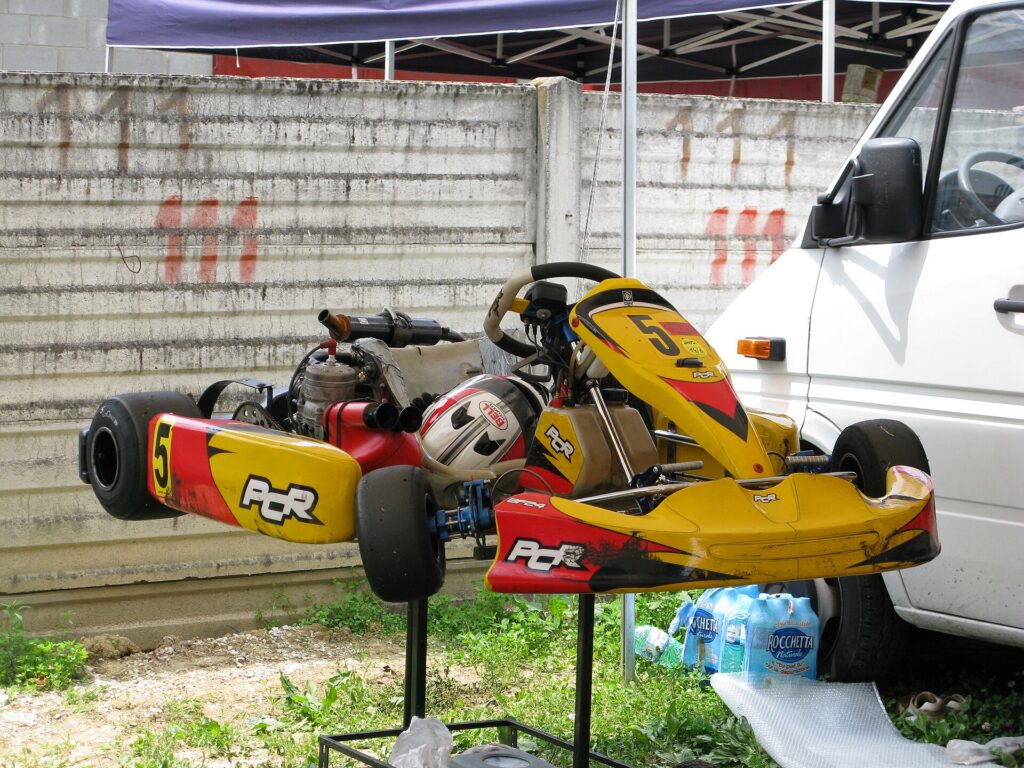
So at the end of the day, what is really touching the ground is still, again, is the tyres, as it’s supposed to be, unless you have anything scratching, which is something you should be looking looking to to avoid, please. You don’t want anything to scratch the ground, because that’s going to slow you down. But, yeah, the tyres are going to be the only things in touch with the ground.
And this is, again, the rigidity of the axle, which is quite key. You got to always look up to what kind of rigidity you should be going for whether you have to go on a softer axle, on a stiff axle. Again, it’s not just a matter of, oh, I got I need more grip. I got a softer axle, which, again, I don’t believe it’s true, especially on the mid exits.
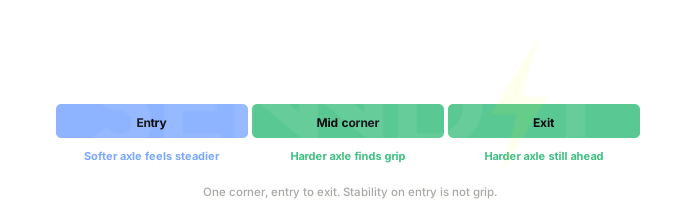
It’s only quite true on the entries, but not mid exits. So I believe
Start with the tyres, always
the priority is always to focus on the tyres. What are the tyres telling us? Are the tyres overheating in the front are the tyres overheating in the rear? You know, based on that, not only in terms of tyre pressure, but also in terms of tyre temperature. Which is more relevant, you can assess whether, okay, I have too much front grip or No, I have too much rear grip or No, maybe I have not enough front I don’t have enough rear.
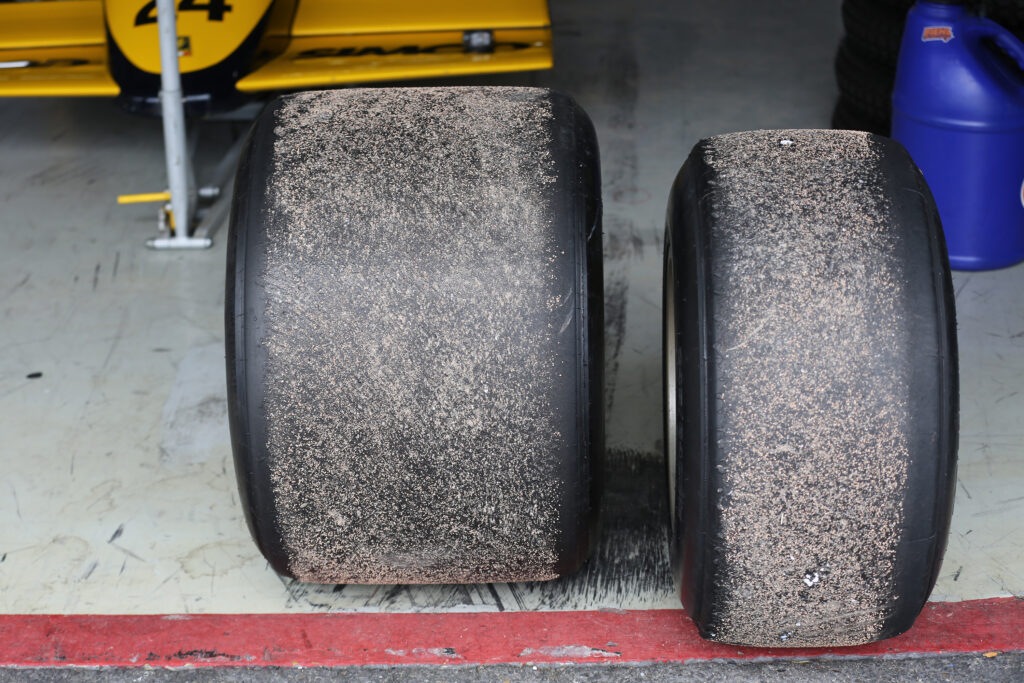
Now, that’s going to be hard to tell by looking at the tyres, but it’s possible to tell by looking
Reading graining
whether the front tyres are grainy. Okay, then probably you have not enough front but if you see that, for example, the rear tyres are still looking very well, very, very well, and the fronts are a bit of grainy. It’s probably because the rear is pushing a bit too much. So maybe we should, instead of adding fronts, you should actually free up the rear, or maybe you should do both.
But again, you should study the tyres. I mean, that’s the practice that I believe is the most useful thing to do, and that’s going to give you an idea else
Camber and toe
in terms of camber, negative camber, whether you have too much and you’re consuming too much the inner edge of the tyre, whether you have too much tow and you’re overheating the front tyres, or whether you just have not enough temperature and you need more negative toe, so toe out, and in that case, well, it’s going to help you out quite well if you do that, but again, it’s going to slow you down slightly on the straights.
So there’s a bit of trade offs you have to do.
Ride height, front and rear
And also, in terms of ride height, what do you want, for example, at the front do you want, you know, more front on the entry? Do you want more front in the mid exit? Well, if you want more front in the entry, you go lower, but then in mid exit, the front is going to be more free if you want to have less entry, but then more mid exit on the front, then you want to have a higher ride height.
And on the rear, it’s also very important to try to find a ride height that’s right for you. Normally, for taller drivers, I always like to go with lower ride heights on the rear. And that’s always seem to work. I mean, in my KZ, I run so low that you can’t go any lower than that, basically I’m almost touching the ground, and I’m, yeah, it’s, it’s like that.
So there’s so many things you have to keep in mind all the time, remember, but always make sure you study the tyres. You have to start from the tyres, and those are going to tell you whether the chassis is not working well enough at the front or not working well enough on the rear, or is working too well at the front and too well at the rear.
Okay, there’s many other aspects you got to consider. There’s also the aspect about flexibility. There’s the reactivity part of there is centre of gravity. There’s a lot of things to talk about. I don’t want to make this too long, but, but there’s definitely a world of adjustments you could be doing on the setup. Again, in terms of flexibility.
Seat stiffness and floor tray flex
You could play with all different sort of seat stiffness. You could also play with the, you know, the flexibility of the floor tray. You can make it stiffer and generate more, you know, let’s say more grip, or more than grip – actually more reactivity. Whereas if you go softer on a very soft floor tray, then in that case, you will make the front less responsive, and it’s going to be a little bit more free overall, and in the changes of direction, it’s going to be less pointy.
But again, it’s not either better or worse. It just depends on the conditions what you necessarily need. I always like to have a front which is nice and pointy, and I play with that on the steer ratio, on the Ackermann and on the caster, but also in terms of seat, I always like to be nice and forward with the seat, even though I will be struggling a lot when the track is green, because I’ll be sliding like crazy on the rear.
But that teaches me a lot about car control. Yeah, it’s just gonna get me up to speed. When the grip is gonna come and everybody’s struggling with understeer, I am going to be flying. So, yeah, I hope this was useful, guys, this was an introduction into setup tuning and basic things about setups and getting introduced in the world of setups for karting.
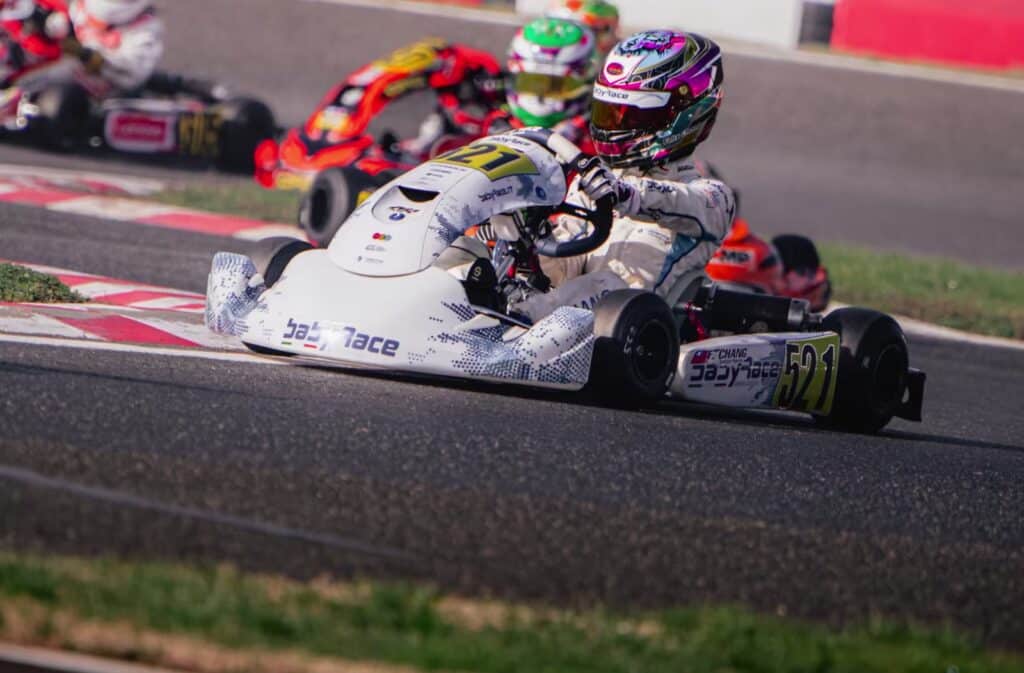
I mean, it’s a long, long topic, and we would need way more time to discuss for this, but I’m happy that you at least get an idea about it and make sure that if you need a one on one conversation with with setups for your specific situation, we can jump on Zoom for a one on one consultation, or if you just need to find some lap time when you’re driving, you can send me your onboard video and I’ll review it.
Besides that, feel free to hit me up on Instagram @alessiolorandi. I’ll be happy to get back to you and get to know you. I hope to see you soon. Keep sending it. Ciao.
Related: soft seats versus hard seats, how a chassis reacts to track conditions, and tyre management over a race distance.
Send your onboard footage. Alessio reviews it corner-by-corner and tells you exactly what's costing you time, and how to fix it. Back within 48 hours.
Get My Onboard Reviewed → Reviewed personally by a CIK FIA World Champion, never an assistant.I promise I'll not spam you with repurposed shitty AI content but real experiences that only I, Alessio Lorandi, experienced. Written in my funny English-Italian tone of voice 😂
Alessio Lorandi is the former CIK FIA World Junior Champion, winning against Lando Norris in 2013 & F3 multiple race winner. He's helped 200+ karting drivers worldwide get faster & win WSK titles with BabyRace Driver Academy & now through Senndit, his online karting coaching platform.