
The 4 Must Have AIM RS3 Telemetry Channels
Hey guys, what’s going on? Today I wanted to show you exactly my four go-to telemetry channels on my AiM Race Studio 3, so you can copy and p…

Hey guys, what’s going on? Today I wanted to show you exactly my four go-to telemetry channels on my AiM Race Studio 3, so you can copy and paste them into your next analysis. Now, we all know that telemetry analysis is super important because it basically unveils all of the hidden places where you’re losing time. I do it every single day, every single session.
Not only when I’m in driving, but also when I’m doing the coaching to the the drivers at BabyRace and I’m, you know, helping them finding lap time, not only in terms of driving uh improvements, but also in terms of setup and engine tuning improvements. So, let’s get into it.
- Speed first, always — but GPS speed is spiky. A rear axle wheel-speed sensor is far cleaner.
- RPM validates the speed trace. If a speed spike has no matching RPM spike, it is a GPS artefact.
- Mid-corner RPM tells you if the driver is bogging the engine down. One sprocket is worth roughly 200 RPM.
- RPM also shows braking effort — how far the revs drop tells you how hard he actually braked.
- Delta time must be distance-based. Time-based will not even display, and some packages compute it wrongly.
- EGT is a legal throttle trace. Where sensors are banned, exhaust temperature still shows the throttle pickup point.
- Throttle release matters as much as pickup, and it is where most drivers are sloppy.
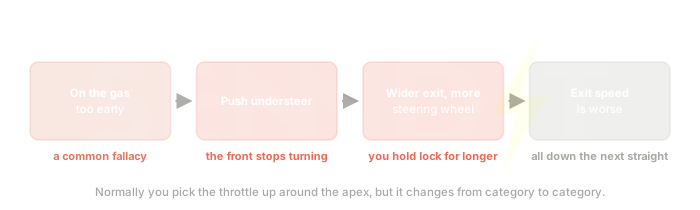
- Earlier on the throttle is not automatically better. Too early and you get push understeer and a slow exit.
- Channel 1: GPS speed
- The one time you can skip speed
- Why GPS speed is spiky
- Wheel speed sensors, front and rear
- Channel 2: RPM
- RPM validates the speed trace
- Reading mid-corner RPM
- One sprocket is about 200 RPM
- RPM tells you how hard he braked
- Channel 3: delta time, which is not a channel
- Set it to distance-based, not time-based
- Not every package computes delta time correctly
- Channel 4: EGT, the exhaust temperature
- Fix the scaling so you can actually read it
- Comparing carburation between sessions
- Why EGT matters most when sensors are banned
- EGT is a throttle trace in disguise
- Throttle release is where most drivers are sloppy
- Earlier is not always better
- The four channels, in summary
Channel 1: GPS speed
The number one channel I obviously include on my on my chart. Basically, this is my AiM Race Studio 3. you know I have multiple uh you know I’ve got multiple profile available one is for the lambda one is for the you know for the web etc. This is on my desktop whereas on my PC on my laptop got like six or seven different oh no I said that all right seven or eight uh different profiles with all different configurations but the number one channel I use in all my profiles is the GPS speed.
Well I guess it’s quite obvious right? I mean, you can check anything, but if you if you don’t have your speed and you don’t know what what kind of speed you’re traveling, I mean, there’s there’s no point looking at anything else. Now,
The one time you can skip speed
in some cases, you may want to you may want to just look at the chassis and you can just, for example, just look at the at the lateral acceleration against, for example, the longitudinal acceleration. So, lateral versus longitudinal G. And you can basically look for example on the on the map you know with the racing lines you can have a look okay you know in this case um you know this is two sessions from the same driver I’m like okay in this session the driver in the green session the driver is able to brake a lot more here in the mechanics corner at Lonato getting up to 0.
83 g against 0.7, into turn three. So you can see these kind of things if you just look at the grip level and you know how much uh lateral G you don’t need the the speed. Well you could actually add it but it’s not necessary but in all the other scenarios I want speed to be there at any given time because without speed basically it’s like uh everything else is um is is meaningless.
But you can see that with GPS speed,
Why GPS speed is spiky
the only thing I don’t really love about any basically any system is that there’s a lot of spikes as you can see like you can’t rely too much on that. Obviously there’s uh you know there’s bit too many spikes and that’s why AiM and other you know and also Unipro I guess and and Alfano they all provide the chance for you to basically add an extra sensor that is connected to your rear axle that basically tells your like wheels spinning speed basically and so you can track with with with very little spikes your yeah you’re just like your wheel speed very very accurately.
You can also have uh so you can have
Wheel speed sensors, front and rear
one sensor on the rear axle and one sensor on the front axle which is you know uh what they do in formula cars obviously you can tell that the difference in terms of speed from the front to rear so you can tell if there’s understeer if there’s oversteer if there’s wheel spin in the rear etc. So there’s I used it in my KZ quite a lot the rear axle speed because it shows you when your wheels spinning or when you’re locking the tyres on the brakes which is impossible to tell from the GPS speed.
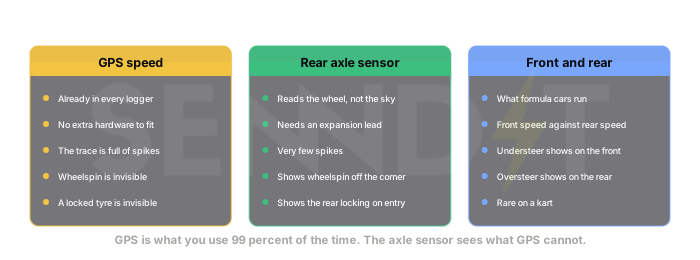
But let’s say 99% of the times you’re just going to rely on GPS speed and just hope that it’s it’s good enough to to not have too many spikes. But remember the GPS speed is important.
Channel 2: RPM
you always have to overlay it with RPM and that’s your second channel that you want to include. RPMs are so important because well, you know, RPMs stands for revolutions per minute. I mean, I hope you um I hope you know what I’m talking about. Basically, it’s that electrical cable that is connected to your um to your basically spark plug um cable.
How do you call that? But yeah, it’s basically connected to the coil and of the spark plug basically. And um it just tells you the revolutions per minute. So you know how how fast let’s say the the wheel is spinning uh per minute and and um yeah I mean for example in in mini this is like a Mini Gr.
3 race at Lonato and I can see that the max RPMs here we can see is 14,200. Uh the minimum here in the corner is like 9,000 there. Um well if we go into very very lowest point. Okay, here’s locking up the tyres and he gets up down to 7,600. Otherwise, it’s like in the middle corner of the second hairpin like 8,100.
Um, so yeah, that’s um um yeah, just in terms of RPMs, the reason why I I want to use RPMs, okay,
RPM validates the speed trace
not only to validate the speed because have a look for example here, you can see that the RPM curve is way smoother than the speed curve. As you can see, the speed curve has a lot of um has a lot of noise, has a lot of uh spikes here and there, which is not ideal. Whereas the RPMs is yeah, it’s quite a bit smoother.
It also has some spikes, you know. Again, it’s it’s very hard to have perfect ones. Okay, you know why is having the spikes though is because it’s like hitting the curb a little bit here also into the first corner. He’s hitting the curb here also in the exit of of turn three, which is the bar corner. And here we have a massive spike because it’s locking the tyres under the braking, which again makes sense.
Um and um and yeah, so you’re going to see occasional spikes here and there, but um but yeah, the great thing about the RPMs is a lot more consistent and a lot smoother in general compared to the speed. And it can always tell you yeah whether whether the speed trace is right or it has like for example here there’s a massive spike in speed but you don’t see equally a massive spike in RPM.
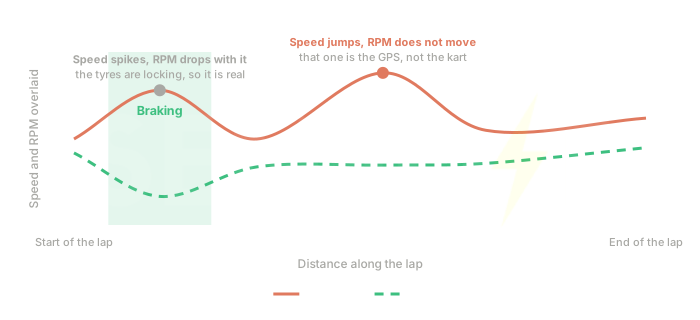
So what it shows is that probably this is a bit unreal you know it went from basically like 92 to like 94 was that yeah it looks like a mice spike but it’s not that much but anyways you can see that it’s not validating the RPM so much. So it’s like okay that must be just a GPS thing. So I use G RPMs a lot, not just obviously to validate the speed.
I mean uh obviously the way I use RPM is to to tell
Reading mid-corner RPM
how much the driver is keeping up the RPMs in the midc corner whether he’s making nice open line or is being the corner too much. You know uh for example this is again the same driver in two different sessions. The red is qualifying and the green is the final. As you can see the there’s a huge difference in terms of minimum speed here in the double left at Lonato and also in terms of RPMs.
It’s it’s kind of validated as you can see in this area we got 10,200 RPMs for the green against 10,900. It’s about 700 RPMs difference and that’s 3 km an hour in this in this corner in this in a specific place. So all the way through the corner the green is doing more of a V. As you can see, it’s attacking more the entry.
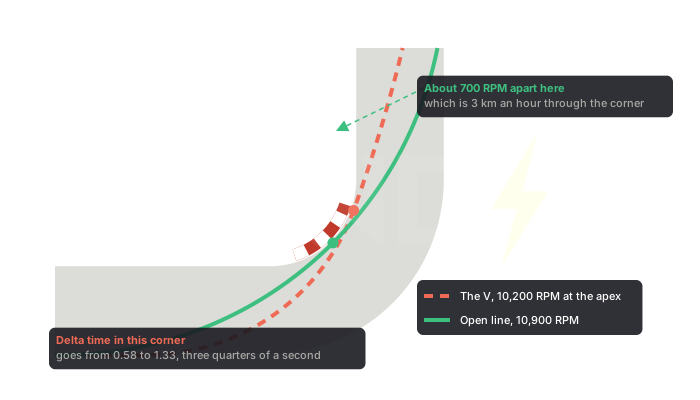
As you see on the entry, it’s going a bit deeper, a bit faster, but it’s stopping too much in the mid. And in terms of delta time, which is our third channel delta time, as you can see, in terms of delta time it goes from 0.58 to 1.33 – about three quarters of a second lost in that corner alone.
And I used RPMs just to to see what I what he was doing basically is that he’s keeping all uh you know about 600 or 700 RPM less which which of course isn’t ideal because you know uh you are basically bogging down the engine. It’s like you feel like it’s like and you know in order to compensate this speed loss in the corner we would have to go up like three sprockets or so because
One sprocket is about 200 RPM
every sprocket difference just to let you know it’s about 200 RPMs. It obviously depends from from a few factors but uh but in this case yeah 200 RPMs. So in this case since we’re lacking about 650 RPMs yeah we would need three sprockets more. So let’s say from 73 to 76. Okay. Uh just to make up the speed loss.
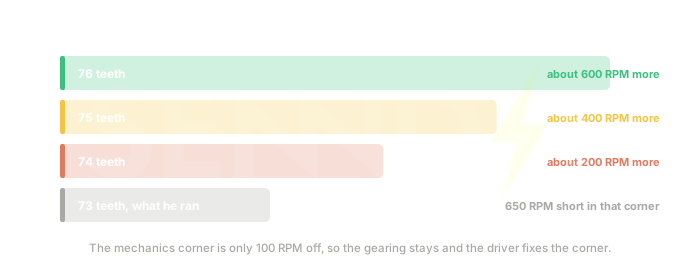
But you can’t do this you know uh for one corner alone. We can’t have you know a different gear ratio just because that corner is bad you know because in other corners is is very close you know here in the mechanics corner the speed is very close just is just like 1 km less 100 RPMs less. And so yeah it wouldn’t make sense to to change the sprockets just for this corner.
So the driver has to fix this corner has to figure out a way to keep up the RPMs more. Maybe doing the corner a little bit more wide open on the entry, you know, a bit more precise at the apex. You see he’s missing the apex in the green. It’s going a bit too deep, missing the optimal racing line.
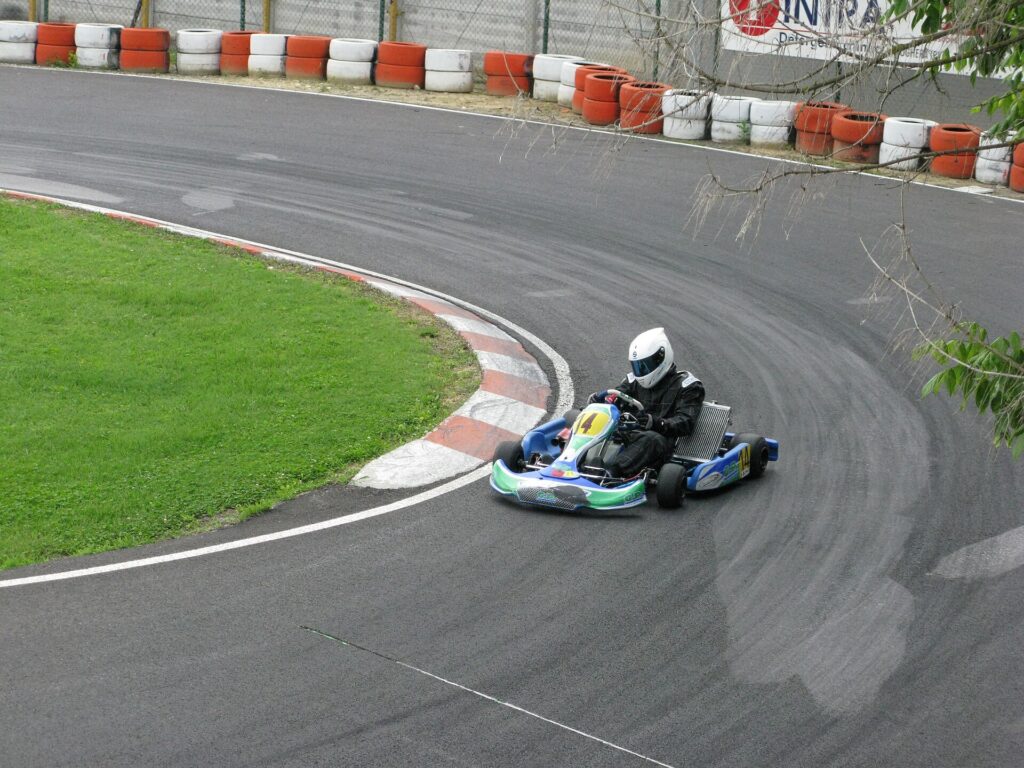
Okay. And on the exit he is not opening the steering enough either. So it’s it’s yeah, for sure with the RPMs you can see a lot. But then
RPM tells you how hard he braked
other very cool way I use RPMs is to obviously tell how efficient the braking was. You can use the longitudinal G, but I I’ll I explain that in another guide. And you can see very well whether the drivers brake hard or not in with the longitudinal G, which is this one. Longitudinal G basically measures the longitudinal acceleration. So how aggressive your braking and how efficient your acceleration is.
So the more negative it is, the value like in this case you can see 083 or 077. The more negative the value means the more you brake efficiently and hard. And uh and then when it gets into positive values is how good the the acceleration was on yeah just on power. And as you can see the green in the race actually did a better job in my opinion because it just managed to brake out quite a bit harder down to 7,500 RPMs.
He used the brakes way more than in quali. So I believe that if in quali with a higher grip of the track if you use the brakes like in the green it would have been finding half a tenth or a tenth in this corner. Um, I’m pretty sure about that. And and you can see also in terms of G’s, you can see gets up to 83 0.
83 compared to 0.70 to 0.80 in the other session. So you can see the green has done a way better job. But I could have told it told it without watching the longitudinal G’s. I could have told it already by just watching the RPM. So you know it’s it’s a ch it’s an easier channel to understand for for most beginners.
So I would suggest you just use that instead of the longitudinal G uh first. And also here you can see, you know, how much braking the driver is using. For example, here is a is a very fast corner. There’s no need to use that much brake, but I guess in this case there was because he arrived a bit more speed.
And so look at that. His peak RPMs is 11,200 compared to let’s say 11,900. So he used the brakes quite a bit more. Obviously, there’s multiple ways I use RPMs. I I then go and to look at exactly how much uh uh you know how much u how much um average RPMs there is through the session so through the lap so I can assess also the the sprocket uh but this I mean the topic for another guide I don’t want to I don’t want to make it too long I don’t want to make it too complicated but it’s just basically you can do it in different ways uh you can either create a custom channel like that and I I show you it’s actually quite cool um I mean let me show real quick.
Just do it like that. You know, you set it to mixed and you can see here if the the car the sprocket change a little bit, it looks like in quali because normally the radius of the tyres changes a little bit like fraction of a millimeter changes from um from session to session. You know, the more you what I’ve noticed over the year is that every session you do, the tyre gets slightly bigger.
Okay. So in terms of diameter um yeah circumference it goes from let’s say 84 cm to 84.1 to next session 84.2 to next session 84.3 which is 0.1 mm but the the bigger the tyre gets, the longer the gearing becomes and as you can see the green seems a little bit longer on the sprocket because the top speed is is a bit further up is um and it’s not related to slipstream uh I mean there’s a I mean I will talk more about this in another guide I don’t want to complicate stuff but I say it’s like uh the higher up here the the line is basically the the shorter your sprocket.
So you will have like more acceleration but your your final speed will be lower. So this is like your final speed. So this is like a an overlay between uh speed here in the bottom and RPM at the top. Okay. So the the you know the higher up here the the longer the sprocket the shorter sprocket and the lower up here but you know the further the further to the right it means the the longer this sprocket because you’re going to have a higher top speed etc.
But I’ll explain this properly in another guide. I’m pretty sure this is going to be very interesting. So stay tuned for the channel. So, back to the analysis. We have covered two channels. Now the third: delta time. So, delta time is basically it’s not really a channel. Okay, let’s be honest. I mean, I I kind of lied to you.
So,
Channel 3: delta time, which is not a channel
delta time is not really a channel. It’s something that’s coming down here in the bottom. This is this one basically. You can you can choose how big to make it. You can make it like that. You can make it just super small. I like to have it se like quite big to be honest because Delta time is my religion.
I always tell my drivers that. Guys, at the end of the day, whatever you do, yes, you’re obviously here to learn. You’re obviously here to push. You’re obviously here to, you know, find the limit. But at the end of the day, what the real thing that we need to care about in all the setup changes we do, in all the configurations on the engines we do, in all the driving you do, it’s are it’s a delta time.
Your corner was faster or slower. The only way to tell is by looking at the delta time. So because the good thing about the delta time of the AiM obviously
Set it to distance-based, not time-based
you got to make sure it’s set to distance based because if you set to um time base is not going to pop up here. You see that? So if you are in Race Studio 3 and you’re wondering oh Alio why I’m not able to see my delta time it’s because probably you are set on time base. So you got to make sure you click this uh stopwatch here and you click on set time distance base.
And you can see down below you can find the the delta time. And it’s really nice. I mean it’s because it it tells you exactly where the lap time is is being found gained or or lost. Okay. So in this case look at the green. The green as I said it was the final. At the end of the lap there’s a five-tenth gap.
Okay. Uh from 54.8 in qualifying to 55.3 in the final. But uh interestingly um yeah the green a bit because I think the radius of the tyres got a little bit smaller and maybe picked up a little bit of slipstream too. Uh but as we saw from the RPM um scatter plot, it looked like it had a little bit longer for whatever reason that the final drive rat the ratio between the sprocket and the tyres, it was actually a little bit longer on the sprocket.
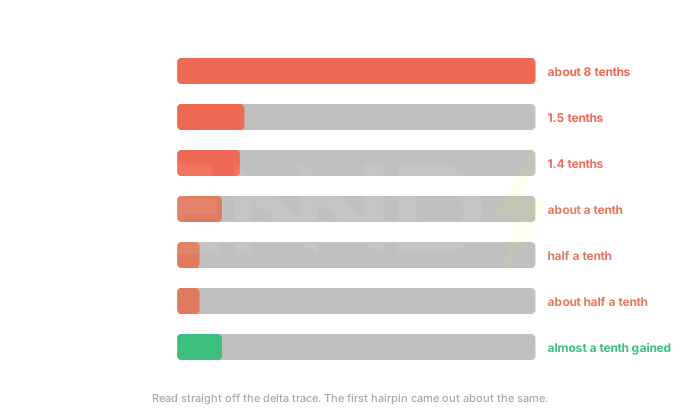
When I say longer is like a little bit smaller at the sprocket, you know, or bigger tyres, I mean uh but yeah, as you can see, the top speed of the green was a little bit quicker. It gained almost a tenth by the end of the straight. Then obviously he lost about a tenth into the Bar corner, turn three.
Then he lost half a tenth in the mechanics corner. Then in the double left he lost 1.5 tenths. All right. Very interestingly you can see. And then in the chicane he went from 2.08 to 2.86, so about eight tenths. Then we go into the first air pin and it goes from 289 to 309. So about the same.
The second hairpin loses about 1.4 tenths, and the last corner about half a tenth. So that’s my favorite. The great thing about the AiM
Not every package computes delta time correctly
the delta time compared to many other you know um you know software anal like data software for example like I mean I’m not going to name names but you know um I’ve noticed for example with with Starlane it’s great it’s it’s a pretty decent one but the the only thing I don’t really like from that is that uh it’s the one we used to have before it’s called um Starlane is that the delta time is not very accurate because it doesn’t compute the distance with the speed because guys remember that there is, you know, to see the delta time, you need to have some like a software that computes speed and distance because you can go super fast through a corner, but if you make too much distance for that, it’s going to it’s going to actually uh be a time loss, you know.
So, there’s there’s got to be a software in this case, Race Studio 3, which does a really good job. But double check with all your software providers, Unipro, Alfano, whatever you’re using. I have to double check myself too because I’m I’m just using Race Studio 3. Um I mean I just like I’m sticking to it. It just works really well for me.
Uh but for um yeah for other for other like for whatever you’re using you got to make sure that the the delta time is accurate. Otherwise it’s um yeah it’s going to be a problem. It’s going to give you false signals because you may be think oh I’m doing such a good corner. Look at the delta time. And the delta time is going really well is is giving me like lap time which was happening with us for example with Starlane and it was like but the reality is that many times the driver was making so many meters and even though it looked like it was super fast on on the speed the reality was that the guy was losing because then we would look at the the sector times of that specific corner.
It was like oh but why is the sector time slower from to this compared to the other driver even though he has so much more speed. So we were like understanding and then we came to the conclusion oh the delta time is wrong. It’s it’s not computing the it’s not computing the distance. So you make sure that the delta time comput.
But anyways whatever the whatever you see on the data at the end of the day you got to make sure everything is you know is is is um benchmarked against delta time. Again here they call it time compare. I just call it delta time but I mean whatever. Then the number four and another hugely important um sensor.
Channel 4: EGT, the exhaust temperature
It’s the exhaust temperature also known as EGT. So why is that important? Well, I mean uh let’s let’s let’s be honest. I mean uh the carburation is is key. All right. It’s absolutely key in in motorsport in racing. I mean in in karting I would say uh there’s also carburation in cars I guess or not. I mean it’s I think it’s electrical.
uh it’s like electrical injection but anyways I need to make some research on that but in karting you have to make sure the carburation is spot on especially in two-stroke engines and you know in in the OKJ and okay I mean juniors and seniors or even X30 you can you can do the carburation with you know if it’s a membrane carburetor you can do it like on your own while you’re driving whereas when you have uh you know the car like carburetors like um 60 mini or the KZ ones you can’t manually do do it by yourself.
In Italian we call it a vaschetta carburettor – the opposite of a membrane one. You simply cannot change the jets while driving. um
Fix the scaling so you can actually read it
First, if you do not like the scaling and the trace is not clear, you can set your own maximum and minimum and you then you go here and you can change the maximum minimum you just click on this Um, you know, you go here to the channels, you click the cog icon. And instead of 750, I’m going to put like 725.
And instead of 400, I’m going to put like uh 445. And you can see now it’s going to be less stretched. And now I can because I see the minimum is still not too close. I can make instead of 445, I can make like 490 because I guess we’re a bit too lean in the bottom. So, we had to All right.
As you can see now, it’s way more pronounced. So, it’s much more clear, right? So, as you can see,
Comparing carburation between sessions
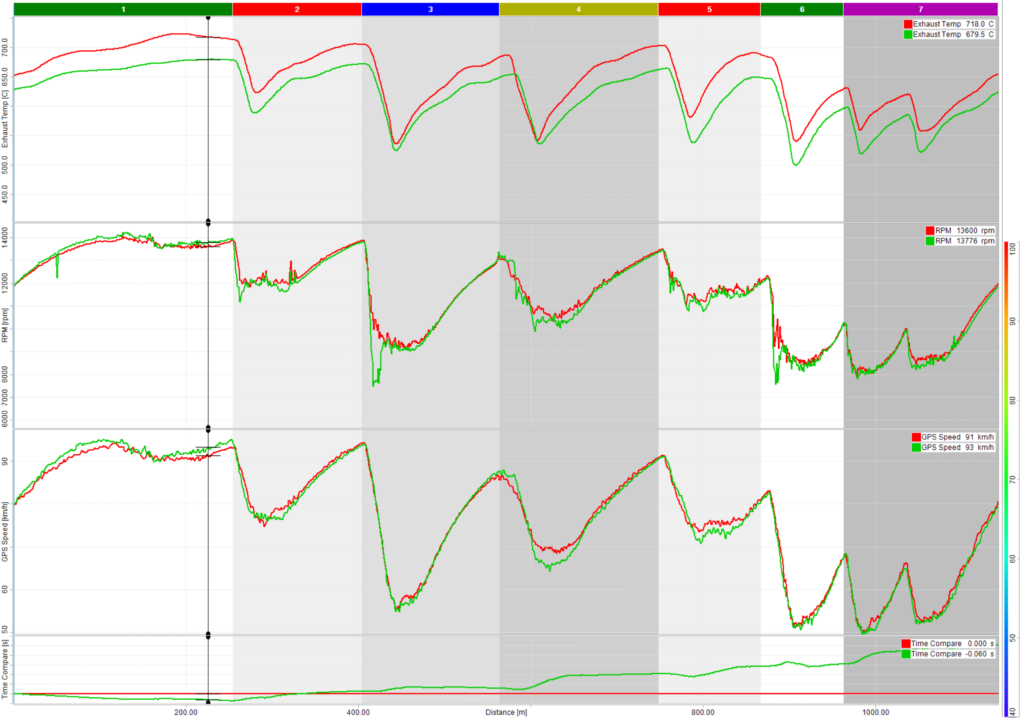
there was a vastly different uh carburation between the the two sessions. And I feel that we were better off in in the race. In quali, we were a little bit too lean, unfortunately. So, yeah, I feel that in quali we left some some time on the table because we were up around 720, a bit too lean. Um but yeah then I guess in qual we did a better no in the race we we improved it quite a bit but we lost time in the corners obviously cuz uh cuz I mean obviously we were like a fourth session on the tyres and the track got a little bit slower.
So yeah but anyways you can see the difference in carburation. So it’s again very useful to see and again by the way we can create another scatter plot. All right like the this like similar to what we did for the RPMs. I’ll explain this and again in another in another lesson right in another um not another one I will explain to you this in another guide more precisely but again you can do something really cool you can do basically that all right and this shows you again how much difference there is in carburation whether it’s again if you stack them, make sure it is set to mixed and not and not uh well like tilted make sure it’s mixed okay so you can overlay them and so you can see this is a very cool hack You can see one over the other and uh and basically you can see okay the red is way higher.
What does it mean? Which mean it means that at the given speed let’s say at the same speed which is like in this case is like 91 km an hour you can see there’s about almost 40° difference. So it’s like when it’s like overlapped when it’s like a um yeah just shifted up it’s too lean. When it’s shifted down it is too rich.
I mean, one of the two is either too rich or one is maybe, you know, maybe the green is spot on. It’s just the red is too lean, but anyways. So, I like to use that a lot. But
Why EGT matters most when sensors are banned
the real reason I use exhaust temperature a lot, especially in the races where you can’t really run um you can’t really run the the throttle or brake sensor. It’s it’s forbidden basically in um in Italy. I mean, I don’t know in uh in other events in the US or you know, in Asia, I don’t know. But uh but in Italy, especially like WSK or CIK races, you just can’t run the the throttle brake sensor.
You can keep them fitted, but you cannot connect them. I mean, a bit of I think it’s a bit of a rule to be honest cuz why would you care? I think they just do it to prevent the costs of karting to go too high because obviously it costs quite a lot to have all the sensors. But I think it’s still because you should still let it I mean you should let people do whatever they can they they want with the sensors, you know.
But uh but yeah, even even then we can’t change the rules. So we’ll stick to what they say. But yeah, the reason why I use a lot EGT is because well exhaust temperature is because
EGT is a throttle trace in disguise
you can tell where the throttle where the driver went on throttle because the way it works is basically this. When the driver goes on the throttle, the EGT goes up. When the driver goes off the throttle, the EGT goes down. Okay, the basically the line goes down. So you can see pretty much and pretty well how efficient the throttle uh release is.
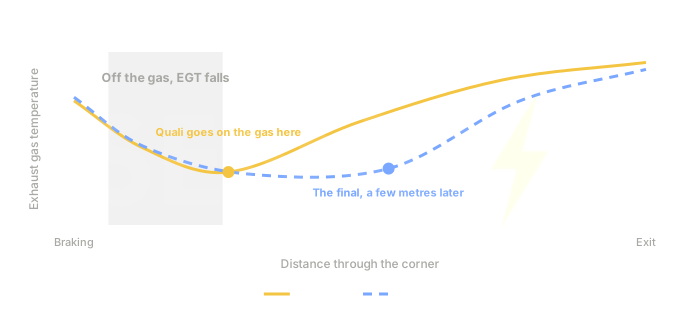
For example, you can see here the red release the throttle more aggressively and efficiently than this the same the other session in green. So okay, that’s more advanced. I’ll show you this in another guide. Uh I I’ll make a note of that. Uh but yeah, you can you can see the the steepness of the of the throttle release. You can see
Throttle release is where most drivers are sloppy
whether the driver release the throttle properly or not, which this is a problem I see a lot in in in many drivers, by the way. And I also spoke to some Formula 4 engineers and recently they said a lot of drivers have this issue and that’s bad because you’re not letting the differential do the right thing in car in cars but in karting as well.
You’re not letting the carburetor inject the fuel that it needs. So that’s one issue in in in what I see but I’ll explain this another guide. But the great thing is that you can see exactly the time the driver goes on the throttle. You can see in this case the red goes on the throttle here whereas the green goes on the throttle about here.
And you can see there’s about a few meters of difference, you know. Um which is quite a lot. And you can see the re the red is leaning out earlier because obviously it went on the gas earlier. So I mean
Earlier is not always better
there is no such a thing as the earlier the better on the throttle. Remember this. Uh it’s it’s a common uh it’s a common fallacy. I’ll make a video of this too. Um but you can see here there’s quite a big difference. This guy on the red still the same driver but he went on the gas at 670 metres here.
Whereas in the green he went on the gas at about 610. Now, it’s it’s not easy to tell exactly the moment it goes on the gas because you can see there’s a bit of like a bit of like a curve. It’s not like perfectly up and down. Even though we are using the the the most rapid AiM EGT sensor, it’s still it’s not easy to say exactly meter by meter where it’s going to throttle, but you can assume you can guess.
And look again here we’re going into the chicane and there’s a quite a big difference in throttle application. And if you say this driver goes on the red goes on the gas at 784 metres, whereas the green goes on the gas at 787 metres, about three metres. The first hairpin is about the same. Then the next corner the second one there’s about like one or two meters difference in throttle.
The last corner is pretty much the same. But you can see it’s great because you can tell how early or late the driver is going on throttle. And yeah it’s quite useful especially between driver to driver when you’re comparing the same driver different sessions. you’ll see very similar, you know, patterns. But it’s good when you when you compare against other drivers because you can see whether uh it’s faster to go on the throttle earlier or whe it’s fast to go on the throttle later because as I said, sometimes you’ll maybe tempted to go on the gas earlier and earlier, but the reality is that if you go too early, you’re going to generate push understeer.
You’re going to go even wider on the exit. You’ll probably end up with too much steering wheel on the exit and your exit speed is going to be not good enough. So, and by doing so, you also lean out the engine, which is again not that ideal in some some occasions when your engine is really quite lean. So,
The four channels, in summary
these are my four channels, my go-to channels, which you know, as a beginner, uh would be what I would suggest you to start. So, number one, as I said, was the speed. All right, the GPS speed, which you can have uh the GPS, but you can also have the axle, the rear axle, the speed, which is very accurate. You can buy it on the on the on the Yeah.
on on on the AiM website. You can you just need an extension between between the between the MyChron and the sensor just to connect the the things. It doesn’t connect right away to the to the mic. You need an extension. It’s called an expansion. Then the second one I mentioned was the RPM because you can validate the speed when there is a spikes and also to tell the sprocket.
You also want to tell the braking efficiency etc. And the third one is, as I said, the delta time, which is not really a sensor, but it just make sure you’re there by making sure you’re in distance base instead of instead of base time base. And the fourth is obviously the EGT exhaust temperature because you can tell obviously the carburation, which is really really important.
And also you can coach the driver by telling how efficient he is on the throttle release, but also on the throttle the throttle pickup point whether he’s picking up the throttle at this specific place or at this other specific place whether it you got it he has to go a bit earlier where he has to go a bit later cuz remember there’s no such a thing as the earlier the better.
you just have to go on the gas at the optimal point and it’s going to change from session to session I guess from setup to setup and um but yeah it’s normally at around the apex point that’s when you go on the gas but it depends from category to category. Okay, I hope this was useful. I have 22 years in this world now, and I can talk about most of it with some confidence.
Now I have to get to the track for our summer camps at BabyRace. Once those four channels make sense, the next step is building your own. On PURPL I covered math channels in karting telemetry, how to create the ones your logger does not give you.
Once those four channels make sense, the next step is building your own. On PURPL I covered math channels in karting telemetry — how to create the ones your logger does not give you.
Related here: how telemetry actually makes you faster, four pro carburation tips, and deceleration efficiency explained.
Send your onboard footage. Alessio reviews it corner-by-corner and tells you exactly what's costing you time, and how to fix it. Back within 48 hours.
Get My Onboard Reviewed → Reviewed personally by a CIK FIA World Champion, never an assistant.I promise I'll not spam you with repurposed shitty AI content but real experiences that only I, Alessio Lorandi, experienced. Written in my funny English-Italian tone of voice 😂
Alessio Lorandi is the former CIK FIA World Junior Champion, winning against Lando Norris in 2013 & F3 multiple race winner. He's helped 200+ karting drivers worldwide get faster & win WSK titles with BabyRace Driver Academy & now through Senndit, his online karting coaching platform.

