The 5 Most Popular Karting Fears ( And How To Overcome Them)
All of us karting drivers have had at least once in our careers any of these fears. Maybe we still have them, some of us, maybe we have had them in…


All of us karting drivers have had at least once in our careers any of these fears. Maybe we still have them, some of us, maybe we have had them in the past, and we don’t have them anymore, because we managed to accomplish and basically break through our fear. So, there’s many different fears, and that’s what I’m going to talk about today.
- Five fears cover almost everyone: crashing, losing, letting your parents down, overtaking, and the wet.
- Most drivers get faster after their first real crash, because the thing they were imagining turns out to be survivable.
- Driving conservatively is not safe, it is slow. A metre here and a metre there is half a second a lap.
- Be performance-driven, not results-driven. You cannot control the result; you can control the lap.
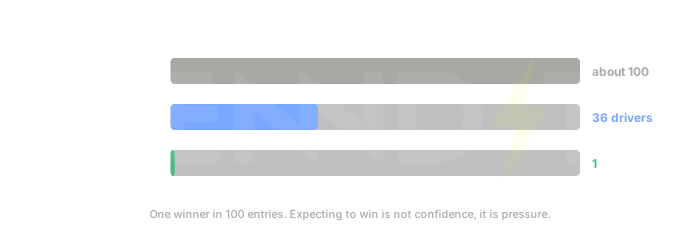
- There are ninety-nine other drivers trying to win. Expecting to win is not confidence, it is pressure.
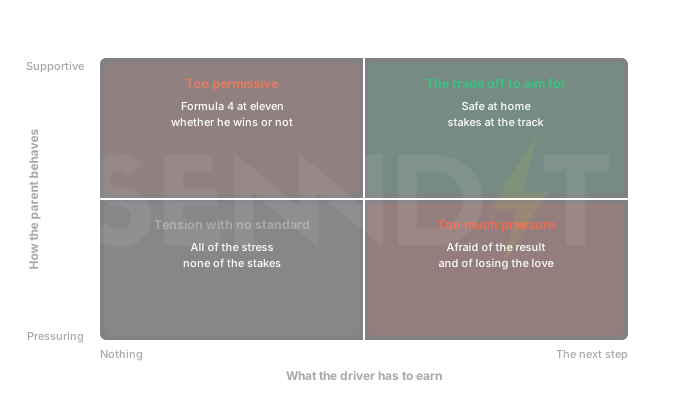
- Parents: supportive, not pressuring. A subtle difference with an enormous effect.
- Break the fear down out loud — what happens, and then what, and then what? It usually ends somewhere survivable.
- Fearless is a requirement, not a personality trait. It is built.
- Fear 1: crashing
- How to talk a young driver through it
- The crash that broke my collarbone
- Fear 2: losing
- Conservative is not safe, it is just slow
- Performance-driven beats results-driven
- The 1% maths that takes the pressure off
- Fear 3: letting your parents down
- Supportive without pressuring
- Why testing an F4 car at eleven is a mistake
- Fear 4: overtaking
- Fear 5: the wet
- Turning fear into fuel
- Ask what the worst case actually is
- The only question that settles it
- Break the fear down, question by question
- Three things a driver has to be
Fear 1: crashing
And the number one fear, probably for most drivers, is the fear of crashing. Now, this is what most of the kids I talk to, they relate to as their biggest fear, because they’re always afraid what’s going to happen when they crash, or will I get hurt, will I die, you know what’s going to happen to me, right? So that is always one of the scary parts, and typically that’s always like a bit of a handbrake for kids, like there’s some kids who are more fearless and are more courageous than others.
I mean, I was a bit more like that. I mean, I never had any major fears in terms of getting hurt or like being afraid to get hurt. To be honest, my passion was so high and so large that it was, you know, overcoming any potential fear that I had, and so, and it still is the case, you know.
I’m happy to get hurt on track, because I just feel like that’s my life, that’s my passion. So, from that point of view, you know, it’s always been like that. And I think it’s the same for many other drivers, like even the Moto GP drivers, you know, they always have to face the fear. At the end of the day, there’s always a high chance for them to crash and get hurt, and to be honest, there’s also the fatal possibility of crashing and dying in racing, you know, you never can reduce that to zero, you can reduce that, but it’s gonna be hard to bring it down to zero.
But anyways, the fear of crashing is real, and many kids, and also adults, may have this. Honestly,
How to talk a young driver through it
the way to overcome this is to just think that you’re doing, I mean, the thing that you love to do it, you’re like that’s your passion, and you’re happy to take the risks, because it’s just so good when you do that, that you wouldn’t want to not do that and stay on the sidelines just because you’re afraid of crashing and getting hurt.
So that’s one of the things you can tell yourself or to your kid, you know, if if he’s afraid of crashing, just tell him, listen, if you want, we can, we can, we can stop doing that, you know. We can just do another sport, but you know, as far as I can tell, it looks like this is your passion, and you know, if you can, if you want to continue to do that, obviously there is the, the risk of crashing.
There’s always going to be the risk in motorsport, but the reality is that, yeah, I mean, it’s it’s what you love to do, and I mean, that’s the price to pay, the risk of crashing and getting hurt, that’s the price to pay, that is, yeah, a bit of a handbrake for a lot of drivers, but the reality is that, you know, what, as soon as the drivers have their first major crash, what happens is most of the times the kids become faster, because now suddenly they realize that it’s okay, most of the times when you crash, you, I mean, still gonna be fine, you’re gonna be still in one piece, it happens to me, I mean,
The crash that broke my collarbone
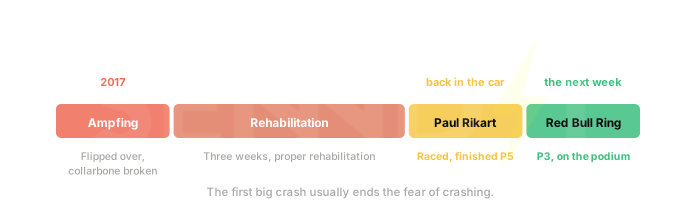
I flipped a couple of times, and once it was pretty bad, I crashed, and I broke my collarbone. It was 2017 and I was actually racing in single-seaters that season, but I had to practice and train karting to keep up and being fit, and I crashed in Ampfing in Germany. I flipped over, I broke my collarbone, and three weeks later I had to be in the racetrack at Paul Rikart, and I managed to, with some proper rehabilitation, I managed to race.
I finished P5, and the next week I finished P3 at the Red Bull Ring, on the podium, but yeah, I mean that’s the number one fear, the fear of crashing, and I can prove that, yeah, I mean, it’s it’s a bit of a handbrake, but when drivers crash for the first time, I mean, you never really want to crash, but eventually, when that happens for the first time, you actually realize it’s not that bad as you thought.
Fear 2: losing
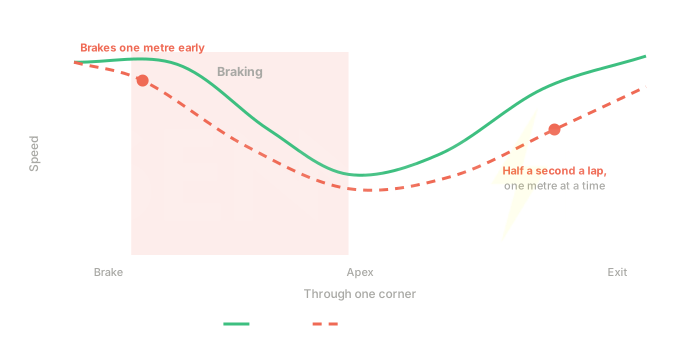
The second major fear is the fear of losing, so when a driver is very results-oriented, they start to be afraid of making mistakes – and being afraid of making mistakes is a massive handbrake, because yeah, you just start to push less, you start to brake earlier, you start to carry less speed, you know, you start to go later on the throttle, you’re more conservative everywhere, but the problem is that if you’re conservative everywhere and you just be conservative, okay, one metre on the brakes here, one metre there, you’re gonna be like half a second off at the end of the lap easily, easily, so you know
Conservative is not safe, it is just slow
you cannot drive around Monaco in an F car and try to be conservative, because if you drive in that mindset, you will be miles of the pace, miles of the pace. Yeah, probably you will not crash, but you will be better off not to drive at all, because what’s the point of driving if it’s just about, you know, bringing the car home?
It’s better to push and to prove how fast you are, and sometimes crash rather than never crash at all, but being all this all the time be super slow. So, yeah, you gotta push. I’d prefer driver will push and make mistakes rather than drivers that are always too conservative. So, yeah, you never want to have that fear of losing.
It’s sometimes you can have that fear of losing mentality when you are fighting for a championship and you are afraid to lose, because if you, I mean, make a big mistake, you will lose the championship. So, in that case, it’s kind of understandable to comprehend that sort of mentality, but the reality is that, again, you don’t want to be afraid of losing, and honestly, I don’t want to be like.
Oh, you know, you don’t have to be afraid of this, you don’t have to be afraid of that. Like, what you should think is that you know what, I’m probably better off to not think about the results.
Performance-driven beats results-driven
What I feel works really well for me is to be performance driven rather than results driven, like that’s a big difference. Performance driven is basically when you are focusing on your own driving and how you can improve corner by corner, lap by lap, like really being self-driven and focusing on your own performance, whereas results driven is basically thinking how, how to achieve that specific result.
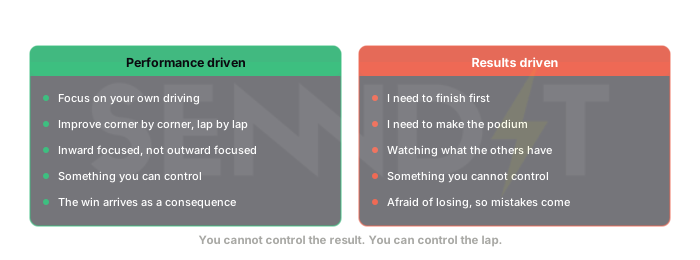
Oh, I want to, you know, I need to finish first, I need to finish, you know, I need to win stuff like that. That’s results driven. I need to make the podium, you know, that’s results driven. The problem is you can’t control that, because even if you do everything perfectly, there may be always somebody who may do something slightly better than you, or they may have a little better material in terms of engine or chassis, or whatever, or maybe they have new tyres and you don’t, and so there will always be someone that can be going a little bit quicker than you, or doing a slightly better job than you, but again, you don’t want to focus on the others, you’re going to be inward focused and not outward focused, and really think about yourself.
How you can get better every session, how you can go faster every session. That’s it. I repeat, you don’t want to be focused on your result, because if you’re focused on your result, then you’ll start to make mistakes, and you will start to be afraid of losing. So, this is, as I said, a very common fear. After the fear of crashing, the fear of losing is very real, and you will realize that there’s nothing to lose.
Honestly, that’s the reality. As soon as you realize
The 1% maths that takes the pressure off
there’s nothing to lose in every race, it’s a new race, and there’s 36 drivers on the grid, let’s say, and maybe 100 drivers have signed on to that race in that category. You know that they all are there to win, and there’s gonna be a 1% chance for you to win, right? Because I say it’s one out of 100 so you have a 1% chance, and so I mean, like, you should not expect yourself to win, so you shouldn’t put yourself to pressure.
You should be thinking: there are 99 other drivers this weekend here to try to win, and I am the hundredth. But the reality is that I don’t have to think about winning, I just have to think about doing my best, focusing on my performance, and if I do that perfectly, and we do a great job with my kart, I will be fighting for the win.
You winning the race is just going to be the consequence of you focusing on your performance rather than you focus on the results. I can’t state this enough. It’s just very, very, very key to focus on your performance and not on your results. So,
Fear 3: letting your parents down
the next biggest fears I see in the eyes of drivers after working for so long with them and also with myself, is the fear of actually looking slow in front of their parents, so yeah, just letting their parents down and being afraid that they won’t be loved anymore. So this is one of the other major fears, is just like being afraid of literally the results, consequences that it’s going to happen in the eyes of the kids’ parents, you know, the mom or the dad, mostly is the dad.
They are afraid that if the result is not coming, you know, the dad is not going to love them anymore. And I mean, I’ve seen this happening sometimes where the parents are so stressful and put a lot of pressure, and you know that the driver may feel this, and if the driver feels this, it’s never really a good thing.
So, from the parents’ side,
Supportive without pressuring
it’s important that they are supportive, but they are not pressuring. This is very, very important. It’s a subtle difference, but it makes a huge, huge difference in terms of outcome. So, the kids need to feel like they’re safe. They obviously need to know that to progress in their lives in karting, they need to get results. I mean, they need to at least show the potential, and they need to show the commitment and the hard work, the discipline, etc.
So they need to know that nothing is for granted, because if they think it’s for granted, then they will never really put their effort, and it’s just going to be very bad for their career. So it’s good that the parents let the kids know: you need to earn your next step in your career. I cannot just give it to you.
I mean, it’s super expensive, it’s super time resourceful, and also I mean you got to show to me and to the other people around us that you have put the effort and you are fast enough to continue. So, I think a balance of the two is is needed, you know, so not too stressful, and not too, you know, yeah, just pressuring into the results, etc.
but also not too permissive and relaxed, because the reality is that, yeah, the kids need to know that they have some stakes, and they need to know that they need to earn their next next step. I mean, even if they may have unlimited budget. I mean, the drivers should really know that to move on to the next step of their career, they need to really earn it.
And unfortunately,
Why testing an F4 car at eleven is a mistake
I’m seeing a lot of parents that even already, when they’re in 60 Mini, can you imagine when they’re in 60 Mini, they already get their drivers to drive a Formula 4 car, and I think it’s insane, because the driver at 60 Mini, when he is ten or eleven years old. You shouldn’t think about Formula 4. You should be thinking about winning races in Mini.
I mean, I mean, if you show that the kid can practice Formula 4, even though he doesn’t get the results. I mean, this is very bad in the psychology for the of the kid, because you will be like, oh, you know, my dad is going to put me in Formula 4 even if I do not win, so I am going to get there eventually anyway.
So you will probably signal in the eyes and on the mind of the driver that the results are not that important, but reality is that results are super important, even if you have unlimited budgets. Results are super important, so the fear of letting your parents down, the fear of looking slow in front of your parents and people around you.
It’s real. I’ve seen it happening a lot, and it’s one of the most common. But yeah, there has to be a trade off between the right amount of pressure that the kids need to receive and also the right amount of support, because yeah, I mean, you don’t want to have too much support, but you don’t want to have too much pressure too.
So there has to be really a good trade off, then there is also another kind of fear, and
Fear 4: overtaking
it’s the fear of overtaking, which again is related to the fear of crashing and getting hurt. Many kids will think twice or three times, or even more, before making an overtake, because they feel like, you know, it’s not safe, it’s risky, etc. And many times they’ll go for a DRS move on the straights rather than making a dive bomb, or just like overtaking on the brakes, literally, you know, just like instead of overtaking under braking, they’re instead, you know, trying to literally wait for the straight to make an overtake, which again is the safest thing to do, but again, you are not going to become the next Max Verstappen by only ever making safe overtakes, that’s the thing I like to tell the kids, you’re gonna take some risks, so yeah, one of the major fears is fear of crashing when you’re overtaking.
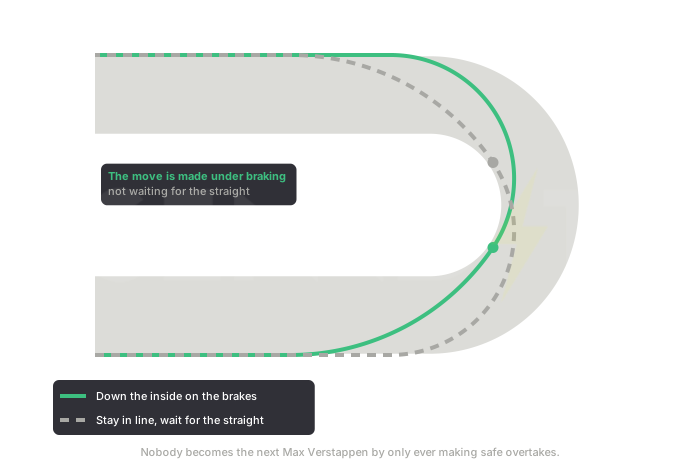
So let’s sum it up as the fear of overtaking, which is a bit of a mental block that keeps drivers stuck in the mid pack, and it doesn’t help them to transition into pro level mode that would get them to win races. But you know what, we have all these fears, and you know,
Fear 5: the wet
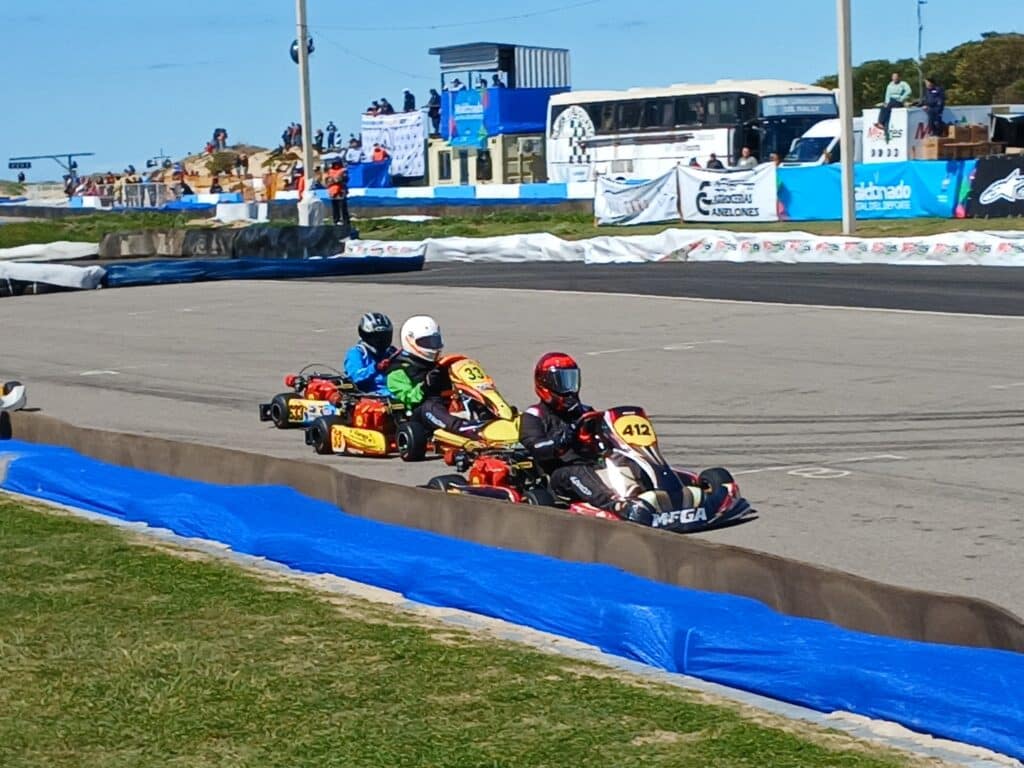
there’s also some fear of driving in the wet stuff like that, because they’re not confident of the grip level, etc. This is real. I’ve seen it happening, and so they drive so carefully because they are not familiar with low grip conditions. I mean, if the kids have that, it means they need to have way more driving time in the wet, essentially.
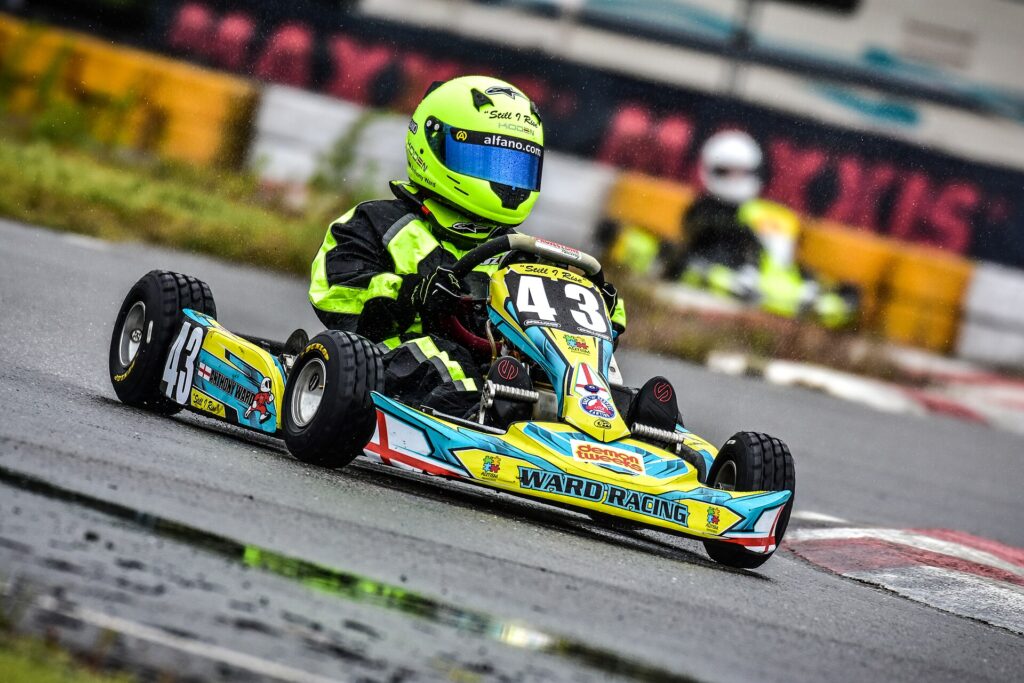
But with all these fears that we mentioned, you know, the fear of crashing, the fear of losing, the fear of, you know, letting their parents down, the fear of overtaking, the fear of driving in the wet, you know, all of these are
Turning fear into fuel
fears that can be used to actually fuel your result, you need to use these fears as fuel, okay, and really shift your mindset from, you know, having this being a negative thing to being actually a positive thing, and how can you do that? Well, you know, you win by reframing again, as I said, instead of thinking “I am afraid of losing”, reframe it: I am okay with losing, as long as I am happy with my performance.
I need to just push as much as I can drive as well as I can, and work on my performance, rather than thinking about my result, and I’m sure that if I work on my performance and I think about that exclusively, the result is also going to come eventually, maybe not this race, maybe not the next one, but the next one too is going to, so you need to really try to reframe this fear and be like, okay,
Ask what the worst case actually is
what’s the worst thing is going to happen, okay, I’m going to crash, all right, what’s the worst thing that could happen? Okay, maybe my car’s destroyed and have to pay for a new one. Okay, maybe I break my wrist. Okay, maybe they drive over my neck and they break my collarbone or my shoulder, or you know, or I flip and they drive over me and you know I break my leg.
Or, you know, there can be few things. I’ve seen 20 years, a lot of crashes, a lot of accidents where people went to the ambulance, they maybe broke a bone or two, and then two, three, four weeks later, they were back in the kart. I mean, thankfully, I’ve never witnessed a fatal crash, and I hope I will never witness in my life.
But yeah, it’s possible, guys. Unfortunately, it’s possible. The probability is super low, and it’s getting lower and lower every year, but the reality is that there’s always going to be a level of risk, even if you are, you know, playing rugby, or if you are like cycling, and you’re, you know, there’s always going to be a risk, probably cycling is more dangerous than than karting, because you know somebody can drive over you with the car, or you can crash by yourself, so there can be many, many sports that you, that you can get hurt big time, but yeah, karting is one of those.
You just have to ask this question:
The only question that settles it
Do I really love it so much that I’m willing to get hurt and still be fine with it, and go back again? You know, all the kids that I saw crashing, they went back at it because they, they love the sport so much, they had so much passion, they, they were okay. You know what, that’s one, that’s one crash, that’s one injury.
Let’s go back at it, you know. So, need to reframe these kind of fears and try to understand. Okay,
Break the fear down, question by question
let’s break the fear down. Okay. All right, now I’m afraid of this. Okay, let’s break it down. Let’s go more in depth, you know. Why I’m afraid of overtaking? Oh, I’m afraid of overtaking, because maybe I will crash. And what is the problem? What happens if you crash? Well, maybe I flip. What happens if you flip? Well, maybe I get hurt.
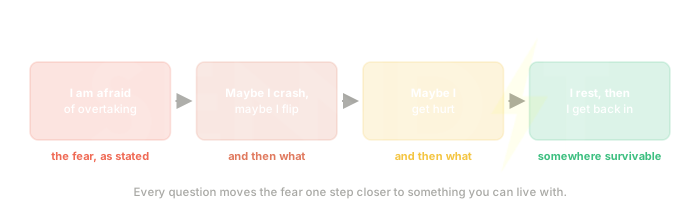
Or what happens if you get hurt? Oh, maybe I, I can’t race for a lot, and maybe you can, I can’t drive for a while. Okay, what’s the point? You’re just gonna rest, and you’re gonna get back it. Oh, true, you know. And you should think about it like that, of course. Sometimes you may have negative consequences, but it’s part of racing, is part of life, I believe.
This is. Part of the game, but yeah, if you drive with fears, conscious fears, you’re gonna have a handbrake. I’m telling you, you’re gonna be driving with the handbrake. So we need to face our fears, and we need to try to overcome them, because at the end of the day, that is really what what we need when we drive.
We gotta be fearless, that is the definition.
Three things a driver has to be
I think there are very few things that a driver needs to know. One of those has to be coachable, then he has to have innate sense of speed, but the other one, he has to be fearless, you know, he needs to take risks, because if the driver is afraid of taking risks, he will always be conservative, and that’s not good at all, because if you’re conservative, you are not pushing in the limits, you’re not overtaking, you are not going fast, and you are not winning, so all these sort of things, it’s very important that you develop them early on in your career.
I wish this was useful. Hit me up on Instagram @alessiolorandi. We can continue a bit the conversation over there, and make sure you sign up to the six months training program if you want to go from zero to hero when it comes to racing, not only karting, but just like getting yourself ready for single seaters. I’m sure I can help you with that.
If you just want to find lap time for your upcoming race, and you want me to analyze your onboard video, then please send me over the onboard video, and I will get it back to you within two, three days. Make sure you keep sending it. I’ll see you. Ciao, ciao.
Related: how to become strong in the head, staying calm under pressure, and how to actually stop crashing.
Send your onboard footage. Alessio reviews it corner-by-corner and tells you exactly what's costing you time, and how to fix it. Back within 48 hours.
Get My Onboard Reviewed → Reviewed personally by a CIK FIA World Champion, never an assistant.I promise I'll not spam you with repurposed shitty AI content but real experiences that only I, Alessio Lorandi, experienced. Written in my funny English-Italian tone of voice 😂
Alessio Lorandi is the former CIK FIA World Junior Champion, winning against Lando Norris in 2013 & F3 multiple race winner. He's helped 200+ karting drivers worldwide get faster & win WSK titles with BabyRace Driver Academy & now through Senndit, his online karting coaching platform.