The Negative Consequences Of The Brake & Gas Technique Explained
Why your brake and gas technique is sabotaging lap times, and how to fix it before it becomes permanent.

- Many drivers subconsciously use brake and gas simultaneously, which is devastating for performance
- The traction circle proves tires can’t handle maximum braking and acceleration at the same time
- Double pedaling overheats the engine, makes it run lean, and kills performance
- When braking, you must be 100% off the gas – when accelerating, you must be 100% off the brakes
- This bad habit will follow you into Formula cars if not fixed early
- Use brake and throttle sensors to identify and eliminate this technique
There’s one technique that, unfortunately, many young drivers do, and they do it subconsciously. Most of them, they don’t do it really consciously. They do it, and they’re not really aware of that.
And that technique is throttle and brake at the same time. It’s basically double pedaling. Call it however you want, braking gas, we have a saying that in our team, we put our we put on the drivers that have this issue.
The “brake and gas” system basically prevents the driver to do 100% brakes or 100% gas. So basically is a system that prevents, literally, the driver to double pedal, but it still will allow double pedal if the driver does like 50% gas and 50% brakes. It’s just impossible to prevent that completely, but it does do a little bit of a help.
Karts are not made to brake and accelerate at the same time. There is no reason for that.
The Traction Circle Explains Why It’s Wrong
But here’s the thing, karts are not made. You know, go karts are not made to brakes and gas at the same time. There is no reason for that. Your kart is literally not made to brake and accelerate at the same time, because and also your tires, by the way, this is so there’s a concept called the traction circle.
The traction circle basically says that you can combine. So this is longitudinal, and this is the lateral. You probably have seen this. This called the traction circle.
So basically it says that when you brake this, your maximum braking is your maximum acceleration. When you brake, you can do a little bit of combine. It’s called like combined. So when you’re turning, braking and turning into the corner, this is where you’re going to be, probably you’re going to be in this area.
So you’ll be somewhere here in this overlapping area. If you are throttling and turning, you’re going to be here, okay, if we’re turning, this is right, but that’s when we turn into the left.
The traction circle is the combination of all the forces that are allowed on the racing tire. It’s not a square – if it was, you could have 100% braking and 100% turning, or 100% acceleration and 100% steering. But the rules of physics don’t work that way.
As you can see, it’s impossible. It’s not a square. If it was like that, you could brake and turn so much more. You could have 100% braking and 100% turning. You could have 100% acceleration and 100% steering and the kart the tires would sustain all of that. There would be so much faster.
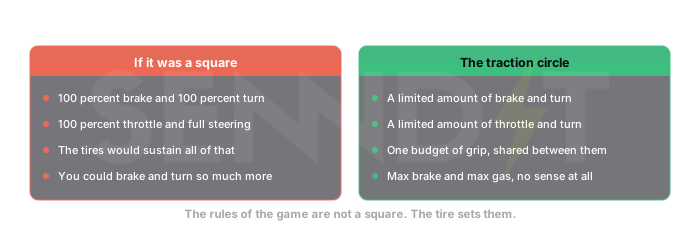
But it’s not like that. You know, the rules of the games are not that. The rules of the games are this. So it allow the tires allow a limited amount of braking and turning, a limited amount of throttling and turning to one side and braking and turning to the other side and throttle and turn to the other side.
So you see the tire cannot at the same time as and it doesn’t make sense if you ask the interaction.
The Performance Consequences
So maximum braking and maximum acceleration at the same time, it makes, it makes really no sense, absolutely no sense. So you should, you should not do that. So that’s the simple answer. But of course, drivers do it, and before they do it for multiple reasons.
So it’s like, here with your left foot, and here with your right foot, you’re trying to basically go on the full gas, and maybe you’ll feel like it’s a little bit not sure that you’re going to make the corner, because maybe you go wide.
And so many drivers do, or instead of coming off the gas, they put some brakes on. Or when they’re braking, they, I don’t know, for some reason they feel comfortable with a little bit of throttle and they brake, and it keeps some throttle, but it makes no sense.
All of this is just deadly. It’s just disaster for the performance.
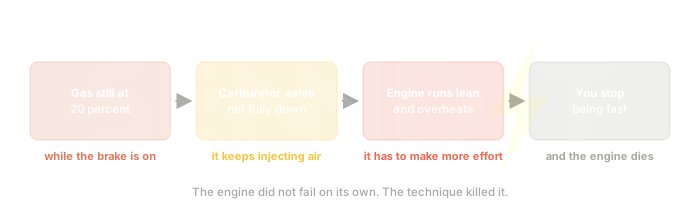
The biggest problem I have noticed in drivers doing braking gas, especially with minis, is you’re gonna overheat the engine so much. When you do like that, you overheat the engine so much, the engine has to make more effort. And so when the engine gets too hot, it gets too lean, you just stop driving like stop being fast altogether.
What the Data Shows
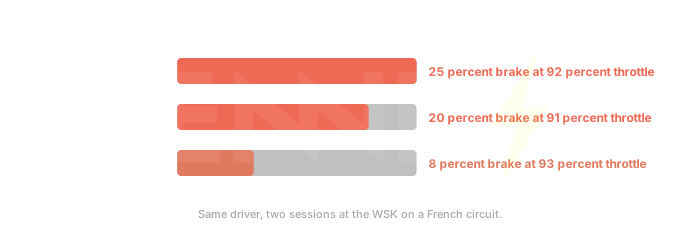
I want you to visualize this. We are at a French circuit, two drivers – actually, it’s the same driver in two different sessions at the WSK, and you can see that on the exit. For some reason, the driver is at 92% throttle, not full, but he has 25% brakes.
And now that is not an extreme amount of braking gas. We have seen way more. I couldn’t find the example, like more of extreme ones, so I just show you this one, which is still quite a bit.
And you can see that the driver is pretty much full throttle, but he still keeps the brakes, and he’s past the apex already. So that makes no sense, right? To have 25-26% of brakes past the apex.
So the only reason why he’s doing that is because he’s trying to control the speed, so he’s going in the gas, and he’s trying to control the speed with the brakes instead of coming off the throttle. So for me, this is deadly. This is very bad.
But it’s not just the only issue, right? That’s the biggest problem. You know that I have noticed in drivers doing braking gas, because when you do so, especially with minis, you’re gonna overheat the engine so much, because you when you do like that, you overheat the engine so much, the engine has to make more effort.
And so when the engine gets too hot, it gets too lean, you just stop driving like stop being fast all together. It’s just, as I say, it dies, and it’s your fault. If it dies, it’s not his fault.
I can see this other mistake in the other corner. For example, here he is almost flat out. He has 93% throttle, and he has 8% of brakes. You can see here is not huge, but it’s still a thing.
And here also is very bad exiting this corner over here, you can see that he is pretty much full throttle, 91% and he also has 20% brakes, again, disaster.
And the other major problem, the other major issue, from this technique, from brake and gas technique is not just in the exit, but it’s also in the mid corner, right.
So in the mid corner, I can see that the driver has got like 97% of the brake, and he’s got 17-89% throttle. Same here. He’s got 18% throttle and 100% brake. So this is a problem.
And you can’t be like, Oh, Alessio, there’s a spike, no, because he got down to 13% there, or it got down too much slower here. You could be, oh, that’s the calibration. Is not right, believe me, the calibration was right.
So when he’s taking off, the gas is not fully of the gas. It’s just 20% that’s a problem, because when you do so, the carburetor is not working properly. And if the carburetor is not working properly, it’s not fully down the valve, and so it keeps injecting air when under braking, which is not needed.
And that’s bad, because it keeps the it makes the engine to lean basically, and it just doesn’t help it to recharge a fuel necessary to get fast on the exit, to get the right amount of fuel. So, yeah, you have to be careful with these things.
The Proper Technique
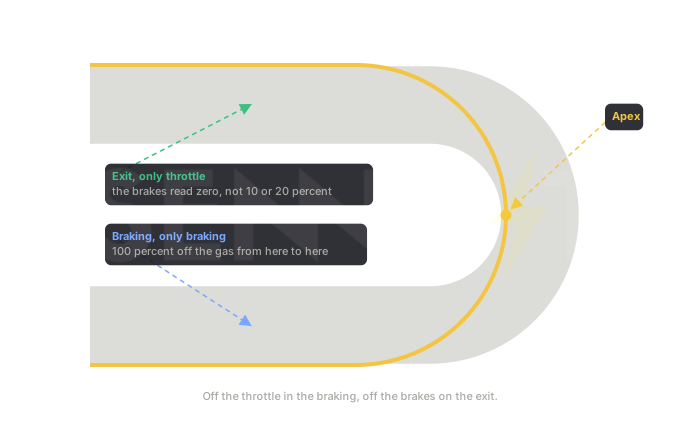
Unfortunately, many drivers do, and it’s mostly out of habits I heard I and, you know, if I look at the data and I describe it myself, even though I’ve I, if I try to charge a data, you need to make sure when you are on the brakes, okay, you need to be 100% off the gas here.
From here to here, you need to be 100% off the gas, only braking from here to here, okay, from here to here, only braking and on the exit, only throttle.
You don’t want to be double pedaling ever, please. Unfortunately, if you don’t fix this now, guys, you’re gonna keep this all the way into Formula cars.
You see here, it should be instead of like that. Instead of being like that. You should be 100% off the gas, and then you go on the gas, and you go 100% right, and on the exit, the brakes should be zero, not like 10% 20% as we saw in the previous corner, right?
It’s not the way to be. It should be 100% brakes on the corner, or 90% it depends on the corner. Of course, you were talking about a hairpin. We want to be completely off the throttle here, completely off and then completely off the brakes on the exit you see, so off the throttle and off the brakes.
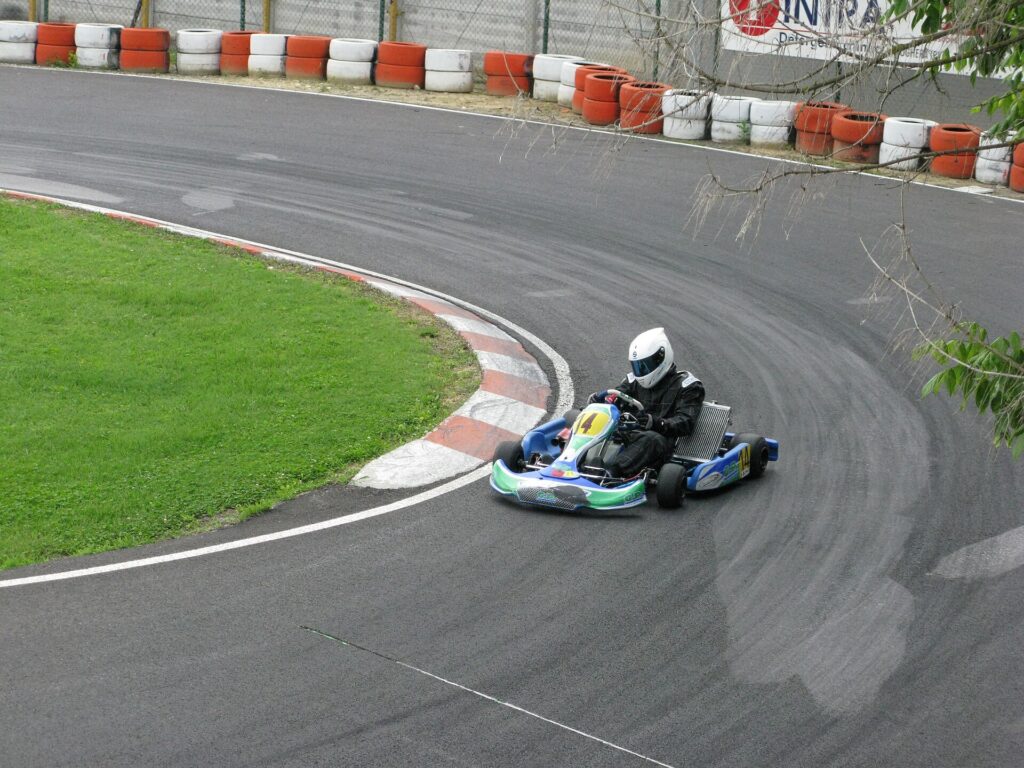
Off the throttle in the braking, and off the brakes on the exit. That’s the way to go. If you do this kind of double pedaling is bad.
If you have this problem, you have to find it out on the data. Using the exhaust temperature sensor can help you a bit. But I need you to get the brake and throttle sensor from AIM. They’re so good, so precise, and I’ll teach you how to calibrate them. Once you have those, it’s so much easier to spot minor differences.
Of course, if you do a big one, of course, you can still see it without this. You can also understand a bit from the RPM and exhaust temperature. When the exhaust temperature is not going down, it’s still gonna, like, almost flat. It means you’re doing braking gas. But again, it’s way better to do it like this.
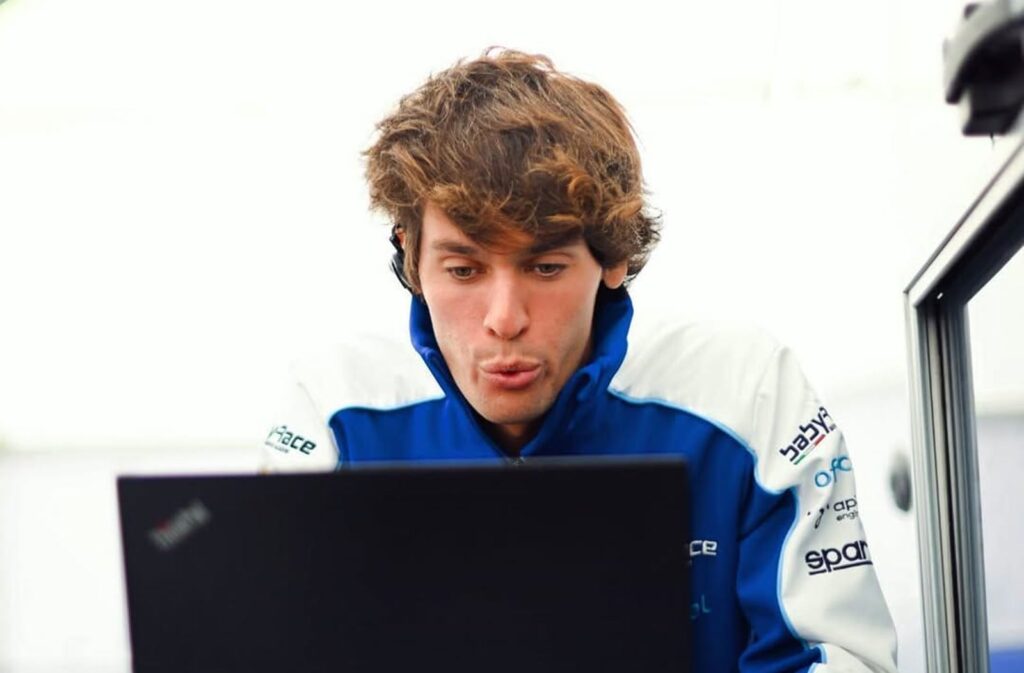
And also, when you notice like that, then you can just tell it straight in the face of the driver. Listen, you’re complaining the engine is bad, but you’re destroying the engine by and you’re killing the engine by doing braking gas like that. So you got to fix your technique. You can’t complain about the engine. It’s really, it’s a joke, if you would.
So, yeah, I encourage you to think about this. Every time you get off the gas, every time, every time you brake, make sure you get off the gas fully 100% your feet has to literally be moving out, like have a gap from the pedal.
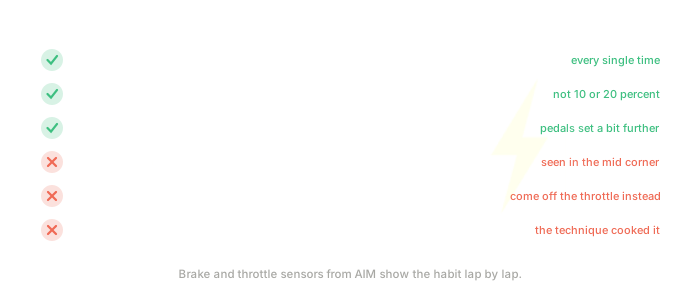
Because if you try to keep it, that’s the thing you have to make sure that your pedals are a bit further, you know, they’re not too close. And that’s really the thing you have to make sure you are, in that regards, very, very, very specific.
On the brakes, come off the gas, on the throttle when you’re on the exit, come off the brakes.
Hope that was helpful!
And remember to keep sennding it! 😉
Ciao!
Send your onboard footage. Alessio reviews it corner-by-corner and tells you exactly what's costing you time, and how to fix it. Back within 48 hours.
Get My Onboard Reviewed → Reviewed personally by a CIK FIA World Champion, never an assistant.I promise I'll not spam you with repurposed shitty AI content but real experiences that only I, Alessio Lorandi, experienced. Written in my funny English-Italian tone of voice 😂
Alessio Lorandi is the former CIK FIA World Junior Champion, winning against Lando Norris in 2013 & F3 multiple race winner. He's helped 200+ karting drivers worldwide get faster & win WSK titles with BabyRace Driver Academy & now through Senndit, his online karting coaching platform.