Why Eye Movement and Focus Matter in Karting
Master your braking points and apex speed by fixing where you're looking. Most drivers stare at the wrong places, here's what actually works.

- Your eyes guide everything: braking points, apexes, and reactions to what’s happening ahead
- Look ahead, not just in front of your kart – always think a step forward
- Flow your eyes smoothly: braking point → apex → exit, no jerky movements
- Keep your head still and move only your eyes, don’t tilt like in MotoGP
- Use peripheral vision to see the apex and kerbs without staring directly at them
- Sharp reaction time helps you hit perfect brake points and make quick racecraft decisions
Let’s talk about something that’s often underestimated: where you’re looking while driving.
Your eyes basically guide everything: your braking points, your apexes, even how you react to what’s happening in front of you.
And if you train your eye movement properly, you’ll be smoother, more consistent, and just straight up faster.
Let’s break it down.
Your Eyes Lead the Way
Where your eyes go, your kart follows
You’ve probably heard this saying before.
It sounds simple, but most drivers get this wrong, especially younger ones.
If you’re staring just in front of the kart, you’re already behind.
You need to look ahead and always be thinking a step forward.
Here’s how it goes when you’re doing everything right on track.
Look at your braking point early.
Then as you get close, you’re already looking at the apex.
Once you’re at the apex, your eyes should already be focused on the exit.
Common Mistakes I See All the Time
- Looking too close: If you’re staring at the track right in front of your kart, you can’t see what’s happening ahead.
- Moving your whole head: Some drivers, especially in Mini, drive like MotoGP, tilting their head with the kart. Don’t do that! Keep your head still and move only your eyes (sure you should still move your head a bit, but not too much as some drivers do).
- Fixating on the apex: Yes, the apex is important, but once you’re turning in, your focus should already be on the exit.
How to Train Your Eyes
You don’t need to overthink it, but you do need to practice consciously if you haven’t yet acquired this skill.
- Peripheral vision: Get used to “seeing” stuff (the apex, kerb or white line) out of the corner of your eye. You don’t always need to stare right at it.
- Smooth transitions: Your eyes should flow from braking point → apex → exit. No jerky, delayed movements.
- Off-track practice: Watch onboard videos or drive in a sim, and pay attention to where you’re looking, not just how you’re driving. Don’t overcomplicate it though, it should happen naturally.
Bonus: Reaction Time and Focus
Reaction time plays a big role here too. When you train your reaction time, even with simple exercises, it sharpens your ability to adjust quickly.
That’s not just for avoiding crashes. It helps you hit that perfect brake point, nail your apex, and make quick decisions in the race craft.
Also, don’t get distracted. Stay locked in.
Try to tune out the noise, and keep your focus on the kart, the track, and building a rhythm
Final Thoughts
Keep it natural, don’t overcomplicate it.
Just build a bit more awareness around the fact that you should be looking further ahead than your front bumper.
Imagine if we had an eye tracking device, we would need to see from the results of it that you’re looking further ahead than the average driver does.
Your eyes guide your driving, and your vision is what helps you stay sharp under pressure.
Next time you’re on track, ask yourself: “Am I looking far enough ahead? Am I already planning my next move?”
If you’ve got questions or want to show me some onboard to review, feel free to reach out. Always happy to help.
Just Senndit
, Alessio Lorandi
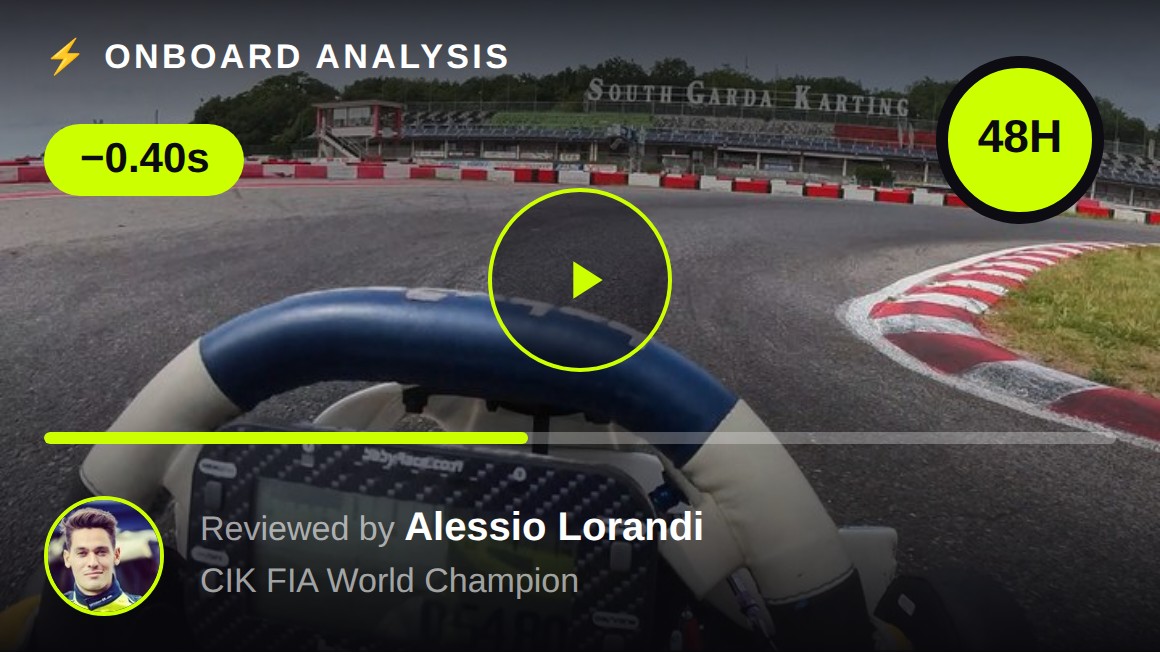
Send your onboard footage. Alessio reviews it corner-by-corner and tells you exactly what's costing you time, and how to fix it. Back within 48 hours.
Get My Onboard Reviewed → Reviewed personally by a CIK FIA World Champion, never an assistant.I promise I'll not spam you with repurposed shitty AI content but real experiences that only I, Alessio Lorandi, experienced. Written in my funny English-Italian tone of voice 😂
Alessio Lorandi is the former CIK FIA World Junior Champion, winning against Lando Norris in 2013 & F3 multiple race winner. He's helped 200+ karting drivers worldwide get faster & win WSK titles with BabyRace Driver Academy & now through Senndit, his online karting coaching platform.