How to Get Better at Go-Karting: Close Your Theoretical Gap
What makes a fast kart driver, and how I measure it: the gap to your theoretical lap, the average loss per lap and your consistency, before the kart.

- Two skills come first. Fearlessness and coachability. Everything else, car control and racecraft included, is built on top of those two.
- Entry speed is the hardest one. Gaining one tenth on the exit and losing two on the entry is a net loss.
- Lap time alone lies to you. The track changes. A slow lap can hide a great session and a fast lap can hide a bad one.
- Look at your theoretical first. Any time I see the theoretical more than one tenth faster than the real lap, it’s bad news.
- Add up every lap, not just the best one. The average loss to your theoretical tells you how accurate you really are.
- Look inward before you touch the kart. Most of the times, I would say 80% of the times, it’s just the driver.
- What makes a fast kart driver?
- Who should you listen to?
- Why is entry speed the hardest skill to develop?
- Can you learn car control?
- Why does your lap time lie to you?
- What is your theoretical best lap?
- How do you measure how accurate you really are?
- How consistent are your laps?
- How many splits should you use?
- How do you close the gap to your theoretical?
- When is it the kart and not you?
- Frequently asked questions
You were P1 in practice. So was it a good session?
Not necessarily. Being P1 doesn’t mean you drove well, and being four tenths off your personal best doesn’t mean you drove badly. If you want to get better at karting you need to know what a fast driver is made of, and you need a way to measure yourself that doesn’t lie. That’s what this article is about.
What makes a fast kart driver?
What I tell to all my drivers at BabyRace is that each driver must have two skills. All the others go on top of those.
The number one is fearlessness. You can’t become a fast racing driver if you’re fearing speed, if you’re fearing crashing, if you’re fearing hurting yourself. You’ll be holding up through a flat out corner. You’ll be afraid of overtaking somebody. And from what I see, by the time a kid is 7, 8, 9 years old that fearless level is kind of set. If it’s not there, I will be wasting my time telling you to brake three meters later or to get on the throttle one meter earlier.
The second one is coachability. It means listening, applying, and leaving your ego aside. The coach tells you that you are braking three meters too early, that you need to brake later and harder and hold the brakes a little bit longer. You go out and you do it. Bam, you found lap time.
I call them meta skills, because you need these two to build the rest: car control, racecraft and so on.
And thankfully in racing you don’t need the genes. You don’t need to be two meters tall like a basketball player. But you do need those two. Out of the hundreds of drivers we have seen at BabyRace over the years, the ones that end up winning are the ones who are fearless and highly coachable.
If fear is what’s holding you back, read the most popular karting fears and how to overcome them.
Who should you listen to?
I know it’s not easy to accept feedback, especially when a coach, your parent or your mechanic tells you in a pretty hard way. I didn’t like being told what to do either. I never really had a coach. I listened to my mechanic, who was very experienced, and to my dad, who had driven shifter karts himself. I had a lot of respect for them.
But when some stranger came up with random advice, or a teammate, I was quite skeptical.
So should you be coachable to everybody? No. Listen to the people that know what they’re talking about. Not to somebody who has never driven a kart.
And if you don’t have a person like that around? Then you analyse yourself, with your onboards and your data. That’s the reason I think a good coach is worth it, but only a good one.
Why is entry speed the hardest skill to develop?
Once the two meta skills are there, the first thing I look at is how much speed you carry into the corner. I call it entry speed sensing. It’s the hardest skill to develop, and it’s what makes the biggest difference between drivers.
This is where I have a problem with the idea of slow in, fast out. You brake early, you get a nice exit and you gain one tenth. But you lost two tenths on the entry. That’s a net loss.
And most of the times it’s worse than that. Braking early leads you to turn in early, and turning in early gives you a bad exit too. So you lose on both sides.
So what do you do? You push yourself. Brake later, carry more speed, and see what happens. I explain my full reasoning in why I hate slow in, fast out, and the braking technique itself is in my tips to drive faster.
The exit is easy to see. The time you gave away on the entry is not.
Then there is speed sensing in general. You need to feel that you were two or three kilometers too fast or too slow in that corner while you are driving, not after. The data is backward looking. It tells you what happened when the session is already over.
How do you develop it? By pushing into the corners, by being self aware in the kart, and by rewatching your videos after. You are alone inside the track. Nobody can choose your corner speed for you.
Can you learn car control?
Yes. Car control is not a yes or no thing. It’s a scale from 0 to 100, and you can move up.
What does great car control look like? The kart snaps, you save the corner and you lose 0.01 instead of half a second.
But you can’t learn to catch a slide if the kart never slides. If you’re driving constantly below the limit, the kart is never sliding by definition. So you never practise it.
That’s why driving in the rain helps so much, and ice karting too. I wrote about the best ways to develop car control and about driving in the wet separately.
Why does your lap time lie to you?
Lap time is only one part of the story. The track changes all the time, so the same lap time can mean two different things on two different days.
You do a 55.1 and you’re happy. The next session you do a 55.6 and you’re upset. But were you really slower? Maybe the track was slower. Slipstream alone can be worth two, three, four tenths on a long straight.
So you get false positives and false negatives. If you are four tenths off your personal best, but your gap to the theoretical is zero and you were on the pace by lap two, that is an outstanding session. Relying on lap time is the losing strategy.
And one more thing. Nobody wins with the fastest lap alone. I would rather be one tenth slower and repeat it every lap. A lap you can’t replicate is almost like you had it by luck.
How long it takes to get to a good level is another question, and I answer it in how long it takes to get good at karting.
What is your theoretical best lap?
Your theoretical is your best splits of the session put together in one lap. You didn’t drive it in one go. It’s stitched together from different laps.
When I was racing, the first thing I heard after a session was “Alessio, look at your theoretical”. And I understand why. When you compare yourself to yourself, in the same session, with the same kart, you have no excuses. No traffic story. No fly that went through the visor.
My rule is simple. Any time I see the theoretical being more than one tenth faster than the real lap, it’s bad news. One tenth or less is a really good job.
It also changes how you read the timing screen. Say you are two tenths off P1 and half a second off your own theoretical. That means you had three tenths in hand over P1. Why would you think about the kart?
At the highest level the gap is basically zero. At the World Championship in Franciacorta my real lap was the same as my theoretical, and I still feel I made a small mistake into the last corner.
But one session doesn’t count. The gap needs to be close to zero again and again, not one time by luck.
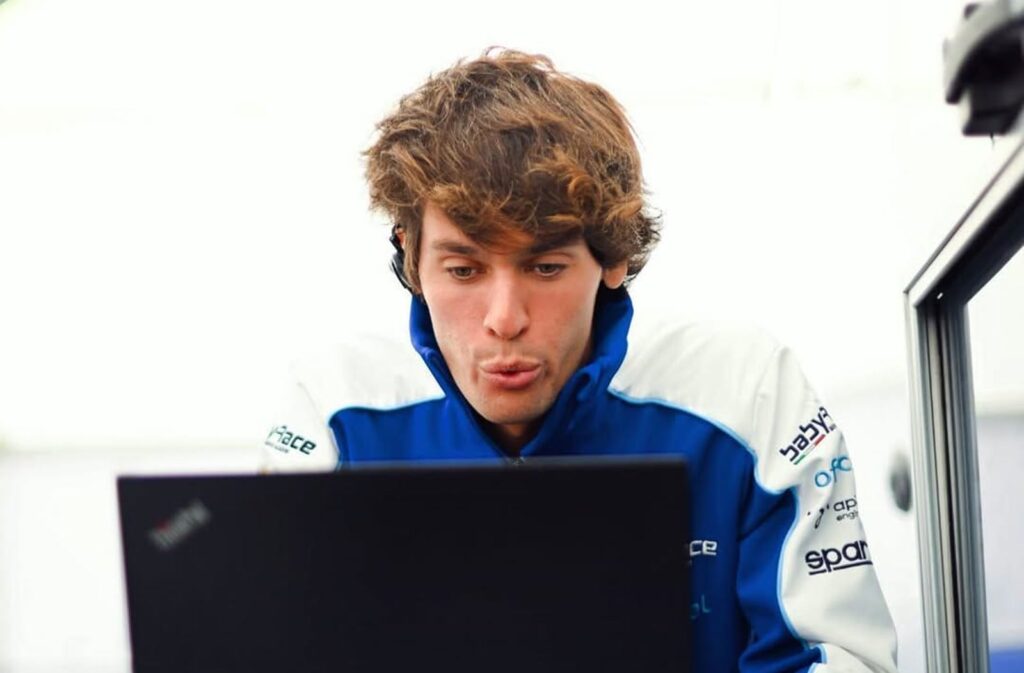
How do you measure how accurate you really are?
Comparing your best lap to the theoretical is the start. But it’s one lap. What about the other eleven?
Here is an example. Let’s say a 60 Mini at Franciacorta. Twelve laps, fastest lap 54.28, theoretical 53.96. The gap is 0.32. Already too much. Now look at every lap.
| Lap | Lap time | Loss to the theoretical (53.96) |
|---|---|---|
| 1 | 55.12 | not counted |
| 2 | 54.74 | 0.78 |
| 3 | 54.41 | 0.45 |
| 4 | 54.52 | 0.56 |
| 5 | 54.32 | 0.36 |
| 6 | 54.49 | 0.53 |
| 7 | 54.38 | 0.42 |
| 8 | 54.62 | 0.66 |
| 9 | 54.30 | 0.34 |
| 10 | 54.28 | 0.32 |
| 11 | 54.46 | 0.50 |
| 12 | 54.51 | 0.55 |
The total is 5.47 seconds over eleven laps. So on average this driver is giving away almost half a second per lap to himself.
This is how you do it with your own session:
- Take the theoretical time of the session.
- Leave out the out lap and the first lap.
- For every other lap, write down lap time minus theoretical.
- Add all the losses together.
- Divide by the number of laps you counted. That is your average loss to the theoretical.
The target is an average loss below one tenth.
And the excuses don’t hold. “I had to overtake” explains one slow lap, not eleven. The best drivers are able to overtake and lose less than a tenth.
If you did that mega corner once, it means you can do it all the time. Accuracy beats absolute speed every time.
How consistent are your laps?
The other number I look at is the standard deviation of your lap times. It tells you how far you are, on average, from your fastest lap.
A standard deviation of 0.1 is really good. 0.6 is a nightmare. You will never get to zero. But you can watch it going down. If it was 0.55 six months ago and it’s 0.25 now, you improved, whatever the lap time says.
Only count the clean laps. A lap where you had a spin or you were stuck behind somebody doesn’t belong in there.
And it’s not only about lap time. The best drivers do laps so similar that you need to zoom in on the data to see a difference. The same goes for the line and for the braking point. If your line moves by two or three meters from one lap to the other, don’t look at the kart.
The last thing is how many laps you need to get up to pace. When you go out you have to discover the grip. I call it grip discovery. If it normally takes you 15 laps to get to a quick lap, you need to take that down to two, three, four laps.
I go deeper on this in why consistency matters more than speed in practice, and it’s one of the points in the most common karting mistakes.
How many splits should you use?
More than three.
With three sectors it’s easy to match your theoretical, and you can’t tell which corners you drove well. So on my AiM RS3 I put one split per major corner. Nine corners, nine splits. A chicane counts as one section, not two corners.
Does it make the theoretical harder to hit? Yes. That’s the point. With three splits you look good. With seven or nine you see the truth.
My other telemetry articles are in the karting telemetry guides.
How do you close the gap to your theoretical?
First, forget the kart. The engine, the chassis, the setup. This part can’t be delegated to your mechanic.
The tyres we use today are hard, and their peak comes in the last laps of the session. So you need to be precise, and you need to be in the right position on track when the peak of the tyres and the peak of the engine arrive together. If in that moment you are in traffic, your best splits will never end up in the same lap.
So find yourself a clear track. Don’t finish the session behind somebody.
What about a new track? Being inconsistent there at the beginning is normal. But you can’t wait until day four to put a lap together. Think about F1 drivers. They get maybe 50 or 60 laps before qualifying. The rest they do with visualization, and you can do the same. I wrote about it in how visualization can improve your performance.
If you fail to prepare, you prepare to fail. From what I see, the most prepared kids are the most consistent ones.
And when you are alone at the track, with no teammate to compare with, the order is the same: first match your theoretical, then work on the consistency. The kart doesn’t change within a session. You do.
The rest is laps. I explain why in why track time is key, and how to organise the day in how to make the most out of practice days.
When is it the kart and not you?
What I notice a lot of times is that drivers struggle to tell if a mistake comes from their driving or from the kart. Most of the times, I would say 80% of the times, it’s just the driver. And the driver even makes it look like the kart is behaving wrong.
An example. You should be aggressive on the brakes and smooth on the steering. If you do the opposite, smooth on the brakes and aggressive with your hands, you get oversteer and it feels like the kart is set up badly. Is that the setup? No. It’s you.
So the order is this. Look at your theoretical first. Then at your consistency: two, three, four laps within one tenth of each other. Then at your braking points and your lines. Only after that you talk about setup.
And when you do, be specific. What do you need? More front? More rear? If you are missing in the corners, it’s the setup or the tyres. If you are missing on the straights, it’s the carburation, the sprocket or the engine.
There is no perfect setup anyway. The setup gets you to 99. You adapt your driving and you get to 100.
Be careful with blaming the kart when it’s not the kart. Do it enough times and nobody in the team believes you the day you are right.
The worst drivers focus outward first. The best drivers focus inward first.
- More on the mental side of driving is in the karting mindset guides.
- To read your splits and your data properly, start from the karting telemetry guides.
- Not sure where you are losing the time? Send me your onboard and I go through your laps in an onboard review.
- I teach all of this in my six month training program.
Next time you’re at the track, before you say anything about the kart, open the data and write down three numbers: your best lap, your theoretical, and your average loss to the theoretical. Then do the same the session after.
Frequently asked questions
What is the theoretical best lap in karting?
It is your best splits of the session put together in one lap. You didn’t drive it in one go. It shows what you were capable of doing with the kart you had in that session.
How close should my best lap be to my theoretical?
Within one tenth. Any time I see the theoretical being more than one tenth faster than the real lap, it’s bad news. One tenth or less is a really good job.
What matters more in karting, the driver or the kart?
The kart matters. But most of the times, I would say 80% of the times, the mistake comes from the driver. So look at your theoretical, your consistency, your braking points and your lines before you talk about setup.
How do I know if I am consistent?
Look at the standard deviation of your clean laps. 0.1 is really good, 0.6 is a nightmare. Then check that your line and your braking point repeat from one lap to the other.
Can you become a fast kart driver without talent?
In racing you don’t need special genes like in other sports. You need fearlessness and coachability. Car control, racecraft and the rest are built on top of those two.
Send your onboard footage. Alessio reviews it corner-by-corner and tells you exactly what's costing you time, and how to fix it. Back within 48 hours.
Get My Onboard Reviewed → Reviewed personally by a CIK FIA World Champion, never an assistant.I promise I'll not spam you with repurposed shitty AI content but real experiences that only I, Alessio Lorandi, experienced. Written in my funny English-Italian tone of voice 😂
Alessio Lorandi is the former CIK FIA World Junior Champion, winning against Lando Norris in 2013 & F3 multiple race winner. He's helped 200+ karting drivers worldwide get faster & win WSK titles with BabyRace Driver Academy & now through Senndit, his online karting coaching platform.