Brake Bias and Controlled Braking in Karting, Explained
Single speed karts brake on the rear axle only, so brake bias is in your foot. KZ karts have front brakes, and I run 60/40 or 65/35. Here is how to…

- Brake bias is the split of braking between the front wheels and the rear wheels. You can only have a split if you have brakes at both ends.
- A single speed kart brakes on the rear axle only. The FIA Karting rules say so for direct drive classes. So there is no bias to adjust.
- KZ and KZ2 have front and rear brakes, and you can change the balance. On a KZ you normally run 60/40 or even 65/35, front to rear.
- Too much rear on a KZ locks the rear tyres. The kart gets unstable and it does not stop as well.
- A KZ weighs 170 kg with the driver and a KZ2 175 kg, against 150 kg for an OK. With only the rears or only the fronts, the kart just won’t stop.
- On a rear brake kart the balance is in your foot. Trail the brake more to load the front, a touch less to give weight back to the rear.
- If a KZ pulls to one side on the brakes, one front brake is working less than the other. Air in the system or dirt on the pads. It cost me a race on lap 1.
- What is brake bias?
- Does a single speed kart have brake bias?
- Which karts have front brakes?
- What brake bias do you run on a KZ?
- Why does a shifter kart need front brakes?
- What is controlled braking in a kart?
- How do you change the balance with the brake pedal?
- How do front brakes change your braking line?
- Does the engine brake change the balance on a KZ?
- Why does my kart pull to one side under braking?
- What can you adjust on the brakes of a single speed kart?
- Frequently asked questions
You read that moving the brake bias fixes a locking rear. Then you look at your kart. Where is the knob?
On most karts, there is no knob.
Almost everything you read about brake bias is written for cars. In a car it makes sense, because a car has brakes on four wheels and a way to move the balance between front and rear.
Your OK, your Rotax, your Mini has one pedal and one disc on the rear axle. So the question changes. And the answer is in how you use the pedal.
What is brake bias?
Brake bias is how the braking is split between the front wheels and the rear wheels. You may also hear it called brake balance. It is the same thing.
You say it as two numbers. 60/40 means 60 percent on the fronts and 40 percent on the rears.
Why does it matter? Because when you brake, the weight shifts forward. The front goes down and the rear gets unloaded. So the fronts can take more braking than the rears, and if you ask too much from the rears they lock first.
In cars you are normally at 58, 59 percent on the front. And in cars this is quantified, it is a number on a screen. In karting almost nothing is a number. You go by feel.
But there is one condition for all of this. You need brakes at both ends of the kart. And most karts do not have that.
Does a single speed kart have brake bias?
No. A single speed kart brakes with the rear axle only, so there is nothing to split.
This is in the rules. The FIA Karting Technical Regulations (2023 edition, article 4.12.1) say that in direct drive classes the brake must work on the rear axle only, on both rear wheels at the same time. Direct drive means no gearbox. That is your OK and your OK-Junior.
And the rear axle of a kart is one fixed piece. There is no differential. So when you press the pedal, both rear wheels slow down together. You cannot send more braking to the left or to the right, and you cannot send any to the front.
So is the conversation over? No.
Because the weight still shifts forward when you brake, in a single speed kart too. The front tyres still get loaded and the rear still gets lighter. The balance of the kart on entry still changes with the brakes. The only difference is who changes it.
In a car, the engineer and the driver move a setting. In a single speed kart, you do it with your left foot, every corner.
Which karts have front brakes?
The shifter karts. The same FIA article says that in gearbox classes the brake must work on the front and on the rear axle. That is KZ and KZ2.
It was not always only them. I drove with front brakes on a single speed kart until 2014. The class was called KF2. The kart was really light, about 150 kg minimum weight, and the brakes were really effective, so you could really brake into the corner.
And the fronts were not on the pedal. You braked the fronts with a lever on the steering wheel, on the right side. Almost like the clutch lever you have on a KZ, but on the other side. So you had to really learn how to use the front brakes.
That was the last single speed category with front brakes. Why did they take them off? I am not quite sure. What they told me is that it was mostly the weight, because the whole front system is something like three kilos.
And Rotax? The Rotax Grand Finals technical regulations for 2023 say front brakes are not allowed in 125 Junior Max and 125 Senior Max.
If you race a national class, check your own rulebook. But if your kart has no gearbox, it is almost sure that you brake with the rears only.
What brake bias do you run on a KZ?
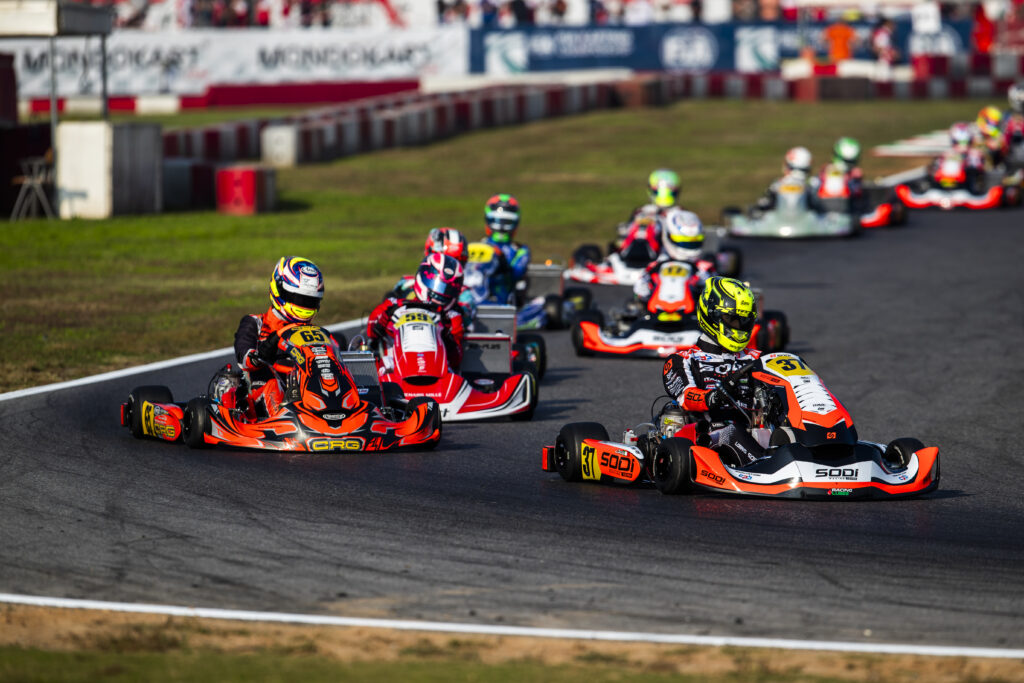
You normally run 60/40, or even 65/35. That is 65 on the front and 35 on the rear. Sometimes even more to the front.
On a KZ the front and the rear brakes are attached, so you can change the brake balance. And in karting you normally run more front than you would in a car.
Why so much on the front?
Because with too much on the rears, you typically end up locking the rear tyres. And you do not want that. It gives you instability, and you cannot stop as efficiently.
The fronts are different. It is very rare to lock the front tyres in a kart. It can happen when the grip is really low, but in the dry on a normal lap you almost never get there. So if something has to be close to locking, I want it to be the front and not the rear.
And listen, you have been given front brakes. So take advantage of them.
The numbers are a starting point, by the way. Nobody gives you a percentage on a display in a kart. You feel which end is locking first, and you go from there.
Why does a shifter kart need front brakes?
Because of the weight.
A KZ has a minimum weight of 170 kg with the driver. A KZ2 is 175 kg. An OK is 150 kg. So a KZ2 is 25 kg heavier than a senior single speed kart.
That is a lot more mass to slow down. And the only way to make it stop is to use the front brakes too.
If you only use the rears, or only the fronts, the kart just won’t stop. That is the feeling. You press and it feels like nothing is happening.
When you use both, a KZ stops very hard. On the data I see up to 1.8, 1.9 G on the brakes.
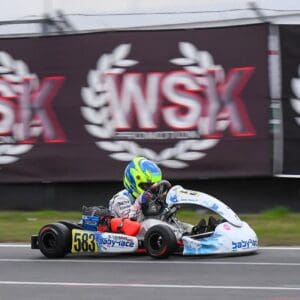
You feel the difference in a race too. At my first WSK Euro Series win I was about 2.5 kart lengths behind going into turn 1 on the last lap. With rear brakes only, that is a bit far for an overtake. With a KF2 or a KZ2, with front brakes, it would have been pretty easy.
What is controlled braking in a kart?
For me controlled braking means three things are decided by you and not by the kart. How hard you press. How long you hold. And where you let go. For the first one, how hard you press, I explain how to go and look for the limit on purpose in threshold braking in a kart.
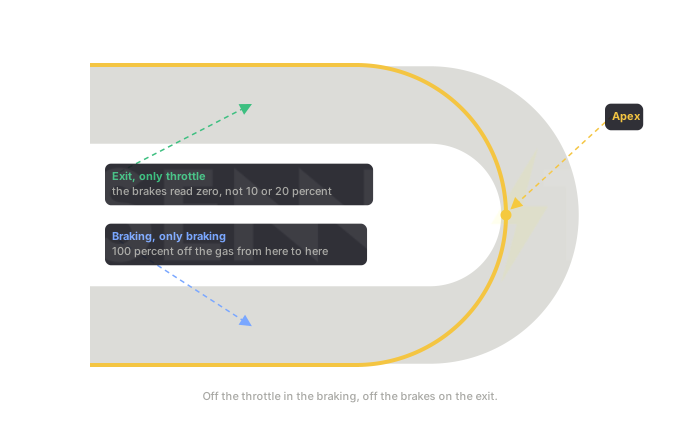
In a heavy braking zone, you brake late and you keep the pressure towards the apex. It is not enough to brake in a straight line and then just turn the wheel.
The most common mistake I see is this. The driver brakes straight, then releases the pedal the moment he turns in. What happens? The front comes back up, the weight goes back to the rear, and the kart understeers.
So how long do you hold?
- Slow corner: you trail the brake almost to the apex.
- Medium corner: you are off the brake before the apex.
- Fast corner: a tap, or just a lift.
When a straight follows the corner, I release 2 to 4 metres before the apex and I am on the throttle at the apex, or 1 to 2 metres earlier.
And the pressure at the end is small. In my trail braking article I explain how even 2% or 3% of brake keeps the front planted.
Controlled does not mean soft, by the way. If you are coasting before the corner, you braked too early. I go through that in how to fix your early braking.
How do you change the balance with the brake pedal?
You use the weight transfer. Braking lowers the front and unloads the rear. So the longer you stay on the pedal into the corner, the more load you keep on the front tyres.
If the kart understeers on entry, trail the brakes more. The front stays loaded, you carry more entry speed, and that generates really good rotation. Brakes are the number one way to rotate a kart.
If the kart oversteers on entry, trail a touch less. The front raises back up, the rear picks up a bit of weight, and you get more stability.
Can you overdo it? On a kart it is hard. The rear axle is fixed with no differential, so it is rare that the kart rotates too much. When you combine brake and steering, the chassis flexes and the inside rear lifts. That is what you want.
So you can play a lot with your balance based on your driving. Use the braking as a tool. In an ideal world the setup is the same, the chassis is the same, the track is the same. But that is not how it works.
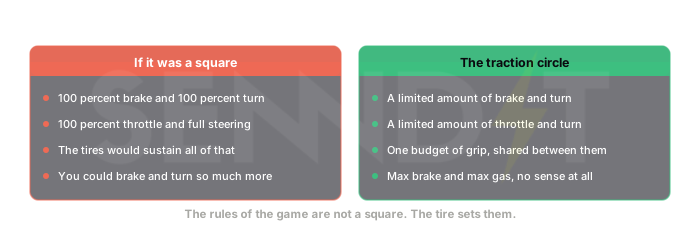
The limit is the tyre. It has one budget of grip to share between braking and turning. And you have to be 100 percent off the gas while you do it. I explain why in the brake gas technique explained.
How do front brakes change your braking line?
In a KZ you brake in a V shape. You want the wheel as straight as possible while you are hard on the brakes, because that is when the fronts are doing the most work.
If you brake really hard and turn at the same time, you unsettle the kart and you lose time.
Will you lock the fronts? It is very rare. In Formula 1 you see white smoke coming off the front tyres. In karting you do not quite see that. What you may get is a vibration on the front, and that is quite upsetting too.
In the wet it is another story. There it is quite possible to lock the fronts. It happened to me a few times on the formation lap as well, when you brake really hard to warm up the tyres.
And front brakes are a tool. You do not have to use them in every corner. At the old Chiocciola, turn 2 at Lonato, I used to go in with no brakes on entry, both in KF3 and in KF2, while other drivers even used their front brakes there.
There is more on the V line in my shifter kart driving tips.
Does the engine brake change the balance on a KZ?
Yes. In a KZ you also brake with the engine when you downshift. And the engine is connected to the rear axle, so all of that braking goes to the rear tyres.
If you are aggressive with the downshifts, you can gain a metre or two in the braking zone. I like a lot of engine brake. It is fun, with the engine roaring in the back.
But it is the rears kind of locking. In the first laps that helps, because it puts temperature in the rear tyres. Later in the run it overheats them, and too much locking costs you stability and lap time.
So the balance you set is one thing, and how you downshift is another. If the rear is moving around on entry, look at your downshifts before you touch anything on the kart.
And if you feel you need the engine brake to stop the kart, that is a symptom. Something else is missing. The pads, air in the system, or the grip.
Why does my kart pull to one side under braking?
On a KZ, sometimes one of the two front brakes is braking less than the other. Either there is some air in the system, or some dirt between the pad and the brake disc.
When that happens it feels like crap, because you can’t even brake straight. It basically pulls you to one side.
It destroyed a race for me one time. I braked super late and hard on lap 1, to the edge of the track. The corner was a left hander. The moment I braked, the left brake did not work, and it pulled me straight to the grass on the right before I could release the brakes.
Nothing I could have expected. It felt alright on the formation lap. I probably collected some dirt on the front left pads after the start.
This is a kind of brake balance too, left against right. And nobody puts it on the kart on purpose.
What about a single speed kart? There the brake works on both rear wheels together, on one axle. So this left against right problem belongs to the karts with front brakes.
What can you adjust on the brakes of a single speed kart?
Not the bias. What you can do is keep the brakes in optimal condition, so the pedal gives you the same thing every lap.
For me this is a big one. If the brakes are even a tiny bit spongy, I feel it, and it upsets me because I cannot brake as late as I want.
- Air in the system. Even a tiny bit of air makes the pedal travel longer. The brakes feel spongy and you lose the initial bite.
- A long pedal. When the pedal goes long, look at the fluid first.
- Pads and oil. Worn pads or no oil in the brake pump look like a driving problem from the outside. Check them before you blame yourself. And replace the oil more often than you think.
- Temperature. The brakes need 1 to 2 laps to come up to temperature, even in summer. In heavy rain a cold disc is a nightmare.
So before you look for a balance problem on a single speed kart, make sure the pedal is the same every time you press it. Then the rest is your foot.
- All my driving technique articles are in the karting technique guides.
- How to hold the brake into the corner: the art of trail braking in go kart racing.
- Why the two pedals never go together: the brake gas technique explained.
- Want me to look at your braking? Send me your onboard and I go through your laps in an onboard review.
And next time you read a car article about brake bias, remember which kart you drive. If it has a gearbox, set it towards the front. If it does not, it is your foot.
Frequently asked questions
Do go karts have brake bias?
Only the ones with front brakes. KZ and KZ2 shifter karts brake on both axles and you can change the balance between front and rear. Single speed karts brake on the rear axle only, so there is no bias to adjust.
What brake bias should I run on a KZ?
On a KZ you normally run 60/40 or even 65/35, front to rear. In karting you run more on the fronts, because too much on the rears typically locks the rear tyres and makes the kart unstable.
Do Rotax karts have front brakes?
Not in Junior Max and Senior Max. The Rotax Grand Finals technical regulations for 2023 say front brakes are not allowed in 125 Junior Max and 125 Senior Max. For any other class, check your own regulations.
How do I control the balance under braking on a rear brake kart?
With the pedal. If the kart understeers on entry, trail the brakes more so the front stays loaded. If it oversteers, trail a touch less so the rear picks up weight again.
Why do karts run more front brake bias than cars?
Because on a kart the rears lock easily and the fronts almost never do. In cars you are normally at 58, 59 percent on the front. On a KZ you run 60 to 65 percent, sometimes more.
Send your onboard footage. Alessio reviews it corner-by-corner and tells you exactly what's costing you time, and how to fix it. Back within 48 hours.
Get My Onboard Reviewed → Reviewed personally by a CIK FIA World Champion, never an assistant.I promise I'll not spam you with repurposed shitty AI content but real experiences that only I, Alessio Lorandi, experienced. Written in my funny English-Italian tone of voice 😂
Alessio Lorandi is the former CIK FIA World Junior Champion, winning against Lando Norris in 2013 & F3 multiple race winner. He's helped 200+ karting drivers worldwide get faster & win WSK titles with BabyRace Driver Academy & now through Senndit, his online karting coaching platform.