Threshold Braking in a Kart: What It Is and How to Feel It
Threshold braking in a kart is braking at the highest pressure the grip allows. What it feels like, the drill I use to find it, and real G numbers …

- Threshold braking is braking at the highest pressure the grip lets you stop with. I call it 100% braking efficiency. Most drivers rarely get close to it on a normal race day.
- In a kart you find it by locking the rear tyres. When they lock, it means you braked at the highest pressure the grip level allowed.
- Hit maximum pressure right away, then hold it. Braking early and coming off early is the habit that keeps you away from the limit.
- The lock does not spin you. Your hands do. You hear the tyres, you panic, you turn the steering. Keep it straight and stay on the pedal.
- The limit has a number. In my KZ at Franciacorta I pulled 1.8 to 1.9 G into turn 5 and turn 13, and 1.6 to 1.7 G when the grip was low.
- The limit moves during a run. Cold tyres, a cold disc, fuel load and worn tyres all change how hard you can stop, so you feel for it again in the first laps.
- In the wet it is about how efficient you brake. You can be better off with 20% less peak pressure, held for longer, and never on the rubbered line.
- What is threshold braking in a kart?
- Why do most drivers never reach 100% on the brakes?
- How hard can a kart actually brake?
- What does the threshold feel like from the seat?
- How do you find the braking threshold?
- Why do you spin when the rear tyres lock?
- Does the threshold stay the same every lap?
- How does threshold braking change in the wet?
- What changes with front brakes in a KZ?
- What if your kart will not let you brake that hard?
- What is the difference between threshold braking and trail braking?
- Can data show you where the threshold is?
- Frequently asked questions
When was the last time you braked so hard that the rear tyres locked, and you stayed on the pedal anyway?
If you have to think about it, this one is for you, my friend.
Because there is one mistake nearly every driver makes: braking too early, and not hard enough. You brake at 60% or 80%, and you never find out how much the kart could really stop.
What is threshold braking in a kart?
Threshold braking is braking at the highest pressure that the grip level allows you to stop with. Not more, because you only slide. Not less, because you leave stopping power on the table.
I call it 100% braking efficiency, or “deceleration efficiency”. It is the same idea: how much of the stopping the kart can do are you actually using?
And the grip you have to work with comes from the kart, the tyres and the track. Change one of them and the threshold moves.
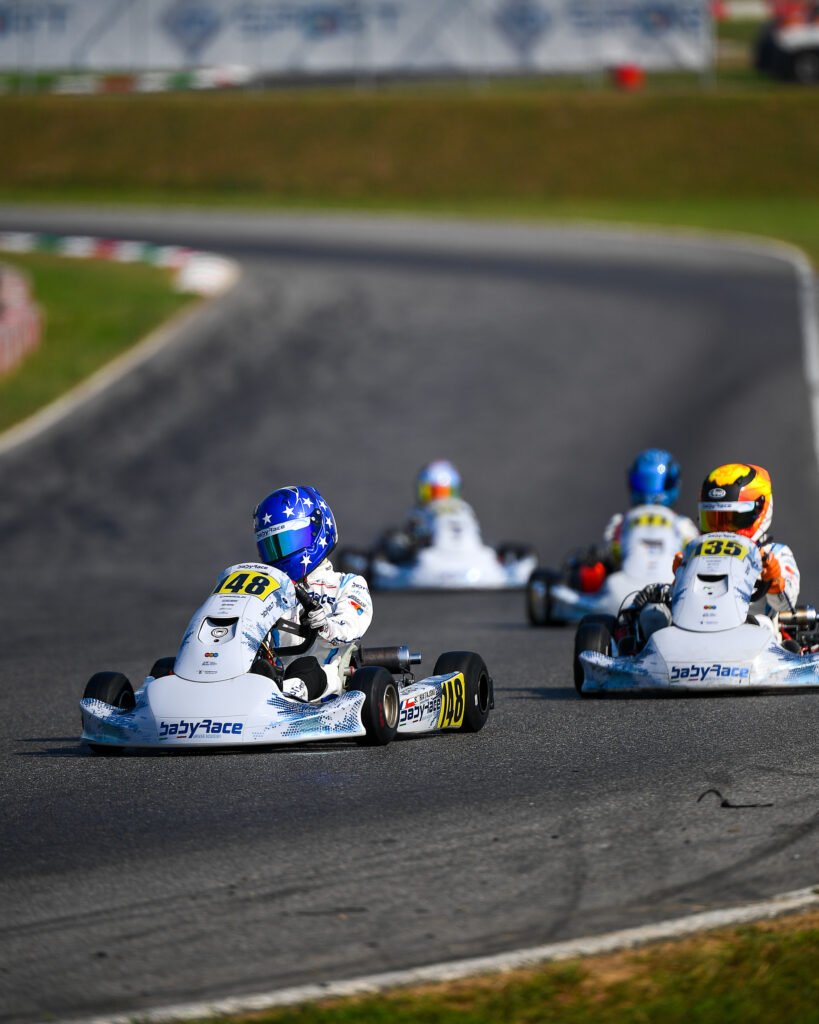
One thing is different from a road car. Your car has ABS, so you can stand on the pedal and the system looks for the limit by itself. A kart has no ABS. On a single speed kart you only brake the rear axle, and the one who has to look for the limit is you, with your foot.
I am talking about slow corners here, the ones you arrive to from high speed. A fast corner is flat, and a medium one is just a tap. So this is not a rule for every corner of the lap.
Why do most drivers never reach 100% on the brakes?
Let me ask you something first.
Imagine you are driving your road car at about 50 km/h. A cyclist falls 30 metres in front of you. There are cars coming the other way and nowhere to go.
What do you do? You slam the brakes as hard as you can. You feel the pedal vibrating because the ABS kicked in. And if the car has not stopped yet, your instinct holds that pedal at max pressure until it does.
So how come under a big threat your instinct does the right thing, while on your usual racing day you rarely get close to that 100% braking efficiency?
Sometimes I just can’t explain that to myself. But I see where it comes from. Fear. And fear is like a handbrake.
You brake early because it feels safe. You are not locking up, you are not running wide. Then you come off the pedal too early and roll into the corner. It feels smooth and it is slow.
If you brake with 60% effort and then roll into the corner, you will never find the real braking point. You cannot move a braking point later when you do not know yet how hard the kart can stop.
How hard can a kart actually brake?
More than you think. Let me give you my own numbers.
In my KZ at Franciacorta, at the world championship, I pulled 1.8 to 1.9 G of longitudinal deceleration on the braking for turn 5 and for turn 13, the last hairpin. A KZ has front brakes, so that is the top end of karting.
When the grip was low, the same two braking zones gave me 1.6 to 1.7 G. Same driver, same kart, same corners. That gap is the threshold moving with the track.
A single speed kart is a different story, because it only brakes on the rear. In a Mini Gr.3 session at Lonato that I analysed, the same driver got up to 0.83 G in the race against 0.70 to 0.80 G in qualifying. He used the brakes way more in the race. I believe braking like that in qualifying, with more grip on the track, would have found him half a tenth or a tenth in that corner.
And think about what a hairpin asks from you in a racing kart: you may go from 130 km/h all the way down to 50 km/h. That is 80 km/h to lose in one braking zone.
What decides how many G you pull? I look at five things: the track conditions, the tyres, the brake system and pads, the grip of the chassis, and your driving. Only the last one is free.
What does the threshold feel like from the seat?
You hear it before you understand it.
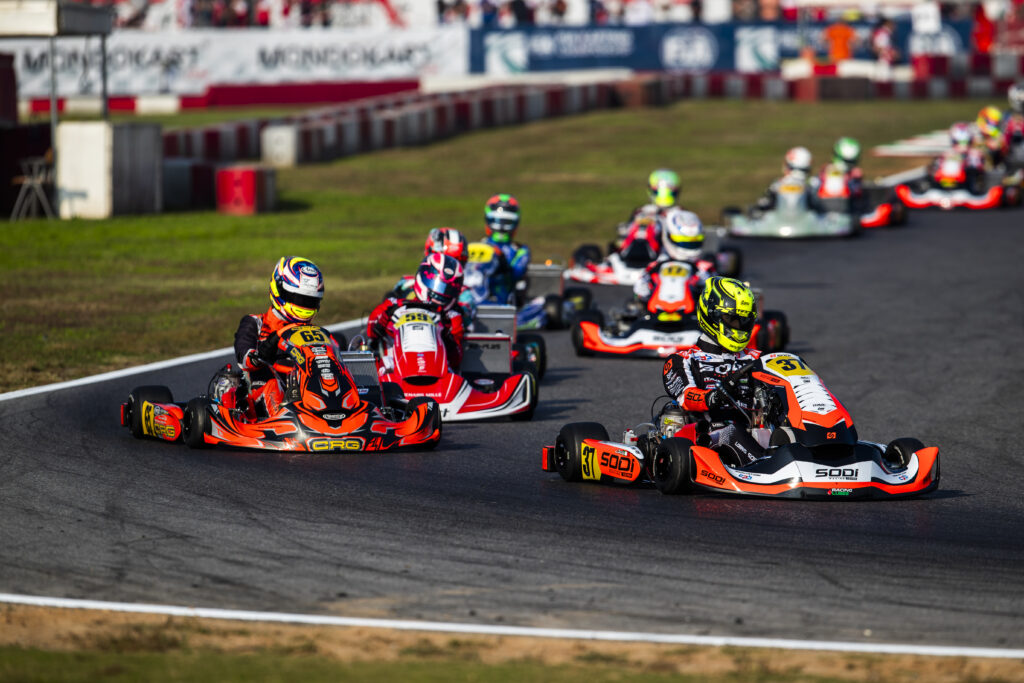
You hit the pedal hard and the rear tyres lock. You hear the noise of the tyres on the tarmac.
Most drivers read that as a mistake. I read it the other way. When the rear tyres lock, it means you braked at the highest pressure that the grip level allowed you to stop with. You asked the tyres everything they had.
Take the mechanics corner at Lonato. You hit the pedal hard, you feel the tyres locking, and you keep the pressure until turn-in. That feeling is what you are looking for.
And by the way, once you get used to it, it gets fun. You start to chase that lock.
You can also see it afterwards in the data. In that Mini Gr.3 race at Lonato the middle of the second hairpin is about 8,100 RPM. Where the driver locks the tyres, the RPM drops to 7,600. And there is a massive spike on the trace right where he locks under braking.
How do you find the braking threshold?
You go and look for it on purpose. This is the drill I give to drivers who are afraid of braking hard.
- Pick a random test day with an open pit lane. Not a race weekend.
- Choose the heavy braking zones of the track, the slow corners after a straight.
- Brake as hard and as late as possible. Lock those brakes.
- Even if you spin, whatever. You are there to find where it is.
- Forget the stopwatch. Even if your lap times are so much slower, you don’t care.
That is the whole drill.
Because if you have never gone past the limit on the brakes, you have never actually found it. You only know where you feel comfortable.
In one or two days of doing this braking drill you become a monster on the brakes.
Then you bring it into your normal driving. On lap 1 and lap 2 you get a feel for the limit. Once you have sensed to what extent you are able to stop the kart, then it is time to push the braking points further and further. No more early brakes and then releasing too early.
No track day this month? You can practise locking the tyres in an empty parking lot or a warehouse. Never on the road.
Why do you spin when the rear tyres lock?
This is the part nobody tells you.
The lock is not what spins you. Here is what happens: you brake hard, you hear the tyres locking, and then you panic and you turn the steering. The steering is what makes you spin.
So the fix is simple to say. You know that the rear tyres lock. You know you need to keep the steering straight. And you just hold on to the brakes.
Straight hands, hard foot.
If even that scares you, the brakes are not really your problem. It is car control. Go drive in the rain. Practise sliding. Once your hands know what the kart does when it moves around, the hard braking stops being scary.
I learned to ride a bicycle with the small extra wheels and my father holding me. You take the extra wheels off one step at a time. Braking is the same. You expose yourself to the lock a little more every run, and one day it is normal.
Does the threshold stay the same every lap?
No. And this is why you cannot learn it once and forget about it.
Everyone can brake on the limit once. Doing it every single lap over a 25 lap race is what separates the great drivers from the good ones, because the limit keeps moving under you:
- The first two or three laps. Tyres and brakes are cold, and the kart is about three kilos heavier with the fuel.
- Lap five to eight. This is normally where the grip peaks.
- Lap 17 to 19. The tyres start to go off and the kart stops less.
A cold disc alone gives you less braking efficiency. Even in summer it takes one or two laps out of the pit lane before the brakes bite like they should.
The track changes it too. I was watching the KZ world championship race in Le Mans, and in the first laps the track was super slow. Drivers were fighting, going on the grass and bringing grass and dirt back onto the track.
So the threshold is something you ask the kart again every time you go out. You will be your own data engineer, and your mind will be your computer.
How does threshold braking change in the wet?
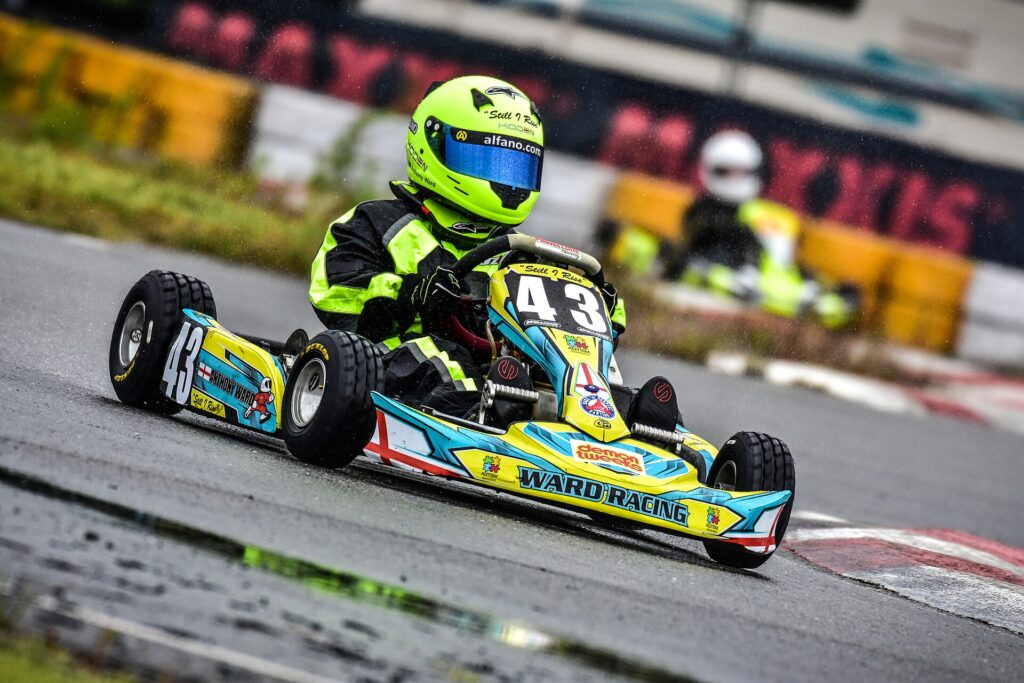
In the rain you need more skill on the brakes, not less courage.
First, understand how much less grip there is. At Lonato, wet against slicks, you carry 15 to 20 km/h less minimum speed at the apex.
So the threshold comes much earlier in the pedal. And here I tell my drivers something that sounds like the opposite of the dry: it is how efficient you brake that counts, more than how hard. In that case you would probably be better off braking 20% less in terms of peak braking, but then holding it for longer.
The second thing is where you brake. In the wet the rubbered line is the slippery one. I see drivers applying the right technique, braking hard and locking the tyres, but in the wrong place. It is like trying to ski in the ocean. Brake in the middle of the track or on the inside, where the tarmac still has some bite.
What changes with front brakes in a KZ?
A KZ has front brakes as well as rear brakes, and that changes the picture.
With front brakes you have to brake as straight as possible. And you set the bias mostly on the fronts. In KZ the brake bias is something like 60/40, or even 65/35.
Why? Because with too much on the rears you end up locking the rear tyres a bit, and in a KZ that gives you instability. If something has to lock, you want it to be more on the front. I wrote more about the brake bias I run on a KZ, and why a shifter needs the front brakes at all.
By the way, actually locking the fronts is rare. Most of the time what you feel is more like a vibration. It happened to me in the wet and on a formation lap.
And be careful with the gears. Aggressive downshifts lock the rears too. If I catch myself relying too much on the engine braking to stop the kart, there is probably something that is not well: the pads, air in the system, or the grip.
What if your kart will not let you brake that hard?
Sometimes it is not you.
If you push the pedal and the kart never gets to the point where the tyres lock, check the kart before you blame your foot:
- Bleed the system. You want to be sure there is no air in your braking system.
- Look at the pads and the disc. Finished pads will not stop you.
- Look at your tyres, and put on new ones when needed.
And one small thing I see a lot with beginners: the shoes. Running shoes with all that foam under the sole kill the feeling of the pedal. Use the thinnest shoes possible, and proper race boots as soon as you can.
What is the difference between threshold braking and trail braking?
They are two parts of the same braking zone.
Threshold braking is the first part. Maximum pressure, in a straight line, as hard as the grip allows.
Trail braking is what happens after. You keep some pressure while you turn in, so the minimum speed arrives at the apex and the front stays loaded. I wrote about that part on its own, so I will not repeat it here: the art of trail braking in karting.
What matters is the order. If the first hit is weak, there is nothing to trail. You arrive at turn-in already too slow, and then you go on the throttle too early because the kart feels dead.
So get the first part right. The second one comes much more naturally after.
Can data show you where the threshold is?
It can confirm it. It cannot teach it to you.
Data is a lagging indicator. You only see it afterwards, and the threshold is something you have to feel in real time, lap after lap. No post-session screen will press the pedal for you.
But here is what I check after the session:
- Longitudinal G. The more negative the value, the more you brake efficiently and hard. Compare your own sessions, like the 0.83 G against 0.70 to 0.80 G at Lonato.
- RPM. A sudden drop below your normal minimum for that corner, with a spike on the trace, is a lock-up.
One honest note. I am not showing you a brake pressure trace here. In the WSK and CIK races in Italy you cannot run a throttle and brake sensor. If you would rather have the session read for you, I built PURPL: you upload the MyChron file from the session you just drove, and it hands back the three things to change next time out.
The three decisions your brain makes every time you hit the pedal are in inside the mind of a driver during braking. And if your problem is still braking too early, start from how to fix your braking technique.
- All my driving technique articles are in the karting technique guides.
- What to do with the pedal after the first hit: trail braking in karting.
- Not sure if you are at 80% or at 100%? Send me your onboard and I tell you in an onboard review.
Next time you are out on a test day, take one heavy braking zone and go look for the lock. Straight hands, and hold on.
Frequently asked questions
What is threshold braking in karting?
It is braking at the highest pressure that the grip level allows you to stop with. I call it 100% braking efficiency. In a kart there is no ABS, so you find that point with your foot, and the rear tyres locking are the sign that you got there.
Is locking the rear tyres bad in a kart?
Not when you are learning where the limit is. If the rears lock, you braked at the highest pressure the grip allowed. What spins you is turning the steering when you hear the lock. Keep the steering straight and hold the brakes.
How many G can a kart pull under braking?
In my KZ at Franciacorta I pulled 1.8 to 1.9 G into turn 5 and turn 13, and 1.6 to 1.7 G with low grip. In a Mini Gr.3 session at Lonato the same driver reached 0.83 G in the race against 0.70 to 0.80 G in qualifying.
How do I practise threshold braking?
Take a test day with an open pit lane, pick the heavy braking zones, and brake as hard and as late as possible until the tyres lock. Do not look at the lap time. One or two days of this drill changes how you brake.
Send your onboard footage. Alessio reviews it corner-by-corner and tells you exactly what's costing you time, and how to fix it. Back within 48 hours.
Get My Onboard Reviewed → Reviewed personally by a CIK FIA World Champion, never an assistant.I promise I'll not spam you with repurposed shitty AI content but real experiences that only I, Alessio Lorandi, experienced. Written in my funny English-Italian tone of voice 😂
Alessio Lorandi is the former CIK FIA World Junior Champion, winning against Lando Norris in 2013 & F3 multiple race winner. He's helped 200+ karting drivers worldwide get faster & win WSK titles with BabyRace Driver Academy & now through Senndit, his online karting coaching platform.