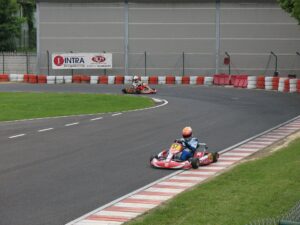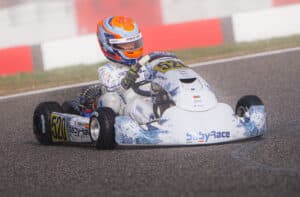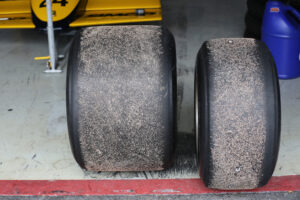
How to Choose the Right Go Kart: Class, Size, New vs Used
Picking the wrong kart wastes months. Here's exactly which one matches your level and goals.


- There is no one size fits all. The right kart depends on your age, your size, your goal and your budget, in that order.
- Start in a single speed, direct drive kart. 60 Mini for a kid. Junior or Senior in Rotax, X30 or Rok for everyone else.
- Look at what races at your track first. Countries do not run the same categories, so that already cuts the list.
- Weight closes the door before age does. I am about 68 kilos with kit and I am too heavy for OK. X30 and Rotax are more flexible on minimum weight.
- A shifter is not a first kart. At Lonato a KZ is about half a second faster than an OK senior, with front brakes and gears on top. Driving a manual road car does not prepare you for it.
- Testing the water? Buy used. Committed and sure of the chassis brand? Buy new.
- Expect 2,000 to 4,000 euros for a first kart with its engine. About half of it is the engine.
- Never cheap out on the chassis. You lose less performance with a used engine than with a used chassis.
- How do you choose the right go kart?
- Which kart should a beginner start in?
- Which kart classes actually race at your track?
- How do age, height and weight decide your kart?
- Can a beginner go straight into a shifter kart?
- When should you move up to a shifter kart?
- Should your first kart be new or used?
- What do you check before buying a used kart?
- How much does a first go kart cost?
- Chassis or engine: where should the money go first?
- How do you pick the chassis brand?
- Do you need your own kart to start at all?
- Frequently asked questions
- So which go kart is right for you?
Let’s face the truth for a second.
Choosing the right go kart can feel a bit overwhelming, especially when you’re just getting started. You hear names like Rotax, X30, shifter thrown around all the time, and everyone’s got a different opinion.
I’ve been there too. And I still am, by the way. Every time I buy a KZ kart for myself, I still wonder: new or used?
So here is how I would choose, if I were you.
How do you choose the right go kart?
There’s no one size fits all. It all depends on your experience, your age, your goals and your budget.
The way I would go about it is in this order:
- What races at your track. You can only choose between the classes that actually run near you.
- Age and size of the driver. Age decides which classes you are allowed in. Weight decides which ones make sense.
- Your goal. Club racing for fun is one thing. Going for WSK or CIK-FIA is another.
- Your budget. New or used, and where the money goes first.
Notice what is not on the list. The horsepower. A faster category is only better if you have the skills and the experience to take it on. If you don’t, the best decision is to stick to a slower kart until you are ready.
Which kart should a beginner start in?
A single speed, direct drive kart. Two pedals and a steering wheel, no gearbox.
If you’re a kid, that is 60 Mini. That’s almost the only thing you’re allowed in anyway.
If you’re starting at 15, 18, 20 or 30 years old, it’s a Senior kart. Rotax Senior, X30 Senior, Rok Senior or OK Senior. If you’re between 12 and 14, a Junior in the same families.
Why single speed? Because it teaches you the fundamentals best. You have to make the corners as round and as wide as possible to keep the RPM and the minimum speed up. And you have to brake late and hard. There’s no gear to save you on the exit. So every time you kill the speed, the kart punishes you.
That’s the school. Racing lines, consistency, and building confidence with speed, without getting overwhelmed by too much power.
I go through every category by age in best beginner kart classes explained.
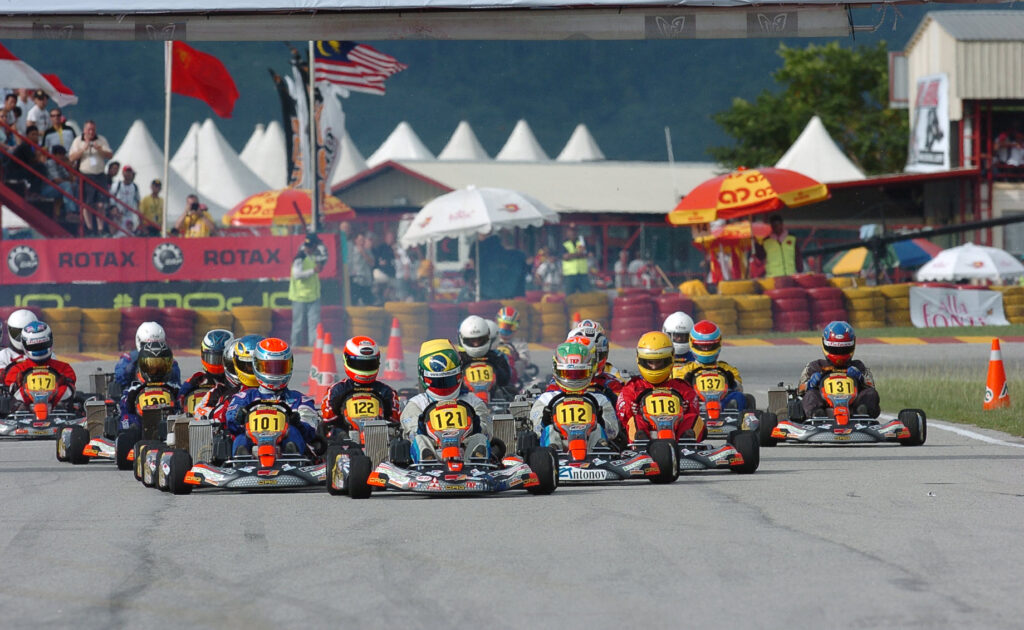
Which kart classes actually race at your track?
First thing. You probably cannot choose between all of them.
In the U.S. there may be categories that we do not even have in Europe. And the other way around. So before you compare engines, look at what actually races at your track and at your local club.
Once you pick the series, the class names follow. In the IAME X30 series you choose between Mini, Junior and Senior X30. In Rotax it’s Mini, Junior, Senior, and then DD2. Rok has Mini, Junior and Senior too.
X30 or Rotax? On my ladder they sit on the same step, with Rok next to them. I would not choose on the engine. Look at which one actually races near you.
And don’t look down on them. At BabyRace the first racing step after our camps is the IAME Series in Italy. In a race week my drivers do roughly 100 laps per day. In a WSK, if you are lucky, you get 30 to 35. X30 and Rotax are less competitive than CIK or WSK level, but they are more affordable. The karts, the engines, the maintenance. Everything is a bit easier on your pockets.
I put X30, KA100, Rotax and LO206 side by side, with the numbers their makers publish, in X30 vs KA100 vs Rotax vs LO206.
How do age, height and weight decide your kart?
Age is the major aspect. If you are eight years old, you drive 60 Mini. If you are 14, you are not allowed in 60 Mini anymore.
Only the junior classes have a ceiling. Senior has a minimum age and nothing above it. So you can even start in your 30s, there’s no rule against it. Rotax also has a Masters class from the year of your 32nd birthday, and some clubs run their own classes for drivers above 30 or 40. Check your local club. More on that in can adults start karting late.
But listen. Weight closes the door before age does.
Take me. I am only about 68 kilos with kit, and I am too heavy for OK. If you are two to four kilos over the minimum, there is no point racing. X30 and Rotax are more flexible in terms of minimum weight. The Rotax Senior MAX minimum is 162 kg, kart plus driver, in the 2026 global regulation.
For kids it works the same way. At 11, in Europe, my answer is often one more year in Mini. OKNJ exists for the kids who are already too tall or too heavy for a 60 Mini. That’s a real reason to move up. Wanting a head start is not. If your kid is not too tall and not too heavy, it is almost better to stay in Mini for one year more. The full path by age is in the karting ladder from 6 to 16.
Can a beginner go straight into a shifter kart?
As an adult, you can. Nobody stops you. There’s people who’ve done that.
But I would not recommend it. The jump from not being a karting driver straight into a shifter kart is quite shocking. They’re a lot of fun, but they’re also super physical and technical to handle.
“But I drive a manual car, I know gears.” I hear this a lot. It’s very, very different. Very, very far from the actual driving experience of a shifter kart. You have the gear lever, you have to lift off the throttle when you shift up, and you have front brakes. That’s a lot more to think about than two pedals and a steering wheel.
The way I see it, there are two approaches:
- Step by step. Start with something easier, master your lines, build your speed gradually.
- Dive in headfirst. Go straight into a high performance kart and learn the hard way. Not wrong, just a bit riskier. If you go this way, you have to be not afraid to struggle at first.
For a kid there is no choice to make. Mini first, then juniors, then seniors, then shifters. That’s the natural pathway.
When should you move up to a shifter kart?
Personally, I love shifter karts. The speed, the gear changes, the challenge. It’s a lot like driving a Formula car. I preferred single speed karts back then. Now I prefer the shifter.
But I’ve been through F3 and F2, so I had already put in years of experience.
Some numbers so you understand the gap. At Lonato a KZ is about half a second faster than an OK senior. At the 2025 CIK-FIA World Championship at Franciacorta I was pulling 1.8 to 1.9 G on the brakes into turn 5 and turn 13. Minimum weight is 175 kilos in KZ2, against 145 for a junior and 150 for a senior.
And it costs more. The shifter is the most expensive class. You rebuild the engine way more often, at the 2025 World Championship the piston was replaced every heat. You change brake pads front and rear more often, and the tires go faster, because with more power and more weight comes more wear. On an X30 or a Rotax the piston maybe goes after 10 hours or so.
So when? Once you get good, you understand how it works, your lap times keep improving and you want to upgrade to something more exciting. Then go into the gearbox class, KZ2, or DD2 if you’re in Rotax. Moving up will feel natural then, and way more fun.
And if you are already in an owner kart, send me your onboard. I go through your braking and your exits corner by corner in an onboard review and I tell you where the time is.
Should your first kart be new or used?
I ask myself this question every year with my own KZ. One year I bought a used one. The next year a new one.
Buy used if you’re testing the water. If you don’t know yet what brand or what category, or even if you like karting at all, a new kart is a mistake. You may get bored of it, or want to change brand. And a used kart is much harder to sell than one that is almost brand new. So you’re left holding the bag. A used kart costs you about 50 percent of a new one, so you get your first taste with much less commitment.
Buy new if you’re committed. If you’ve got the money, you’re going for a proper shot at karting and you know which chassis you want, go new. You start from a blank sheet, with total peace of mind.
And the moment you go into race mode, even club races, I suggest a brand new kart at the beginning of the season, and then you use it for the whole season. A new frame and new components give you more grip.
Is new really faster? Yes, most of the times. The tube is more reactive and a bit stiffer. A brand new kart can need a session or two to wake up, but after a day it’s normally quicker. A fresh used kart with one or two races on it is almost identical to new. After a full season, in a shifter at a track like Sarno, I would guess the used kart is about a tenth slower. It’s very hard to measure.
All the details are in used vs new kart: what to buy first.
What do you check before buying a used kart?
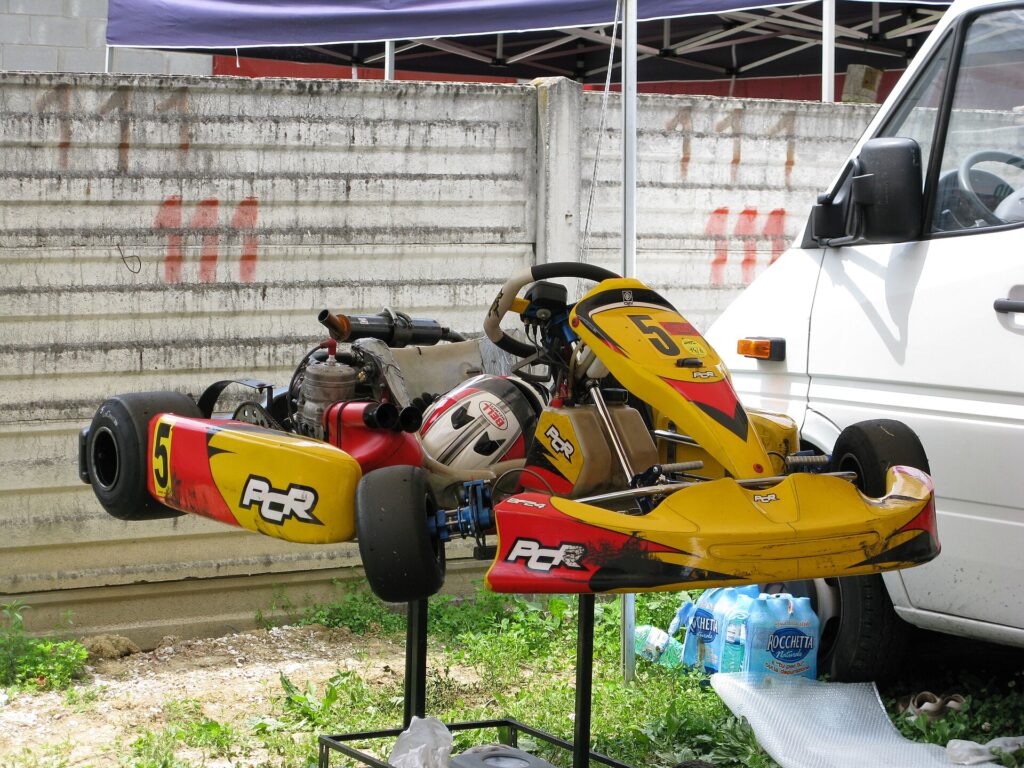
The tube. That’s the first thing. Ask the seller to put the kart up on a stand and send you pictures from the bottom, especially the tube close to the engine.
- Cracks. Big red flag. Don’t continue the conversation with that seller.
- Paint completely gone. Maybe not cracked, but it tells you the kart is very old and very worn. I wouldn’t go with that either.
- How many races. One or two races is a different kart from a full season with 5,000 laps on it.
Because if the tube is finished, you may still do a couple of sessions. Then you hit the kerb, it cracks, and you find yourself holding the broken kart that nobody wants anymore.
Then budget for what comes after. Bearings, brake fluid, brake maintenance. And if the engine comes with it, check whether it needs a new piston and rings. More on that in karting maintenance basics.
How much does a first go kart cost?
Coming from rental karts, where you pay about 25 euros for 15 minutes, this is where it changes.
A first kart with its engine is about 2,000 to 4,000 euros. About 50 percent of that is the engine.
A kart meant for club racing, bought new, is about 2,500 euros for the chassis and another 2,500 for the engine. About 5,000 euros, before the telemetry device. A used one is roughly half.
And that’s only the start. Once you have your own kart you pay the track tickets, the fuel, the maintenance, the tires and maybe a mechanic. And your own helmet, rib protector, race suit, boots and gloves, because in rental karts you don’t need any of that.
The full year is in how much karting costs per year. The cheapest way in is in cheapest way to start kart racing.
Chassis or engine: where should the money go first?
The chassis. Never cheap out on the chassis.
I think the biggest waste of money is spending too little on your own kart. You save 50 percent on a beaten up kart and then you lose so much performance down the road. You ironically end up paying more than if you just bought a brand new one.
If I had 5,000 euros today, this is what I would do. I would look for the best chassis brand for the specific category I race in, and buy it brand new. I would try to get a discount from the reseller. Then the engine: I would not buy a new one. I feel you lose less performance with a used engine than you do with a used chassis.
So, my strategy, and what I’ve been doing all my career:
- Testing days: your own engine, ideally an X30 or a Rotax, because the maintenance is super low. No mechanic, used tires. You can do a day for about 150 euros.
- Race days: rent a proper race engine from a proper tuner.
One thing, though. You cannot compensate a poor engine with a brand new chassis, and you cannot compensate a worn chassis with a great engine. If you want to perform at the really high levels, both have to be maxed out.
How do you pick the chassis brand?
The best brand is not the same in every category. The one that is strongest in 60 Mini is not the one that is strongest in shifters, or in juniors. So buy the best chassis built for the category you race in, not just any decent kart.
And don’t buy new until you are sure. If you’re not quite sure about a brand, you don’t have to marry it. Buy a used one from that brand first, for around 2,000 euros instead of the 4,000 to 4,500 of a new one, and see if you really like it.
Do you need your own kart to start at all?
No. A lot of drivers start with rental karts for their first year and they are also very successful.
The skills carry over. Racing lines, braking late and hard, smooth steering. What rental karts don’t give you is the speed, the grip and the G-forces, so at some point your progress stops.
Me? I started immediately in owner karting, because my father was a pro karting driver himself. Both ways work.
When to make the move, and what changes when you do, is in rental vs owner karting explained.
Frequently asked questions
What is the best go kart for a beginner?
A single speed, direct drive kart. 60 Mini for a kid, and for a teenager or an adult a Junior or Senior kart in Rotax, X30, Rok or OK, depending on age and on what races at your track.
Should a beginner buy a shifter kart?
Not as a first kart. An adult is allowed to, but the jump is quite shocking: at Lonato a KZ is about half a second faster than an OK senior, it has front brakes and gears, and driving a manual road car does not prepare you for it. Start in a single speed kart and move up once you get good and your lap times keep improving.
Is it better to buy a new or used go kart?
Buy used if you are testing the water and not sure about the brand, the category or karting itself. Buy new if you are committed and know which chassis you want, ideally at the start of the season.
How much does a first go kart cost?
About 2,000 to 4,000 euros including the engine, with the engine about half of it. A new kart for club racing is about 2,500 euros for the chassis and about 2,500 for the engine. On top come track tickets, fuel, tires, maintenance and your own safety kit.
Which kart class fits a heavier driver?
X30 and Rotax are more flexible on minimum weight than OK. At about 68 kilos with kit, Alessio Lorandi is too heavy for OK. The Rotax Senior MAX minimum is 162 kg for kart and driver in the 2026 global regulation, and a shifter is heavier still at 175 kg in KZ2.
So which go kart is right for you?
- If you’re new: a single speed kart. X30, Rotax or Rok, in whatever races at your track. Mini if you’re a kid.
- If you want a challenge: a shifter, but be ready to put in the work. I would still do a season in single speed first.
- If you’re experienced: pick something that matches your skills and keeps pushing you.
- If you’re not sure you’ll stay: used. If you’re committed and know your brand: new, at the start of the season.
Remember. The right class at the right time builds skills and shapes your driving abilities. The wrong class builds frustration. Don’t cut the steps.
And whatever kart you choose, the important thing is to master your lines, progress each time and get as many laps in as possible. That’s where real progress comes from.
More for drivers starting out is in the beginner guides.
Just Senndit, Alessio
Already driving and want me to look at how you drive? Send me your onboard for an onboard review, or work with me for six months in the 6 months transformation.
Send your onboard footage. Alessio reviews it corner-by-corner and tells you exactly what's costing you time, and how to fix it. Back within 48 hours.
Get My Onboard Reviewed → Reviewed personally by a CIK FIA World Champion, never an assistant.I promise I'll not spam you with repurposed shitty AI content but real experiences that only I, Alessio Lorandi, experienced. Written in my funny English-Italian tone of voice 😂
Alessio Lorandi is the former CIK FIA World Junior Champion, winning against Lando Norris in 2013 & F3 multiple race winner. He's helped 200+ karting drivers worldwide get faster & win WSK titles with BabyRace Driver Academy & now through Senndit, his online karting coaching platform.