The Racing Line in Karting: Why a Kart Is Not a Car
The racing line is the path your kart takes through a corner. Here is why a kart, with no differential, needs a different line from a car, corner b…


- The racing line is the widest arc you can make through a corner. Open up the entry, be tight at the apex, open up the exit.
- A kart has no differential. It rotates on three wheels, and the inside rear only lifts if you carry speed. That is why a single speed kart wants an open corner.
- The late apex is a bit of a myth in karting. The faster the corner, the earlier the apex. The slower the corner, the later the apex.
- Use as much track as possible, until it is too much. The limit is the white line, the grass, or a kerb with less grip.
- The exit is a consequence. 90% of the mistakes in a corner start from the entry.
- A shifter does not take the same line in the slow corners. With front brakes and gears it is more of a V shape.
- The line with the most grip is often not the theory line. Banking, rubber and rain all move it.
- What is the racing line in karting?
- Why is the racing line different in a kart?
- How much track should you use on the entry?
- Where is the apex, and should it be early or late?
- What is the mid corner for?
- How do you get a good exit?
- Should you use the kerbs?
- How does the line change in a chicane?
- How do banking and elevation move the line?
- Does a shifter kart take a different line?
- Why is the fastest line not always the theory line?
- How do you learn the line on a new track?
- How do you know if your line is the problem?
- Frequently asked questions
So, what is the perfect racing line?
So, you’re trying to get quicker on track, right?
You’re probably asking yourself, “What’s the perfect racing line?” or “How do I find it?”
Well, well, well.
There is such a thing as a perfect line, but here’s the catch: it really depends on the corner, the kart you’re driving, and even the track layout itself.
On top of that it will depend on the current track conditions, as a slippery session may require slightly different lines than a session with lots of grip.
Some tracks have kerbs you can use on entry and exit, while others don’t, sometimes there’s just grass after the white line!
And there is one more thing. A kart is not a car, and the line is not the same. I will tell you why.
What is the racing line in karting?
The racing line is the path your kart takes through a corner, from the braking point to the next straight.
So what’s the goal? Well, it’s quite simple:
You want to open up the corner as much as possible.
- Widen the entry to the limit of the track (using the entry kerb if it can be used).
- Get the “Perfect” turning point to apex at just the right place.
- And open up the exit completely using all of the kerb available (not for shifters).
That’s pretty much the recipe.
If you can do that, you’ll carry way more entry speed and maintain higher mid-corner speed, which is key, especially in categories like Mini, Junior, or Senior where you don’t have gears to help you recover from slow exits.
I want you to visualize a corner as an arc. As wide open as possible on the entry and on the exit, and as tight as possible in the mid corner. That is line theory 101: open up the entry, open up the exit, minimize the distance from the apex.
Why does it matter so much? Because the first thing a driver needs to master is the racing line. There is no way you can be fast if your racing line is wrong.
And I believe track usage is the single biggest driving hack to find lap time. You need to use every single inch of track available that makes sense to use.
Why is the racing line different in a kart?
Because there is no differential in karts. In formula cars and GT cars, there is.
What does a differential do? In a corner the outside wheel travels on a longer arc than the inside one, so it has to turn faster. The differential allows that. A kart has a solid rear axle, so the two rear wheels turn at the same speed.
So the goal, to rotate the kart as fast as possible, is to make the turn on three wheels. The inside rear wheel has to lift.
And how do you lift it? Try lifting up the inside rear wheel when you are going slow into the corner. It is just literally impossible. The only way to lift up the rear wheel is by carrying a truckload of speed.
It feels counterintuitive. If you carry less speed, you feel like you are going to get a better exit. But the reality is that you get a worse rotation.
In a single speed kart, the only way to keep the momentum, and of course the RPMs, is to open up the corner arc as much as possible. The U shape is the way to go for single speed karts.
And the late apex everybody talks about? In karting that is a bit of a myth. It comes from very high powered cars like Formula One. In a kart you are almost making it rotate with the speed that you carry.
One note. You chase that inside rear lift in the slow, tight corners and the hairpins. Not in the fast ones.
I go deeper on the three wheels in weight transfer in a kart.
How much track should you use on the entry?
As much as possible, until it’s too much.
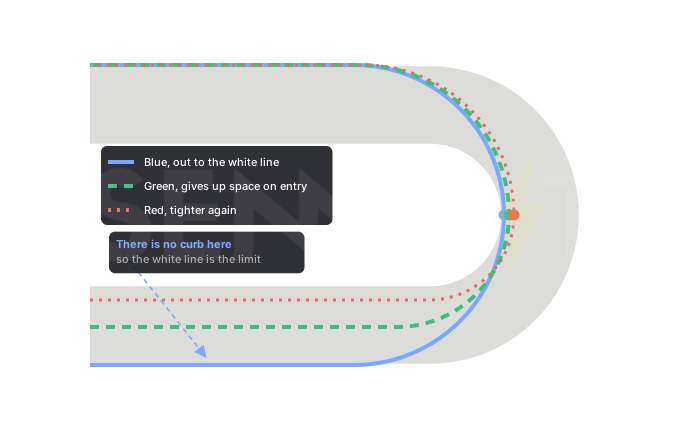
Let me give you an example. The last hairpin at Franciacorta. There is no kerb on the entry there, so the white line is the limit. I compared two drivers on the GPS overlay. One went out to the white line. The other one gave up some space on the entry.
The result? The second driver was five kilometres per hour too low in the mid corner. 55 against 60. And 500 RPMs less.
Just from the entry width.
So the line is how you keep the minimum speed up. I show you how to read it in the data there.
But Alessio, the tight line is shorter. Yes, it is. Time is equal to distance divided by speed. On the tight line you make less distance, but the speed is so much lower that you lose anyway.
So where does it become too much?
When you go past what we have been given. If you put a wheel on the grass, you go straight on. If you go wide onto the dirty part, you are making more metres with no extra speed. And when there is a kerb on the entry, like at turn two of the same track, use some kerb, but not too much, because there is less grip out there.
So it’s not true that you should always use the track to the maximum. You use what gives you speed.
Where is the apex, and should it be early or late?
The apex is the narrowest point across a corner. The narrowest inside part of the track. It is also the area where there is more grip, so don’t miss it by a metre. Out there the tarmac is dirtier.
Then you have the geometric apex, which is the theory, and the early and the late apex on either side of it.
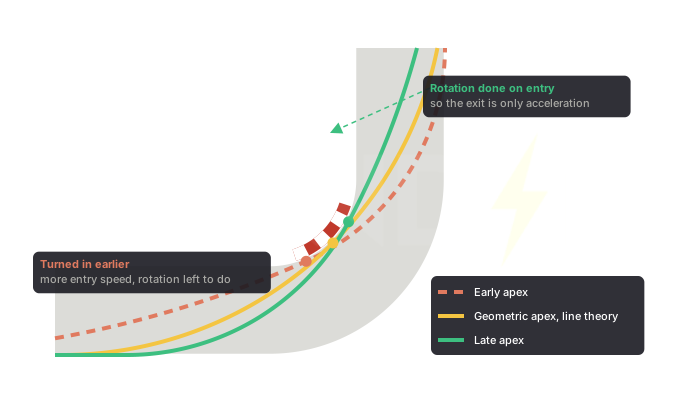
Which one is right? My rule is this: the faster the corner, the earlier the apex. The slower the corner, the later the apex.
And then you let the data decide. Delta time, that is our religion.
- If you are losing on the exits, you need a later apex and more rotation on the entry.
- If you are losing on the entries, you need to carry more speed and turn in earlier.
- If the exit is narrow, go for a later apex.
- If you are overtaking, you will apex earlier.
Why do beginners always apex early? Because they brake early. And when you brake early, you always turn early.
The other reason is understeer. When the front does not turn, you are tempted to turn in sooner. It is a survival mechanism in your brain.
You don’t have to reinvent the wheel here. Look at where the fast drivers put their apex in that corner and start from there.
By the way, I put the four of them on one page you can print. Late, early, mid and double apex, and when to use each. You can get the free apex cheat sheet and keep it at your kart stand on race day.
What is the mid corner for?
I split a corner in four zones. Straight line braking, SB, I like to call it. Then the entry, where you are holding the brakes and turning. Then the mid corner. Then the exit.
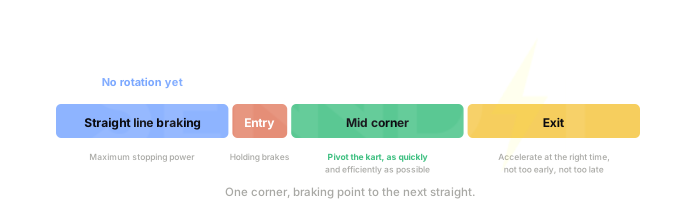
And it’s not symmetric. By the time you get on the gas, it is already starting to be the exit phase.
The mid corner goal is to pivot the kart as quickly and as efficiently as possible. This is where the highest rotation happens.
How do you rotate? There are four ways: the steering wheel, the pedals, the speed and the setup. And the best way to rotate the kart is not really with the steering wheel. It is with your braking and with the speed.
The two work together. If you have the speed but you don’t hold the brakes, you go straight and you miss the apex. If you hold the brakes but you have no speed, the kart turns too tight and too early.
And between the brake and the gas, I always say to my drivers that I want a transition of 0.1 seconds. Maximum 0.2. In that moment the kart loads laterally, it flexes, and then it springs you out. If you go on the gas too early, you put both rear wheels down and the kart pushes.
It just works out better to be on three wheels in the mid corner rather than on four.
This counts mostly for the twisties, the slow corners and the hairpins. More on those in tight turns and hairpins and in where you want to rotate.
How do you get a good exit?
You don’t get it on the exit. The exit is a consequence.
Five elements decide it: the braking point, the braking efficiency, the turning point, the mid-corner rotation and the throttle pickup point. In that order.
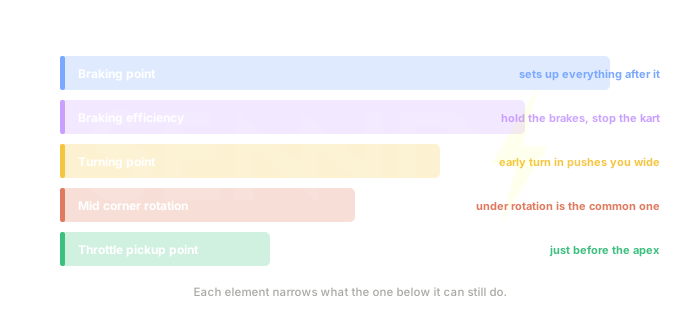
If you mess up the entry, you mess up the exit. Period.
And the myth that the earlier you brake, the better your exit? It’s bullshit. If you brake too early, you turn early, you go on the gas early, and you get pushed out wide. Then you have to lift, or put too much steering and scrub the speed.
If you brake too late, you miss the apex and you delay the throttle. So both are wrong.
What do you do with the exit itself? Let the kart run out wide.
If you make your corner too tight on the exit, you’ll choke the engine and lose all that precious speed and thus lap time.
And you go on the gas a little bit before the apex, at the peak of the rotation.
So should you ever prioritize the exit? Yes, in the corner that sets you up for a long straight. Think of long tracks like Sarno, Zuera or Franciacorta. There you can trade one metre of braking to be one metre earlier on the gas. One metre. Not ten.
Everywhere else, the goal is to make both. A fast entry on the limit and a good exit.
More on the braking side in the art of trail braking.
Should you use the kerbs?
If the track allows it, use all the tarmac and the kerbs available.
Go really wide on entry, opening it up, then cut in tight to the apex (but not too early or too late), and then let the kart run out wide on the exit, using every bit of kerb if it’s usable and not too aggressive or dirty.
Why? Because the reason for a kerb is the same reason as the line. To open up the arc of the corner as much as possible. This way, you keep the RPMs higher, especially in single-speed karts.
So most of the entry and exit kerbs should be used. The apex kerbs are the opposite. 95% of the times you won’t be able to use them.
When do you stay away from a kerb?
- When it is too dirty.
- When it is too steep, so the kart bottoms and drags.
- In the wet, when it holds a puddle.
- When it pushes you out before the next corner.
The last one is Lonato. I live 35 minutes from there and I have been driving there for 20 years, since I was six years old. At the first and the second hairpin you don’t use the exit kerb, because another corner is coming. At the third hairpin you do, because it launches you onto the straight.
And at the mechanics corner, which is turn four, you brake right over the entry kerb on the left, almost ditching a wheel into the grass. That kerb opens up the corner very well.
One warning. The more kerbs you use, the more kerbs you need to use. So walk the track and look at them before you decide.
How does the line change in a chicane?
In a chicane the racing line counts even more than in an individual corner. Because now you have two corners, and the first one decides the second.
Three elements make a chicane: the preparation, which is the track usage on the entry, the turning point, and the angle of the kart between the two corners.
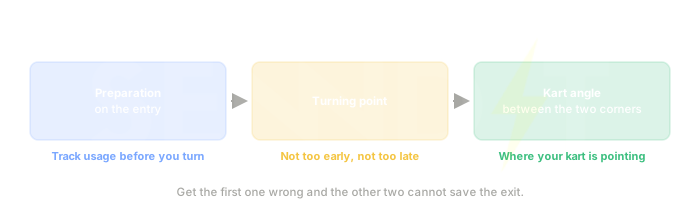
Start with the preparation. Open up. Open up. Open up. That is the goal in a chicane. As much as you can, until it becomes too much. There is always a trade off, and you don’t want to over prepare.
The most common mistake I see is exactly that one. Not opening up.
Then the turning point. If you turn too early, you bounce off the kerb and you go wide. If you turn too late, you lose the grip, you lose the rail, and you go wide as well.
Then the angle. The angle is basically where your kart is pointing between the two corners. And normally you always have to prioritize the second part of the chicane, without damaging the first one too much.
So in a tight chicane you carry a bit less minimum speed in the first part, to focus on the exit of the second. In a double apex corner it is the other way around. You carry huge speed to the first apex.
Remember, the steering wheel is a brake as well. The more you have to turn to fix the angle, the more speed you scrub.
And be ahead of the sequence. If you are late for the sequence, it’s bad.
How do banking and elevation move the line?
A lot. The theory line is for a flat corner, and most corners are not flat.
Take positive banking. Turn one at Zandvoort. I raced there two times in Formula Three, and I remember very well that you had to turn in a bit earlier than normal, because you wanted to catch the banking. So it looks like an early apex on theory. But what you care about most there is the grip.
With negative banking it is the opposite. You want to turn in quite a bit later, to stay on the lower part for longer and keep away from the area that gives you less grip.
Then the elevation.
- If the exit goes uphill, the exit is going to struggle. So most of the times you need a later apex, to straighten up the kart and get the best exit possible.
- If the exit goes downhill, you can attack the entry more. Even with an earlier apex, the hill helps you out.
It is the same in karting. On the long left at Viterbo you fall into the banking early. At Ugento the banking starts early, so you commit earlier.
And the mechanics corner at Lonato has all of it in one corner. Deep braking slightly downhill, then uphill from the mid corner to the exit, with a tiny bit of positive banking at the apex. So there you want a nice late apex.
How do you know before you drive? You walk the track.
I wrote more about this in how elevation changes and banking affect grip.
Does a shifter kart take a different line?
In the slow corners, yes.
Remember the recipe at the top. Open up the exit using all of the kerb available, not for shifters. A shifter is driven differently.
A single speed kart, a Mini, a Junior or a Senior, has no gears to recover from a slow corner. So it lives on momentum. Wide open on the entry, lots of rolling speed, a U shape.
A KZ has front brakes and gears. The brakes are so powerful that in the hairpins you want to take advantage of them. And to use the front brakes you need to be kind of straight with the steering wheel. You can’t be straight if you are opening up the line.
So in a KZ the line in the slow corners is more of a V shape. You arrive almost in a diagonal, you brake deep, you stop the kart more at the apex, and you go on the gas with the kart straight.
What happens if you drive a KZ with the single speed line? You can’t brake as late, because you can’t brake straight. And on the exit you are still super open, so the power pushes you out wide onto the kerb, or you have to release the throttle.
Don’t overdo it. You still want to carry quite a bit of minimum speed. And this is for the slow corners only. In the fast corners and in the medium ones, you drive it the same way.
If you are moving up from a single speed, the V on the brakes is the thing you have to get used to. Watch an onboard from a fast KZ driver before you go out.
Why is the fastest line not always the theory line?
Because the line you want is the one with the most grip. And most of the times that is not the geometrical, theoretical line.
That is why I tell my drivers that they are grip hunters. There is no point trying to brake as late as possible if you are not on the grip.
Where is the grip? On a dry race weekend, it is where the rubber is. In a WSK or a CIK-FIA field the experienced drivers lay the rubber down on the line, lap after lap. And there, just 10 or 20 centimetres of difference in line changes the grip level massively.
So a line that is right on theory, but with no rubber on it, is like a wet line.
And in the wet it flips. The rubber line is where there is no grip.
I learned this in 60 Mini, when I was 11 or 12. It was raining and I kept telling my mechanic that the kart was sliding on the exit. He changed the sprocket. He gave me more rear grip. Nothing. So he walked out and stood in those corners. Then he drew two lines on a map, my line and the ideal wet line. My line was always a bit too tight, almost a dry line, and I was putting the throttle down on the rubber.
So the problem was the line. The kart was fine.
The perfect line today might not be the same tomorrow. The grip moves through the day and you have to move with it.
More in racing drivers need to be grip hunters and in driving on a wet track.
How do you learn the line on a new track?
I made a video on how I analyze a track before driving it.
Here is the short version.
Walk the track. Every day, again and again. Look at the kerbs, the banking, where the tarmac changes.
Watch the other drivers. Where do the fast ones turn in? Which kerbs do they use? Again, you don’t have to reinvent the wheel.
Look from above. I use a small drone and I keep it stationary over a corner. From up there I see the whole arc, and how drivers are either opening up the lines or keeping them too narrow. I see who is apexing early. I see who is keeping half a metre from the white line. An onboard does not show you track usage that clearly.
And what do I find? Most of the time it is just a racing line issue. Check the rules of the track before you fly one, and keep it safe.
Check the data. If something feels good but the data says it’s slower, believe the data.
And then you drive. Because this is theory, and it is here for your awareness. On track we drive subconsciously. Racing is more of an art than a science.
If you want my eyes on your line, send me a lap. That is what the onboard reviews are for.
How do you know if your line is the problem?
Go back to the entry. Always.
90% of the mistakes in the corner start from the entry. And three things make an entry: the line, the speed and the inputs.
Here’s what I cringe about: when a coach or parent tells you “you’re going too wide on the exit,” that’s pointing at the symptom, not the cause. The actual problem is that you worked too tight on the entry.
So if you are a parent at the fence and you see your driver running wide on the exit, look at where the kart was before the corner. Was it out at the white line? Or half a metre inside?
The same with the mid corner. 100% of the times, when a kart has too low speed in the mid corner, it is because the entry was wrong.
I can tell you from my own karting. Turn 1 in Siena is a fast 90 degree right-hander at the end of the straight. In 2013 I found a way to make it flat while the others were lifting. How? By maximizing every single centimetre on the entry and being inch perfect at the apex, kissing the apex kerb. That made me pull about 1 tenth there every lap.
One tenth, from one corner, from the line.
And when you get it right, you feel it.
A smooth racing line means faster laps most of the times. You’re not really forcing the kart. You’re letting it flow through the corner, maximizing grip, speed, and engine performance.
You’ll also notice that when you start hitting that ideal line, entry wide, tight apex, open exit, you’ll stop scrubbing speed off and start shaving tenths off your time.
Which is what we’re all here for, right?
Just Senndit,
Alessio
- All my technique guides are in one place: technique guides.
- Send me a lap and I will show you where your line gives time away: onboard reviews.
- If you want to work on it with me for six months: the 6 months transformation.
Frequently asked questions
What is the racing line in karting?
The racing line is the path your kart takes through a corner. The goal is to open up the corner as much as possible: wide on the entry, tight at the apex, wide on the exit. That keeps your speed and your RPMs up.
Is the racing line the same in a kart and in a car?
No. A kart has no differential, so it has to rotate on three wheels, and the inside rear wheel only lifts if you carry speed. A single speed kart needs an open arc to keep its momentum. The late apex comes from very high powered cars.
Should you apex early or late in a kart?
The faster the corner, the earlier the apex. The slower the corner, the later the apex. If you are losing on the exits, go later. If you are losing on the entries, carry more speed and turn in earlier.
Should you always use the whole track?
Use as much as possible, until it is too much. The limit is the white line, the grass, or a kerb that is dirty, steep or has less grip. More metres with no extra speed do not help you.
Is the racing line different in the wet?
Yes. In the wet the rubber line is where there is no grip, so a dry line is the wrong line. You have to look for the grip away from the rubber.
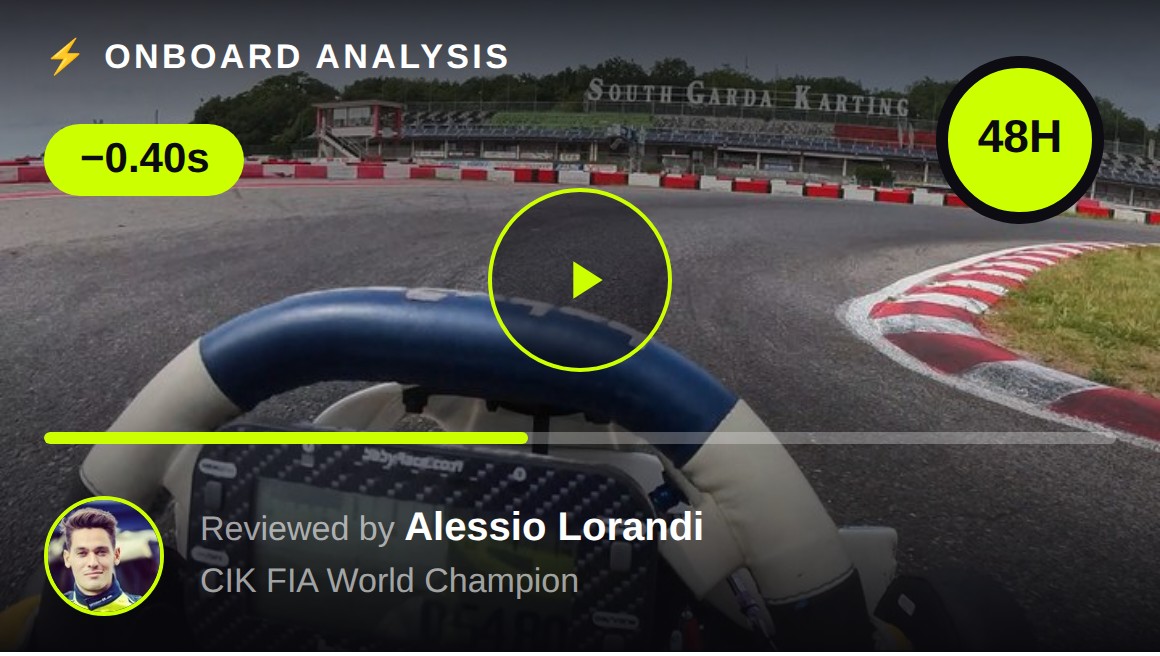
Send your onboard footage. Alessio reviews it corner-by-corner and tells you exactly what's costing you time, and how to fix it. Back within 48 hours.
Get My Onboard Reviewed → Reviewed personally by a CIK FIA World Champion, never an assistant.I promise I'll not spam you with repurposed shitty AI content but real experiences that only I, Alessio Lorandi, experienced. Written in my funny English-Italian tone of voice 😂
Alessio Lorandi is the former CIK FIA World Junior Champion, winning against Lando Norris in 2013 & F3 multiple race winner. He's helped 200+ karting drivers worldwide get faster & win WSK titles with BabyRace Driver Academy & now through Senndit, his online karting coaching platform.