How to Overtake in a Go-Kart: The Move, Step by Step
How I overtake in a kart: set up the move, stay close to the sidepod, brake later than him and stop by the apex so you don't get switchbacked.


- You create the overtake. If you want to make the move in turn five, turn two, three and four have to be spot on, so you close the gap.
- Brake later than him. The number one reason for a collision is not braking later than the driver you are passing.
- Stay close to his sidepod. The closer you are in gap, the closer you can be laterally. You almost take off the sidepod stickers.
- Stop by the apex, just enough. If you overshoot it, you get switchbacked on the exit.
- Lose less than a tenth. The best drivers overtake and lose less than a tenth, ideally just half.
- Forget the outside. In karting an overtake around the outside very rarely works, and when it fails you lose more places.
- Do some overtakes every day. Overtaking is a skill, and the confidence comes with repetition.
- What does a good overtaking opportunity look like?
- How do you set up an overtake in a kart?
- Which corners are the best for overtaking?
- Where do you put the kart when you make the move?
- When do you brake when you overtake?
- How do you avoid getting switchbacked on the exit?
- How much time should an overtake cost you?
- What is a dive bomb and when do you need it?
- Can you overtake around the outside in a kart?
- Why do overtakes end in a crash?
- Does the setup change how you overtake?
- How do you practice overtaking?
- Frequently asked questions
It’s very rare that you lead a race from the start to the finish.
So you will have to overtake. It’s one of the most important skills in racing, and not many drivers master it. I raced against drivers who were very quick in qualifying. But if I passed them on lap one and made them lose some time, they would panic and lose more positions. In this article I go through the move itself: how you set it up, where you put the kart, when you brake and how you make it stick.
What does a good overtaking opportunity look like?
A good opportunity is when the overtake feels almost inevitable. You’re closing up to the driver in front. You have more pace than him. Or you have the same pace, but it’s critical that you pass him, for example because being in front also defends you from the drivers behind.
When you are within striking distance, you have to just send it.
Listen, there’s never going to be the best moment to overtake. You have to find a moment that is good enough. And every overtake needs some level of risk, so you assess it. Passing for P1 on the last lap of a world championship is one thing. Going from P4 to P3 in a qualifying heat is another one.
How long you should wait behind a driver is a different topic. I talk about it in when to be patient and when to attack. The short version: most of the time, when you have more pace and you’re closing up, you just need to pass him at the first occasion.
How do you set up an overtake in a kart?
You create the opportunity yourself.
If you want to make the move, let’s say, in turn five, you have to make sure that turn two, turn three and turn four are spot on. That’s how you close the gap. And you need a clear overtaking zone in your mind, like a hairpin at the end of a long straight.
Then there is the exit of the corner before. A great exit comes from a later apex. You do the rotation early, you straighten the kart and you have the traction for the exit. That exit is what lets you close up and get the slipstream on the straight.
And what if you don’t have a good exit? Then you have to dive bomb, and you take more risk. When your exits are good, the overtakes happen quite effortlessly.
By the way, closing the gap is also how you put pressure on him. In formula cars you show yourself in the mirrors. In karting there are no mirrors, so you just close the gap as hard as you can. His mechanic will sign it to him, or he will turn his head. And unless he’s mentally strong, most of the time he cracks.
I also look for the mistake. If the driver in front misses the apex and runs wide, he’s going to have a bad exit. So I already set up the overtake for the next corner. And if he looks behind right after the mistake, he’s telling me he’s panicking. I pass him right away.
Which corners are the best for overtaking?
It depends on the track. But normally it’s the hairpins, and above all the hairpins that come before and after a long straight.
Why? Because on a long straight you get the slipstream, and then you have a long braking distance to make the move. And in a low speed corner everybody has to take a later apex, so the inside is open.
Franciacorta is a good example. It has many straights. When a driver prepares the exit onto a straight, he opens up the entry, and that gives a chance to the one behind.
The longer the straights and the wider the corners, the more overtaking you see. On a twisty and narrow circuit it’s hard. Think about Monaco in Formula 1. And in the fast corners it’s way more difficult.
Some places also work when you’re close and committed enough. The Lonato chicane is one, you can make big lunges down the inside there.
Where do you put the kart when you make the move?
On a long straight I follow him in the slipstream, as long as possible, to get that extra bit of speed. In a sequence of corners the slipstream doesn’t really work, so there I don’t. What I always say is to be a little bit ahead of the sequence. You prepare the move a bit earlier.
Then I go down the inside. And here is the part that many drivers get wrong. You lean into the inside of the other driver. You stay close to him.
How close? The closer you are in gap, the closer you can be laterally. When you arrive right behind him, you almost take off the sidepod stickers. Staying that close opens up your line, so you still get a really good exit.
If you are coming from far away, it’s different. You have to position the kart more to the inside, because you are cutting the line to get to the apex before him.
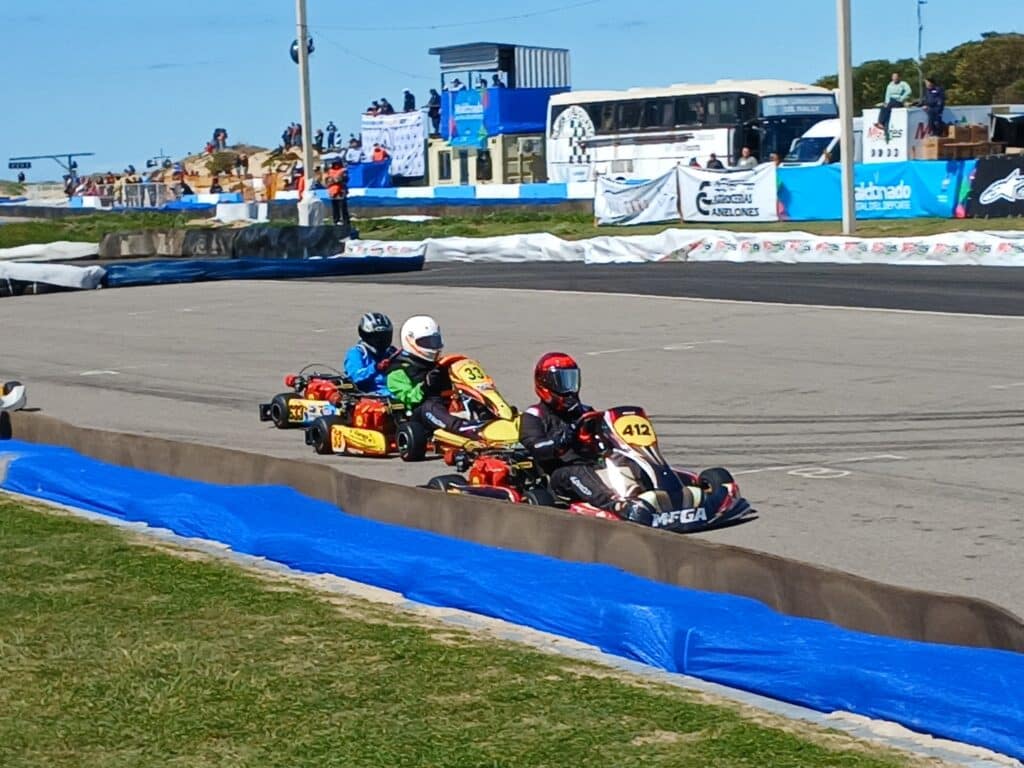
The move, step by step
- Get the corners before your overtaking spot right, so you close the gap.
- Follow him in the slipstream on the straight.
- Go down the inside and stay close to his sidepod.
- Brake a little later than him.
- Stop the kart by the apex, just enough to not get switchbacked.
- Take a good exit and go catch the next one.
When do you brake when you overtake?
A little later than the driver in front. That’s the rule.
The most common mistake I see is the opposite. The driver brakes early, and then he releases the brakes to get into the inside. That’s dangerous. Either the other driver resists on the outside, or you crash into him.
I’m fighting with my drivers on this so many times. It’s a confidence thing. If the driver in front brakes late, with a strong initial bite, you can’t just release the brakes inside him. You have to brake later than he does.
But not too late. You brake just at the right time. Enough to get alongside him under braking, but not so late that you struggle to get to the apex.
And what happens if you don’t commit? You end up with a half move. You show the nose, you back off and you lose a ton of time. I wrote about it in half moves in karting.
So the better you are on the brakes, the easier the overtakes get. If the braking is your weak point, start from my go-kart braking tips and from late braking in karting.
How do you avoid getting switchbacked on the exit?
We’ve all been switchbacked at least once. You pass him on the brakes, you overshoot the corner and he crosses back under you on the exit. You feel quite stupid in that moment, because the overtake has just failed.
The reason is almost always the same. You didn’t stop properly by the apex.
So when I’m passing somebody just to go and catch the group in front, I stop by the apex. Just a bit, just enough to not get switchbacked. Because too much stopping guarantees that he won’t pass you back, but it also makes you lose a ton of time on the exit.
How easy it is to get switchbacked depends on how late you braked and how close you got to him. It also depends on the track. On a wide track it’s easier to switch back, on a narrow one it’s harder.
And think about how it looks. If you try to overtake a driver because you simply have more pace, but you keep getting switchbacked 2 or 3 laps in a row, even the other driver will be like “WTF?”. It’s not good for your reputation.
How much time should an overtake cost you?
Do you agree that losing 3 tenths for making an overtake is too much?
The best drivers are able to overtake and lose less than a tenth, ideally just half. That’s the target when you are coming through the field.
Say you overtake the driver in P14 on lap 4. Your main goal is to lose as little time as possible, to then go and catch the drivers in front. So you wait until you’re really close. You get alongside him under braking, you stop well by the apex and you have a good exit.
An overtake for the lead with less than 2 laps to go is another story. You want that move to be final. In that case I forget about the tenth. I may even decide not to go for the apex, and take him wide with me so he loses time too. But for that you have to be fully alongside, otherwise there’s no hope you’ll make the move stick.
The move depends on the situation. I go deeper on that in when to overtake and when to defend, and on the end of the race in last lap mastery.
What is a dive bomb and when do you need it?
A dive bomb is when you send it from far away. You are not right behind him, but you brake very late and you go for the inside anyway.
Dive bombs were my specialty. Especially when we had front brakes, you could really send it from far away. Back then we had them in the senior categories, now you find them only on the shifters. And that’s where the name Senndit comes from.
When do you need it? When you can’t afford to wait. If you stay behind him you’re going to be attacked from behind, so you send it even from far. Or at the end of a race, when the move has to be something he doesn’t expect.
But it’s the riskier move. The closer you are, the cleaner the overtake. From far away the driver in front has less time to react. So first become really good on the brakes. Then the dive bombs come.
Can you overtake around the outside in a kart?
We’ve watched way too many Formula 1 races. And deep inside we believe that if they can overtake around the outside, so can we.
How naive.
In karting the driver on the inside can power early and open up the steering. You end up wide, over the exit kerb or beyond, and at some point you have to lift. Most of the time you even lose more places, because you back off on the exit, often on the dirt, and the drivers behind get you.
I see it every single race at T13 in Franciacorta, the last hairpin, which is really wide. Somebody brakes later than the driver defending and tries to cut in front of him around the outside. It rarely works.
It works the other way too. If you are the one who gets outbraked around the outside, in my opinion that’s the most embarrassing way to get overtaken.
So go for the inside. That’s where the overtakes are in karting.
Why do overtakes end in a crash?
Number one: you didn’t brake later than the driver you were passing. You are half alongside, he doesn’t see you in his peripheral vision and he turns in. And most of the time you are the one at fault.
Number two: you misjudged the braking point. You dive bombed from too far, and the driver in front had no time to react. Or you overshot the braking and you ended up on his side.
Every overtake is a gamble. That’s the truth. You can do everything right and still get a contact once in a while, because the other driver didn’t see you. But if you only bet when the probability is high, the overtakes that work will pay for the one that doesn’t.
What you can’t do is hesitate. Every hesitation massively reduces the chance of making that move. It has to be instinctive. I don’t think about it when I’m racing.
And don’t confuse hesitation with defending. A driver who is afraid of the move usually ends up defending too much instead. I explain why that costs you in why defending too much is a losing strategy.
Does the setup change how you overtake?
Yes. You need the front.
Danilo Rossi says you can’t win a world championship without the front. “Senza il davanti”, as we say in Italian. You can be fast over one lap with little front grip. But in the race it won’t help you with the late moves.
Because when you make a bold move, you have to trust that the kart will rotate and not end up over the sidepod of the other driver. And that you won’t miss the apex when you go a bit deep to make it stick.
Imagine you want to make a late overtake, courageous but doable, say from two kart lengths in a junior. If you feel you don’t have any front, you wait and wait to get closer. You hesitate. Sometimes you just hope to pass him on the straight with the slipstream.
I was raised with a lot of front in my driving. So I can’t really remember the last time I had to think twice about a move because the front wasn’t enough.
How do you practice overtaking?
Beginners are cautious because overtaking is a skill, and the confidence only comes with repetition. So you have to overtake more, also beyond your comfort zone, until it becomes second nature.
Do some overtakes every day you drive. Sometimes do a dive bomb. Sometimes it won’t work. But if you have never done it in practice, you won’t have the balls to do it on the last lap of an important race.
In free practice you can schedule specific sessions for racecraft with other drivers, without crashing. And off the track, watch onboards and race videos. I used to watch past races to find the best overtaking spots on each track. I also do a lot of visualization. That’s how you train the instinct, so in the race you don’t have to think.
Obviously the best practice is racing. The more races you do, the better your racecraft gets.
- All my articles on fighting on track are in the karting racecraft guides.
- Not sure why your overtakes don’t stick? Send me your onboard and I go through your race in an onboard review.
- I teach all of this in my six month training program.
Next time you’re on track, pick one corner and one driver. Get the corners before right, close the gap and make the move. Then check how much time it cost you.
Frequently asked questions
Where is the best place to overtake in a go-kart?
It depends on the track, but normally in the hairpins, above all the ones that come before and after a long straight. You get the slipstream, a long braking distance and a low speed corner where the inside is open. Fast corners are way more difficult.
Do you have to brake later to overtake in karting?
Yes, a little later than the driver in front. Braking early and then releasing the brakes into the inside is the most common mistake, and it’s the number one reason for collisions. But don’t brake so late that you struggle to get to the apex.
How much time should you lose when you overtake?
The best drivers overtake and lose less than a tenth, ideally just half. Losing 3 tenths for an overtake is too much.
Can you overtake around the outside in karting?
It very rarely works. The driver on the inside can power early and open up the steering, so you end up wide and you have to lift. Most of the time you lose more places on the exit.
What is a dive bomb in karting?
It’s an overtake where you send it from far away, braking very late and going for the inside. It carries more risk than a move made from right behind, because the driver in front has less time to react.
Send your onboard footage. Alessio reviews it corner-by-corner and tells you exactly what's costing you time, and how to fix it. Back within 48 hours.
Get My Onboard Reviewed → Reviewed personally by a CIK FIA World Champion, never an assistant.I promise I'll not spam you with repurposed shitty AI content but real experiences that only I, Alessio Lorandi, experienced. Written in my funny English-Italian tone of voice 😂
Alessio Lorandi is the former CIK FIA World Junior Champion, winning against Lando Norris in 2013 & F3 multiple race winner. He's helped 200+ karting drivers worldwide get faster & win WSK titles with BabyRace Driver Academy & now through Senndit, his online karting coaching platform.