How to Defend a Position in a Kart Race
How I defend a position in a kart race: when it makes sense, what is legal, where to put the kart, and how to stop the switchback on the exit.

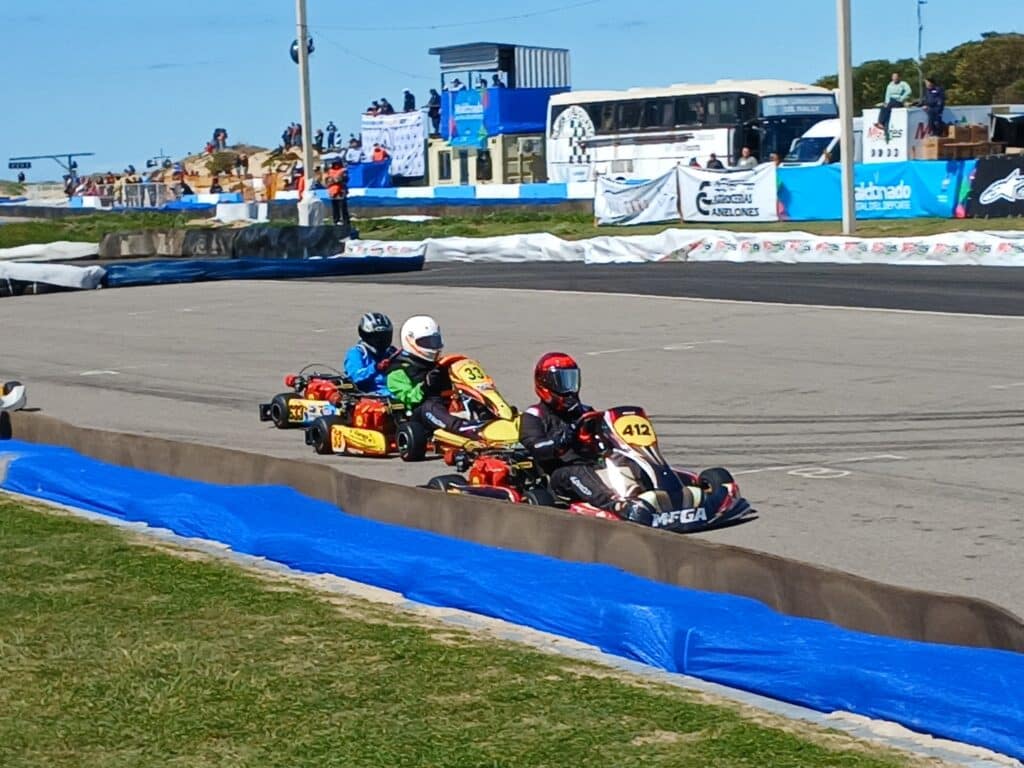
- Defending costs lap time, and the cost depends on the kart. A KZ defending a corner properly loses very little. A Junior, a Senior or a Mini may lose three or four tenths, or even half a second.
- First ask if you should defend at all. Lap one and the last lap, yes. Lap five of 20 against one driver, no.
- You defend before he is alongside. Once a driver is already next to you, you cannot squeeze him onto the grass. You try to pass him back in the next corner.
- Make the kart as wide as possible. You want to send the driver behind exactly where you want him to go.
- Stop by the apex. If you defend without stopping properly at the apex, you will get switched back, and you’ll deserve that.
- The best defense is to attack. If you are P2 and you only defend, the leader goes away.
- How much time do you lose when you defend in a kart?
- When does it make sense to defend?
- How do you defend legally in karting?
- Where do you put the kart when you defend?
- How do you defend without getting switched back?
- Should you defend on the first lap?
- Should you defend right after an overtake?
- What do you do when you lead with no pace?
- What if you are P2 and the driver behind attacks you?
- Is braking late a way to defend?
- How do you practice defending?
- Frequently asked questions
You cover the inside, you feel safe, and on the exit he is already past you. What happened?
We’ve all been switched back at least once in our racing career. I have too. And we all felt quite stupid in that moment, because we defended and we still lost the position.
Listen, defending is a skill of its own. Most drivers think it means closing the door. But closing the door is the easy part. The hard part is knowing when to do it, doing it in a legal way, and still making the corner. So let me go through it the way I see it.
How much time do you lose when you defend in a kart?
A lot. And how much depends on what you drive.
When you defend you take a tight entry. In a single speed kart that kills your momentum in the middle of the corner. A Junior, a Senior or a Mini defending one corner may lose three or four tenths, or even half a second. Because they don’t have the gears and they don’t have the brakes to take advantage of that V-shaped line.
A KZ is different. When a KZ defends the line properly it doesn’t really lose much.
So before you defend, remember what you are paying. If you defend, you can’t set fastest laps. You can’t pull away from the others. And you can’t catch the one who is in front of you.
When does it make sense to defend?
This is the first question, before any technique. Does it make sense to defend or not?
If it’s lap one or the last lap, it makes sense. In those moments the pace doesn’t really matter. You are just trying to keep your position.
If it’s lap five of 20, there’s not much point. Say you are P4 and you defend from just one driver behind. What happens? The drivers in front pull away. A bit silly if you think about it.
Because defending is a very short-term decision. If you defend once, you have to defend the next corner, and then the next one. The driver behind is not going to disappear. You are going slower, so why would he?
I wrote a full article about this, so I won’t repeat it here: why defending too much is a losing strategy. In this one I want to talk about how you do it when you really have to.
How do you defend legally in karting?
Lots of drivers defend in an illegal way. And it’s not only illegal. It’s dangerous.
Changing direction multiple times on the straight, for example. That is very dangerous and you should not do it.
Then there is what I call the gray area. You defend all the way to the white line, leaving no space on the inside. The driver behind opens up to switch you back. And you fall back onto the line before the corner. Theoretically that is not allowed. But kind of everybody does it. And if you don’t open up and you keep just one line, it’s almost obvious that you are going to get passed on the exit.
So you have to stay within the gray area. If you defend really well, on the edge of the regulations, you can keep anyone behind you. Unless they smash you off, of course. But then they are the ones who receive the penalty.
Now, where is the limit? If somebody is already alongside you, you cannot squeeze him onto the grass. That is not allowed and you will get a penalty. I’ve seen penalties being applied for it, and to be honest that’s fair. You cannot turn into somebody who is already next to you to scare him into lifting off the gas. That is not the way to race.
And it’s a bad habit to pick up. If you take it with you to formula cars it gets very dangerous. Flipping at 80 kilometers an hour in a go-kart is not like flipping at 300 kilometers an hour in a formula car.
So what do you do when he is already alongside? You accept it. And you try again in the next corner, overtaking him back.
By the way, this is how I see it from my racing. Every series has its own regulations and its own stewards, so read yours.
Where do you put the kart when you defend?
You make your kart as wide as possible. And you keep control of the situation.
What does control mean? It means you send the driver behind exactly where you want him to go. He should not be able to dive down the inside of you. He should not be able to switch you back. And he should not go around the outside.
Because when somebody is trying to pass you, there are three things he can do.
| How he gets past | What you did wrong |
|---|---|
| He dives on the inside | You were defending, but you still left him half a kart on the inside |
| He outbrakes you around the outside | You braked too early |
| He switches you back on the exit | You didn’t stop properly by the apex |
The second one is the most embarrassing way to get overtaken. I hope it’s not going to happen to you.
The third one is one of the most common things I notice, also on the last lap. So let’s go there.
How do you defend without getting switched back?
You stop the kart by the apex. That’s it.
If you defend without actually stopping properly at the apex, there’s almost a mathematical 100% guarantee that you will get switched back. And you’ll deserve that. The driver passing you will be like, “Oh, thanks for the gift”.
And many times it wasn’t even his ability. Sometimes he hasn’t even planned it. You covered the inside, you overshot the apex, and he just drove past on the exit.
So this is the move I would do:
- Check that the corner and the moment are right. Do it on the last lap, perhaps just in the last couple of corners, when the driver behind is really on your rear bumper. And do it in a medium or low speed corner.
- Cover the inside with the whole kart. Make your kart as wide as possible. If you leave half a kart on the inside, he will take it.
- Hold hard onto the brakes. Brake so that you are properly stopped by the apex. Hold the pedal hard, so if the driver or the group behind pushes you, you still make the corner.
- Keep him in your lateral field of view. Get the driver into the side of your vision, especially if you braked early. Then you know where he is, and you know he can’t switch you back.
- Take the bump and go. If you stopped properly, the most he can do is bump you at the apex. You keep the inside and you keep the position.
Why hold the brakes so hard? Because yes, the drivers behind may end up getting a penalty for pushing you. But in the meantime your race is lost. Better to still make the corner.
And remember where this works. Mainly in the medium to low speed corners. In the high speed corners you will probably get overtaken around the outside, so there’s no point doing it there.
It’s also bad for your reputation when you get it wrong. Who is looking from the outside thinks, what the hell, that looked so stupid. And the other drivers remember it.
Should you defend on the first lap?
Yes. On lap one you defend.
You can have the best pace on the track and start from pole. But if you make a conservative start and you are not defending properly in the first lap, the driver in P2 passes you, and then the one in P3. People are not going to follow you because you have the pace. They don’t care.
Even when I decided to be conservative on lap one and just stay behind the driver in front, I would obviously still defend. Because otherwise all the drivers behind are going to pass me.
But be aware of what this does to the pack. On lap one everybody is braking early into the first corners, because everybody is defending. If you forget that and you brake where you always brake, you drive over the kart in front of you.
There is one way to not defend on lap one. You start from P1, you make a really good start and you pull a small gap before turn one. Then you take your normal lines while everyone behind you has to defend and fight each other. Your gap grows, and you don’t have to defend for the rest of the opening lap. Easier said than done. But when you do it, the race is in your hands.
Should you defend right after an overtake?
Sometimes you have to. This is the mid-race exception.
Say you have seven drivers behind you, all close to each other, and you just made an overtake. You defend for one corner. Just to make sure there is a bit of a gap. Then you put the head down and you pull away.
I learned how much this corner matters in 2012 at Zuera. In the final I came out P7 after the start and I drove myself up to 2nd. The pace was awesome. I had P1 in my sight.
The problem was, I made the overtake for P2 in the last sector. And there was a group of four or five drivers behind who took my slipstream down the long main straight. I had to defend at Turn 2, otherwise I would have been passed back by the whole group. And while I was defending I got pushed wide. I lost several positions and I got my tyres full of sand.
I drove back to P6 in the end, with the 2nd fastest lap of the race, one tenth quicker than P1. I was shattered.
So that one defense, right after a move, with a pack behind you, can decide your race. It’s one of the few moments in the middle of a race where I say yes, defend.
There is one more. Sometimes a driver in front is defending and you can’t get past him, so the whole group bunches up. You are stuck in this massive train of drivers all attached to each other. In that case you have to defend too, because if you don’t, you get passed by everybody. I hate those kind of races. But sometimes it’s like that.
What do you do when you lead with no pace?
Say there are eight laps to go. You are leading because something happened at the beginning, but you know you have no pace. The driver behind is catching you half a second a lap.
You can let him go, stay behind him and hope to finish P2. But I think that’s a bit of a weak mentality. Kind of giving up.
When you are there, you are a gladiator in the arena. You can always try your best and make life difficult for the others, even if they have the speed. They are going to do the same to you the day you have more speed than them.
And if he passes you? You can overtake him back. Maybe he is not alone. Maybe it’s one against two, or three, or four, and then it gets more difficult for him too. Because when you start fighting and defending, the pace doesn’t really matter anymore. I’ve seen these things happen many times to my advantage.
The same goes for the last two laps when you have some technical issue, or just zero pace for whatever reason, and you need to bring it home. There I give you the green light to defend.
What if you are P2 and the driver behind attacks you?
Here I would do the opposite of what most drivers do.
If you are P2 and you start defending from P3, you let the leader go. And the driver behind is still there in the next corner.
So I always remind this to my drivers. The best defense is to attack. If you’re not passing, you’re going to get passed. If you want to make sure nobody overtakes you, overtake the driver in front. Sometimes he is a bit far and you have to send it anyway. Sometimes it’s not going to work. But you have to take those bets.
How to do the move itself is in my article on how to overtake in a go-kart race.
Is braking late a way to defend?
Yes. You can defend not really by closing the line, but by being so late on the brakes that the driver behind has no room to outbrake you. I explain it with the whole last lap in how to defend your position on the last lap, and the braking itself in the article on late braking.
And if you want to know when it’s worth checking behind you, read when you should and shouldn’t look in the back.
How do you practice defending?
To be honest, the only way to practice racecraft is to race. Do more races.
In free practice you can also schedule specific sessions just for racecraft. I’m not saying you should defend in every practice session. But a session where you work on not getting switched back, without crashing, is very useful.
Indoor karting is good for this too. You can practice attacking and defending against other drivers without really getting hurt or destroying the karts. Otherwise you learn it on the track with trial and error.
And watch races. Your onboards and race videos from past races. You start to recognise the patterns.
- All my articles on overtaking, defending and race starts are in the racecraft guides.
- If you feel bad about closing the door, read stop driving like a gentleman.
- If you keep getting switched back and you don’t see why, send me your race in an onboard review. For the long work on racecraft there is the six month training program.
So next race, before you move to the inside, ask yourself one thing. Do I truly need this? If yes, cover the inside early, hold the brakes and stop by the apex. If no, look ahead and drive.
Frequently asked questions
When should you defend in a kart race?
On the first lap, on the last lap, and in the corner right after you made an overtake with a group behind you. In those moments the pace doesn’t really matter. In the middle of the race, defending makes you lose time to the driver in front, so I keep it for when it is truly needed.
Is defending legal in karting?
Yes, if you do it before the other driver is alongside you. Covering the inside all the way to the white line is normal. What gets you a penalty is changing direction multiple times on the straight, or squeezing onto the grass a driver who is already alongside you. I’ve seen penalties for that and I think it’s fair.
How do you stop a switchback when you defend?
Stop the kart properly by the apex. If you cover the inside and then overshoot the corner, you will get switched back on the exit almost every time. Hold hard onto the brakes and keep the other driver in your lateral field of view, so you know where he is.
How much time do you lose when you defend?
It depends on the kart. A KZ defending a corner properly loses very little. A Junior, a Senior or a Mini may lose three or four tenths, or even half a second, because a single speed kart lives on momentum and the tight line kills it.
Should you let a faster driver past?
In the middle of the race, if you are not leading and it’s one driver, fighting him only lets the drivers in front pull away. If you are leading near the end with no pace, I wouldn’t just let him go. Make his life difficult, and if he passes you, try to overtake him back.
Send your onboard footage. Alessio reviews it corner-by-corner and tells you exactly what's costing you time, and how to fix it. Back within 48 hours.
Get My Onboard Reviewed → Reviewed personally by a CIK FIA World Champion, never an assistant.I promise I'll not spam you with repurposed shitty AI content but real experiences that only I, Alessio Lorandi, experienced. Written in my funny English-Italian tone of voice 😂
Alessio Lorandi is the former CIK FIA World Junior Champion, winning against Lando Norris in 2013 & F3 multiple race winner. He's helped 200+ karting drivers worldwide get faster & win WSK titles with BabyRace Driver Academy & now through Senndit, his online karting coaching platform.