How to Tell if Your Kart Driver Is Fast or Just Well Funded
A fast engine can hide a driver. Here are the checks I use, and that you can do as a parent at the next race, to see how much of the result is your…

- P1 on the timing screen does not tell you he is fast. A lap he cannot replicate is almost like a lap he had by luck.
- An engine can hide a driver. If the engine is 2 tenths faster than the rest of the grid, he can drive 1.99 tenths slower and still be P1.
- At the front of a WSK final the equipment is very similar. The top 25 to 30 drivers have maximum 1 tenth of difference between engine and chassis.
- Compare him against himself first. The gap between his best lap and his theoretical lap has nothing to do with the engine. Above one tenth is bad news.
- Three tenths lost to his own theoretical is about 25 positions in a WSK qualifying. You cannot blame the kart for one tenth when he is giving away three by himself.
- Listen to what he says when he gets out of the kart. The best drivers I have raced with or coached blame themselves first and are the first to come and look at the data.
- Count the laps before you judge the talent. A kid with 9,680 laps cannot drive the same lap time as a kid with 38,080.
- What does “actually fast” mean for a kart driver?
- Can money make a kid look faster than he is?
- How much lap time can a better engine really buy?
- How do I check his speed without comparing him to other karts?
- Is he fast for one lap or for every lap?
- What happens when the engines are the same for everyone?
- What does he say when he gets out of the kart?
- Is he slow, or does he just have fewer laps than the others?
- How do the people in the paddock tell the difference?
- What should I do if I am the one paying the bills?
- Frequently asked questions
Your kid is at the front. Or he is at the back. How much of that is him, and how much is what you are paying for?
It is the question every parent in the paddock has in the head and almost nobody asks out loud.
Listen, I am not going to tell you money does not matter. There are many aspects involved in making it to F1, and the first one is financial resources.
But money and speed are two different things, and you can check which one you are looking at. You do not need to be an engineer. You need to know where to look.
What does “actually fast” mean for a kart driver?
Most parents look at one thing. The lap time. Where is he on the screen?
And that is the mistake. I would say 90% of drivers and parents do it. The lap time on its own gives you false positives and false negatives. You see P1 in a practice session and you think it was a good session. Maybe it was not.
Because when you do a lap and you cannot replicate it anymore, it is almost like you had it by luck.
So what is a fast driver for me? It is the one who is squeezing every single millisecond of performance out of the kart he has, and who does it lap after lap. With a really good driver you look at his lap times and you cannot quite tell the difference from one lap to the other.
That is a different thing from being at the front. People that have been in motorsport for dozens of years can tell the difference between those that are at the front because of their package and those that are at the front because of their driving. You can learn to see it too.
Can money make a kid look faster than he is?
Yes. And most of the time it comes from the engine side. Rarely is a chassis considered “too good”.
Say for instance your kid has an engine that is even 2 tenths faster than all the other ones on the grid. It means he can still be driving 1.99 tenths slower and still be P1. That is the problem hiding in plain sight.
Everybody claps. The kid thinks he is exceptional. And if you have it too easy early on, then you probably will not put the effort to become exceptional, because you think you already are. Early success rarely does a young driver any good.
The other problem is what the material covers. Material that is given to you will always hide your driving weaknesses. A poor braking technique. Racing lines that are not the best ones. Dirty steering inputs. Late throttle application. Or “gentlemen” racecraft, as I call it.
Now, engine tuners betting on the fastest driver in the team, that is okay. It makes sense. What is not right is when the “special” engine goes to the highest bidder and not to the fastest driver. In my book I put it like this: 7/10 drivers can pay 10x more and get a 13/10 engine, which suddenly makes them look like 10/10 drivers.
So it is two different things, having the best material because daddy is paying, and earning it.
How much lap time can a better engine really buy?
Less than most parents think, once you are at the front of a serious race.
Let me be fair first. You can be a 10 out of 10 driver, but if you have a 6 out of 10 package between chassis and engine, you cannot compete for the win. With a 9 out of 10 package you still can. So the equipment has to be there.
But look at a WSK final. The top 25 to 30 drivers that make the final will all have very, very similar equipment. There can be maximum 1 tenth of difference between engine and chassis. The number one driver of a tuner maybe gets half a tenth extra. In my early years we raced on our own engines and I believe we were at least 2 or 3 tenths down, so I could only fight for the podium once, P3 at Val Vibrata, I explain what it takes to get your first WSK podium.
You cannot expect half a second of difference in the engine. It does not exist at that level.
So when you see a driver being two tenths quicker than everybody else, maybe yes, he has half a tenth of engine. The rest is just the driver.
And this works in both directions. If your kid is half a second off, the engine is not the first place to look. A 5% less performing engine will be felt, I am not saying the opposite. But it is not always the engine. It can be the chassis balance, some friction somewhere, or the driving.
I have been on the racetrack for about 22 years. 80% of the times, it is just the driver.
How do I check his speed without comparing him to other karts?
You compare him against himself. In the same session.
Why? Because when you compare with other drivers you can always blame something. Different engine, different tyres, different chassis, different setup. When you compare him with himself in the same session, there are no excuses. Same kart, same engine, same track, same day.
The number is the theoretical lap. You take his best sectors of the session and you put them together. That is the lap he has already shown he can do, piece by piece. Then you look at his real best lap.

Anytime I see that gap above one tenth, it is bad news. Even if he is P1.
If he is three tenths from his own theoretical, in a WSK qualifying he has basically given up about 25 positions. In that kind of session you are at least P15 if you are more than a tenth off P1.
And here is the check for the “our engine is slow” conversation. Say he is half a second off his theoretical and only two tenths off P1. If he puts his own lap together, he is three tenths ahead of P1. So you cannot moan and argue about the kart.
You cannot blame the engine or the chassis for one tenth if he has three or four tenths in himself. At WSK you do not even need the laptop. The PDF results document gives you the ideal lap time, all the sectors put together.
Is he fast for one lap or for every lap?
One good lap does not make a fast driver. Not one session by luck. It has to be repeatedly.
In my book I use a 60 Mini session at Franciacorta. Twelve laps. The fastest lap is 54.28. The theoretical is 53.96. So 0.32 seconds are left on the table on the best lap already.
Then you do the same for every lap. How far was each lap from the theoretical? In that session it adds up to 5.47 seconds. The average is 0.49 seconds per lap. I call it “Average Loss To Theoretical”.
That number tells you much more than the best lap. Accuracy beats absolute speed every time. The day his average loss to theoretical is below one tenth, he can be proud of himself and feel confident to go for the win.
And the excuses? “I had traffic.” “I had to overtake.” “The tyres were old.” Slipstream, traffic and tyre degradation do not have as much of an effect as you think. There are exceptions, like Zuera, where the slipstream can be worth up to two, three or four tenths in 60 Mini and Juniors. But the best drivers are able to overtake and lose less than a tenth, ideally just half.
So do not look at one session. Track the trend across the sessions. Is the gap to the theoretical getting smaller? Are the laps getting closer to each other? That is progress you cannot buy with an engine.
What happens when the engines are the same for everyone?
There will never be such a thing as driving on the exact same material. I have to say it. But there are places where it gets close, and there you learn a lot about your kid.
One I explained to our BabyRace parents is the IAME Series Italy. Six rounds. The engines are lotterized, so it is super equal. In Under 10 and Mini Gr.3 you have about 20 drivers per category, in Baby about 15.
What I like about it is what it does to the head. The drivers do not have that excuse about the engine anymore. They have more of an open mind to just work on themselves and on the chassis.
So that is one check. How does he go when the engine comes out of a lottery?
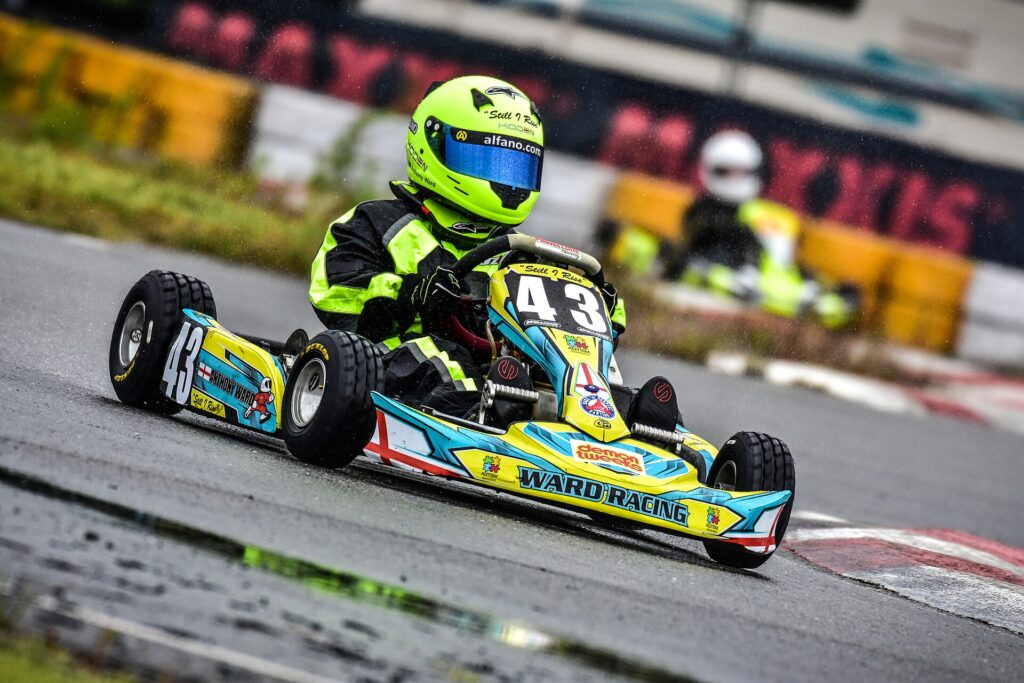
The second one is the rain. For me a fast driver has entry speed sensing, speed sensing and car control. And you can see that car control skill in action when you go and drive in the rain.
I am not telling you the equipment disappears in the wet. I am telling you where I look. If your kid is at the front in the dry and you want to know how much of it is him, watch a wet session with attention.
What does he say when he gets out of the kart?
This one costs nothing and you can do it at the next race.
Let me tell you a story from a WSK weekend. First heat. The dad of one of our drivers comes to me and says, “We’re still missing something.”
What had happened? In qualifying the kid found traffic on his last lap, because his positioning on track was bad. Sixth of his group, one tenth off his teammate in P1. But with the overall best ideal lap in the WSK results PDF. In the heat he started P6, dropped to 8th and came back to 4th while setting the fastest lap, one tenth quicker than the top 2, who were bumper drafting in heavy wind.
So I said, “Hasn’t he just done the fastest lap?”
Then I asked the driver, “What do you need?” He shrugged. “We’re missing something.” Mate, did you realize you were the fastest on track? He did not. His dad had contaminated his feedback.
So it was clear he had the package of a comfortable P1 in qualifying. And the family was still looking at the kart.
The opposite also happens. The dad blames the team for the traffic. The mum blames the engine for one corner exit, while the driver is overshooting his braking.
A fast driver gives specific feedback. “I need more rear.” “More front.” “One extra sprocket.” The best drivers I have ever raced with or coached are the ones who blame themselves first. They are the first ones coming to look at data, they review every corner, they watch the onboard every session.
The worst drivers focus outward first. The best drivers focus inward first.
Is he slow, or does he just have fewer laps than the others?
Before you decide your kid has no talent, or that the team is giving him bad material, count the laps.
One of the questions I get asked most by parents is, “How do we make him faster?” Mostly the dads. They believe that at their son’s third race in Italy, at a WSK, he should be up there fighting for wins already.
So I reply something like, “Listen, how many races has he done here?” “I guess three.” “Right. So tell me, how many races have the others done here?” “Got it.”
If there are 80 drivers in that same category, and most of them have been doing every single race of the season, why would you think your kid will be up to pace with them?
We believe that since we are paying lots of money to race in the “best team”, then the win is the consequence. It is not.
In my book I take two 11 year olds. One has done 476 track days, the other 121. At 80 laps a day that is 38,080 laps against 9,680. A difference of 28,400 laps. They cannot drive the same lap time. And you cannot expect a less experienced driver to repeatedly beat a much more experienced one.
You cannot buy experience, even if you hire the best coaches out there. It is a bit like a score.
So ask the dads whose kids are winning how many times they took them testing and racing. Ask if they gave them the best equipment right away, or if they spent some time sharpening their skills in less competitive karts. The answer normally explains the gap better than the engine does.
How do the people in the paddock tell the difference?
For the people who know, the “better man” will always be noticed on track. Even when he is not winning.
And teams vote with their money. I have seen drivers spending one fifth of the budget, or even getting almost a free drive, for how good they were. Why? Because the teams always need one really good driver per year, who drives the team in the right direction and helps the teammates get faster by reading his data.

So here is a question you can ask yourself. Does the team look at my kid’s data to help the others? Or are we the ones always looking at somebody else’s?
Typically the best material ends in the hands of the best ones. That is how it should be. You need to earn the best material, not have it be given to you.
And what do the ones who make it have in common? I see it with the hundreds of drivers we have seen at BabyRace over the years. The ones that end up winning and making it as professional racing drivers are the ones who are fearless and highly coachable. I call them the two “meta skills”.
You tell him to brake three meters later and harder. Does he go out and do it? That is coachable. No engine gives you that.
What should I do if I am the one paying the bills?
First, drop one idea. The idea that since you are paying, he should always have the superior performance to win.
For me this is one of the biggest dangers for a young talented driver. Everyone is pretty much paying to drive in karting. And that expectation gets transferred back to the driver at the dinner table.
Be realistic about the edge. If a team gives you superior performance 25% of the time, say 5 races out of 20 with 1 or 2 tenths in hand, that is a luxury. Be grateful when that edge is given to you, and be ready to grab it with both hands. You cannot expect to be always 3 tenths faster than everyone.
Second, let him talk first. After the session he gives his feedback to the team, hot, in his own words. Then you speak. Not before.
Third, do not be afraid of the weaker kart. A driver on an inferior package who is still 1 or 2 tenths off will naturally become better than the driver who is cruising around in P1. Because the real goal in karting is to develop his driving abilities to the maximum, to then reap the fruits in single seaters.
- New to all of this? Start from my karting guides for beginners and parents.
- Why a second pair of eyes changes things: why you need to hire a go-kart coach.
- If you want me to work with your kid on exactly these things, have a look at the 6 Months Transformation.
So at the next race, before you look at the position, look at his gap to his own theoretical and listen to the first thing he says to the mechanic.
Frequently asked questions
How can I tell if my kid is fast in karting?
Compare him against himself before you compare him with the others. Look at the gap between his best lap and his theoretical lap in the same session. Anytime I see it above one tenth, it is bad news, even if he is P1. Then look at how close his laps are to each other.
Can a better engine make a kart driver win?
It can hide a driver, yes. If the engine is 2 tenths faster than the others, he can drive 1.99 tenths slower and still be P1. But among the top 25 to 30 drivers of a WSK final there is maximum 1 tenth of difference between engine and chassis. The rest is the driver.
My son is off the pace. Is it the kart or the driver?
80% of the times, it is just the driver. Check his theoretical first. If he is half a second from his own theoretical and two tenths from P1, his own lap put together is three tenths ahead of P1. Then count how many laps and races he has done compared to the others.
Does paying for the best team guarantee results?
No. We believe that since we are paying lots of money to race in the “best team”, the win is the consequence. It is not. If a team gives you superior performance 25% of the time, 5 races out of 20, that is already a luxury. You cannot buy experience.
Send your onboard footage. Alessio reviews it corner-by-corner and tells you exactly what's costing you time, and how to fix it. Back within 48 hours.
Get My Onboard Reviewed → Reviewed personally by a CIK FIA World Champion, never an assistant.I promise I'll not spam you with repurposed shitty AI content but real experiences that only I, Alessio Lorandi, experienced. Written in my funny English-Italian tone of voice 😂
Alessio Lorandi is the former CIK FIA World Junior Champion, winning against Lando Norris in 2013 & F3 multiple race winner. He's helped 200+ karting drivers worldwide get faster & win WSK titles with BabyRace Driver Academy & now through Senndit, his online karting coaching platform.