5 Common Myths About Go-Karting
Stop believing karting is just for kids. Here's what actually happens on track, and why every pro started here.


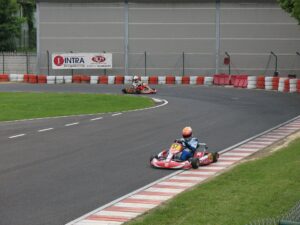
- Karting is not only for kids. There are categories for every age, even masters categories for drivers over 40 or 50.
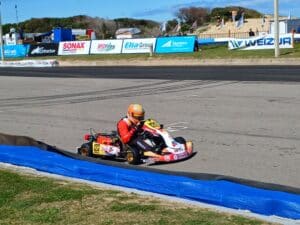
- Race karts are fast. Shifters can hit 170+ km/h. At Lonato a rental kart would be at least 20 seconds a lap slower than a junior or senior kart.
- A rental kart teaches you the racing lines. But a race kart brakes from 130 to 50 km/h for a hairpin, not from 50 to 35.
- Karting is the foundation of professional motorsport. Almost every F1 driver started here.
- You can start without breaking the bank. It only gets really expensive when you aim for international titles, about 10,000 euros for one international race.
- Karting is very physical. Your heart rate sits at about 178, 180 for a 15, 20 minute session, and you get up to 2.5 G in the corner.
- Karting is dangerous, but not as dangerous as you believe. Sitting two centimeters off the ground makes the speed feel higher and actually makes you safer.
- Talent is not required. Talented drivers are shaped, not born.
- What are the most common myths about karting?
- Is karting only for kids?
- Are racing karts slow?
- Is a rental kart the same as a race kart?
- Is karting just a hobby?
- Can karting be a career?
- Is karting too expensive?
- When does karting get really expensive?
- Is karting a physical sport?
- Is karting dangerous?
- Is karting easy to learn because it’s just driving?
- Do you need to be born with talent to be fast in a kart?
- Should you give karting a try?
- What do people ask most about karting myths?
Karting is one of those things people think they understand, until they actually try it.
What are the most common myths about karting?
Over the years, I’ve heard so many myths and misunderstandings, from “karting is just for kids” to “it’s not physical.” Seriously?
Some of them are funny, some are frustrating, but they all have one thing in common: they stop people from truly experiencing how incredible karting really is.
So let’s get some clarity about what karting really is, and, equally important, what it’s not.
Here are five common karting myths, and the truth behind them.
And then a few more I get asked all the time. Is it dangerous? Is it easy to learn? Do you need to be born with talent?
Is karting only for kids?
I’ve heard this one way too often. People imagine karting is just something you do at a birthday party when you’re 10 ahahah.
But that’s just the entry point for some.
Karting is for all ages. There are categories for kids, teens, adults, even masters categories for drivers over 40 or 50. Whether you’re 6 or 60, there’s a category for you.
And some of the best racing happens in the adult categories. Whether it’s seniors or shifter karts, you’ll find intense, real racing.
Now, is it easier for a kid? In a way, yes. Kids have the luxury of having more time ahead of them. They started young, so they get more practice time, and that makes it easier for them.
But adults can still get very good results. Let me be honest with you. If you start at 40, you’re not going to be faster than a kid who started at five years old. 99% of the time that’s not possible.
But if you put in a lot of commitment, dedication, high quality coaching and a high quantity of track time, you will still be able to get very good. Perhaps not at international level, but at a national or local club level, yes.
And adults have one big advantage. They are more mature, so they are probably going to be more coachable. They listen more. Kids or teenagers may have a lot of talent, a lot of skills, but maybe they are not as coachable as someone who has got some more decades on their back.
The biggest barrier is in the head. It’s your inner voice telling you that you’re too old, too slow, too heavy, that you started too late.
And whatever class you start in, the fundamentals come first. Driving fundamentals are one of the modules in my six month training program, and there is a live call with me every week.
Are racing karts slow?
If you’ve only driven rental karts at a rental track, I get why you might think that. But real racing karts?
Oh boy, whole different level.
Racing karts are FAST. Shifters can hit 170+ km/h on a long straight. Even mini karts for kids can do 115-120 km/h on the long tracks. And when you’re just a few centimeters off the ground, it feels like double than that.
Some superkarts even race on F1 tracks and hit over 220 km/h. Crazy ones, though I love to try one day!
Let me give you a real example. At Lonato, at South Garda Karting, we normally do 46, 47 seconds a lap with senior karts, or even with junior karts. Juniors and seniors reach about 135, 140 km/h on that track.
If you put a rental kart on the same track, you would do at least 20 seconds slower. Rental karts, I believe, reach up to about 75 km/h. So you will feel so slow when you drive a rental kart. But they’re not built for performance. They’re built for fun.
So no, karts aren’t slow at all, they’re just underrated.
Yes, if you compare them to Formula 1 they’re slower, quite a lot. But for their sizes and safety standards, they’re already very very quick!
Is a rental kart the same as a race kart?
Most of the myths come from here. Somebody did a few laps in a rental kart and thinks that’s karting.
Don’t get me wrong. In rental karting you can learn a lot of the skills you will need for professional karting, and even for cars, GTs, formulas. The first thing is the racing lines. The lines you learn on rental karts are the same as you learn on a racetrack.
But the braking is a different story. In a rental kart you may have to brake for just 10, 15 meters, because you go from 50 km/h top speed to 35 at the minimum to make a hairpin.
In a professional kart you may go from 130 km/h all the way down to 50 for the same hairpin. So you slow down about 80 km/h, with a very hard braking, for a longer time. That’s why braking efficiency matters even more in a race kart.
The grip is higher too, so you have to be even smoother with the steering. And with more power, getting on the throttle at the right time and taking advantage of the exits becomes very very important.
When is it time to move up? When you are able to consistently win or do very fast lap times in the rentals, and you always feel like you want a faster kart, faster in the corners. That’s the moment. Just be aware, the costs are going to be much higher.
By the way, one is not better than the other. I started immediately in owner karting, because I was introduced by my father, who was a pro karting driver himself. But I see lots of drivers nowadays starting with rental karts for their first year, and they are also very successful.
Is karting just a hobby?
Yes, it’s really fun. Yes, lots of people do it for the love of the sport. But calling it “just a hobby” really undersells what karting actually is.
Karting is the foundation of professional motorsport. Almost every F1 driver started here.
Karting is the foundation of professional motorsport. Almost every F1 driver started here. It’s where you learn the fundamentals: racecraft, focus, fitness, and pressure.
And listen, if it is a hobby for you, that’s fine. Rentals are a good option for drivers with low budgets, maybe still at school or working a job, without that much free time or spare money. They may not want to go for the high performance, high competition level, which is really exciting for some but also quite demanding for others.
Can karting be a career?
And for some drivers? It is their actual career. There are factory drivers who get paid to race for top teams, they travel the world, test equipment, and race full-time.
Official factory teams are always looking for their next drivers. By definition, factory teams produce their own chassis, so the only way for them to stay in business is to sell more of those chassis. And to sell more chassis, they need to win on Sunday.
So they want the best drivers possible. Fast enough to win races, but also mature and professional enough to guide the setup development work.
They don’t want to take gambles hoping to take a slow and unprofessional driver with the bet that they’ll make him fast and professional. So if you want to get asked to join a factory team, behave as if you were already part of one.
And being good saves you money. I’ve seen drivers spending one fifth of the budget, or even getting almost a free drive, for how good they were. Simply because teams always need one really good driver per year that drives the team in the right direction and helps the teammates get faster.
But let me be honest. Very few pro drivers in the world make a living just from driving karts, and I explain why in my post on karting and simulators.
Is karting too expensive?
Motorsport has a reputation for being expensive, and yes, high-level karting can cost a lot. But it’s also one of the most accessible ways to get into racing.
You can get started without breaking the bank. Try rental karting first, it’s cheap, fun, and gives you a feel for the sport. When you’re ready to commit, you can buy a second-hand kart and train on your own without spending crazy money.
When you step up from rentals, you go from paying something like 25 euros for 15 minutes to buying a kart of your own, which costs between 2,000 and 4,000 euros.
Then come the track tickets, fuel, maintenance, tires. And the equipment, because in rental karts you don’t need any. Helmet, rib protector, race suit, race boots, race gloves.
If money is tight, spend it on testing, not on races. On a testing day you do about 150 laps. On a race day just about 40, 50. So you understand how much of a difference there is.
And the best championships for beginners are the club races, one or two days long. The level is not super high and everybody is driving quite affordably. I explain how I would do it with a small budget in the cheapest way to start kart racing.
When does karting get really expensive?
Only when you start aiming for international titles, world championships, or F1 does it get really expensive. But for local or national racing? There are ways to manage it.
A race in a professional team in an international league like WSK, the FIA European Championship or Champions of the Future is about 10,000 euros, because most of the time it’s a five day event.
If you want to race juniors at the highest level internationally, with a shot at Formula 1, the bare minimum per season is about a hundred thousand. And I’ve seen kids doing literally 47 races in a year, almost a race every week, spending up to 300,000 euros. Which is quite crazy if you think about it.
And where does the money make the biggest difference? Coaching. That’s what improves the performance the most.
Is karting a physical sport?
This one really makes me laugh, usually from people who’ve never done a 25-lap race in a KZ shifter.
Karting is extremely physical. You’re dealing with high G-forces, no power steering, and tons of grip. Your neck, forearms, core, and even your ribs take a beating. It’s not uncommon to have sore arms, blisters and scratched hips after a proper session.
And it’s aerobic too, heart rate easily hits 170+ bpm.
In a professional kart you’re going to have heartbeats at about 178, 180 for 15, 20 minute sessions. That’s definitely a proper workout. It’s almost as if you’re running at full capacity.
Why so high? The adrenaline is high, and your brain is processing so much information. And you’re doing a lot of work with your full body. Your legs, your core stability, your neck, your chest, your forearms. And you get up to 2.5 G laterally in the corner.
I’ve had more than a few gym freaks tell me they were destroyed after a full day of karting.
Because being gym fit doesn’t help, to be honest. Most of the time it makes you too bulky. And when you don’t drive the kart for a long time, as fit as you think you are, you’re not going to be fit to drive. You need to drive, drive, drive in order to be fit to drive. I wrote about how I train for it in endurance training for racing drivers.
Is karting dangerous?
Yes, there is a risk, I won’t lie to you. The major danger is the speed. The karts are very light, they have no airbags, no carbon monocoque chassis like in F1, no seatbelts, and they are quite easy to roll and flip.
Now, this may sound very scary. But it’s not as dangerous as you actually believe it is.
Sitting so close to the ground makes the speed perception really high, but it actually makes you safer. Imagine going at that speed with no seatbelt two meters above the surface of the track, rather than two centimeters.
The most common injuries are at the ribs. I’ve seen drivers breaking a little bit their wrists or their fingers, but that was maybe one or two weeks off and then back in the kart. I flipped a couple of times and I broke my collarbone, but I’m one of the few who have had a severe injury.
In all these 20 plus years I’ve been on the track, I’ve seen some broken bones and some big crashes, but thankfully I’ve never seen a fatal crash. It’s a numbers game and it could always happen. But racing is life, and the small chance of getting hurt should not overrule the fantastic sensations you get behind the wheel. If you’re a parent, I go through it all in is karting safe for kids.
Is karting easy to learn because it’s just driving?
No. It’s quite hard to learn, because there are so many different micro skills you need to mix to become a pro kart racing driver. It’s not just about kicking a ball or running a 100 meter sprint. It’s coordination, speed sensing, reaction times. Skills that very few are going to be able to max out in their lives.
The hardest one at the start is sensing the speed, and building the confidence at that speed. As human beings we are designed to just walk on the ground. We’re not designed to drive at 150 km/h on a four wheel machine.
Then the racing lines. If your racing lines are wrong, as a consequence the rest of your technique will be wrong, and there’s nothing you can do to compensate that mistake. And smoothness takes a lot of time, because drivers normally overreact to the steering wheel. You need to really imagine that the smoother you drive, the faster you are.
And don’t think a karting simulator at home does the job for you. I believe it actually makes it worse for you on the real track. I explain why in the benefits of practicing with simulators.
It’s easy to do lots of laps. But if you do lots of laps and learn the bad habits, the bad technique is actually going to hurt you longer. Those are the most common karting mistakes I see. More on the whole learning curve in is karting hard to learn.
Do you need to be born with talent to be fast in a kart?
That’s a wrong belief, to me. I firmly believe that talented drivers are shaped, not born.
When you compare two drivers, you need to assume it’s quite unfair. Some drivers may have had 10,000 hours of driving in their lives, and others only 1,000 or 500 hours. That makes a massive difference. If you gave all drivers the same amount of track time, I believe they would all be very close at the end.
So I don’t believe talent is required. You’re going to shape your talent. You need to train exactly as Michael Schumacher would do, as Ayrton Senna would do, as Max Verstappen would do, physically as well as in terms of driving.
And expect it to take time. Finding the first few seconds is easy. Finding the last few tenths of a second when you’re fighting for pole position is hard.
Should you give karting a try?
Most of these myths come from people who haven’t tried the real thing, or have only done a few laps in a rental kart. But once you step into a proper race kart, everything changes. Oh, it does.
Karting is fast, physical, competitive, and seriously fun. Whether you’re doing it for a hobby, fitness, or chasing a dream, give it a shot.
Just be warned: once you get hooked, there’s no going back.
I told you so.
What do people ask most about karting myths?
Is karting only for kids?
No. There are categories for kids, teens and adults, and masters categories for drivers over 40 or 50. Kids have more time ahead of them, but adults with a lot of track time and good coaching can still get very good at national or club level.
How fast does a racing kart go?
Shifters can hit 170+ km/h on a long straight, and mini karts for kids can do 115-120 km/h on the long tracks. At Lonato, juniors and seniors reach about 135, 140 km/h, while a rental kart reaches about 75.
Is karting expensive?
Not to start. Rental karting is cheap, and a kart of your own costs between 2,000 and 4,000 euros. It gets really expensive at international level, where one race with a professional team is about 10,000 euros.
Is karting a real sport?
Yes. Karting is the foundation of professional motorsport and almost every F1 driver started there. Physically, your heart rate sits at about 178, 180 for a 15, 20 minute session and you get up to 2.5 G in the corner.
Is karting dangerous?
There is a risk, mainly the speed, with no seatbelts and no airbags. But it’s not as dangerous as people believe. The most common injuries are at the ribs, and in more than 20 years on the track I’ve never seen a fatal crash.
Do you need talent to be fast in a kart?
No. Talented drivers are shaped, not born. Some drivers have 10,000 hours of driving and others 500, so comparing them is unfair. Give them the same amount of track time and they would all be very close.
If you want me to look at how you drive, send me your onboard for an onboard review. And if you want to build your driving properly from the fundamentals up, that is what we do in the 6 months transformation.
Send your onboard footage. Alessio reviews it corner-by-corner and tells you exactly what's costing you time, and how to fix it. Back within 48 hours.
Get My Onboard Reviewed → Reviewed personally by a CIK FIA World Champion, never an assistant.I promise I'll not spam you with repurposed shitty AI content but real experiences that only I, Alessio Lorandi, experienced. Written in my funny English-Italian tone of voice 😂
Alessio Lorandi is the former CIK FIA World Junior Champion, winning against Lando Norris in 2013 & F3 multiple race winner. He's helped 200+ karting drivers worldwide get faster & win WSK titles with BabyRace Driver Academy & now through Senndit, his online karting coaching platform.