
Go-Kart Flags: What They All Mean (And Why You Really Need to Know Them)
Master flag rules or lose your race. Here's what every driver needs to know before you hit the track.

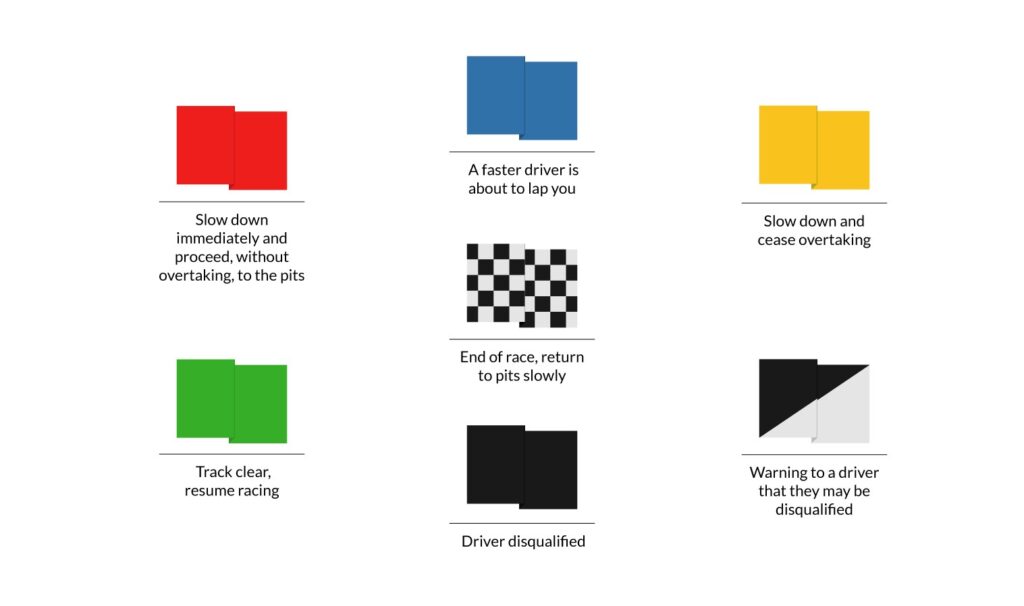
- FIA Karting lists 12 flags. They are in Article 2.15 of the 2026 General Prescriptions. Seven are listed for the start line and five for the marshal posts.
- Yellow means slow down and no overtaking. One waved yellow is a hazard beside or partly on the track. Two waved yellows mean the track is wholly or partly blocked and you must be ready to stop.
- The blue flag tells you that you are about to be overtaken. The blue and red one with your number is different: you stop, because you are being lapped or have been lapped.
- The black and white flag is shown only once. It is a warning for unsportsmanlike behaviour.
- The black flag means stop. The decision is only of the Stewards. In the Italian regulation it automatically means disqualification.
- A front fairing out of position is 5 seconds. In FIA Karting races no flag is shown for it. The penalty comes after the chequered flag and cannot be appealed.
- The FIA Karting rulebook has no “full course yellow”. It has the SLOW procedure: waved yellows and a yellow SLOW board at every post, single file behind the leader, no overtaking.
- What do the flags mean in go kart racing?
- What does a yellow flag mean in karting?
- What does a red flag mean in karting?
- What is the SLOW board, and is it a full course yellow?
- What does the yellow flag with red stripes mean?
- What does a blue flag mean in karting?
- What is the blue and red flag in karting?
- What does the black and white flag mean?
- What does a black flag mean in karting?
- What does the black flag with an orange disc mean?
- What do the green flag and the white flag mean?
- What does the chequered flag mean, and what happens after it?
- Is a kart race started with a flag or with lights?
- How do you see the flags when you are racing?
- How do you learn the flags before your first race?
- Frequently asked questions
Alright, let’s talk about flags.
I know, it’s not the most exciting topic when you’re thinking about speed and overtakes, but trust me, knowing your flags can literally save your race.
You could be leading, doing everything right on the track. But if you ignore one of these signals? You’re done. Game over.
So this page does two things. The meaning of each flag is taken from the rulebook, word by word, because that is not my opinion. And around it I put what I’ve seen in my own racing.
What do the flags mean in go kart racing?
Here is the whole list from Article 2.15 of the 2026 FIA Karting General Prescriptions. Your national federation and your club can change details, so the briefing of your race always comes first.
| Flag | Who it is for | What it means |
|---|---|---|
| Yellow, one waved | Everybody in that sector | Reduce your speed, do not overtake, be ready to change direction |
| Yellow, two waved | Everybody in that sector | Same, and be ready to stop. The track is wholly or partly blocked |
| Yellow with red stripes | Everybody in that sector | Less grip after the flag, because of oil or water |
| Green | Everybody | The track is clear after a yellow |
| Blue | The driver it is waved at | You are about to be overtaken |
| White | Everybody in that sector | A much slower vehicle is in that sector |
| Red | Everybody | The session or the race is stopped |
| Black and white, diagonal, with number | One driver | Warning for unsportsmanlike behaviour, shown only once |
| Black with orange disc, with number | One driver | Technical issue that is a danger. Stop in the Repair Area on the next lap |
| Black, with number | One driver | Stop. Decided only by the Stewards |
| Blue and red, double diagonal, with number | One driver | Stop, you are being lapped or have been lapped. Only where the event rules provide it |
| Black and white chequered | Everybody | End of the practice session or the race |
The twelfth signal in the article is the national flag. It can start a race when the lights are not working.
What does a yellow flag mean in karting?
This one’s simple. No overtaking.
The rule gives it two levels. One waved yellow: reduce your speed, do not overtake and be prepared to change direction, because there is a hazard on the edge or on part of the track. Two waved yellows: the same, and be prepared to stop, because the hazard is wholly or partly blocking the track.
And it does not end at the crash. Overtaking is not permitted between the first yellow flag and the green flag shown after the incident. So you wait for the green.
If you pass someone under yellow, even by mistake, your race might be ruined. If you see it, back off and play it safe, even if it’s frustrating.
What is it for? The marshals and the flags tell the drivers coming up that there is danger in front of them. Maybe there’s a crash, maybe somebody’s stuck in the middle of the track.
And there is a race craft side to it. Say you see that two drivers have just crashed in front of you. That probably means there will be a yellow flag on that corner next lap. So you will have to plan the overtake in the corner before, or after. It’s what I call a “mental sticky note”: a way of taking notes while you’re driving, to use them on the following laps.
What does a red flag mean in karting?
The session or the race is stopped. It is waved at the start line, and at the same time the marshal posts that have one show it too.
What you do depends on when it comes out. In the FIA Karting text:
- In practice, all karts immediately reduce speed and go back slowly to the Servicing Park.
- In a race, all drivers immediately reduce their speed, are prepared to stop at any time, and go where the Race Director or the Clerk of the Course directs, returning to the start and finish line on track.
The Italian regulation adds one line that is worth keeping in your head everywhere: overtaking is forbidden under red.
The decision is taken only by the Race Director or the Clerk of the Course. They use it when the circuit is blocked by an accident, or when the weather or other conditions make it dangerous to continue.
So if there’s a red flag, the drivers know there’s been a serious crash. That’s very unlikely to happen. But when it does, you need to be ready and know all the rules.
If you want the full picture on the risks, I went through them in is karting safe for kids.
What is the SLOW board, and is it a full course yellow?
In karting it is called the SLOW procedure. “Full course yellow” is a term from car racing: the FIA’s Appendix H for circuits uses it for a speed limit on the whole course, shown with a yellow flag and an FCY board. The karting rulebook does not use those words.
The slow procedure is pretty much the same as a safety car for formula cars. It is Article 2.20b of the General Prescriptions, and it is used when the track is obstructed or people are in immediate danger, but not enough to stop the race.
- Every post shows a single waved yellow flag and a yellow board with SLOW written in black. Orange lights flash at the line.
- All karts line up behind the leader. Overtaking is strictly forbidden, unless a kart slows down with a serious problem.
- The leader sets a moderate pace and the others stay as tight as possible.
- Every lap counts as a racing lap.
- When the orange lights go off, the race resumes the next time you cross the line. On that last lap the yellow flags are held still.
- A green flag is waved at the line. You may accelerate only after the yellow line before it, and you may overtake only after you have crossed the line.
Why so strict? Because they need to let the doctors or the ambulance get inside the track. Treat it seriously.
What does the yellow flag with red stripes mean?
This one signals something’s on the track. The rule says a deterioration of adhesion due to oil or water, in the area beyond the flag. It is shown motionless, not waved.
If you miss it and dive into the corner flat out, you might end up in the barriers.
How long does it stay out? Here the rulebooks differ. FIA Karting says at least 4 laps, unless the surface returns to normal before. The Italian regulation says for as long as the grip of the tarmac requires. Both add that a green flag does not have to be shown after it. So no flag tells you where the oil ends.
It’s not always easy to spot in the heat of the moment, but if you know what it means, you’ll stay out of trouble.
And don’t wait for a flag to tell you. A darker line on the tarmac and the drivers in front all missing the apex and running off track? Probably someone lost water. Better brake earlier and stay tighter.
What does a blue flag mean in karting?
Ah, the blue flag. Not a great one to see.
The FIA Karting definition is one line: it is normally waved, as an indication to a driver that he is about to be overtaken.
It usually means someone’s about to lap you. If you’re in the way, let them through, especially during finals.
The Italian regulation goes into more detail:
- Always: a blue flag held still is shown to a driver leaving the pits if karts are approaching on the track.
- In practice: leave room to a faster kart that is coming, without getting in its way.
- In the race: it is normally shown to a driver about to be passed by a kart that is at least one lap ahead. That driver must let the kart behind through at the first opportunity.
The FIA’s Appendix H, the one for car circuits, says the same about the race: the flag goes to a car about to be lapped. So in a race, the blue flag is about being lapped.
What is the blue and red flag in karting?
This one exists in karting and you will not find it in the car racing list. It is blue with a red double diagonal, and it is shown with your number.
The meaning in Article 2.15: the driver concerned must stop before being lapped, or also when he has been lapped. The Italian text says the same thing in a different way: you are about to be lapped or you have been lapped, so you go back to the pits.
So with the plain blue you let the leader through and you keep racing. With the blue and red your race is over.
But it is not used everywhere. The rule says it may only be used if the championship regulations or the supplementary regulations of that event provide for it. For example, the supplementary regulations of the 2026 FIA Karting European Championship round at La Conca carry a point on this flag.
That’s why you read the papers of your race and you go to the briefing. The same flag can be in use one weekend and not the next.
What does the black and white flag mean?
Think of this as your final warning.
It is the flag divided diagonally, black and white, shown motionless with a black board and your number in white. The rule says it should be shown only once, and it is a warning to the driver that he has been reported for unsportsmanlike behaviour.
You’re pushing people off? Driving aggressively? This is Race Control telling you, “Cut it out.”
What is not allowed? If somebody is already alongside you, you cannot squeeze them onto the grass. You cannot turn into somebody who is already alongside you to make them lift off the gas. I’ve seen penalties being applied for that and, to be honest, that’s fair.
It was not always like this. We didn’t have bumper penalties in 2013. If you smashed somebody off and you were not at the front, they would rarely notice it. In the World Championship final at Bahrain that year I got into the lead on lap 9, and three corners later the driver behind smashed me off at the turn 5 hairpin.
I couldn’t give back what I received. It was too much of a risk. If I got penalized, no matter where I finished, I would have lost it. I ended P2, with enough points for the title.
More on where the limit is in when to overtake and when to defend.
And this is racecraft. Knowing when to fight and when to bring the points home. It is one of the things I teach in my six month training program.
What does a black flag mean in karting?
This one’s brutal.
In the FIA Karting text, the black flag informs the driver that he must stop at his pit, or at the place named in the regulations of the event, on the next approach to the Parc Ferme entrance. It is shown motionless with your number. The decision to show it rests solely with the Stewards.
Does it mean you are disqualified? It depends on the rulebook.
- The Italian regulation says it in black and white: you must return to parc ferme on the lap after it is shown, and this automatically means disqualification from the race, from practice or both.
- The FIA Karting article only says stop. It does not name a penalty.
- One FIA case is written down. If you stop on the formation lap and try to start again ahead of the field, hoping the leaders will overtake you, you are shown the black flag and disqualified from that race.
And what if you don’t see it? The rule says that if a driver fails to comply for any reason, the flag should not be shown for more than four consecutive laps. That is how long they keep showing it. The rule for you is the next approach to the entrance.
In 2013, at round one of the European Championship at Aragon, I finished P4 and got disqualified because I was underweight by 100 grams. And theoretically you can get disqualified for a race suit that is out of homologation, or with a hole in it. 99% of the times they close an eye on the hole. But the rule is there.
What does the black flag with an orange disc mean?
This one means something’s wrong with your kart.
Maybe you lost a side pod, or something else is flapping around dangerously. The rule: there is a technical issue likely to endanger yourself or others, and you must stop in the Repair Area on the next lap. When the issue has been fixed, the kart may rejoin the race. So it is not a penalty. You fix it and you go.
The front fairing is the exception, and here you really have to know which rules you are racing under.
- FIA Karting, Article 2.3.3: the black flag with an orange disc will not be shown to a driver whose front fairing is no longer in the correct position. If it was out of position when the chequered flag was waved, a time penalty of 5 seconds is imposed automatically, and it is not subject to appeal.
- If you or anybody else tries to push the fairing back outside the Repair Area, the driver is disqualified from the competition.
- The Italian regulation for 2026 also gives 5 seconds, but it says the black flag with the orange disc will be shown to those drivers.
Is 5 seconds a lot? In a normal race it is everything. I once put a driver on slicks on a drying track. He started P19 and was P1 by lap five. He got a bumper penalty of 5 seconds and then 3 more, 8 in total. He still won by 11 seconds, because he was about four seconds a lap faster. That almost never happens.
What do the green flag and the white flag mean?
Green is the good one. It is waved at the post right after the incident to tell you the track is clear. From there you can race and overtake again.
The Race Director can also use it to send you off for a warm up lap or a practice session. And it is the flag that restarts the race at the line after a SLOW procedure.
White is the one people forget. It is waved, and it tells you that there is a much slower vehicle on the part of the track controlled by that post.
One thing about lights. Many circuits now have light panels at the marshal posts. At the 2026 European Championship round at La Conca, the race director’s notes said that the light signals have the same meaning as the flags, and that if a flag and a light disagree, the more restrictive one wins. A waved yellow flag beats a green panel.
That was the rule for that event. Ask at your briefing how your circuit does it.
What does the chequered flag mean, and what happens after it?
The one we all love. Race finished.
Hopefully, you’re seeing this one in P1!
The rule is short: it is waved, and it means the end of a practice session or a race. But the race is not finished for the officials when you cross the line.
- The Parc Ferme rules apply as soon as the chequered flag is shown.
- The front fairing is judged at that moment. If it was out of position when you took the flag, it is 5 seconds.
- In the Italian regulation, trying to refit the front fairing after the chequered flag is disqualification from the race and a fine of 260 euros.
- At La Conca in 2026 the notes asked every driver to go back to parc ferme without delay and at a slow speed.
Then comes the weighing, and at international level your suit, gloves, shoes and helmet get checked at scrutineering too. The worst feeling would be to win a race, get checked by the scrutineers and be disqualified because your race suit is out of homologation.
So after the flag you go slowly back to parc ferme, and you don’t touch the front fairing.
Is a kart race started with a flag or with lights?
With lights. Article 2.20a of the General Prescriptions says the start signal is given by means of lights. The national flag is only for when the lights no longer work, and for qualifying practice.
The flags still have a job before the start:
- The green flag sends the karts away for the formation lap.
- On the formation lap it is forbidden to overtake. The penalty is 5 seconds or disqualification from the heat.
- For a rolling start you come to the line in two rows, each one inside a lane painted on the track. The Stewards can give 3 seconds for partly crossing the lane and 5 seconds for getting completely out of the corridor.
- The red lights are on while you approach. The start is given when they go off.
- If the starts keep going wrong, the Race Director can stop the procedure with the red flag.
The Italian regulation has the same 3 and 5 seconds for the lanes.
So you want to go in with a full send mode, but you got to be careful. Bumper penalty on your nose cone, penalties for contacts, the corridor lines. That’s a lot of things to take care of before turn one.
I visualize the three or four most likely scenarios before every start. It’s all in my race start strategies.
How do you see the flags when you are racing?
With your eyes up. Your eyes are your data feed.
When you drive you are constantly scanning every bit of the track. The braking points, the apex, the entry kerb, the exit kerb, the driver ahead you’re trying to pass. And in the same list: the marshal flags being waved, the track surface, and the start and finish line to tell how many minutes or laps are left.
Even a split second glance at your mechanic’s hand signal on the mechanics stand makes a big difference.
By the way, drivers with poor depth perception frequently get nose cone penalties, or crash on the first lap, because they can’t judge properly the distance to the drivers ahead. I’ve seen over the years quite a few drivers that would always be involved in a crash if there was one, and now I start to realize this could be a reason why.
And what about the stewards? You could go on to complain to them every time you receive some sort of injustice, but they’ll do little about it. There are hundreds of micro contacts during a race. The reality is that they only penalize the major and obvious ones, which are just a small minority.
So how do drivers control safety? With the driving standards. That is exactly what gets discussed in the briefing room. Drive aggressively if you need to, yes. But you cannot go beyond the limit, and if you do you should get a penalty.
How do you learn the flags before your first race?
You can be the fastest driver on the grid, but if you ignore the flags, none of it matters.
You’ll either get penalties, lose positions, or even get thrown out. That’s why knowing the meaning of each flag is a big part of being a complete driver.
It’s part of knowing the basics, the foundations of racing.
So how do you prepare? Study the rules and the flags before you take on a race. Go to the briefing. And try to understand all of the race scenarios, with the flags and the potential penalties. If you read this page before your first championship, read the first championship checklist too.
For the very young ones, some countries have a licensed course for kids of six, seven, eight years old, where they teach basic safety procedures like the flags. Italy does. I explain it in do you need a license for karting.
You have to respect the flags. You need to respect the marshals. And you need to respect the rules. That’s very important.
You find the rest of the first steps in the beginner guides.
And if you want me to look at how you drive, there is the onboard review and there is the 6 months transformation.
Frequently asked questions
How many flags are there in kart racing?
Article 2.15 of the 2026 FIA Karting General Prescriptions lists 12 flag signals: national, red, chequered, black, black with an orange disc, black and white diagonal, blue and red, yellow, yellow with red stripes, blue, white and green. National federations and clubs can add their own boards and details.
What does a yellow flag mean in go karting?
Danger. One waved yellow flag means reduce your speed, do not overtake and be prepared to change direction. Two waved yellow flags mean the track is wholly or partly blocked and you must also be prepared to stop. Overtaking is not permitted from the first yellow flag until the green flag after the incident.
What does a blue flag mean in go karting?
In the 2026 FIA Karting General Prescriptions a waved blue flag tells a driver that he is about to be overtaken. The 2026 Italian karting regulation adds that in a race it is normally shown to a driver about to be passed by a kart at least one lap ahead, and that he must let it through at the first opportunity.
Does a black flag mean you are disqualified?
It depends on the rulebook. The 2026 FIA Karting General Prescriptions say the driver must stop at his pit or at the place named in the regulations, and the decision rests solely with the Stewards. The 2026 Italian karting regulation says the black flag automatically means disqualification from the race, from practice or both.
What is the penalty for a dropped front fairing in karting?
Under Article 2.3.3 of the 2026 FIA Karting General Prescriptions it is a time penalty of 5 seconds, imposed automatically if the front fairing was out of position when the chequered flag was waved. It is not subject to appeal, and no black flag with an orange disc is shown for it.
Is there a full course yellow in karting?
Not by that name in the FIA Karting rules. They use the SLOW procedure of Article 2.20b: every post shows a single waved yellow flag and a yellow SLOW board, the karts line up behind the leader at a moderate pace, and overtaking is forbidden until the race is resumed with a green flag at the line.
Send your onboard footage. Alessio reviews it corner-by-corner and tells you exactly what's costing you time, and how to fix it. Back within 48 hours.
Get My Onboard Reviewed → Reviewed personally by a CIK FIA World Champion, never an assistant.I promise I'll not spam you with repurposed shitty AI content but real experiences that only I, Alessio Lorandi, experienced. Written in my funny English-Italian tone of voice 😂
Alessio Lorandi is the former CIK FIA World Junior Champion, winning against Lando Norris in 2013 & F3 multiple race winner. He's helped 200+ karting drivers worldwide get faster & win WSK titles with BabyRace Driver Academy & now through Senndit, his online karting coaching platform.