GPS Speed vs Wheel Speed in Karting Telemetry: Which One Do You Trust?
GPS speed is the kart over the ground, wheel speed is the rear axle. Where they disagree, why GPS is spiky, and how I use RPM to check it, with rea…

- GPS speed is the speed of the kart over the ground. Wheel speed is how fast the rear axle is turning. Most of the lap they agree.
- They disagree in two places: wheelspin and a locked rear. That is impossible to tell from GPS speed, and it is the reason I ran a rear axle sensor on my KZ.
- GPS speed is spiky on basically any system. In one of my Lonato files it jumps from 92 to 94 km/h with nothing happening on the RPM.
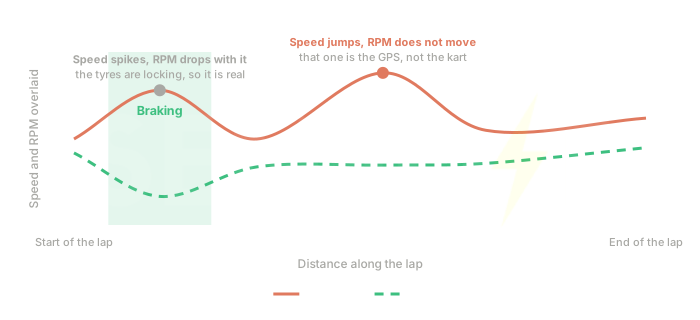
- On a single speed kart, RPM is the wheel speed check you already own. A speed spike with no matching RPM spike is the GPS, not the kart.
- A lock-up shows on the RPM. In a Mini Gr.3 race at Lonato the second hairpin is about 8,100 RPM, and 7,600 where the driver locks the tyres.
- When I judge the sprocket I throw away anything below 5,000 RPM. Those ultra low values normally come from a lock-up on the brakes, not from the corner.
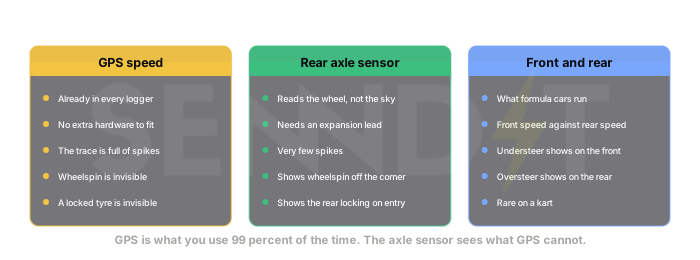
- 99% of the time you rely on GPS speed. The axle sensor is an extra for when you need to see the tyres, not the first thing to buy.
- What is the difference between GPS speed and wheel speed?
- Why is GPS speed spiky on a kart?
- What does a wheel speed sensor show that GPS cannot?
- Do you need a wheel speed sensor on your kart?
- How do you use RPM as your wheel speed check?
- What does a locked rear look like in the data?
- How do you spot wheelspin without a wheel sensor?
- Why does the tyre change what the axle is telling you?
- Which one do you trust for delta time and racing lines?
- GPS speed or wheel speed: which one do I trust?
- Frequently asked questions
Your logger shows one speed. Your rear tyres may be doing another. Which one is the truth?
Both. And that is exactly why it gets confusing.
The speed on your MyChron comes from the satellites. It is the speed of the kart. The rear tyres can be doing something else for a moment, spinning on the exit or locked on the brakes, and the GPS will not tell you.
So let me show you how I deal with it. What I trust, what I do not trust, and what I look at when the two do not agree.
What is the difference between GPS speed and wheel speed?
GPS speed is how fast the kart is travelling over the ground. The logger works it out from the satellites. Nothing touches the wheels.
Wheel speed is how fast the wheels are turning. On a kart you measure it with an extra sensor connected to the rear axle. It tells you your wheels’ spinning speed.
When the tyres are gripping, the two say the same thing. The kart moves as fast as the tyres roll.
They split in two moments:
- Wheelspin. The rear tyres turn faster than the kart is moving.
- Locking the tyres on the brakes. The rear tyres turn slower than the kart is moving, or they stop.
That gap is the whole point of having both. In formula cars they run one sensor on the front and one on the rear. You compare the front speed with the rear speed and you can tell if there is understeer, if there is oversteer, if there is wheelspin in the rear.
On a kart almost nobody has that. So you need to know what the GPS can show you and what it cannot.
Why is GPS speed spiky on a kart?
GPS speed is the number one channel in every Race Studio 3 profile I have. If you do not know what speed you are travelling, there is no point looking at anything else.
But the one thing I do not love about it, on basically any system, is the spikes. You cannot rely too much on it.
A spike is the trace jumping up or down for an instant when the kart did nothing. I have one in a Lonato file where the speed goes from about 92 to 94 km/h and comes straight back. It is not that much. But it is not real either, and I will show you how I know.
The loggers have improved. AiM lists the MyChron 6 GPS at 25 Hz on four satellite systems. At 90 km/h a kart covers 25 metres every second, so that is a point about every metre. It is a lot of points. It is still a signal coming from the sky, and it still has noise in it.
That is why AiM, and also Unipro and Alfano, give you the chance to add a sensor on the rear axle. It tracks your wheel speed very accurately, with very little spikes.
If you are still choosing the box itself, I compared the GPS rates in MyChron 6 vs Alfano 6.
What does a wheel speed sensor show that GPS cannot?
It shows you what the tyres are doing.
I used the rear axle speed on my KZ quite a lot. The reason is simple: it shows you when your wheels are spinning and when you are locking the tyres on the brakes. That is impossible to tell from the GPS speed.
Think about a shifter. You have a gearbox, and you have front brakes. A lot is going on in the braking zone. Every time you downshift very aggressively, the rear tyres are kind of locking. I like to use a lot of engine brake, and it is quite fun when you feel the engine roaring in the back.
But you need to be careful with it. Those rear locks overheat the tyres a little bit. In the first few laps that may even help you to warm them up. Later in the run it is too much locking, and it may cost you some stability and even lap time.
The GPS speed does not show any of this. On the GPS a braking zone with the rear locked and a braking zone with the rear turning look the same, because the kart is slowing down in both.
So the wheel sensor is not there to give you a nicer speed line. It is there to tell you about grip at the rear tyres, on the way in and on the way out.
Do you need a wheel speed sensor on your kart?
For most drivers, no.
Let’s say 99% of the time you are just going to rely on GPS speed and hope it does not have too many spikes. That is what I do too.
If you want one, a few things to know first.
On AiM you can buy the rear axle speed sensor, but it does not connect straight to the MyChron. You need an expansion between the MyChron and the sensor. Ask your dealer for the right one for your unit before you order.
Extra sensors are also extra work. I say the same about tyre temperature and tyre pressure sensors: you would need one extra mechanic just to take care of all the sensors on the kart. In karting you have limited time between sessions and limited people.
And check your regulations. In Italy, at WSK or CIK races, you cannot run the throttle and brake sensors. You can keep them fitted but you cannot connect them. So before you fit anything extra for a race weekend, read what your series allows.
Where does it make sense? Where I used it. On a KZ, when you want to see the wheelspin and the rear locking.
For everybody else there is a second channel that does most of the job. You already have it.
How do you use RPM as your wheel speed check?
On a single speed kart there is no gearbox. The engine drives the rear axle through the sprocket, and the rear axle is stiff, with no differential. So the RPM tells you how fast the wheels are spinning. If the rear tyres slow down, the RPM comes down with them.
That is why RPM is my second channel, always overlaid with the GPS speed.
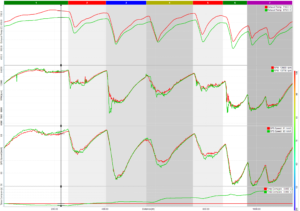
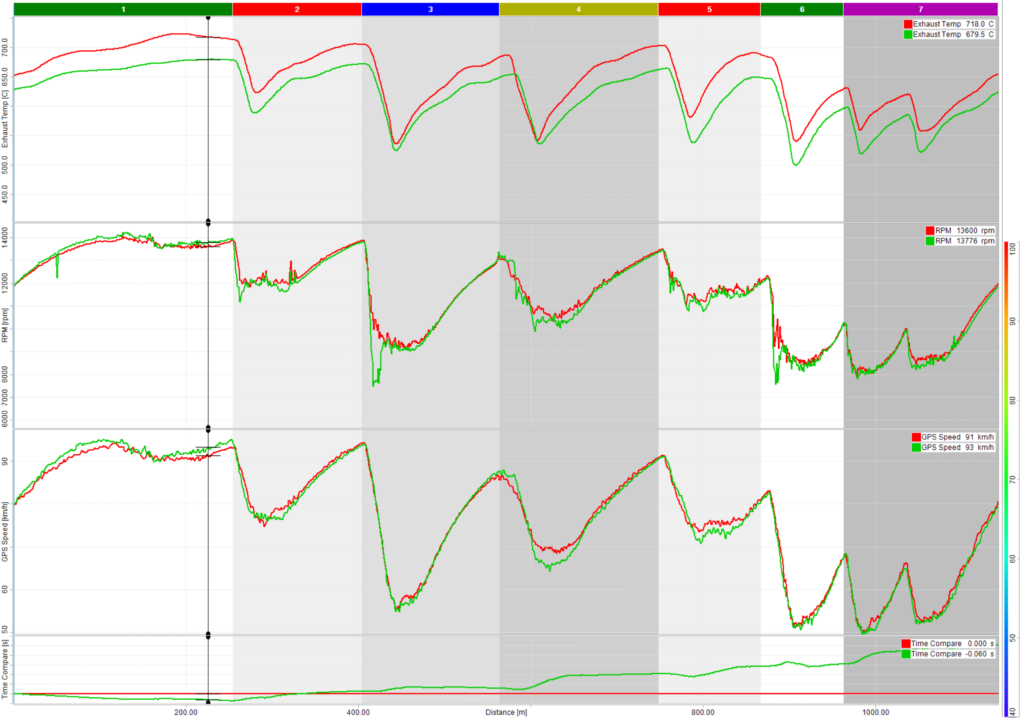
The first thing you see when you put them together: the RPM curve is way smoother than the speed curve. The speed has noise and spikes here and there. The RPM is a lot more consistent.
So here is the check. You see a spike in speed. Is there an equal spike in RPM in the same place?
- No. Then it is probably unreal. That 92 to 94 km/h jump I told you about had nothing on the RPM. So, okay, that must be just a GPS thing.
- Yes. Then something really happened to the kart, and you go and find out what.
The RPM has its own spikes too. It is very hard to have a perfect trace. But the RPM spikes have a reason. In that same Lonato lap I can match them one by one: the driver is hitting the kerb a little into the first corner, he is hitting the kerb on the exit of turn three, the bar corner, and there is a massive one where he is locking the tyres under braking.
On a KZ this check is weaker, because with a gearbox the same RPM is a different wheel speed in every gear.
What does a locked rear look like in the data?
It looks like the RPM falling through the floor for an instant.
Real numbers. This is a Mini Gr.3 race at Lonato. The maximum is 14,200 RPM. In the middle of the second hairpin the minimum is about 8,100. But if you go to the very lowest point of the lap, it is 7,600. That is not a slower corner. That is the driver locking up the tyres.
Why does this matter? Because of what you do with the minimum RPM afterwards.
I monitor the minimum RPM to understand whether the sprocket is on point for the track conditions. And when I do that, I exclude the ultra low values, anything below 5,000 RPM. Those normally come from a lock-up on the brakes. If you leave them in, you think your engine is dying in the corner and you go shorter on the sprocket for a problem that was in the braking zone.
Now, do not get this wrong. A lock-up is not always a mistake. I use RPM to tell how hard the driver braked. In one comparison at Lonato the same driver braked down to 7,500 RPM in the final, with 0.83 G of longitudinal, and he did a better job on the brakes than in qualifying.
So the lock-up in the data is information. It tells you where the limit of the rear tyres was in that braking zone.
How do you spot wheelspin without a wheel sensor?
This one is harder, and I want to be straight with you. With a rear axle sensor you see wheelspin directly. Without it, you put the picture together from other things.
The first one is lateral G on the exit. It is one of the questions I ask when I compare two laps: how is the lateral G force on exit? If it is suddenly dropping, you may have low traction. If it stays for too long, you probably have too much traction, and the rear feels like it is pushing.
The second one is the gearing decision in the wet. You look at the RPM and you think, I need a shorter sprocket for more acceleration. But if you already have a lot of wheelspin, you may not need it. If you are controlling the wheelspin really well and your bottom is weak while your top is strong, then yes, a shorter gearing is better.
The third one is the tyres themselves. The more you slide, the hotter the tyre gets, and when it overheats it degrades quicker. The rears take most of the beating. So do not snap at the throttle. With a soft tyre on a very hot track, controlling the wheelspin and the slides is what keeps the tyre alive for the stint. I go through it in tyre management in karting.
And the driver has to tell you. No channel replaces what he feels at the rear on the exit.
Why does the tyre change what the axle is telling you?
Because the axle only knows how fast it is turning. How far the kart goes for each turn depends on the tyre.
What I have noticed over the years is that every session you do, the tyre gets slightly bigger. And the bigger the tyre gets, the longer the gearing becomes.
So you compare two sessions, same sprocket, nothing changed on the kart. And the RPM against the speed is not the same. One looks a little bit longer on the sprocket. It is not always slipstream. It can be the tyres.
Check the two rears against each other too. Even new tyres do not always match. Say for instance one has a circumference of 83 centimetres and the other 85. One of the two is wrong. It changes the final drive ratio a lot, and it unbalances the chassis massively.
What does this mean for our comparison?
GPS speed does not care about your tyres. 90 km/h is 90 km/h, on new tyres or old ones. Anything you read from the axle, RPM or a wheel sensor, moves with the tyre.
So when the RPM and the GPS speed drift apart slowly, over a session or between sessions, it is not wheelspin. Look at the tyre circumference first.
Wheelspin and lock-ups are fast. They are there for a few metres and then they are gone.
Which one do you trust for delta time and racing lines?
GPS. Here the wheel sensor cannot help you at all.
I always show my drivers at BabyRace that the speed is just 50 percent of the equation. The rest is the distance. You want the least amount of distance while carrying the highest amount of speed.
A wheel does not know where it is on the track. The GPS does. It is the GPS that draws your line on the map. From it you can tell that one lap you were one metre further away from the white line compared to your average line. That is huge. You can tell whether a different line worked, or whether you just made more distance.
The delta time needs it as well, because it has to match the speed with the distance. I explain how we got false signals from a system that did not do that in my four go-to telemetry channels.
One limit to know. The three sectors on your MyChron are taken from the GPS and split evenly across the track. Most of the time the beginning and the end of a sector are right in the middle of a corner. So do not judge one corner from those three splits. That is why I cut the lap into more sections than three, so each corner sits in its own one.
So it is not one against the other. GPS tells you where the kart is and how fast it is going. The axle tells you what the rear tyres are doing.
GPS speed or wheel speed: which one do I trust?
I trust the GPS speed for the lap, and I check it with the RPM.
That is my honest answer for a single speed kart. GPS speed for where you are faster or slower. RPM on top of it, to throw away the fake spikes and to find the lock-ups. Delta time to decide if it was worth it.
On the KZ, when I wanted to see wheelspin and rear locking, I added the rear axle sensor. Because there the GPS simply cannot show it.
What I would not do is buy a sensor before you can read the two channels you already have. Open your last session. Put RPM over GPS speed. Find one spike in the speed and look right above it. That takes you two minutes, and you will never look at a speed trace the same way. And if you want that session read for you, upload the MyChron file to PURPL, the app I built, and it hands back the three things to change next time out.
- All my telemetry articles are in the karting telemetry guides.
- The channels I open first, with the Lonato session in full: the 4 must-have AiM RS3 telemetry channels.
- Want me to look at your driving? Send me your onboard and I go through your laps in an onboard review.
And if a number on your screen looks too good or too bad, check it against a second channel before you change anything on the kart.
Frequently asked questions
Is GPS speed accurate enough for karting telemetry?
Yes, for almost everything. 99% of the time I rely on GPS speed. The weak point is the spikes, so I always overlay it with RPM. A speed spike with no matching RPM spike is a GPS thing, not the kart.
What does a wheel speed sensor do on a kart?
It is an extra sensor connected to the rear axle that tracks how fast the wheels are turning, with very little spikes. It shows you when the wheels are spinning and when you are locking the tyres on the brakes, which is impossible to tell from GPS speed.
Why do GPS speed and wheel speed disagree?
Because GPS measures the kart and the sensor measures the axle. With wheelspin the tyres turn faster than the kart moves. With a locked rear they turn slower. A slow drift between sessions is something else: the tyre circumference changed.
Can RPM replace a wheel speed sensor?
On a single speed kart it does most of the job. In a Mini Gr.3 race at Lonato the second hairpin is about 8,100 RPM and the lock-up is 7,600 RPM. On a KZ the gearbox gets in the way, which is where I used a rear axle sensor.
Send your onboard footage. Alessio reviews it corner-by-corner and tells you exactly what's costing you time, and how to fix it. Back within 48 hours.
Get My Onboard Reviewed → Reviewed personally by a CIK FIA World Champion, never an assistant.I promise I'll not spam you with repurposed shitty AI content but real experiences that only I, Alessio Lorandi, experienced. Written in my funny English-Italian tone of voice 😂
Alessio Lorandi is the former CIK FIA World Junior Champion, winning against Lando Norris in 2013 & F3 multiple race winner. He's helped 200+ karting drivers worldwide get faster & win WSK titles with BabyRace Driver Academy & now through Senndit, his online karting coaching platform.