Minimum Corner Speed: What Your Telemetry Is Telling You
Minimum corner speed is the lowest point of your speed trace in a corner. Here is how I read it in the data, with real RPM numbers from Lonato.

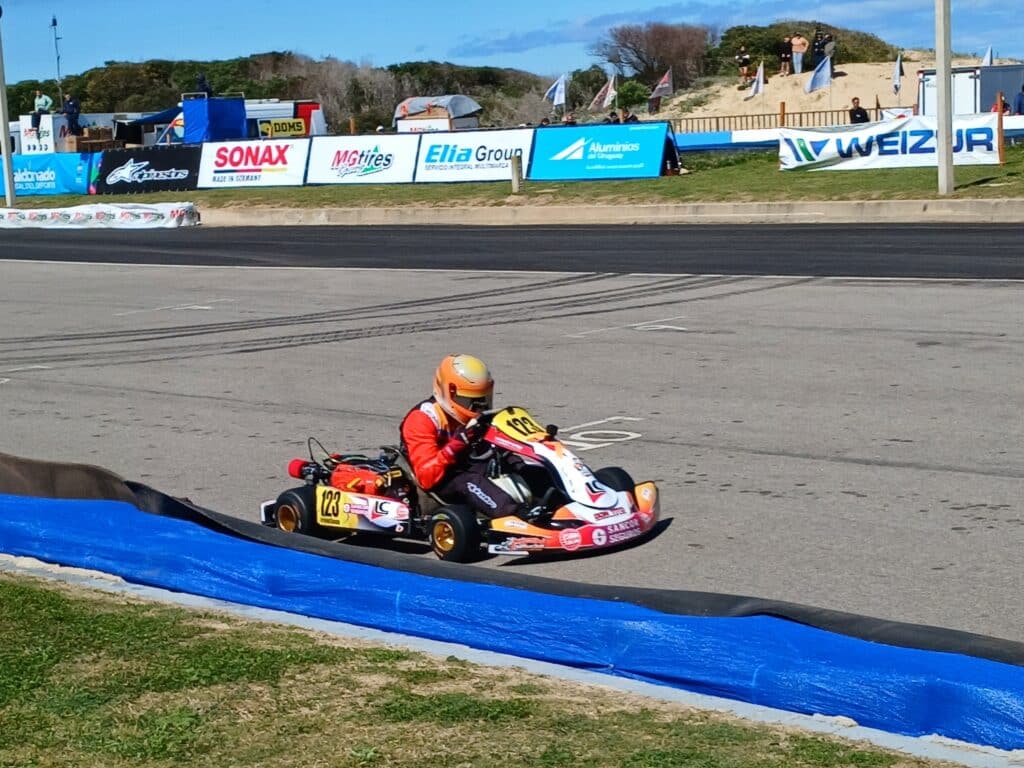
- Minimum corner speed is the lowest point of your speed trace in a corner. In a single speed kart it is also your lowest RPM, and that is what you accelerate from.
- Look at the shape, not only the number. A V shaped speed trace means you overslowed. A U shaped one means you carried the speed.
- A low minimum speed gives you a worse exit too. You feel slow, you go early on the throttle, and the kart pushes.
- 3 km/h is a lot. In the double left at Lonato the same driver was at 10,200 RPM in the final against 10,900 in qualifying. To get that back with gearing he would need about three sprockets.
- Slow in, fast out does not pay in a single speed kart. You lose two tenths in the corner and you gain back one and a half on the straight.
- A KZ is different. With gears and front brakes you V the slow corners, but you still carry quite a bit of minimum speed.
- Delta time is the judge. More minimum speed with a missed apex or more metres is not a faster corner.
- What is minimum corner speed in karting?
- Where do you see minimum corner speed in your telemetry?
- What does a V shaped speed trace tell you?
- Why does a low minimum speed give you a worse exit?
- How much is 3 km/h of minimum corner speed worth?
- Is slow in, fast out the wrong advice?
- When should you give up minimum speed on purpose?
- Does minimum corner speed matter in a KZ?
- How do you raise your minimum corner speed?
- Can you carry too much minimum speed?
- Frequently asked questions
You open the data, you put your lap on top of a faster one, and in the middle of one corner your line drops lower than his. What is that telling you?
It is telling you a lot. In a kart with no gears, I would say that little dip is the first thing I go and look at. So let me show you how I read it, with real numbers from Lonato.
What is minimum corner speed in karting?
Minimum corner speed is the lowest speed you touch in a corner. On the speed trace it is the bottom of the dip. You brake, the line goes down, it hits the lowest point, you go on the gas and it climbs again. That lowest point is your minimum speed.
It normally sits in the mid corner. I always say a corner has four phases: straight line braking, entry, mid corner and exit. The mid goes from the moment you come off the brakes to the moment you go on the gas. And that is where the trace bottoms out.
Why do we care so much? Because in a single speed kart your momentum is entirely relying on the speed you carry at the apex. Juniors, seniors, Rotax, X30, 60 Mini. You have no gears to help you recover. So your minimum speed is also your minimum RPM, and your RPM massively affects your torque and your acceleration out of the corner.
Say for instance turn two at Franciacorta. If your minimum RPM is 9,000 against 9,400, that 400 difference is going to be huge in terms of acceleration out of that corner. And you pay for it all the way down the next straight.
The key word is momentum.
Where do you see minimum corner speed in your telemetry?
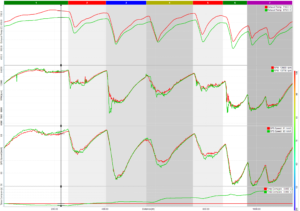
You see it on two channels. GPS speed and RPM. I always overlay them.
GPS speed is the obvious one. But GPS speed is spiky, in pretty much any system. RPM is a lot smoother, so I use it to validate the speed. If the speed line does something strange and the RPM does not move, it is just a GPS thing.
To give you an idea of real values. In a Mini Gr.3 race at Lonato the engine peaked at 14,200 RPM. In the corners the minimum was about 9,000. In the middle of the second hairpin it was about 8,100. There was also a point at 7,600, but that one was the driver locking the tyres on the brakes, so I do not count it as a minimum speed.
Then you put two laps on top of each other, on distance. Your best lap against another lap of yours, or you against a faster driver. And you ask two questions in every corner. Who has a higher minimum speed? And who makes an earlier minimum speed?
After that you look at the delta time. Delta time is my religion. Your corner was faster or slower, and the only way to tell is the delta. A higher minimum speed that does not show up in the delta is not worth anything.
If you want the channels one by one, I went through them in my four go-to telemetry channels.
What does a V shaped speed trace tell you?
It tells you that you overslowed.
Careful, I am talking about the shape of the speed trace, not about the racing line. When the dip is sharp, like a V, you went in, you stopped the kart too much, and you went straight back on the gas. When the dip is round, like a U, you kept the speed up through the middle of the corner. That is what I call rolling speed.
In a single speed kart you want the U.
There is another sign, and you do not even need the data for it. Steering angle. The steer ratio of a kart is about 1 to 1. In a car it is about 1 to 15. So a kart is really direct, you need very little steering. If you find yourself using a lot of steering angle in a slow corner, it means you are not carrying enough speed.
And where does the V come from? Most of the time from the entry. Everything starts in the entry. The mid and the exit are pretty much a consequence of what you do there. You brake early, so you turn in early, so you apex early, and now you still have rotation to finish on the exit. I explained that part in entry vs exit, where do you want to rotate.
Why does a low minimum speed give you a worse exit?
This is the part most drivers get wrong. They think: I was slow in the middle, so at least I will have a good exit. No.
If you carry low minimum speed, you will get an even worse exit, because you will feel tempted to go early on the throttle. You feel the kart is slow, so your foot goes down. It is a bandage. Sometimes it takes you from three tenths lost to one tenth lost. Sometimes it makes it worse.
Why worse? Because a kart has no differential. To turn properly it has to be on three wheels in the mid corner, with the inside rear lifted. And the only way to lift up the rear wheel is by carrying a truckload of speed. If you are slow and already on the gas, you are on four wheels, and your two rear wheels are going to push you. Push understeer. You go wide, you add steering, and the exit speed is not there.
By the way, there is no channel that shows you the inside rear wheel lifting. What you can check in the data is whether the minimum speed has that U shape and whether the RPM stays up.
And remember, there is no such a thing as the earlier the better on the throttle. That is a common fallacy. You go on the gas at the right point, normally around the apex, and you can only do that if the kart arrived there with speed and with the rotation done. More on that in how to optimize the mid corner phase.
How much is 3 km/h of minimum corner speed worth?
Let me give you a real one. Same driver, Lonato, two sessions. 54.8 in qualifying, 55.3 in the final.
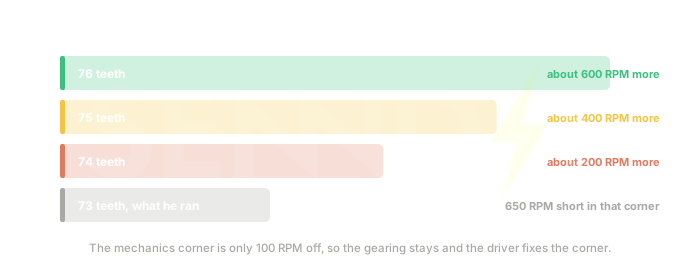
In the double left there was a big difference in minimum speed, and the RPM validated it. In the final he was at 10,200 RPM. In qualifying he was at 10,900. That is about 700 RPM, and in that place it is 3 km/h.
Through the whole corner the final lap was more of a V. He attacked the entry more, but then he stopped too much in the mid. He missed the apex, and on the exit he was not opening the steering enough either.
One sprocket is worth about 200 RPM. So to make up that speed loss with gearing we would have to go up about three sprockets. Let’s say from 73 to 76.
But you cannot do that for one corner alone. In the mechanics corner, same lap, he was only 1 km/h and 100 RPM down. So it would not make sense to change the sprocket. The driver has to fix that corner. More open on the entry, more precise at the apex.
It also works the other way. Based on my experience, the best drivers are the ones who manage to run one sprocket down from everybody else. If 90 percent of the drivers go with 75 and you manage to go on 74, most of the time you are going to be the winning driver. And the only way to run a lower sprocket is to have higher minimum speeds than the others.
Is slow in, fast out the wrong advice?
For a single speed kart, yes. I am really a big enemy of that technique. Lots of coaches preach slow in, fast out. But the goal is to be fast in, fast out.
Here is what happens with slow in, fast out. You lose two tenths in the corner because you overslowed. Then you get a nice exit and you gain back one and a half on the straight. You are still half a tenth down. And you did that in one corner only.
A 60 Mini has about 10 horsepower. If you gain half a tenth on the entry but you lose two on the exit because your mid corner is too low and your RPMs are dead, that is not a good trade-off. It is all about momentum.
So you brake really late, but you make sure you stop and make the apex, so you can get a really good exit too. And pay attention to the word “stop”. I am not saying you stop like a KZ. I am saying you slow the kart enough to make the apex. Nothing more than that.
The line helps you here. If you open up the entry and you use all of the exit, you keep the RPM up without doing anything special. I wrote about that in mastering the racing line. If you exit a corner two metres from the kerb, you are never going to have a good minimum speed in that corner. And it’s kind of like a vicious cycle, the more entry kerb you use, the more speed you carry at the apex and the more exit kerb you have to use, I explain why more kerb means even more kerb.
When should you give up minimum speed on purpose?
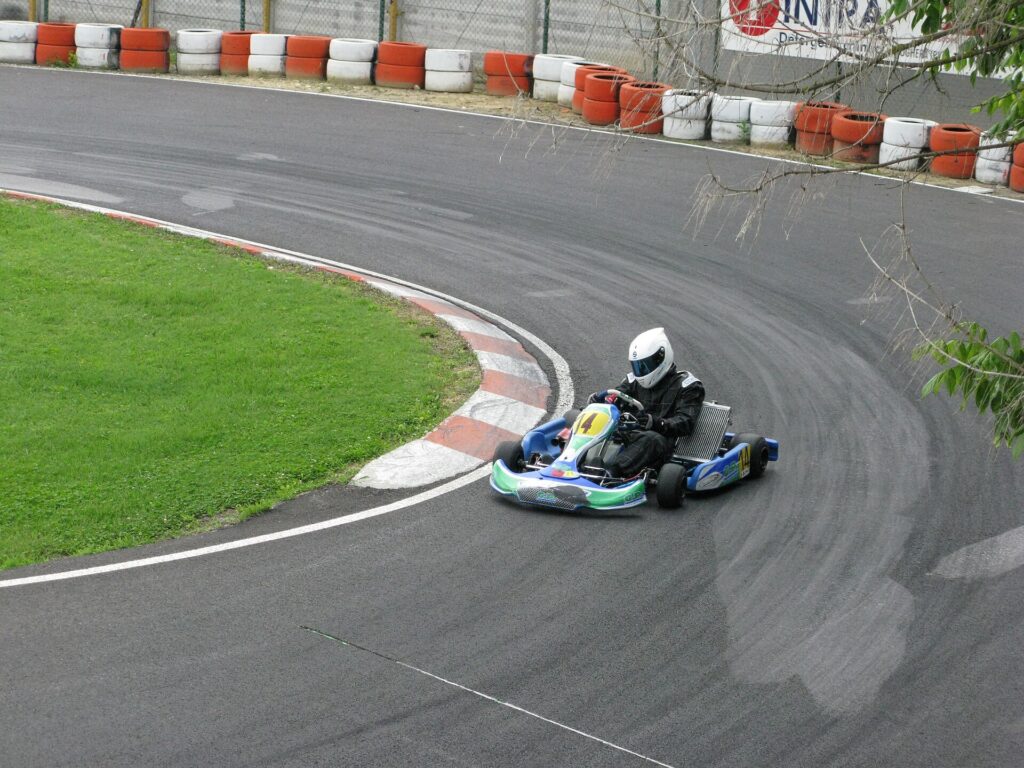
When there is a long straight after the corner. That is the only case where I sacrifice a bit of the mid corner for the exit.
If no long straight follows, I prioritise the mid corner. Turn two at Franciacorta is one of those. Turns nine and ten too, the double right. It is downhill, and if you go early on the gas there you get push understeer and a bad change of direction for turn eleven. So in nine and ten I tap the brakes and then it is about one second of roll.
Lonato is a good example of how the plan changes corner by corner. The last three hairpins are exactly the same in terms of radius and angle, and still they have to be approached quite differently. In the first one you arrive with a high speed, so you attack the brakes and you look for time on the entry. In the second hairpin, in Mini and Junior, you are not really using the brakes. It is more about rolling speed, and the exit is not too important. The last hairpin is the opposite. It launches you onto the longest straight of the track, so there you prepare the exit.
Two more cases. In a double apex you carry a huge speed at the first apex. In a tight chicane you carry less minimum speed in the first part, because you need the second part.
So before you look at the number, look at the track map. What comes after this corner? That decides how much minimum speed you want there.
Does minimum corner speed matter in a KZ?
It matters, but less. When I am driving my KZ the technique in the slow corners is different.
A KZ has gears and it has front brakes. You can pull 1.8, 1.9 G of longitudinal deceleration. So in a slow corner you V the line quite a bit, a stop and go, because you want to win time on the entry and on the exit. You have the brakes to stop it late and the gears to pull you out.
Of course you do not want to overdo it. You still want to carry quite a bit of minimum speed. And in the medium and fast corners you drive a KZ pretty much like a single speed kart, opening up the entries.
You see the difference when drivers defend. A KZ defending a corner properly may lose only half a tenth. A junior, a senior or a mini defending the same corner may lose three, four tenths, or even half a second. They do not have the gears and they do not have the brakes to take advantage of that V shaped line.
That is also why on a very twisty track it is mostly the senior kart that is quicker, even if on paper the KZ is the faster kart. Give the KZ a few braking spots and it changes again.
So when you read the data of a shifter, do not judge a hairpin by minimum speed alone. Judge it with the delta.
How do you raise your minimum corner speed?
First, rolling speed does not mean coasting like a beginner. That is the wrong picture. You brake late. You hold the brakes into the corner. Then between the brake and the gas there is a small transition, a “dead zone” of about 0.1 of a second. 0.2 maximum. In that moment the kart loads up laterally and it springs you out of the corner.
Second, use the track. Open the entry, make the apex, open the exit. For me track usage is the single biggest driving hack to find lap time, and the goal of it is exactly this, keeping the RPM up.
Third, and this works even if you are driving alone with nobody to compare against. Take your 15 laps and find the lap where you had the most speed in that corner. Now you know it is possible, because you did it. Next session you try to carry a bit more.
Say your hairpin is 60 km/h in the middle. The goal is to get to 61, 62. Of course you cannot judge that precisely from the seat. But you push a bit more every session. And if it is too much, you will know. You miss the apex, you lose the exit. Then you probably found your limit.
Because listen, data analysis is really good, but it is backward looking. It tells you what happened. Sensing the speed on the way in is something you develop only by leaving your comfort zone, lap after lap.
Can you carry too much minimum speed?
Yes. And the speed trace alone will not tell you.
If you carry more minimum speed and more minimum RPM but then your exit is bad, you gained nothing. Too much speed in the mid and you miss the apex, you go wide, and you wait on the gas.
There is a second trap. Metres. You can go super fast through a corner, but if you make too much distance for that, it is a time loss. We had this with the data system we used before. The delta was not computing the distance properly. The driver looked super fast on the speed, the delta said the corner was good, and then we would look at the sector time of that specific corner and he was losing. He was making so many metres.
So whatever you see on the speed, benchmark it against a delta time that is distance based, and double check with the sector times.
And do not chase the same thing in every corner. Lifting the inside rear by carrying speed is a slow corner thing. In a fast corner you cannot go looking for it.
- Learn to read the rest of the lap. Start at the karting telemetry guides.
- If you want me to work on this with you corner by corner, that is what my 6 month training program is for.
- No laptop at the track? On PURPL there is a walkthrough on how to analyze kart racing data.
At the end of the day, racing is more of an art than a science. The number in the data tells you where you were slow. Carrying the speed is something you have to go and feel.
Frequently asked questions
What is a good minimum corner speed in karting?
There is no number that is good everywhere. It depends on the corner, the class, the grip and the gearing. Compare it against your own best lap in that same corner, or against a faster driver on the same day. If your hairpin is 60 km/h today, a good minimum speed for you is 61 or 62 with the same apex and the same exit.
Should I look at speed or RPM for minimum corner speed?
Both, one on top of the other. GPS speed gives you the km/h but it has spikes. RPM is smoother and it validates the speed. In a single speed kart the lowest RPM in the corner is the number I look at most, because that is what the engine accelerates from.
Can I fix a low minimum speed with a bigger sprocket?
Only if the RPM is low everywhere. One sprocket is worth about 200 RPM. If you are 700 RPM down in one corner and 100 RPM down in the next one, it is a driving problem, and you cannot have a different gear ratio for one corner.
Is rolling speed the same as coasting?
No. Rolling speed means you brake late, you hold the brakes into the corner, and you have a transition of about 0.1 of a second, 0.2 maximum, before you go on the gas. Coasting for a long time with no brake and no gas is what a beginner does, and it is slow.
Send your onboard footage. Alessio reviews it corner-by-corner and tells you exactly what's costing you time, and how to fix it. Back within 48 hours.
Get My Onboard Reviewed → Reviewed personally by a CIK FIA World Champion, never an assistant.I promise I'll not spam you with repurposed shitty AI content but real experiences that only I, Alessio Lorandi, experienced. Written in my funny English-Italian tone of voice 😂
Alessio Lorandi is the former CIK FIA World Junior Champion, winning against Lando Norris in 2013 & F3 multiple race winner. He's helped 200+ karting drivers worldwide get faster & win WSK titles with BabyRace Driver Academy & now through Senndit, his online karting coaching platform.