MyChron 6 vs Alfano 6: Best Kart Data Logger in 2026
The Alfano 6 is no longer sold new, so the real choice is MyChron 6, a used Alfano 6 or the Alfano 7. Verified specs, prices, and the four channels…

- The Alfano 6 is no longer sold new by Alfano. Their shop lists the Alfano 7 and only sensors, cables and boxes for the 6.
- GPS rate is the big gap: MyChron 6 logs GPS at 25 Hz, the Alfano 6 at 10 Hz. The Alfano 7 is 25 Hz too.
- Battery goes the other way: about 20 hours on the MyChron 6, more than 40 hours claimed for the Alfano 6.
- New prices today: MyChron 6 at $659, MyChron 6 2T at $759, Alfano 7 at 529 EUR (1T) and 599 EUR (2T) for the unit alone.
- Four channels do most of the work: GPS speed, RPM, delta time and exhaust temperature. Every logger here can record them.
- Buy the system your team and your coach already use. The software you live in matters more than the box on the steering wheel.
- Is the Alfano 6 still sold new in 2026?
- MyChron 6 vs Alfano 6: what are the real spec differences?
- How much does a MyChron 6 or an Alfano cost?
- Does 25 Hz GPS vs 10 Hz actually matter on a kart?
- Which channels do I actually look at first?
- Do you need the 2T version or is one temperature enough?
- Which software will you live in, Race Studio 3 or ADA?
- Which kart data logger should you buy?
- What will a data logger not do for you?
- Frequently asked questions
MyChron 6 or Alfano 6: which kart data logger should you actually put on the steering wheel?
I do telemetry analysis every single day, every single session. So the logger is not a gadget for me. It is the thing that tells me where the lap time went.
Let me be straight before we start. I run AiM. My analysis happens in Race Studio 3 and I am sticking to it, because it works really well for me. I have not put the same hours into the Alfano software, so I am not going to pretend I have. The Alfano side of this comparison comes from Alfano’s own pages and manual, and from TKART’s analysis of the unit. The driving side comes from my own data.
And there is one thing most comparisons skip, so we start there.
Is the Alfano 6 still sold new in 2026?
Not by Alfano. If you go on the Alfano webshop today, the units on sale are the Alfano 7 and a new budget unit called the Legend. The Alfano 6 category is still there, but it only holds sensors, cables and boxes. The unit itself is gone from the shop.
The Alfano 6 launched in 2018. When TKART analysed it in 2021 the price was 405 EUR for the 1T and 505 EUR for the 2T. Today it is a second-hand or old-stock purchase.
So the honest version of this comparison is three loggers, not two:
- MyChron 6: AiM’s current kart dash.
- Alfano 6: the one you will find used in the paddock.
- Alfano 7: what you actually get if you buy an Alfano new.
The spares are not the problem. Alfano still sells the Alfano 6 accessories: a speed sensor at 80 EUR, an M10 water temperature sensor at 80 EUR, an exhaust sensor at 135 EUR. What you will not get is the newer hardware. Alfano states that its new lambda sensor cannot be used with an Alfano 6.
MyChron 6 vs Alfano 6: what are the real spec differences?
Here is what I could verify from the manufacturers and from TKART. Where I could not verify a number, I left it out instead of guessing.
| Spec | AiM MyChron 6 | Alfano 6 | Alfano 7 |
|---|---|---|---|
| Sold new by the maker | Yes | No, accessories only | Yes |
| GPS rate | 25 Hz | 10 Hz | 25 Hz |
| Satellite constellations | 4: GPS, GLONASS, BeiDou, Galileo | 3: GPS, Glonass, Galileo | 4: adds BeiDou |
| Temperature inputs | 1 sensor, 2 on the 2T | 1 at a time, 2 on the 2T | 1 at a time, 2 on the 2T |
| Battery | 3,900 mAh lithium, about 20 h | Lithium-ion, can exceed 40 h | Not verified for this post |
| Wireless | Wi-Fi and Bluetooth LE | Bluetooth to the ADA app | Bluetooth, wireless and USB |
| Track recognition | Integrated track database | More than 2,600 tracks, automatic | Not verified for this post |
| Analysis software | RaceStudio 3, PC and phone app | ADA app | ADA app, ADA PRO on PC |
A few more MyChron 6 facts from AiM: a 6 axis inertial platform sampled at 50 Hz, 4 GB of memory, a 320 x 136 pixel display, two CAN connections, USB-C for charging and data. It weighs 370 g and it is rated IP67.
On the Alfano 6, TKART counts six buttons and eight LEDs, six for RPM or lap delta and two for temperature alarms. It can time laps from GPS or from the magnetic strip.
One number from the Alfano 7 manual tells you how the two generations compare: the Alfano 7 downloads data on average 17.6% faster than the Alfano 6.
How much does a MyChron 6 or an Alfano cost?
These are the prices I found today. They are in two currencies and I am not going to convert them for you, because the exchange rate and your local tax change the answer.
- MyChron 6: $659.00 at OG Racing, a US dealer. You pick the temperature sensor type as a variant.
- MyChron 6 2T: $759.00 at the same dealer.
- Alfano 7 1T: 529.00 EUR for the unit in Alfano’s own shop. 629.00 EUR with the water temperature sensor, 684.00 EUR with the exhaust sensor.
- Alfano 7 2T: 599.00 EUR for the unit. 849.00 EUR with water and exhaust sensors, 929.00 EUR with water, exhaust and speed sensors.
- Alfano 6: no new price, because the maker no longer lists the unit. The last reference I can give you is 405 EUR (1T) and 505 EUR (2T) from 2021.
Look at the Alfano 7 2T line again. The unit is 599 EUR, the full pack with three sensors is 929 EUR. That is 330 EUR of sensors. On any brand, the box is only part of the bill. Before you compare two prices, check what is in the kit.
One detail I like on the Alfano 7: the 1T can be upgraded to a 2T later with a paid licence key. You do not have to buy a second unit.
Does 25 Hz GPS vs 10 Hz actually matter on a kart?
Yes, and here is the simple way to think about it.
GPS speed is the number one channel in every profile I use. At 90 km/h a kart covers 25 metres every second. A 10 Hz GPS gives you a point every 2.5 metres. A 25 Hz GPS gives you a point every metre.
Now think about a braking zone or a hairpin. The whole story of that corner happens in a few metres: where you got off the brake, where the minimum speed was, where you picked the throttle up. With more points you see the shape of it. With fewer points the software is drawing a line between dots.
But I do not want to oversell it. The thing I do not love about GPS speed on basically any system is the spikes. You cannot rely on it 100%. That is why AiM, Unipro and Alfano all let you add a wheel-speed sensor on the rear axle.
I used the rear axle speed sensor on my KZ quite a lot, because it shows you when the wheels are spinning or when you are locking the tyres on the brakes. That is impossible to tell from GPS speed.
Still, 99% of the time you are going to rely on GPS speed. So if you are buying new, 25 Hz is what both brands sell now. If you are buying a used Alfano 6, 10 Hz is the main thing you are giving up.
Which channels do I actually look at first?
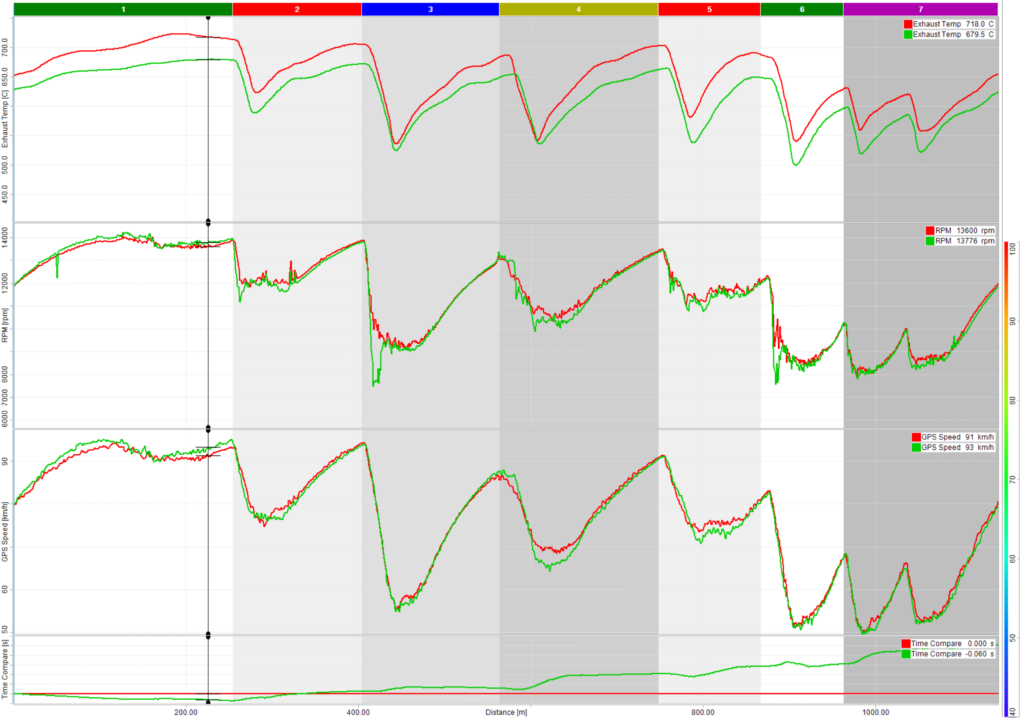
Four. On my laptop I have seven or eight Race Studio 3 profiles, and these four are in all of them.
- GPS speed. Where is the driver faster or slower, in km/h.
- RPM. It validates the speed. A speed spike with no RPM spike is the GPS, not the driver. It also tells me about the sprocket.
- Delta time. Delta time is my religion. Your corner was faster or slower, and this is the only way to tell.
- Exhaust temperature (EGT). Carburation, and a throttle trace in disguise.
In Race Studio 3 I keep those channels on one screen, with two laps overlaid against distance.
Real numbers, so you see what I mean. On a Mini Gr.3 race at Lonato, logged on AiM, the max is 14,200 RPM. The minimum in the corner is about 9,000. In the middle of the second hairpin it is about 8,100, and it drops to 7,600 when the driver locks the tyres.
In one comparison a driver was at 10,200 RPM against 10,900 in the same place. That 700 RPM was 3 km/h, and the delta in that corner went from 0.58 to 1.33 seconds. About three quarters of a second in one corner.
And one sprocket is about 200 RPM. That is how I read gearing from the data.
I go through all four in detail in my four go-to telemetry channels. The point for a buyer: none of the four needs an exotic logger.
Do you need the 2T version or is one temperature enough?
Both brands split the range the same way. The base unit reads one temperature. The 2T reads two.
- MyChron 6: one temperature sensor. MyChron 6 2T: two.
- Alfano 6 1T: one probe at a time, exhaust gas or water. 2T: both.
- Alfano 7 1T: one at a time. 2T: one water sensor plus one exhaust sensor together.
So the question is really: which temperatures do you need?
For me exhaust temperature is hugely important, and not only for the carburation. When the driver goes on the throttle, the EGT goes up. When he comes off, it goes down. So you can see where he picked the gas up, even with no throttle sensor on the kart.
That matters a lot in Italy. At WSK or CIK races you cannot run the throttle and brake sensors. You can keep them fitted, but you cannot connect them. EGT is what is left.
It is not perfect. Even with the fastest AiM EGT sensor the line is a curve, not a switch, so you cannot say metre by metre where the throttle went down. But you get close.
If your engine is water cooled and you want EGT as well, that is two temperatures, so that is a 2T. If you only need one of them, the base unit does the job and you save 100 dollars on the MyChron or 70 EUR on the Alfano 7.
Which software will you live in, Race Studio 3 or ADA?
This is the part people skip, and it is the part that decides how much you get out of the logger.
The MyChron 6 works with RaceStudio 3 on the PC and with the RaceStudio 3 phone app on iOS and Android. The Alfano units send data over Bluetooth to the ADA app, and Alfano has ADA PRO on the computer.
I can only speak first-hand about Race Studio 3. What I can tell you is what to test in whatever you buy: the delta time.
Delta time has to be computed on distance, not only on speed. You can be super fast through a corner, but if you make too many metres you are losing. We had this problem with another system we used before. The delta said the driver was gaining, then we looked at the sector time for that corner and he was slower. The delta was wrong because it was not computing the distance.
If you cannot see delta time in Race Studio 3, you are probably set to time base. Click the stopwatch and switch to distance base. It appears.
And once you have the data, this is the order I open it in.
So whatever you use, AiM, Alfano or Unipro, check the delta against your real sector times once. If they agree, trust it. If they do not, you are going to get false signals.
And think about who you share data with. Telemetry works best when you compare with a teammate, one or two corners at a time. That is a lot easier when you are both on the same system.
Which kart data logger should you buy?
Here is how I would decide, based on what is verified above.
- Your team or your coach runs AiM: buy the MyChron 6. Take the 2T if you want water and exhaust temperature together.
- Your team runs Alfano and you are buying new: you are buying an Alfano 7, not a 6. Same 25 Hz GPS as the MyChron 6.
- You found a cheap used Alfano 6: it still records what you need to start. GPS speed, RPM, lap times, one or two temperatures. You give up GPS rate, 10 Hz against 25 Hz, and the newer sensors. For a first season, that is a fair trade if the price is right.
- Long days and endurance: the Alfano 6 battery is the strong point, more than 40 hours claimed against about 20 hours on the MyChron 6.
The mistake is to choose on the spec sheet alone. A coach brings his own cameras, but he will use your data logger, whether it is your MyChron, your Alfano or your Unipro. So ask him what he works in before you spend the money. And make sure it is charged and working before the session. It sounds obvious. It is not always.
My own answer is simple and a bit biased: I use AiM and Race Studio 3 every day, so that is the system I can help you with fastest.
What will a data logger not do for you?
It will not make you faster by sitting on the steering wheel.
Inside a MyChron, an Alfano or a Unipro you have the same family of things: GPS, accelerometers, a gyroscope, and the sensors you plug in. The logger records. Somebody still has to read it.
And in races it is often all you have. In Europe you cannot run onboard video during the races, so the telemetry from your logger is the only record of what happened on track. Same in the wet: there is still a ton of value in the data when the track is wet.
So budget for the reading, not only for the box. Three ways to do it:
- Learn it yourself. Start at the karting telemetry guides.
- Use a tool that does the first pass for you. This is what I use PURPL for, and there is a full walkthrough on how to analyze kart racing data.
- Send me your onboard from a practice day. With an onboard review I go through your laps on video and tell you where the time is.
Frequently asked questions
Is the Alfano 6 discontinued?
Alfano’s own webshop no longer lists the Alfano 6 unit. It lists the Alfano 7 and the Legend, and it still sells sensors, cables and boxes for the Alfano 6. You will find the Alfano 6 itself used or as old stock.
What is the GPS rate of the MyChron 6 and the Alfano 6?
The MyChron 6 GPS runs at 25 Hz on four constellations. The Alfano 6 satellite chip runs at 10 Hz on three. The Alfano 7 moved to 25 Hz and added BeiDou.
What is the difference between the MyChron 6 and the MyChron 6 2T?
Temperature inputs. The MyChron 6 reads one temperature sensor, the 2T reads two. At OG Racing the gap is 100 dollars, $659 against $759.
How long does the battery last?
AiM states about 20 hours for the 3,900 mAh battery in the MyChron 6. TKART reports that the Alfano 6 battery can exceed 40 hours.
Which channels should a beginner look at first?
GPS speed, RPM, delta time and exhaust temperature. Those are my four go-to channels, and every logger in this comparison can record them.
Send your onboard footage. Alessio reviews it corner-by-corner and tells you exactly what's costing you time, and how to fix it. Back within 48 hours.
Get My Onboard Reviewed → Reviewed personally by a CIK FIA World Champion, never an assistant.I promise I'll not spam you with repurposed shitty AI content but real experiences that only I, Alessio Lorandi, experienced. Written in my funny English-Italian tone of voice 😂
Alessio Lorandi is the former CIK FIA World Junior Champion, winning against Lando Norris in 2013 & F3 multiple race winner. He's helped 200+ karting drivers worldwide get faster & win WSK titles with BabyRace Driver Academy & now through Senndit, his online karting coaching platform.