How Telemetry Can Transform Your Karting Performance
Telemetry separates drivers who improve from those who stagnate. Real data beats guesswork every time.

- Telemetry provides real numbers and facts about where you’re losing time, not just vague opinions
- Key data points include GPS speed traces, RPM, exhaust temperature, throttle/brake sensors, steering input, and G-forces
- The drive-analyze-adjust loop helps build consistency and pace faster than guesswork alone
- Data removes excuses and builds mental confidence by giving you clarity on exactly what to fix
- Start simple by focusing on one or two corners per session where your delta time is worst
- Drivers who consistently improve and win races are the ones who embrace telemetry early
When you want to gain a serious edge in karting, there’s one tool that makes all the difference.
You guessed it, telemetry.
If you’re not using data to review and refine your driving, you’re leaving lap time on the table, plain and simple.
As a coach and former racing driver, I’ve seen firsthand how telemetry can completely change a driver’s performance on track.
We’re not just talking about vague ideas or opinions, we’re talking about real numbers that show you exactly where you’re losing time and how to get it back next time out on track.
Why Telemetry Is a Game-Changer in Karting
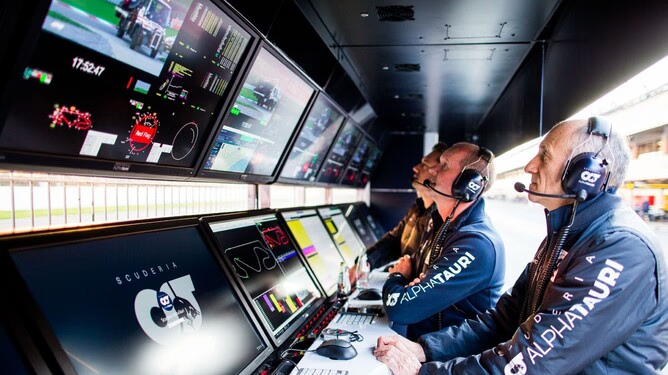
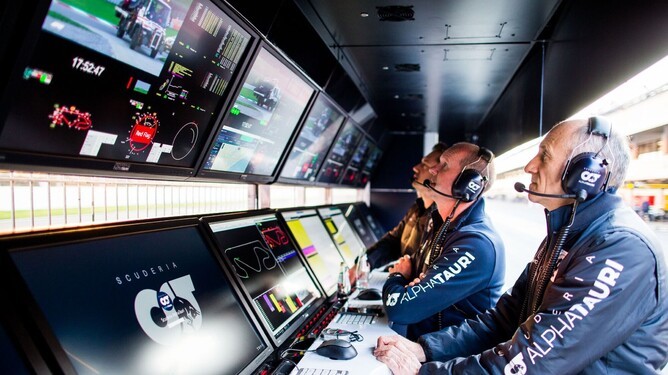
The thing is that telemetry gives you insights that the naked eye or even onboard videos can’t fully capture. Things like:
- GPS Speed traces
- RPM
- Exhaust temperature (or “EGT”, To spot carburation anomalies or delayed throttle pick up)
- RPM
- Throttle and brake sensors (if mounted on, highly recommended)
- Steering input
- Lateral and longitudinal G-forces (Create a “Combined G” channel sum between the two and you’ll see how much grip is being used)
- Racing lines (GPS)
When you combine these data points, it becomes crystal clear where your strengths and weaknesses are.
One driver might be braking too early.
Another might not be using the full track on exit.
And someone else might be inconsistent with throttle application mid-corner.
This kind of precision allows you to take a much more focused approach to improving, no guesswork, just facts.
How I Use Telemetry With Drivers I Coach
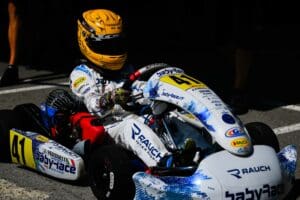
Whether I’m working with a 60 Mini driver at BabyRace, I always say the same thing: “Let’s have a look at data.”
The goal isn’t to overwhelm you with charts and numbers. It’s to give you simple, actionable feedback. For example:
- Comparing your best lap with a reference driver
- Highlighting delta time difference from corner entry to mid, to corner exit
- Finding where you coast too long (thus spending too long off the brakes and off the gas) or brake too early
- Spotting line differences that cost tenths every lap (still very common at the highest levels and among the best drivers)
We take that feedback and apply it directly on track in the next session.
That loop, drive, analyze, adjust, is how you build consistency and pace fast.
The Mental Side: Building Confidence With Data
One thing most drivers don’t expect is how much telemetry helps your mental game.
When you see the numbers backing up your progress, or pointing to exactly what went wrong and so the areas you’ll need to work on, it gives you clarity. And clarity builds confidence. Oh yeah it does.
And it removes the boolshit excuses out of the equation (we’re all victim to those…;) )
Instead of guessing, you know: “Okay, I braked 3 meters too early here, next session I will fix that.”
It becomes a process. You’re not just hoping to improve, you’re working with evidence towards perfecting your driving.
Getting Started With Telemetry: My Advice
If you’re just starting out, keep it simple:
- Focus on one or two corners per session (the ones where your delta time is the worst).
- Spend some time to learn how to read basic data like throttle trace and speed, while at the same time get coached by a data guy or anyome with lots of experience (us at senndit.com for example 😉 )
- Compare your laps to a consistent benchmark (likea quick teammate or other previous sessions from yours or from other days when you were faster).
And remember: it’s not about being perfect, it’s about getting better, every session, one step at a time.
Final Thoughts
I’ve worked with drivers at every level, and the ones who consistently improve and win races are the ones who embrace telemetry early. It’s not magic. It’s just about knowing where lap time needs to be found.
Whether you’re chasing a tenth or trying to find a full second, telemetry gives you the roadmap.
So start using it. Master it. And watch your performance transform.
Just Senndit
, Alessio Lorandi
The single most useful number once you are comparing two laps is delta time. I broke down how to read it on PURPL: delta time explained.
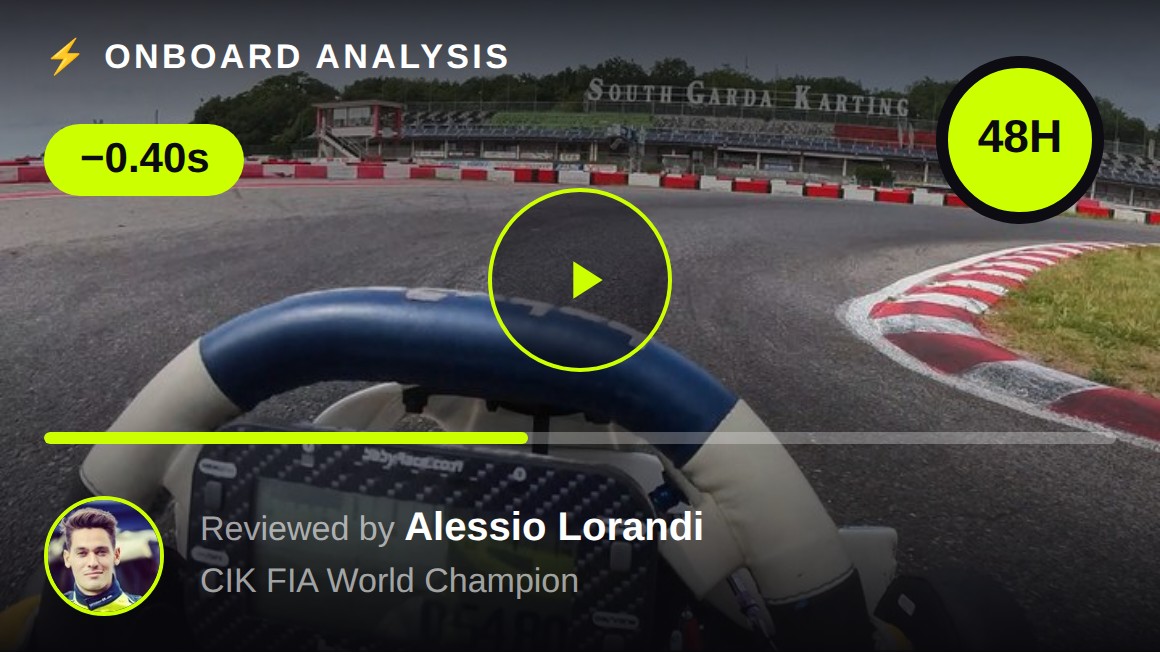
Send your onboard footage. Alessio reviews it corner-by-corner and tells you exactly what's costing you time, and how to fix it. Back within 48 hours.
Get My Onboard Reviewed → Reviewed personally by a CIK FIA World Champion, never an assistant.I promise I'll not spam you with repurposed shitty AI content but real experiences that only I, Alessio Lorandi, experienced. Written in my funny English-Italian tone of voice 😂
Alessio Lorandi is the former CIK FIA World Junior Champion, winning against Lando Norris in 2013 & F3 multiple race winner. He's helped 200+ karting drivers worldwide get faster & win WSK titles with BabyRace Driver Academy & now through Senndit, his online karting coaching platform.