Data Doesn’t Lie: Using Telemetry to Find Lap Time
Your telemetry is telling you exactly where you're losing tenths. Most drivers ignore it.

- Telemetry reveals driving improvements even when you’re already the fastest driver
- Focus on comparing data with teammates to identify specific weaknesses
- Work on one or two corners at a time instead of trying to fix the entire lap
- Data analysis should follow a cycle: review, adjust on track, test, repeat
- Great drivers combine talent with data analysis, not just raw speed
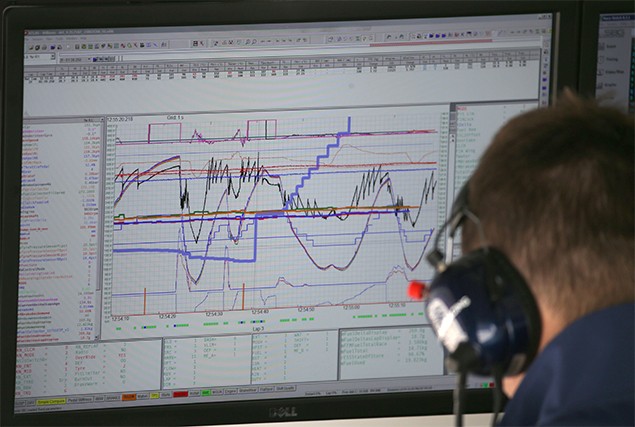
- Telemetry helps spot braking points, throttle application, and consistency issues
Let me ask you something.
Have you ever noticed how Formula 1 drivers seem to improve lap after lap, even within the same session?
It’s not luck. It’s not guessing.
It’s data. Telemetry.
F1 teams have entire armies of engineers (at the track and back at the factory) watching every single braking point, every throttle trace, every steering input in real time.
That’s how Red Bull, Mercedes, Ferrari… they all squeeze out extra performance.
Now, I know we don’t have that kind of budget in karting. No team of engineers in the factory looking at our laps live.
But… that doesn’t mean telemetry isn’t for us.
In fact, it’s one of the biggest game-changers you can use to improve as a driver.
Why Telemetry Matters More Than You Think
Here’s the truth:
Even if you’re the fastest on the grid, there’s always something to improve. Always!
When I was racing juniors and seniors, I’d often be the quickest in my team.
I’d set the best lap time, beat my teammates. But every single time, there were one or two corners where they were quicker than me.
My first reaction?
“Who cares? I’m still faster overall.”
But that’s the cocky way to think. The champion’s way is to ask:
“Why are they faster there, and what can I learn from it?”
That’s the difference between good drivers and great ones.
What Telemetry Really Gives You
Telemetry isn’t just about setup choices, gear ratios, sprockets, water temp, axle stiffness.
Sure, that stuff matters. But the real gold is in the driving improvements it reveals.
With telemetry, you can spot:
- Are you braking too early?
- Are you rolling too much speed into a corner?
- Are you picking up the throttle too late (or too aggressively)?
- Are you losing consistency lap after lap?
Sometimes the data tells you what you don’t want to hear.
And that’s exactly why it’s so powerful. I can’t just drive anymore without looking at my data.
3 Steps to Use Telemetry Like a Pro
You don’t need F1-level software or 20 engineers. Here’s how to get the most out of it in karting:
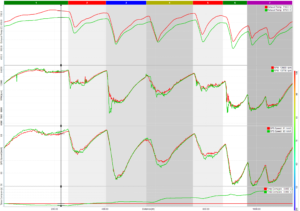
Don’t just look at your own data. Overlay it with a faster driver’s lap.
1. Compare With Teammates
Ask yourself:
- Where am I losing?
- How are they braking differently?
- Are they carrying more speed mid-corner?
This humbles you fast, but it also makes you faster.
2. Focus on One or Two Corners
Don’t try to fix the entire lap in one go. Pick the biggest weak spots to work on first.
Often it’s just one corner that’s costing you two tenths.
Clean that up, and then move on to the next ones after fixing the first.
Remember always to adapt as well as you can to the kart balance.
3. Review, Adjust, Repeat
Data is useless if you don’t act on it.
Make the change, test it on track, and then check the data again.
That’s the cycle every top driver lives by.
Final Thoughts: Data Doesn’t Lie
Look, you can win races without telemetry. But if you want to keep winning, if you want to climb higher, if you want to build the champion’s mindset, then you need to respect the data.
Because the truth is simple:
- Fast drivers rely on talent.
- Great drivers rely on data plus talent.
So next time you’re at the track, ask yourself: “Am I guessing? Or am I learning from the numbers?”
That’s where the edge is.
I literally can’t drive without anymore nowadays.
It’s just so much easier to find lap time performance and spot problems earlier on.
The step-by-step version of this workflow, from downloading a session to finding where the time actually went, lives on PURPL: how to analyse kart racing data.
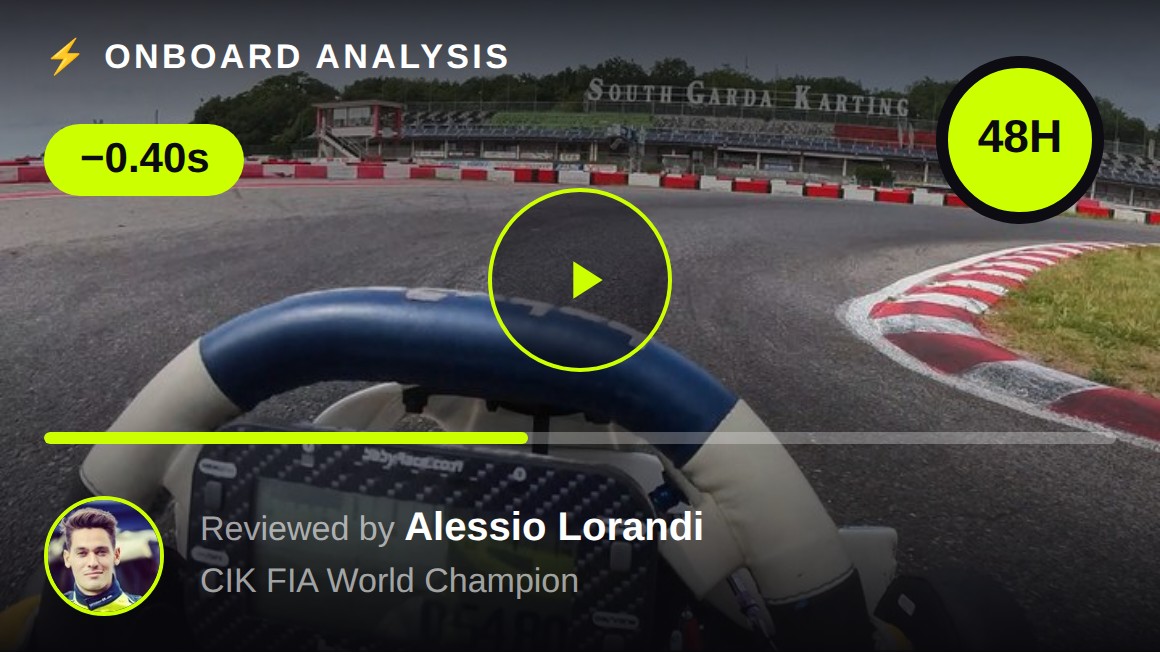
Send your onboard footage. Alessio reviews it corner-by-corner and tells you exactly what's costing you time, and how to fix it. Back within 48 hours.
Get My Onboard Reviewed → Reviewed personally by a CIK FIA World Champion, never an assistant.I promise I'll not spam you with repurposed shitty AI content but real experiences that only I, Alessio Lorandi, experienced. Written in my funny English-Italian tone of voice 😂
Alessio Lorandi is the former CIK FIA World Junior Champion, winning against Lando Norris in 2013 & F3 multiple race winner. He's helped 200+ karting drivers worldwide get faster & win WSK titles with BabyRace Driver Academy & now through Senndit, his online karting coaching platform.