Karting Helmets: What to Look For in Your First One (2026)
What I check before buying a first karting helmet: the homologation for your age, the fit, the weight, the visor, and when a used one is fine.

- Homologation comes first. Look for the homologation number inside the helmet and check that it is not expired, or about to be.
- Under 15 is a different standard. In FIA Karting competitions a driver under 15 needs a Snell-FIA CMR2016 or CMS2016 helmet.
- The helmet should squeeze your cheeks a little bit. Almost on the edge of squeezing you. That is the sweet spot.
- Try it on with your balaclava. Those two, three, four millimetres change the fit.
- Weight matters twice. For your neck over a long race, and for the centre of gravity of the kart. Even 100 or 200 grams.
- A motorcycle helmet is not homologated for kart racing. At international races they check.
- Do not buy the helmet cheap. If you buy cheap you pay twice. And without big crashes you can keep a good one until the homologation runs out.
- What matters most in a first karting helmet?
- Which homologation does a karting helmet need?
- What is different for drivers under 15?
- Where is the homologation label, and when does it run out?
- Can you use a motorcycle helmet for karting?
- How should a karting helmet fit?
- What mistakes do people make when trying a helmet on?
- How much does helmet weight matter in a kart?
- Does helmet aerodynamics make a difference in a kart?
- What about the visor and the ventilation?
- How much should you spend, and is second hand OK?
- When should you replace a karting helmet?
- Frequently asked questions
You are about to buy your first karting helmet. Or your kid’s. What do you actually look at?
Listen, the helmet protects the most valuable part of your body. So it is not the place to guess.
I am not going to rank brands on this page. I already wrote about the karting helmets I have raced with. This one is about how to choose. What to check before you pay, in the order I would check it.
What matters most in a first karting helmet?
You choose a helmet for three things. Safety, comfort and performance.
Safety is the homologation. That part is not really up to you. Either the helmet is homologated for karting and still valid, or it is not.
Comfort is the fit. And I do not mean comfortable like a sofa. I mean the helmet stays where it is when the kart is shaking you around.
Performance is mainly the weight, and a little bit of aero.
So what are the priorities? Once the helmet is homologated and the size is right, for me it is weight first, then aero, then comfort.
And there is one thing nobody thinks about in the shop. The sound. You need to hear the engine. Not too much, not too little. I tested different ones, and you can really notice a difference from helmet to helmet.
Which homologation does a karting helmet need?
The first thing I look for is a homologation number. And that the homologation is not expired. If anything’s wrong with a helmet and the helmet breaks and you have a fatal injury, the homologation is a good insurance, I would say.
Most of the helmets you find from the karting brands have it. So you can relax and just double check.
What do the rules say? For FIA Karting competitions the 2026 technical regulations say the driver must at all times wear a homologated full-face helmet. Then Article 7.1 lists what is accepted.
For drivers over 15 the list includes:
- Snell K2020 and SA2020. The older K2015 and SA2015 are still on the list, with an end date.
- FIA 8859-2015 and FIA 8859-2024.
- FIA 8860-2018.
- FIA 8878-2024. This is the FIA standard written for karting helmets. It only covers full-face helmets. Open face and flip-up helmets are out.
- Snell-FIA CMR2016 and CMS2016. The youth standard is accepted for older drivers too.
You can read the full article in the FIA Karting technical regulations.
That list is for FIA Karting competitions. Your national federation or your club series can have its own. So before you pay, read the rules of the series you want to race in.
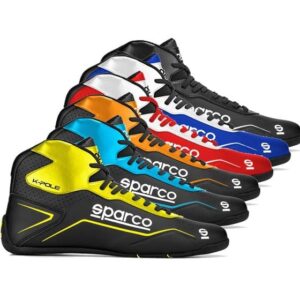
At international races you get checked at scrutineering. Suit, gloves, shoes, helmet. For the shoes, I explain why your karting shoes have to be homologated. At club level they check less often. I would not plan around that.
What is different for drivers under 15?
The standard is different. This is the part I would check twice if I was buying for a kid.
For drivers under 15 the FIA Karting regulations ask for Snell-FIA CM. That means a helmet labelled CMR2016 or CMS2016. So when you buy for your kid, CMR is what you look for.
There is one exception, and it comes with numbers. If the driver’s head circumference is greater than 59 cm, he can use a helmet for drivers over 15. But then the weight of the helmet must not exceed 1,500 g, including paint, visor and all accessories.
And what happens on the 15th birthday? Nothing. The same article says a helmet that meets the Snell-FIA CM standard can keep being used after 15 years of age, without limitation. So a CMR helmet that still fits is not money thrown away.
Where is the homologation label, and when does it run out?
It is inside the helmet. You take off the foams and you find it. It is a shiny silver number.
The FIA karting standard, 8878-2024, describes that label. It is fixed inside the helmet on the liner, and it is made so it destroys itself if somebody tries to remove it. On it you find the name of the standard, the manufacturer, the model, the size, the homologation number, the date of manufacture with month and year, and a serial number.
So you have two things to read. Which standard, and how old.
Why does the age matter? Because standards run out. In the 2026 FIA Karting regulations, Snell K2015 and SA2015 are not valid after 31.12.2028. FIA 8859-2015 is no longer accepted after 31.12.2035.
What I tell people is simple. Check that the expiry is at least five years down the road. Otherwise you buy a helmet today, and in a short time you have to buy a new one just to keep racing.
For the karting standard the FIA also publishes the helmets it has homologated, model by model, with the homologation number. It is Technical List No 108. If you are not sure about a model, look there.
Can you use a motorcycle helmet for karting?
For racing, no.
A motorcycle helmet is not homologated for kart racing. At club level you may get away with it. At international races they check. And I do not recommend it anyway, because you want a helmet that stays intact in a big crash.
The two are also built differently. A motorcycle helmet is more of a V shape. A karting helmet is a bit more round. To be honest, I am not exactly sure why.
The speeds are not the same either. A kart gets up to 150 km/h or so in the shifters and the seniors. A MotoGP bike does 300 to 350 km/h. It is a different job.
So once you are doing test days and races, you need a homologated karting helmet. From the likes of Schuberth, Arai, Bell, Stilo and so on.
How should a karting helmet fit?
It should fit in a way that makes you squeeze your cheeks a little bit. I think that is my number one thing.
Not so tight that your face is exploding. Not so loose that your head moves inside.
How do you check it?
- Put it on and move your head. Up and down, left and right. The helmet has to be firm. No shaking.
- Feel the top. It should not hurt at the top of your head.
- Feel the cheeks. A little squeeze. Almost on the edge of squeezing you. I think that is the sweet spot.
The common mistake I see is a helmet that is way too loose. The head goes way too far up into the helmet.
And gear that does not fit is not only uncomfortable. An oversized helmet is a distraction. It takes your attention away from the driving.

What mistakes do people make when trying a helmet on?
Two mistakes.
The first one is trying the helmet without the balaclava. You are going to drive with a balaclava. Those two, three, four millimetres change how the helmet fits. So bring it to the shop and put it on first.
The second one is choosing the comfortable one. You try two sizes, one feels nice and one feels tight, and you take the nice one. Normally that is the oversized one.
Tighter helmets are better. Why? Because in the shop you are standing still. On track you have bumps, you have kerbs, and you have the wind at 100 km/h or more. If it moves while you are standing still, imagine what happens over the bumps.
So try before you buy, in a store if you can. I am not going to give you a size in centimetres here. The size that counts is the one on your head, with the balaclava on.
How much does helmet weight matter in a kart?
A lot. For two reasons.
The first one is your neck. A lighter helmet is less strain on the neck muscles. So you are less tired over a long race.
The second one is the centre of gravity. 100, 200, 300 or even 500 grams on your head make a big difference in the centre of gravity of your kart. Especially when the grip is high.
That is why I say lighter is better. And it is why the weight is the first thing I look at after the homologation and the size.
For me it was also the reason for a change. I used Arai all my life, and recently I swapped to Schuberth. I chose it for the weight. My neck feels way less tired after long races.

Does helmet aerodynamics make a difference in a kart?
A little bit. Not as much as people think.
My estimate is half a tenth, maybe. On a long track, 0.05 seconds at the end of the lap, or less. It is very, very hard to tell.
And I want to be straight with you. I have not made an actual test in the wind tunnel. So that is a feeling, not a measurement.
One thing the rules do say. In FIA Karting competitions you can only add a device to a helmet, aerodynamic or not, if it was homologated with that helmet. So do not go sticking things on it.
What about the visor and the ventilation?
The visor is part of the safety. You need a homologated helmet and a homologated visor, so that in case of a big crash the helmet stays intact and protects you.
The FIA Karting regulations ask for an efficient and unbreakable visor for the eye opening. The visor must show the logo of the manufacturer and the production date. So look for those two on it.
When you buy the helmet, check which visor options you can get for it. Clear, tinted, rain.
If you take karting seriously I would have two visors, or even three. Because if you break one or lose one on a race weekend, you have a backup.
And clean your helmet and your visor every session.
Ventilation is a trade off. Too much, and you pick up dust and dirt in your eyes. Too little, and you overheat. My helmet has a clip system with two choices of ventilation. When it is wet and the visor fogs, I open it more.
But it is not going to be the number one priority on a first helmet.
How much should you spend, and is second hand OK?
Quality costs a premium. A top helmet, between the helmet and the painting, is about 2,000 euros. A full kit of safety gear is around 3,000 to 3,500 euros.
I know that is a lot. But the helmet is the one thing I would never buy cheap. If you buy cheap you pay twice.
Can you buy second hand? Yes. You can save 500 to 600 euros on a second hand helmet, and I understand it for families who are counting the cash.
A used helmet is fine unless it had big hits. With big hits the carbon fibres in the shell may break. So ask about its history. And you still check the label and the dates like on a new one.
I prefer new, for another reason. A kid can design his own helmet. It is a bit like their Christmas gift.
And when you have one, do not sell it later. Keep it. Like a museum.
When should you replace a karting helmet?
Less often than people do.
To be honest, there is not enough wear and tear in karting to justify a new helmet all the time. Most drivers replace the helmet for the style, because they want a new design.
Without big crashes you can use a helmet until the end of its homologation. Use the whole cycle.
If you have big crashes, it is less.
And one more thing. I would never let anybody drive with my helmet, even just to try it for a session. It is such a personal thing.
- All my gear articles are in the karting gear guides.
- First day in a kart coming up? Read my 9 tips for first-time go kart drivers.
- Once the helmet is sorted and you are on track, send me your onboard and I go through your laps in an onboard review.
And put the balaclava on before you try it. I hope you will never have to test its safety.
Frequently asked questions
What homologation does a karting helmet need?
In FIA Karting competitions, drivers under 15 need a Snell-FIA CMR2016 or CMS2016 helmet. For drivers over 15 the 2026 list includes Snell K2020 and SA2020, FIA 8859, FIA 8860-2018 and the karting standard FIA 8878-2024. National and club series can have their own list, so check your rulebook.
Can a child use an adult karting helmet?
In FIA Karting competitions, only if the driver’s head circumference is greater than 59 cm. Then the helmet must not weigh more than 1,500 g including paint, visor and all accessories. Otherwise a driver under 15 needs a Snell-FIA CMR2016 or CMS2016 helmet.
Can I use a motorcycle helmet for go karting?
Not for racing. A motorcycle helmet is not homologated for kart racing. You may get away with it at club level, but at international races they check. For test days and races you need a homologated karting helmet.
How tight should a karting helmet be?
It should squeeze your cheeks a little bit, almost on the edge of squeezing you. It has to be firm when you move your head up and down and left and right, without hurting at the top. Try it with your balaclava on.
Send your onboard footage. Alessio reviews it corner-by-corner and tells you exactly what's costing you time, and how to fix it. Back within 48 hours.
Get My Onboard Reviewed → Reviewed personally by a CIK FIA World Champion, never an assistant.I promise I'll not spam you with repurposed shitty AI content but real experiences that only I, Alessio Lorandi, experienced. Written in my funny English-Italian tone of voice 😂
Alessio Lorandi is the former CIK FIA World Junior Champion, winning against Lando Norris in 2013 & F3 multiple race winner. He's helped 200+ karting drivers worldwide get faster & win WSK titles with BabyRace Driver Academy & now through Senndit, his online karting coaching platform.