What Is Qualifying in Karting? The Out Lap, the Peak Lap and Track Position
Karting qualifying is three, maybe four laps. What the out lap is, which lap counts, how pressures change and how I think about slipstream and roll…

- Qualifying in karting is short. You normally get three, maybe four laps, and the peak of the tyre arrives on the last ones.
- The grip on the last lap comes from the out lap. Grip is mostly tyre temperature, and you are the only one responsible for it.
- Pushing warms the tyres more than weaving. The heat comes from braking on the limit and the lateral G, not from the steering.
- New soft tyres get a massage first. Three, four corners easy, then push. On used or hard tyres you push right away.
- Fewer laps means a higher start pressure than in the race. The hot target is what counts, and it moves with the track temperature.
- The slipstream is worth about one tenth. An overtake on your fastest lap costs three, four tenths.
- Roll on the second last lap if you have to. Never on the last one.
- Judge the session against your theoretical. Anything above one tenth is bad news, even from P1.
- The out lap decides the race too. On the formation lap you can’t push, so keep a gap, load the chassis in the corners and finish the lap tired.
- What is qualifying in karting?
- What is the out lap, and why does it decide the timed lap?
- How do you drive the out lap in qualifying?
- What warms the tyres more, weaving or pushing?
- Which lap is the one that counts?
- What tyre pressure do you start on in qualifying?
- What is track position, and what does rolling mean?
- How much is the slipstream worth in qualifying?
- When do you roll, and when do you never roll?
- What has to be ready at the same moment?
- Why is the grip in qualifying the highest of the weekend?
- How do you judge your qualifying afterwards?
- Why does the out lap decide your race too?
- Why is it easier to warm the tyres on a rolling start?
- How do you warm the tyres on the race formation lap?
- Frequently asked questions
Why is the fastest driver not always on pole?
Not always the fastest driver actually sets the fastest lap. Yes, you’ve heard me well.
You can be half a tenth off somebody on pure pace and still take pole from him, because you had the optimal track position and he did not.
So being fast is only one part of qualifying. The tyres, the engine and the track in front of you all have to be ready on the same lap. And you get very few laps to make that happen.
What is qualifying in karting?
Qualifying is the timed session where your fastest lap decides where you start. You will also hear it called a time attack, especially when everybody goes out on new tyres.
And it is short. You have only like three laps, maybe four. In Italy we got six minutes, and normally the last two laps are the best ones, with about a tenth between them.
Why the last ones? Because the peak of the tyre arrives late. The tyres nowadays are very ecological, so they are quite hard, and it takes a bit of time to get them up to temperature.
So there is almost no room for a mistake. And the gaps are tiny. Two tenths can cost you 15 or 20 positions in a WSK or CIK race, even 30, depending from track to track. That is a massive difference to the rest of your weekend.
I’ll be honest with you. It’s a bit of a lottery, qualifying. Some luck is required. But a big part of it is in your hands.
What is the out lap, and why does it decide the timed lap?
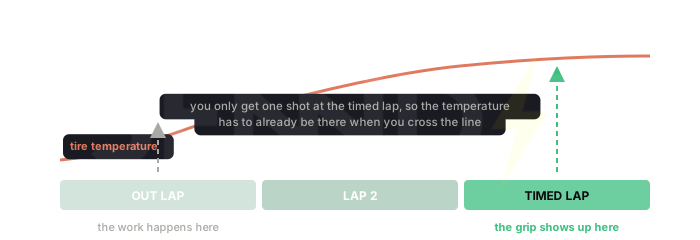
The out lap is the lap from the pits to the start of your first timed lap. Nobody times it.
But where does the grip on your final lap come from? Most of the times it comes from the out lap.
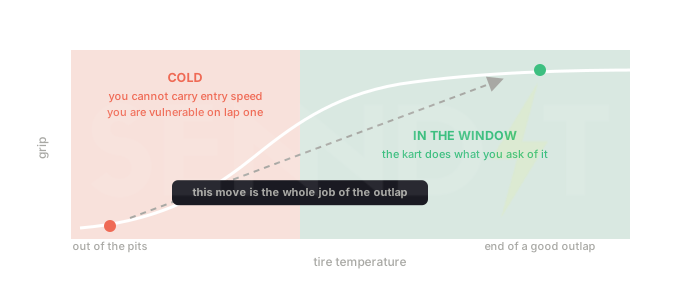
Because grip is mostly down to tyre temperature. The pressure has an effect in the equation, but most of it is the temperature. You can already have the tyres set at the optimal pressure, say 0.90 bar as an example of a hot target, and start with 0.90 on cold tyres. You won’t have the same grip, and you won’t have the same lap time.
“Remember to warm up the tyres, Alessio.” That’s what my mechanic Piero always used to say when we were racing together between 2012 and 2014.
And believe me, even at WSK and CIK level almost nobody warms up the tyres like they are supposed to. I remember watching Max Verstappen at the Winter Cup in Lonato. He would literally bring up smoke from his rear tyres by how hard he was braking, on the formation lap and on his first push lap too.
You may feel like your tyres are already hot. Most of the times they are not. I have seen summer days with 60 degrees of track temperature where the first laps were still one second slower than the end of the race.
And you are the only one responsible for your tyre temperatures.
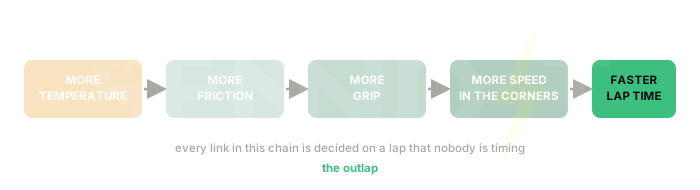
Because with higher temperature you get more friction. More friction equals more grip. More grip equals more speed in the corners. More speed equals faster lap times, and hopefully a pole position and a trophy at the end.
And the out lap is not only for qualifying. It decides your race too, I come back to that further down. This is the episode where I talk about the out lap:
How do you drive the out lap in qualifying?
In a qualifying, my standard operating procedure is simple. I go out of the pits and I want to use every millisecond I have. I instantly want to build some tyre temperature, because every little extra warming you do early in the out lap compounds.
You are not on a race formation lap, so you won’t weave much. A bit of weaving out of the pits, brakes and throttle combined with turning, and then you start pushing early.
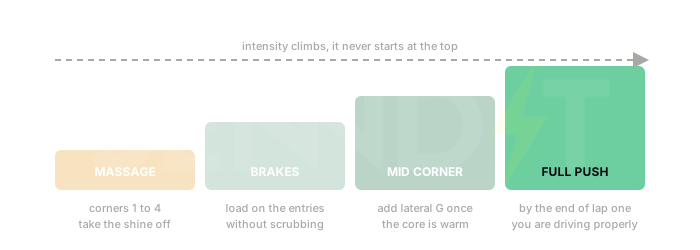
On new soft tyres I don’t over stress them while they are new and cold. You almost have to massage them. I do the first three, four corners easy, to remove the shine of the rubber. Then I push to build the core temperature.
What I don’t want is to slide them. Slide a cold soft tyre on low pressure and you get graining: the inside is still cold and the outside is too hot. You are eating away the good of the tyre.
On used tyres I just go for it. On hard tyres I’m full sending it.
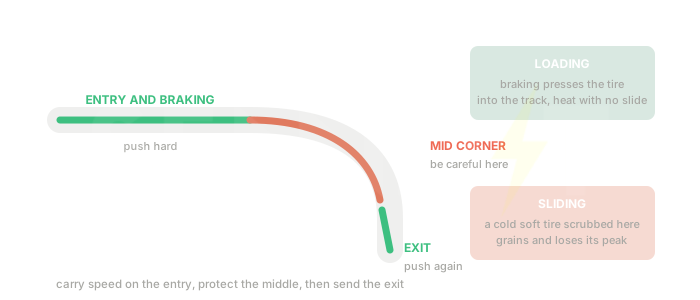
So how do you push without sliding? You push a lot on the brakes, you stay careful in the mid corner, and you push again on the exit. Heavy braking is what warms the fronts, and the fronts are the difficult ones.
Two more things. Stay on the racing line, because pickup and dirt cool the tyres down. And stay away from the kerbs when you run low pressures. I learned that on a test day in Formula 3 with Prema: on the out lap the kerbs raise the chance of a puncture and of blisters.
What warms the tyres more, weaving or pushing?
I remember my engineer in Formula 3 used to ask me: Alessio, what do you think is going to warm up the tyres more? Weaving left to right on the straights, or pushing flat out?
And I was like, oh, maybe weaving.
And he’s like: no. It’s pushing flat out.
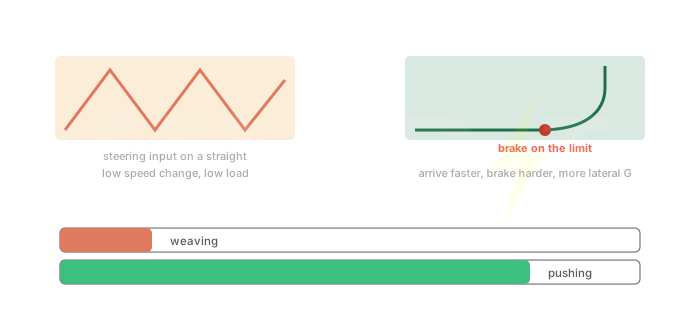
In fact, when you push flat out and you carry so much speed into the corners, you are braking on the limit. That is when you generate the temperature you need.
Think about it. You go flat out on the straight, so you arrive at the corner faster. Because you arrive faster, you brake harder to stop the kart. You generate more lateral G. So you warm the tyres under braking, and again in the mid corner through the lateral force.
So in qualifying or in a practice session you are not really warming up the tyres left and right. You are pushing right away, and by the act of pushing you heat up the tyres more than going from side to side on the track.
When you can push, you push. That’s going to be way better than just weaving.
Which lap is the one that counts?
In many cases the last lap will be the one that counts. The peak of the tyre is always towards the last couple of laps of a qualifying. Normally your second last lap is your second best lap.
That is why the out lap matters so much. If you warm the tyres better than the others, you probably get the peak temperature earlier. That can mean one or two laps at the peak, when the others have half a lap or just one. Especially in colder conditions.
I like to see it in a gamified way. At the end of the out lap, who has the warmest tyres on the track?
It would be awesome if we could actually make this experiment. You could really tell which drivers warm the tyres up the most and which don’t, and then track their results on the next lap. Lap time in a qualifying, or overtakes made and lost in a race.
On new tyres there is one more thing to know. New tyres reward those that push. But what I notice is that you don’t get a lot of lap time on the braking. You get it in the mid corner and on the exits, mostly in the medium to fast corners. I go through the build-up on a new set in my new tyre time attack tips. And if you can choose the compound, the softer tyre is nearly always faster over the one lap.
And one small habit. Watching your lap time while you drive influences your driving, mostly in a negative way.
What tyre pressure do you start on in qualifying?
Listen, the first thing to understand is that the hot target is what counts.
Let’s say that on average, across the year and across the tracks, your hot target for an MG tyre is 0.90 bar. That is an example. It moves.
If the track is very cold, say January with zero degrees of track temperature, I’ll try to come out at 0.95 and see whether that’s quicker than 0.90. If the track is at 65 degrees, like we had many days in a row in Italy between July and September, you play with very low pressures. Tyre pressures are always a moving target.
The compound moves it too. A harder tyre wants a higher pressure. A green track wants more pressure, a grippy track wants less.
So what is different in qualifying? The number of laps.
To win a 20 lap race you can’t really run on high pressures. You have to start quite a bit lower than in qualifying, because in qualifying it’s normally just three, four laps. Same hot target, fewer laps to reach it, so you start higher.
How much higher? It depends on so many factors that I’m not going to give you one number here.
And set the pressures in a consistent place, so the rim temperature is consistent. In January the tent is very cold in the morning and very hot at midday with a heater on.
What is track position, and what does rolling mean?
Track position is where you are on the circuit compared to the other drivers when you start your lap. Rolling means slowing down on purpose to get a better one.
Why would I slow down in a session of three laps?
Say for instance I can see I’m going into the traffic. A group of 10 drivers all fighting for position. If I go in there, I struggle to get my tyres up to temperature and I probably have to overtake somebody on my fastest lap.
So I roll, and I create some space.
To be honest, I prefer to slow down on the racing line, so I don’t get my tyres dirty. But I do it on the straights, so I’m not creating any dangerous situation. I don’t want to screw up other drivers’ lap times on purpose. If they then do it to me, it’s karma, and I will have deserved it.
What is the best position? One quick driver in front of you, two at the maximum. Ideally somebody as fast as you or a tenth slower.
And how many times do you roll? Maybe once. Maybe not at all.
How much is the slipstream worth in qualifying?
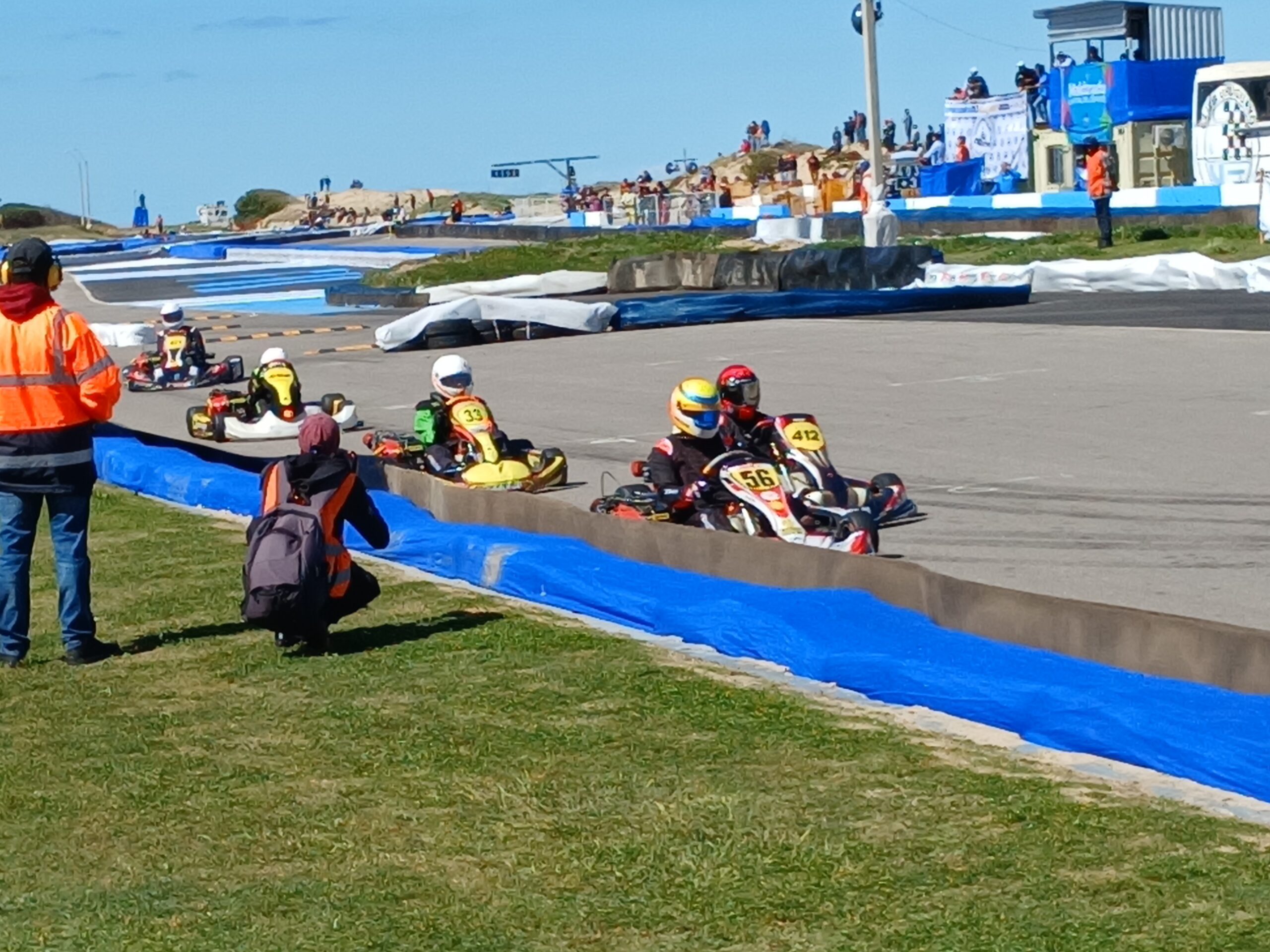
I believe in karting the slipstream makes about one tenth, sometimes two tenths, in qualifying.
It depends a lot on the category. In 60 Mini it is massive, even three, four tenths. In KZ it is not that massive. And there are tracks like Zuera where the slipstream is massively effective in any category.
Now look at the other side. You may gain one tenth of slipstream by being very close to the driver ahead. But if you have to overtake him, you lose three, four tenths. And nobody wants to get overtaken in quali, especially on the last lap, because then it’s game over.
So what does driving completely alone cost you? In many categories about one tenth of slipstream. For some drivers another tenth in references and racing lines, especially if they are not experienced. That’s two tenths left on the table.
And dirty air? It rarely affects performance in a kart. The exception I found is KZ at Franciacorta in the summer, in July or August. A lot of track temperature, a lot of fast corners, and every time you got close you would get massive understeer.
In the past the slipstream was not that needed for me in qualifying. Now I work with 60 Minis, and I see it in juniors too: track position has become almost too important.
The ideal is a bit of a gap at the beginning of the last lap. You close it during the lap and you get a bit of draft at the end.
When do you roll, and when do you never roll?
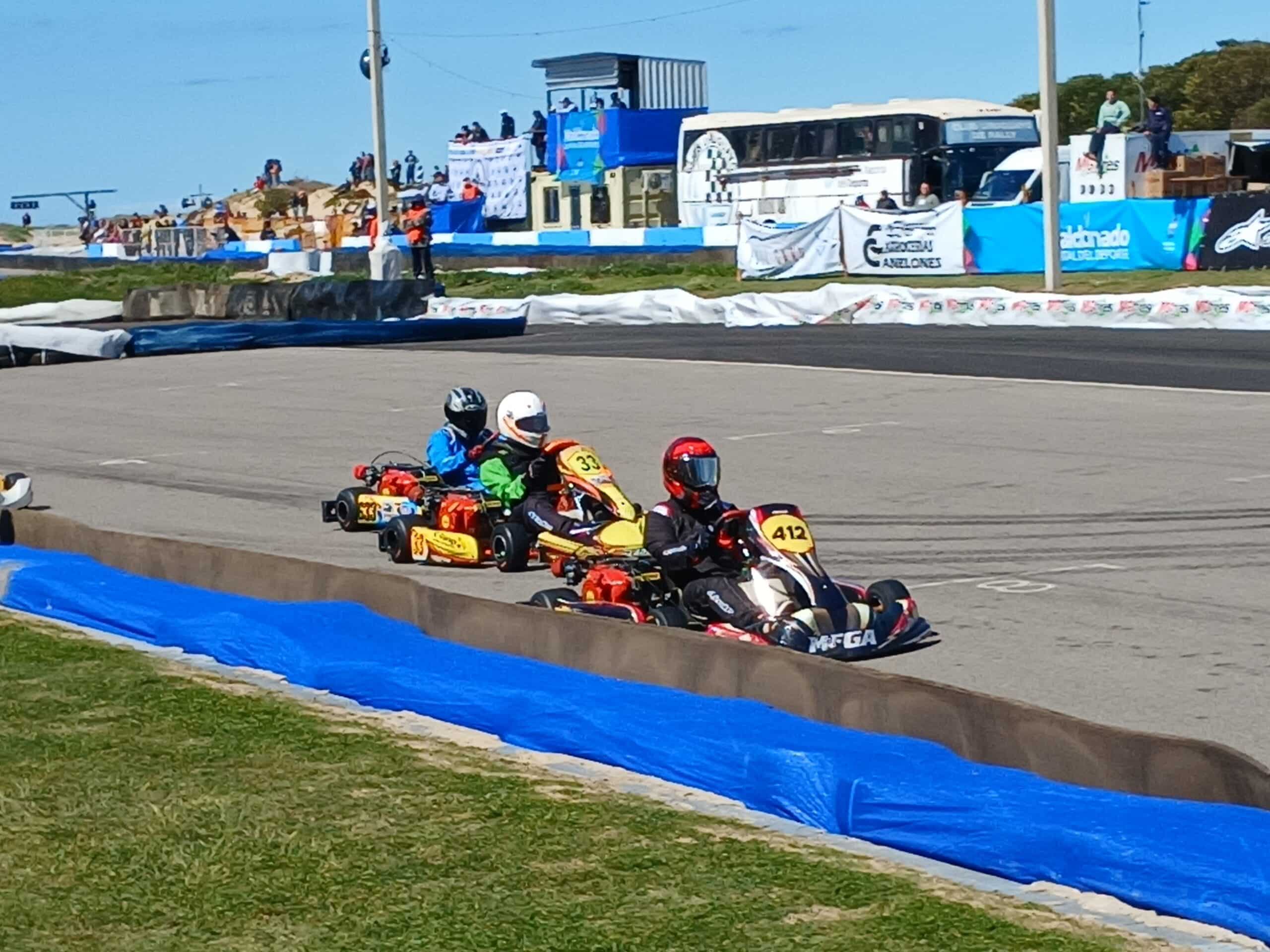
You roll whenever the situation requires it. At the beginning of the session, or on the second last lap.
Many times drivers are not going to roll because they think: there’s only one more lap after this one. For me that’s quite silly. If you need to roll, you need to roll, even on the second last lap.
Because in many cases the last lap is the one that counts. So if you are closing up massively on a group, or you know you are about to catch a really slow driver and you would have to overtake him on the last lap, you abort the second last one. You sacrifice it to get the last lap right.
The one lap you never roll on is the last. You need to complete that lap.
Will you know in the moment whether it was the right call? No. You will know at the end of the session.
One warning for the rest of the weekend. I see mechanics asking their driver to roll as soon as he finds himself alone on track, in every session, even the most useless one of the Wednesday. Rolling for a reference is clearly the right choice in qualifying or in the last couple of sessions leading up to it. But not every lap of every session.
Otherwise, when your driver finally gets to the front, he drives like he’s lost on track. Where do I brake now? Where do I turn now?
What has to be ready at the same moment?
Timing plays a massive role in qualifying, because you need to put everything together on one lap.
Your tyres need to be in the optimal operating window, to have the highest grip level.
Your engine needs to be at the optimal temperature, and in the optimal carburation window as well.
Then there are the other drivers. You need to anticipate their moves and take the right decision.
And the clock. The time is ticking and you cannot wait too much. If you wait too much, you are likely not going to get the lap done at all.
I mean, the perfect lap doesn’t exist. The perfect qualifying doesn’t exist. Even Ayrton Senna, even with pole position, never really believed it was the perfect lap.
So control what you can control. The driver five seconds ahead of you can spin. There can be grass on the track at the one corner where you needed the grip. That is not on you.
The rest of how I think about racing against other drivers is in the racecraft guides.
Why is the grip in qualifying the highest of the weekend?
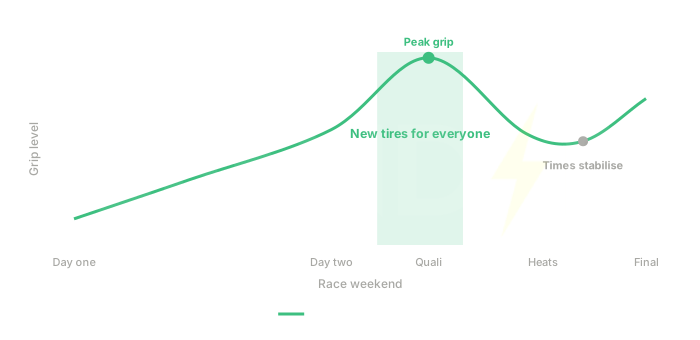
Pretty much 99 percent of the times, the grip level in quali is the highest of the whole weekend. Together with the session right before it.
Why? Because everybody is putting new tyres on. And the first layer of a new tyre is the softest part, the one that goes off the fastest. So in a very short time the whole field lays its best rubber down on the racing line.
How big is the step? At a CIK race the track is already pretty good at the start of the week, because there has been plenty of testing before. So maybe half a second from the beginning of the week until quali.
And then it goes the other way. After qualifying the times go up through the heats, and they come down again in the final when new tyres go back on. I explain the whole arc in track evolution in karting.
The kart has to be set up for the grip that is coming, not for the green track you had earlier in the week.
And you have to go and find that grip yourself. The driver is the grip hunter, and the hunt starts as soon as he goes out on the out lap.
And one check. If your kart feels perfect on used tyres, you will probably struggle on the new ones. If it slides just a little on used tyres, you are normally spot on when the new set goes on.
How do you judge your qualifying afterwards?
Not by the position. By your theoretical.
The theoretical is your best sectors of the session put together in one lap. It compares you against yourself, in the same session, on the same kart. So you have no excuses.
If you have three tenths of theoretical from yourself, you have essentially given up like 25 positions in qualifying.
Anytime I see the theoretical above one tenth, it’s bad news. Even if that driver was P1. I stop the excitement right away. Mate, do you realise you gave up one, two, three tenths to yourself?
At the highest level it goes down to zero. At the CIK-FIA World Championship in Franciacorta my theoretical was literally the same as my real lap time. I was P2. And I still feel I made a small mistake into the last corner, and that one would have put me on pole.
And you look at it in smaller pieces. In Race Studio 3 I put more splits than the standard ones. Nine corners, nine splits. More on that in the karting telemetry guides.
Why does the out lap decide your race too?
The out lap is fundamental, not only for qualifying, but also for the race. Because you want to get a good start and attack in the first lap. Or if you’re starting from P1, you want to pull away in the first lap.
Max Verstappen used to do that really well. I used to watch him from the grandstands at Lonato.
This guy would warm his tyres so well in his out lap that he would pull away big time in the first lap. He would defend a bit into the first corner, then he would find a way to not have to defend, because he had already pulled a bit of a gap.
And then the race was basically ended for the drivers behind him. They knew they couldn’t catch him anymore, and he just opened up a gap lap by lap.
That was very impressive from him. But it all started from the out lap. If his out lap wasn’t strong enough, he wouldn’t have had such a comfortable first lap and such a comfortable race.
I relate that to drivers today, and to myself. If your tyres don’t have the optimal temperature on lap one, or in the first laps of the race, you will be vulnerable.
You will not be able to do whatever you want with your kart. You will not be able to carry the right amount of speed into the corners. And that leaves you with worse lap times, potentially not being able to overtake, or even worse, getting overtaken by the drivers behind you.
Why is it easier to warm the tyres on a rolling start?
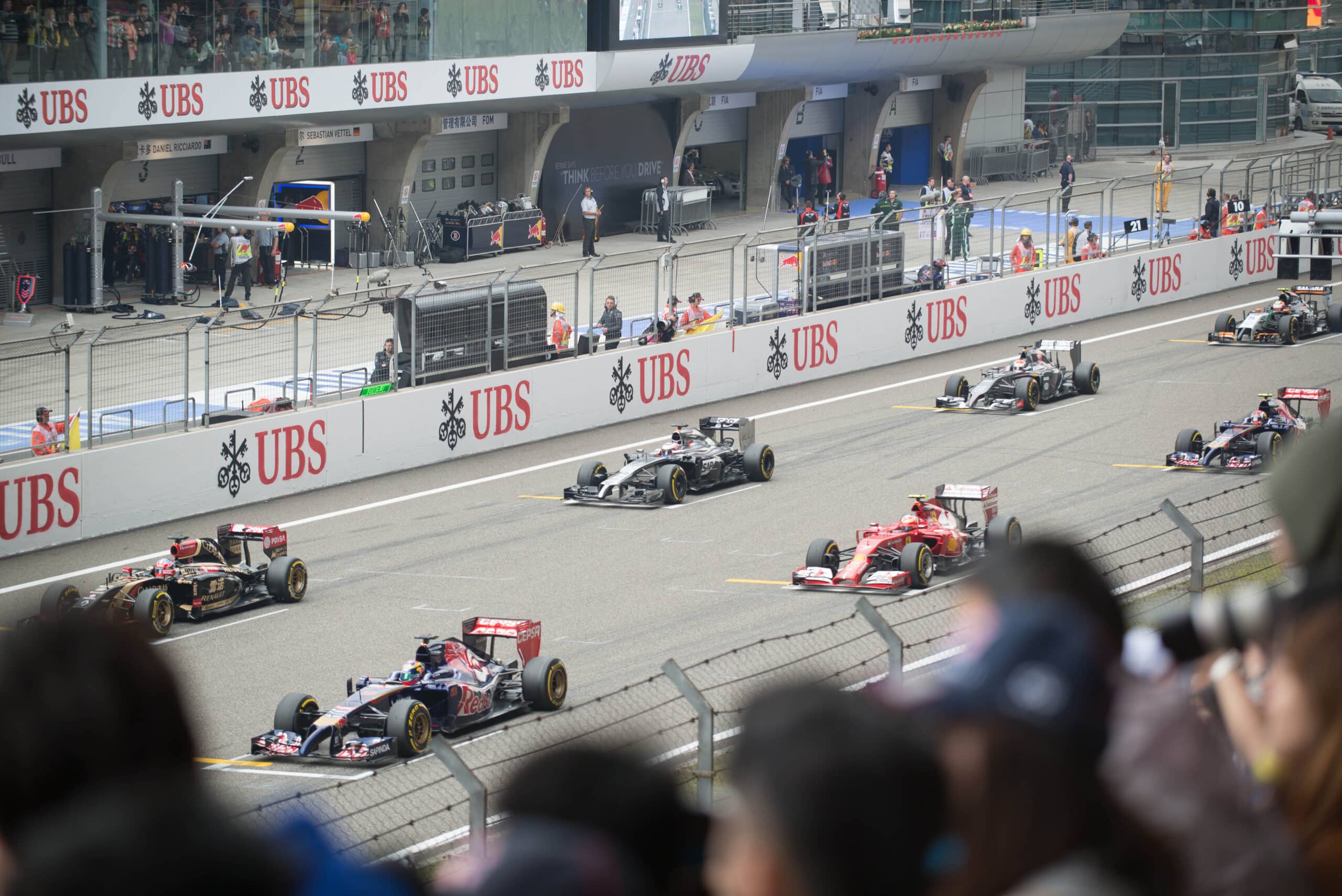
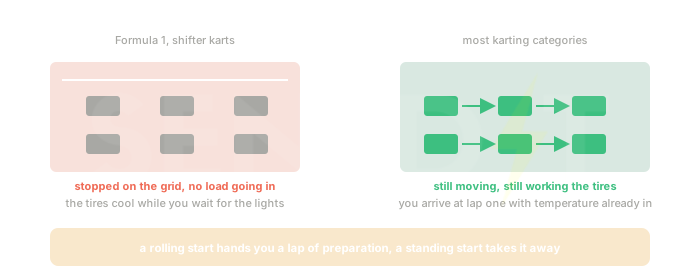
In Formula 1 the tyres are very important for a good start, the rears especially. But you’re going to struggle to get a very good tyre temperature on the first lap, because you start from a standing grid.
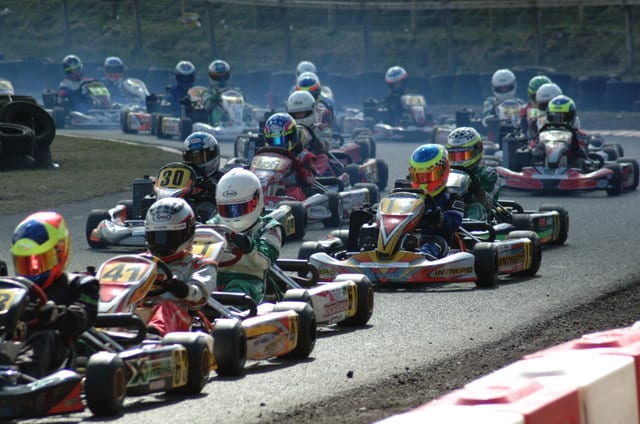
In karting you start from a rolling start in most cases, unless you’re driving a shifter kart. So it’s a bit easier to warm up the tyres and get them up to temperature, especially in the race.
How do you warm the tyres on the race formation lap?
If it’s a race, you’ve got to warm the tyres up differently. You can’t push, you have to go at a slower pace.
So try to always keep a gap to the drivers in front of you, and give yourself the freedom to work the tyres. But then in the corners you still have to push.
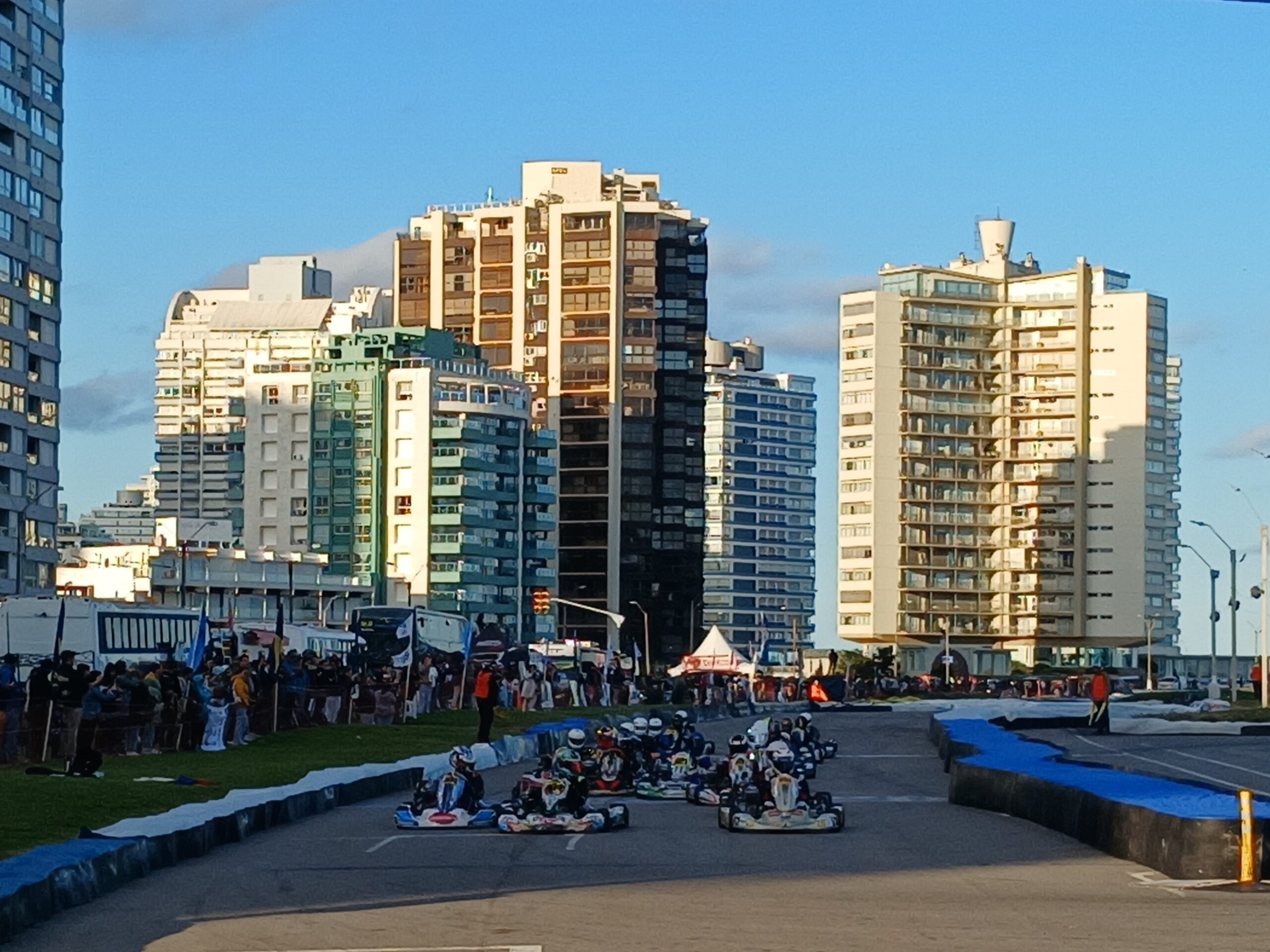
Try to put the kart on two wheels. Try to get the chassis to flex and load the tyres like crazy. You want to feel tired at the end of the formation lap.
You want to be thinking: holy cow, I feel tired. If you feel tired, it probably means your tyres did a lot of work, because you did a lot of work. And that’s good news going into lap one.
What I do from the start onwards is in race starts and the first lap.
- All my articles on racing against other drivers are in the karting racecraft guides.
- Sector times, splits and theoretical laps are in the karting telemetry guides.
- The build-up on a new set, lap by lap: new tyre time attack, my top qualifying tips.
- Want me to look at your qualifying laps? Send me your onboard and I go through them in an onboard review.
- If you want to work on your qualifying and your starts with me over a season, look at the six month training program.
And next time you leave the grid for qualifying, ask yourself one question at the end of the out lap: are my tyres the warmest ones on this track?
Frequently asked questions
How many laps do you get in karting qualifying?
Very few. Normally three, maybe four. In Italy we got six minutes, and normally the last two laps are the best ones, with about a tenth between them.
Should you weave on the out lap in qualifying?
Not much. Weaving is for a race formation lap, where you cannot push. In qualifying you start pushing early, hard on the brakes. On new soft tyres I massage them for the first three, four corners before I push.
Is it better to qualify alone or in the slipstream?
It depends on the category and the track. The slipstream is worth about one tenth, sometimes two, and even three, four tenths in 60 Mini. But an overtake on your fastest lap costs three, four tenths. The best position is one quick driver ahead, two at the maximum.
What does rolling mean in karting qualifying?
Rolling means slowing down on purpose to get a better track position, away from the traffic. You can roll even on the second last lap. You never roll on the last lap.
How do you warm the tyres on a race formation lap?
You can’t push, so keep a gap to the driver in front and give yourself the freedom to work the tyres. In the corners you still push. Put the kart on two wheels and get the chassis to flex. If you feel tired at the end of the formation lap, your tyres did a lot of work.
Send your onboard footage. Alessio reviews it corner-by-corner and tells you exactly what's costing you time, and how to fix it. Back within 48 hours.
Get My Onboard Reviewed → Reviewed personally by a CIK FIA World Champion, never an assistant.I promise I'll not spam you with repurposed shitty AI content but real experiences that only I, Alessio Lorandi, experienced. Written in my funny English-Italian tone of voice 😂
Alessio Lorandi is the former CIK FIA World Junior Champion, winning against Lando Norris in 2013 & F3 multiple race winner. He's helped 200+ karting drivers worldwide get faster & win WSK titles with BabyRace Driver Academy & now through Senndit, his online karting coaching platform.