Kart Race Starts and the First Lap: How a Rolling Start Works
How a kart race start works, from the formation lap to the end of lap one: warming the tyres, the jump from pole, inside or outside, and where to b…

- Most kart races start rolling. In Europe it is a rolling start for almost every category and a standing start for shifters. So the start begins one lap before the lights.
- The formation lap is work. You go at the pace of the leader, so you build tyre temperature by weaving and by using the brakes, the throttle and your body. You should feel tired at the end of it.
- The front tyres are the hard part. The rears warm up with traction. The fronts only warm up when you put weight on them under braking.
- Every start is different. “Always take the inside” is not a rule. I believed it myself as a coach until a few years ago.
- On lap one everybody brakes early. If you brake where you always brake, with a pile of karts in front of you, you create the crash.
- You cannot win the race on lap one, but you can lose it there. The goal is at least to hold your position and to still be in the race at the end of the lap.
- What is a rolling start in karting?
- Why is the first lap different from every other lap?
- What should you do on the formation lap?
- How do you get the front tyres ready?
- What do you prepare on the kart before the lights?
- How does the start work from pole?
- Is the inside or the outside better at the start?
- Where should you brake on the first lap?
- Should you attack or wait on lap one?
- Why are some drivers slow in the opening laps?
- How do you practise starts?
- Frequently asked questions
The start is the one part of the race you cannot repeat. And most drivers arrive at it with cold tyres and no plan.
I already wrote about what goes on in my head on the grid, in pre-race start strategies to help you gain positions. That one is about the decisions.
This one is about the mechanics. What a kart start actually is, what you do with your hands and feet from the pre-grid to the end of lap one, and where it goes wrong.
What is a rolling start in karting?
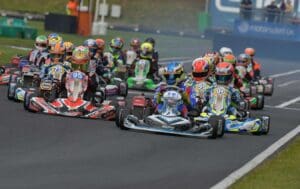
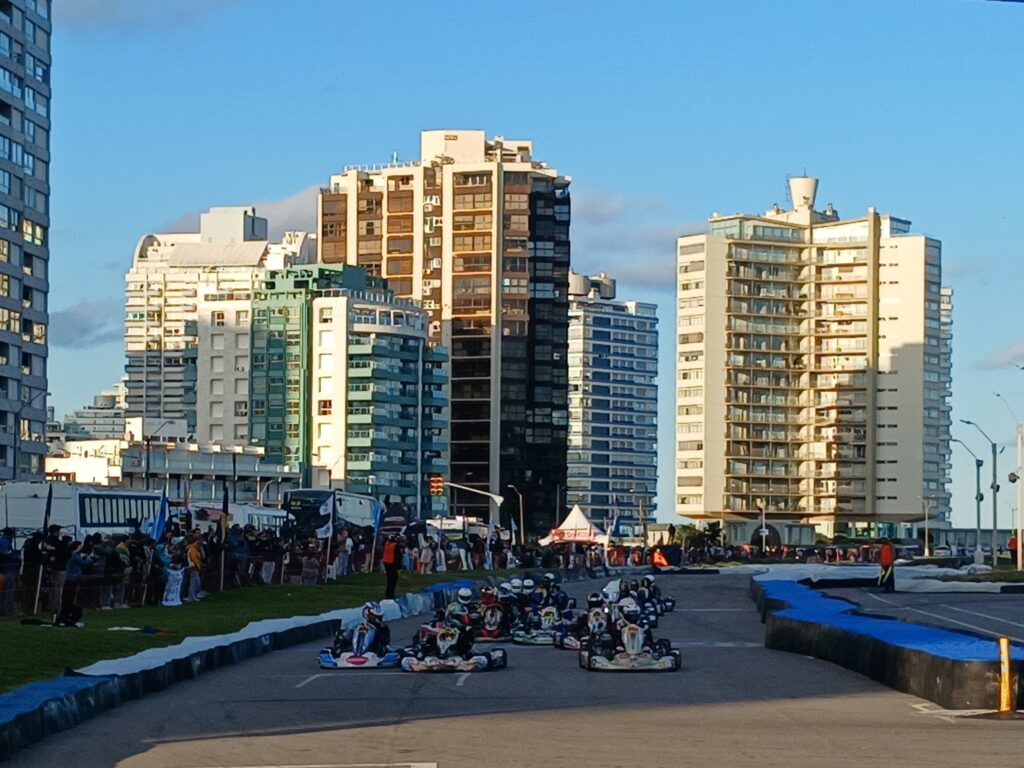
A rolling start means the race begins with the karts already moving. You leave the pre-grid, you do a formation lap in two lines, and when the pack comes onto the straight the lights go out and you race.
It is a standing start for shifters and a rolling start for any other category in Europe. We had rolling starts pretty much all my career.
Why does that matter? Because with a rolling start there is no moment where you sit still and wait. The whole formation lap is part of the start. The pace is set by the leader, you cannot do a push lap, and the group has to be packed and compact when it arrives at the line.
The goal is always the same, no matter if you start P1 or in the midpack. You want to improve from your starting position and ideally come out P1 at the end of lap one.
Why is the first lap different from every other lap?
Because nothing is where it will be for the rest of the race.
The tyres are cold. You start on low pressures, the kind you need to be fast in the second half of the race, and on lap one they are not there yet. Driving on cold tyres is like driving on ice, basically. That is why nobody sets the fastest lap of the race in the first few laps.
And you are not alone. You are surrounded by 30 plus drivers, with the group very packed in the early stages.
In those first couple of laps the pace does not really matter. It does not matter if your kart is one tenth slower or one tenth faster.
In my experience a 15 laps race has on average 4 to 5 key moments. The start and the first few corners of lap one are always on that list.
So here is the line I keep coming back to. You can’t win a race in lap one, but you can lose the race on lap one. The goal is at least to maintain your position.
What should you do on the formation lap?
“Remember to warm up the tyres, Alessio.” That is what my mechanic Piero always used to say when we raced together between 2012 and 2014. It sounds boring. It is the thing almost nobody does properly, even at WSK and CIK level.
Nobody can preheat kart tyres like in F1. And even if you did it in the tent, it normally takes 20 plus minutes from when you access the pre-grid to when you get on track. Any extra temperature would be gone. So the only place you can warm them is on the formation lap.
But there you go at the pace of the leader, so you cannot push like in qualifying. What can you do? You weave. Left to right, right to left, as many times as you can. And you do not only turn the steering wheel. You use the brakes, you use the throttle, you use your body, and you try to put the kart on three wheels all the time, so the tyres are really loaded.
A tyre heats up under load. In the corners the load is high. On the straights it is almost zero. So brake while you turn, accelerate while you turn, and use every metre of the lap.
Two things to avoid. Do not weave off the racing line onto the dirty part of the track, because the tyres pick up dirt and that cools them. And stay off the kerbs while the pressures are still low.
You should be tired at the end of the formation lap. If you did a lot of work, your tyres did a lot of work.
How do you get the front tyres ready?
The rear tyres have an easy time. A kart is rear wheel drive, so just by getting on the throttle with traction you put temperature into the rears. When you weave, you are warming the rears more than the fronts.
The fronts get warm when the weight goes forward. That means braking. When you brake deep, the weight transfers to the front and the front tyres have a lot of work to do. This is true with front brakes on a shifter, and it is also true on single speed karts like Mini, Junior and Senior that have no front brakes.
So the thing I like to do for the fronts is to push a lot on the braking and attack the entries of the corners.
What I do not do is scrub the fronts with extra steering angle. In formula cars you do that on purpose in the formation lap. In karting I do not think it is right.
In a shifter I add one more thing. I try to be very gentle on the throttle in the preparation lap. If I hit the rears too quickly, the rears are ready and the fronts are not, and then I have understeer. I just hate having understeer.
And the brakes themselves need temperature too. If you want the qualifying version of all this, it is in why your outlap decides your race.
What do you prepare on the kart before the lights?
Everything has to be up to temperature, not just the tyres. Brakes, front and rear if you have them. And the engine. When I rewatch Max Verstappen’s old karting races, he kept the radiator cover high for the start and the opening lap.
Then there is the carburation.
When I was in juniors, with membrane carburettors, I would lean the carburation on the bottom during the formation lap. Max did the same in KF3 and KF2. You see it in his race videos, one hand on the steering wheel and one on the carburettor for the final part of the formation lap.
The reason is simple. With too much fuel at the start you get a delay in the throttle response, and you lose the maximum acceleration you need for a proper jump. Lean on the bottom, the engine responds right away.
And then I would put it back to normal at the end of the first lap.
The last thing is where you sit in the line. During the lap you want some room to work on the tyres. But when the pack comes to the start, I want to be right behind the driver in front.
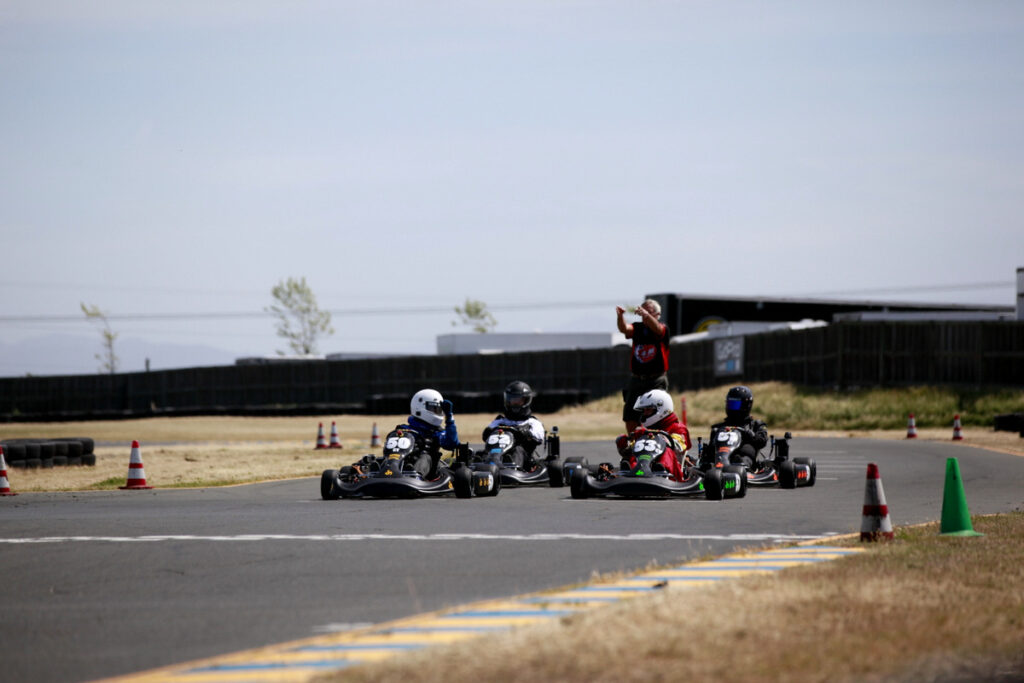
How does the start work from pole?
From pole you set the pace. The question is what you do with it.
The best I have seen at this was Max Verstappen. I watched him at the Winter Cup in Lonato and I have rewatched those race videos many times since.
He would do a bit of “elastic”. He let the driver in P2 creep a tiny bit ahead of him. In my book I explain it with the rule as I knew it: if the driver in P2 is ahead of the leader when the lights go out, he gets a time penalty. So P2 has to slow down a lot. And in that very moment Max would go on the throttle. Suddenly, not progressively. He would even add a bit of brake just before the jump, to surprise them more.
It makes a gap to P2, and to P3 as well. I learned that technique from him.
And why does the gap matter so much? Because if you have two kart lengths before turn one or turn two, you do not have to defend.
If you are the one in P2, the lesson is the opposite. Do not let the leader pull you ahead of him. And check the start rules of your own series before the race, because the exact rule and the penalty are in your regulations, not in this article.
Is the inside or the outside better at the start?
For years I would have told you: always be on the inside. I believed it myself as a coach until a few years ago.
There is a reason for it. The inside is less distance. And when a crash happens, it always goes to the outside of the corner, because of the centrifugal force. Starting from the outside lane will lose you 2 to 3 positions most times, since it is the slower lane of the two.
I know that feeling well. At the 2013 World Championship round in Bahrain, I started the final P8, on the outside of the fourth row. I thought, “ouch”. Then I got a much better start than I expected, started picking up positions, and I was in the lead on lap 9. I finished P2, which was enough for the title.
So I still like the inside if I have the chance. But as a fixed rule it is wrong. Often the inside is already taken. The karts are bumper to bumper and there is no space, unless somebody “sleeps” alongside you.
Every start is different. That is the only rule I trust now.
So do not look only at the kart in front of you. Look at the front of the grid. And look at who is around you. Some drivers are tough, some are soft.
The outside move on lap one may work three out of four times. But the fourth time it may be catastrophic.
Where should you brake on the first lap?
Earlier than you think.
The number one cause of crashes in karting is what I call proximity judgment. How well you judge the distance and the speed between you and the karts around you. And lap one is where it gets tested the most.
Picture turn two on lap one. Everybody is packed. Everybody is braking early, because everybody is defending. Now the driver behind forgets about that. He brakes in the same place he always does. And he drives over the rear bumper of the kart in front. His race is destroyed, and somebody else’s too.
If that driver is you, it is your fault. If you brake as late as possible with a pile of drivers in front of you, you create the pile-up and you deserve the penalty.
The other thing is your eyes. You need eagle eyes to spot any dirt on the track and anticipate the grip. So many times it happened to me to spot some dirt, brake 1 to 2 metres earlier, keep the optimal line, and gain positions on drivers who did not and ran wide.
I go deeper on crashes in want to stop crashing in karting? Try this.
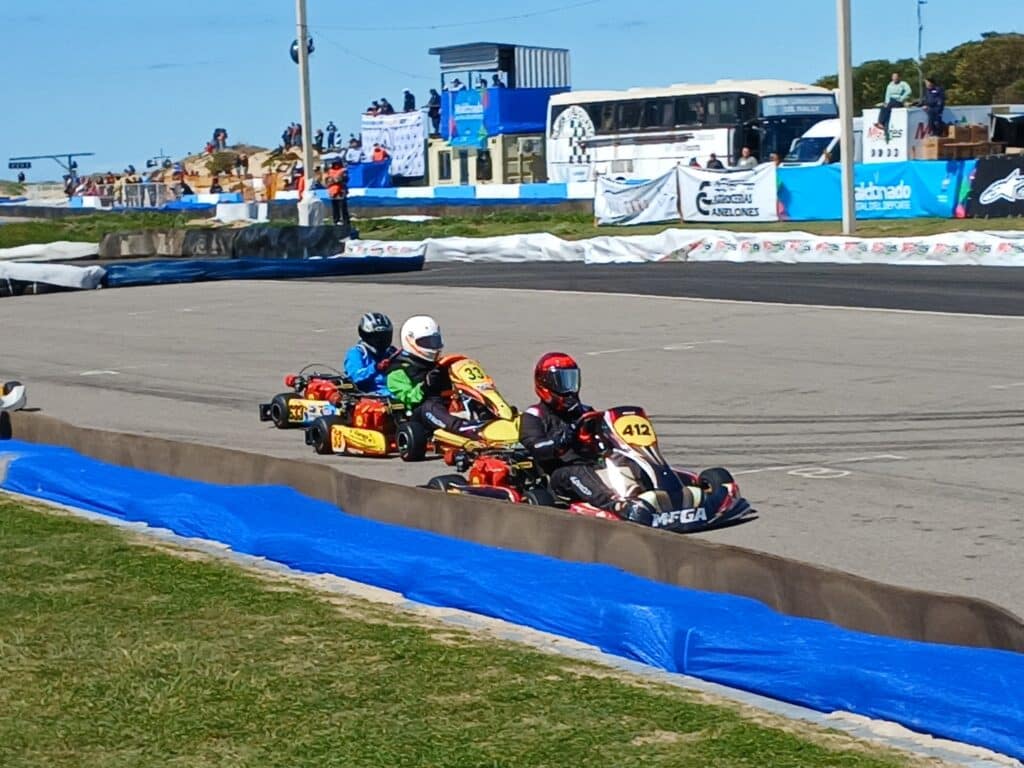
Should you attack or wait on lap one?
It depends on the race. But waiting is not safe either.
If you don’t overtake on lap one, you probably get overtaken. So I do not go to the start with a defensive mindset. I want my tyres hot enough to attack.
My plan was usually this. Follow the driver in front into turn one. If he does not defend, I go. If he half defends, then into turn two I go for the move.
What changes is how much risk I take. In a one shot race you go for it. In a championship I am more conservative, because to finish first you first have to finish. And the race is long, 15 to 20 laps. There is time.
Where you start changes it too. At the front it is easier. In the mid pack and at the back, the drivers around you have nothing to lose.
Once the lights are out, do not overthink. The minute you start to overthink is when you start to make mistakes. You drive by instinct.
And forget about protecting the tyres. In the moment the race starts it is game time. You just push.
The full decision side is in my article on when to overtake vs when to defend, and in how to spot opportunities during a race.
Why are some drivers slow in the opening laps?
I call it the sleeping driver syndrome. You don’t lose a race on lap 13. You lose it on the opening laps, when your brain is still in “sleep mode”.
I have seen it on myself and on other drivers I have worked with. And it gets worse. If the others know you are a slow starter, they attack you on lap one.
How much is in those laps? At that Winter Cup in Lonato, it felt like Max was pulling a consistent 1 to 1.5 tenths a lap on P2 for the first 9 to 10 laps. And I think the very first lap, on cold tyres, was something like 5 tenths. Those are my estimates from watching, not timing sheets. I looked for a secret in the videos and I did not find one. What I saw was tyre preparation and a flawless start procedure.
So you need to arrive at the lights awake. These are the things that work for me:
- Music, especially with noise cancelling headphones.
- A few minutes of rope skipping before the session, to bring the heart rate up.
- Before I get in the kart, I clap my hands twice with the gloves on and make a single jump.
- In the kart, I pump the brakes a couple of times.
Find yours. The point is that you are already switched on when the lights go out, not three laps later.
How do you practise starts?
You get one start per race. So you build a database. Before a race, watch dozens of starts at that track. On YouTube, and from the grandstands when the other categories are racing. All of them: Mini, Juniors, Seniors, Shifter.
Then visualise. Not one perfect start, but the top three or four scenarios that are likely to happen. I call visualisation mental telemetry, and there is a full article on how visualization can improve your karting performance.
The start is a bit of a russian roulette, but with a caveat. The caveat is your reaction time, and that you can train. Ball sports, juggling, which I love to do, reaction lights. I wrote about it in how to develop quick reaction times for kart racing.
And measure it. Positions gained or lost on lap one is a number you can track. Some drivers are really fast and still lose on average five positions on lap one. Others are not as fast and always gain two or three.
If somebody starts behind you and ends ahead of you at the start, you do not have a speed problem. You have a racecraft and decision making problem.
- All my articles on overtaking, defending and race strategy are in the karting racecraft guides.
- A first lap is hard to judge from inside the helmet. Here is why you need a go kart coach.
- Want me to look at your start? Send me your onboard and I go through it in an onboard review.
Next race, count the karts in front of you at the lights and count them again at the end of lap one. Write the two numbers down.
Frequently asked questions
Are kart races rolling starts or standing starts?
In Europe it is a rolling start for almost every category and a standing start for shifter karts. With a rolling start the karts do a formation lap in two lines at the pace of the leader, and the race starts when the lights go out.
How do you warm up kart tyres on the formation lap?
You cannot push, so you weave left and right and use the brakes, the throttle and your body to load the tyres. The rears warm up easily with traction. The fronts need hard braking, because they only work when the weight goes forward.
Is it better to start on the inside or the outside in karting?
The inside is less distance, and crashes go to the outside of the corner. Starting from the outside lane will lose you 2 to 3 positions most times. But always taking the inside is not a rule, because often it is already full. Every start is different.
Can you win a kart race on the first lap?
No. You can’t win a race in lap one, but you can lose the race on lap one. The goal is at least to hold your position and to be in the race at the end of the lap.
Send your onboard footage. Alessio reviews it corner-by-corner and tells you exactly what's costing you time, and how to fix it. Back within 48 hours.
Get My Onboard Reviewed → Reviewed personally by a CIK FIA World Champion, never an assistant.I promise I'll not spam you with repurposed shitty AI content but real experiences that only I, Alessio Lorandi, experienced. Written in my funny English-Italian tone of voice 😂
Alessio Lorandi is the former CIK FIA World Junior Champion, winning against Lando Norris in 2013 & F3 multiple race winner. He's helped 200+ karting drivers worldwide get faster & win WSK titles with BabyRace Driver Academy & now through Senndit, his online karting coaching platform.