Why Defending Too Often is a Losing Strategy in Karting
Stop defending every lap. It's costing you the race.

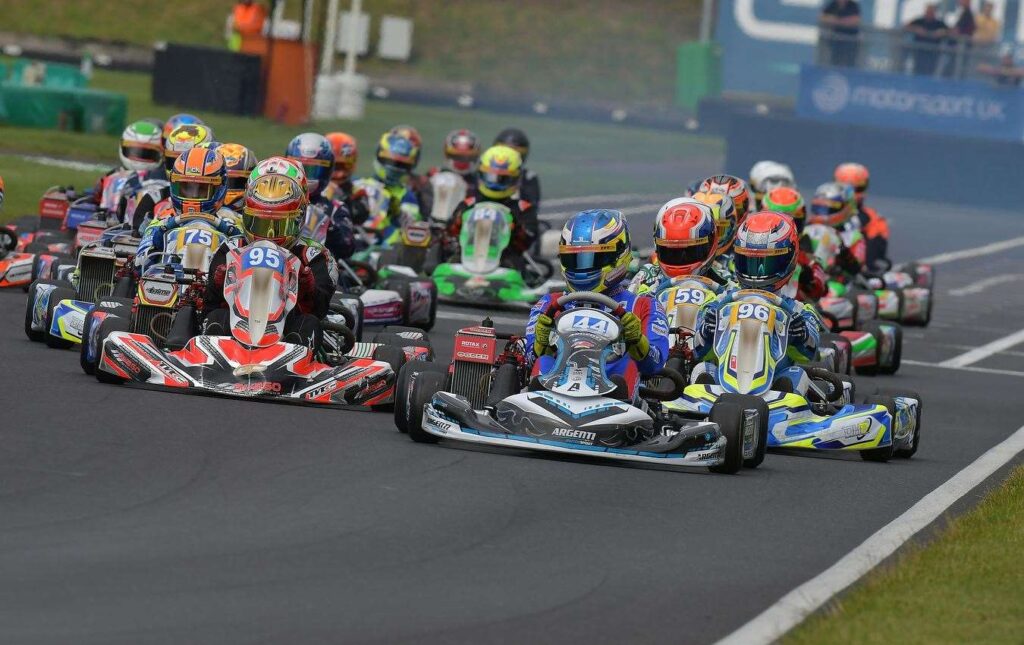
- Defending is a short-term decision. Defend once and you have to defend the next corner, and the next one. The driver behind is not going to disappear.
- When you defend you can’t set fastest laps. You can’t pull away from the others and you can’t catch the one in front of you.
- A single speed kart pays the most. A Junior, a Senior or a Mini may lose three or four tenths, or even half a second, defending one corner. A KZ loses much less.
- Unless you’re leading, defending means giving up on the driver in front. That’s a loser mentality.
- Defending P7 halfway through the race drags the whole pack back to you. As soon as one passes you, everybody passes you.
- Keep it for when it’s truly needed. Lap one, the last lap, and the corner right after an overtake with a group behind you.
- The best war is the one you don’t even fight. Pace first, then you don’t have to defend.
- Why is defending too much a losing strategy in karting?
- How much time do you lose when you defend every lap?
- Why do drivers defend when they don’t need to?
- What happens to the pack when you defend in the middle of the race?
- Is defending a loser’s mentality?
- What should you do when a faster driver catches you?
- What if he passes you straight back after your overtake?
- When does defending actually make sense?
- What did I learn chasing a leader who started to defend?
- Why did Max Verstappen hardly ever have to defend?
- Is it worth crashing to keep a position you don’t need?
- What should you ask yourself before you defend?
- Frequently asked questions
We’ve all been there. Mid race, the driver behind is right on your bumper, and the only thing on your mind is:
“I need to hold my position.”
So what do most drivers do? They start defending. Early. Every single corner.
And that is exactly how they lose the race.
Why is defending too much a losing strategy in karting?
Because defending is a very short-term decision. Many kids forget this, unfortunately.
If you defend once, you’ve got to defend the next corner. And then the next one. And then the next one. The driver behind is not going to disappear. Of course, you’re going slower, so why would he?
You will only get rid of him if somebody behind crashes into him, or overtakes him. That’s the dream of many drivers when they’re defending for their life, say for P4 on lap six. They’re hoping. But hoping is not a strategy.
And think about what you’re giving up. If you defend, you can’t set fastest laps. You can’t pull away from the others. You can’t close up on the leaders. You can’t catch the one who was in front of you.
So if you defend when there’s no need, you will never move forward. You will always be defending.
Kart races are not three lap sprints either. If it’s lap five of 20, or lap 10 of 20, what’s the point?
How much time do you lose when you defend every lap?
It depends on what you drive. A KZ defending the line properly doesn’t really lose much, maybe half a tenth in that corner. It has the gears and the brakes.
A Junior, a Senior or a Mini is different. In a single speed kart it’s all about momentum. Make a tight entry to close the door and the momentum is dead. You may lose three or four tenths, or even half a second, in one corner.
Now do that every lap. Do the math.
And it’s not only the corners where you close the door. When you start driving to keep a position, you start driving conservative. I did this calculation in my book. Say the track record is a 46.5 and two drivers are both doing corners at 99.5% of the limit. That’s a 46.733 each.
The leader has a full second with 5 laps to go. He starts driving to not lose it, and drops to 99.2%. That’s a 46.875. The driver in P2 has nothing to lose, pushes a bit harder, goes to 99.8%. That’s a 46.593.
Almost 3 tenths a lap. In karting you don’t need to be at zero to send it down the inside. A gap of one tenth is enough to try. So the full second is gone in about 3.2 laps.
That’s what defending and protecting does to you.
Why do drivers defend when they don’t need to?
Number one reason? They’re afraid of being overtaken.
When there’s a massive gap and the mechanic shows it on the board, the driver is relaxed. He doesn’t look back. But when there’s no gap, especially on a weekend where you don’t have so much pace, or you don’t have too much confidence in your package and maybe in yourself, the body language changes. You start to look in the back more often. And then you start to defend.
Again, it’s a short-term decision. The driver behind is not going to disappear because you looked at him.
And you’re actually giving him a signal. A psychological signal that you are afraid of him. Like when I’m coming up to a driver and he’s looking in the back, the first thing I do is try to pass him as soon as possible. Because I know he’s fragile in that moment.
I see it in the middle of races all the time. A driver is P1, the pack is closing up, and he starts to change his driving. Overpushing here, underpushing there, looking in the back several times, and even starting to defend on lap 8, halfway through the race. That’s not strategy. That’s cracking under pressure.
I explain when you should and shouldn’t turn your head in this article on looking in the back.
What happens to the pack when you defend in the middle of the race?
You bring the whole pack back to you.
Say you’re severely struggling with pace, you’re P7, halfway through the race. You start to defend. What happens? The driver behind is stuck. The one behind him closes up. Then the next one. Now you have a group on your bumper.
And as soon as one passes you, everybody passes you. You lose one spot, then two, then five. It happens in a flash.
You would probably have been better off not fighting that position too much.
And there’s another thing. When somebody is defending every corner, it’s so frustrating for the drivers behind. I know, it happens to me. At some point you build so much frustration inside of you that you feel like smashing the guy in front. It’s not right and you shouldn’t do it. But you get my point.
The drivers behind you feel the same. And if you keep making mistakes, looking in the back and defending, it’s like a vicious cycle. At some point somebody goes down the inside of you with a dive bomb, even if you’re defending. I’ve seen this happen also to me once. I was like, I gotta defend, I gotta defend, I gotta defend. And then somebody drove over me.
Is defending a loser’s mentality?
Most of the time, yes. And I know that sounds harsh.
Defending for no reason is one of the biggest mistakes beginners make. Because when you defend, you’re losing time from the driver in front. So unless you’re leading the race, any time you’re defending you’re basically giving up on the driver in front of you.
That’s a loser mentality, right?
If you have the winner mentality, you want to reduce the defending as much as possible. Unfortunately few drivers understand this concept.
Think about it from P2. If you defend from P3, you let the leader go. And the driver behind you is still there in the next corner. So I always remind this to my drivers: the best defense is to attack. If you’re not passing, you’re going to get passed.
Your job is to go forward, not to hold on.
Listen, this is racecraft, and it can be learned. It is one of the things I teach in my six month training program, together with the starts and the overtakes.
What should you do when a faster driver catches you?
In the middle of the race? Let him go. Then follow him.
Of course you’re not happy with that. But you can’t change that. You just have to put your head down, follow him, try to find the pace you’ve been missing, and try to pass him back within a few laps.
I’ve seen this so many times. A driver without the ultimate pace gets overtaken by somebody quicker. But instead of fighting him, he follows him. They go and chase the leader together. They both overtake the leader. And then it’s a one against one fight in the last couple of laps. And based on experience, even with little pace, you can still win that race.
Those are the most rewarding races. Because you realise you did the best strategy. You didn’t have the best pace, you just took all the right bets.
Now, if you’re leading near the end with no pace, that’s a different story. There I would make his life difficult. I explain that one in how to defend a position in a kart race.
What if he passes you straight back after your overtake?
If someone re-passes you right after you passed him, he’s telling you: “I don’t believe you’re faster than me.”
That’s when you make a point. Next lap, pass him again and drive away from him. Don’t crash, but make it clear he made the wrong move. If a driver disrespects you, he pays the price, and the others remember it. More on this in stop driving like a gentleman.
But notice what made it possible for him to come back. Most of the time you passed him, and then instead of pushing you started defending too soon. He stayed in your slipstream, and now the whole group behind joins the party.
So pass, defend one corner if you need it, then drive clean, fast laps to make the gap. If you’re truly faster, you’ll break the slipstream and pull away. How to make the move itself is in my article on how to overtake in a go-kart.
When does defending actually make sense?
I’m not saying never defend. Of course I did it too. Sometimes you need it.
- Lap one. The pace doesn’t really matter yet, you’re just trying to keep your position.
- The last lap, and sometimes the second last.
- The corner right after an overtake, when you have a group of drivers behind you close to each other. You defend one corner, just to make sure there’s a bit of a gap. Then you put the head down and pull away.
- When a driver in front is defending, you can’t get past him and the whole group bunches up. Then you have to defend too, or you get passed by everybody. I hate those kind of races. But sometimes it’s like that.
- When you know your first laps are always a struggle, for example because you go with low tyre pressures. Say you’re P3 on lap one. If P4 passes you, everybody passes you. Then it makes sense to hold on.
- The last two laps when you have a technical issue, or just zero pace for whatever reason, and you need to bring it home. There I give you the green light.
That’s it. Everything else is a short-term decision.
When you do have to defend, do it properly: kart as wide as possible, hold the brakes and stop by the apex, or you get switched back. The full technique is in how to defend a position in a kart race, and the last lap has its own article, last lap mastery.
What did I learn chasing a leader who started to defend?
Let me take you to Val d’Argenton, France, 2012. WSK Euro Series, KF3, Juniors.
I had a poor start and a crazy recovery. Then my final target was the leader. He was quite far away, but I put purple lap after purple lap.
At 2 laps to go the gap was about half a second. I could see his mechanic change the signals, telling him to push hard. And right after the sign he looked in the back. That told me he was starting to feel under pressure.
He made a mistake, and I closed up to about 2 tenths at the beginning of the last lap. He looked back again, quite nervously, on the start finish straight. And from there he started to half defend here, half defend there.
In that moment I knew I had to risk it all. I sucked all the slipstream I could, and full sent it down the inside. He only closed the door three quarters of the way, which left me just enough space to fit my kart. My first ever WSK Euro Series win.
Can I tell for sure he cracked under pressure? No. But I know this. I, in P2, had nothing to lose. Him, in P1, had everything to lose.
And I’m pretty sure that if our roles were reversed, I would have made the same mistakes.
Why did Max Verstappen hardly ever have to defend?
Because he was already gone.
To be honest I can’t remember a moment where Max really had to defend. When he was in the lead he would just extend his gap every lap. Half a tenth, one tenth, sometimes even two tenths a lap. And everybody else would just fight behind for the leftovers.
Boring races. But that’s the goal.
As I like to tell my drivers at BabyRace, the best war is the one you don’t even fight. How do you make sure you don’t have to fight? You have a gap. With two or three kart lengths halfway through the race, the driver behind will probably think twice before trying.
And if he wants to make a crazy move from far away? That’s not within your control. You can’t control other drivers’ decisions. You can control your focus, your braking, your lines, your driving at your best.
That’s why I always say pace comes first.
Is it worth crashing to keep a position you don’t need?
No. And that’s usually ego, not racecraft.
I’ve met many drivers along the way. Some of the fastest raw talents had the biggest egos. They would crash into another driver simply to not give up a position they didn’t even need to still win the championship. That’s not a racing decision.
Karting is not bumper cars. It’s not about who blocks better. It’s about who races smarter.
Use your head, not your ego. And don’t let your ego drive the kart.
If you’re fast, prove it with your pace. No need to defend that much.
What should you ask yourself before you defend?
One question. Next time you feel the urge to defend every corner, ask yourself:
“Is this a long-term decision, or am I just panicking?”
You already know the answer.
Pass cleanly. Defend one corner if you really need it. Then hit every apex, brake clean, and drive away. There’s no trophy for most blocks, but there is one for finishing first.
All my articles on racecraft, from overtaking to when to be patient and when to attack, are in the racecraft guides. Or start from the Senndit home page.
Keep sending it.
Frequently asked questions
Why is defending too much bad in karting?
Because it’s a short-term decision. If you defend once, you have to defend the next corner and the next one, and the driver behind doesn’t disappear. While you defend you can’t set fastest laps, pull away, or catch the driver in front.
How much time do you lose defending a corner in a kart?
In a single speed kart, a Junior, a Senior or a Mini, defending one corner may cost three or four tenths, or even half a second, because the tight line kills the momentum. A KZ defending properly loses much less, maybe half a tenth.
When should you defend in a kart race?
On lap one, on the last lap and sometimes the second last, in the corner right after an overtake with a group behind you, and when you’re stuck in a train where you get passed by everybody if you don’t. Most of the rest of the race, focus on pace.
Should you let a faster driver past in the middle of the race?
If you’re not leading, fighting him only lets the drivers in front pull away and brings the pack back to you. Let him go, follow him, find your pace and try to pass him back within a few laps.
Why do drivers over-defend?
Mostly because they’re afraid of being overtaken, and that usually comes from a lack of confidence in the package or in themselves. Looking in the back and defending early also tells the driver behind that you feel under pressure.
If you want me to look at your race and tell you where you defended for nothing, send me your onboard for an onboard review.
Send your onboard footage. Alessio reviews it corner-by-corner and tells you exactly what's costing you time, and how to fix it. Back within 48 hours.
Get My Onboard Reviewed → Reviewed personally by a CIK FIA World Champion, never an assistant.I promise I'll not spam you with repurposed shitty AI content but real experiences that only I, Alessio Lorandi, experienced. Written in my funny English-Italian tone of voice 😂
Alessio Lorandi is the former CIK FIA World Junior Champion, winning against Lando Norris in 2013 & F3 multiple race winner. He's helped 200+ karting drivers worldwide get faster & win WSK titles with BabyRace Driver Academy & now through Senndit, his online karting coaching platform.