
We’ve talked about rotation multiple times across the 6-month training program, but in this specific lesson, I want to go and address the differences between rotating mostly on the entries, on the brakes to rotating mostly on the exits, on the throttle.
Now, among the racing community, it’s quite common, and it’s quite clear that the rotation has to happen mostly until the apex, and then you still be rotating a little bit on the exit. But you should not have to rotate more on the exit if if you rotate more past the apex, it’s a problem. It means you did not complete the corner. If you rotate mostly on the entry, you now get a much better exit, and the whole corner is going to be faster. Now, of course, there’s a limit to it, but I said among the racing community, the and also what you know, studying many, many years data, telemetry, and doing also myself, if I’m basically else when I’m driving, if I’m rotating the kart mostly on the entries to meet on the exit, is going to be very easy. If I don’t rotate the kart enough on the entry to meet, because, for some reason, I turn in early, then my exit is going to be a nightmare. And it’s the same for every driver.
The way I like to address the rotation is by using the accelerometer
Now, the way I like to address the rotation is by using the accelerometer, y on the on a, I m. I also use the lateral G force. Sometimes I use them interchangeably. This basically measures the lateral acceleration, right? It’s not really the same as lateral G, because lateral G actually shows mostly the grip level, I would say. Whereas, in this case, the accelerometer, okay, left and right. In this case, tells me, in a good way, like with a good idea how to how to spot the maximum rotation point, that is, that is visible on the micron six. So in this case, we see a driver at Lonato. But before going in depth with this specific case, that can be used an example, but it’s going to be a very good example for pretty much any other corner.
We remember, we have four phases of a corner
We remember, we have four faces of a corner that i i discussed. Okay, so when we’re going through a corner, we have in the hairpin, we got four in the winter straight. When a break in a hairpin with a breaking zone, we all for all the other corners, we have three zones. So I like it to make it a bit more complicated No, just kidding. So the four areas, I remember the moment we hit the brakes, until we hold the brakes on a straight line. That is our straight line breaking. So that’s just you break on a straight line is maximum pressure without really turning. Then we have the next area, which is basically the entry. So from the moment you start turning with the brakes till basically the moment you are about to come off the brakes. Okay, that’s your entry. And then you have the mid speed, which is basically from the moment you come off the brakes to the moment you to go on the gas. And that’s normally a little bit before than the apex. The apex is slightly later. The apex is like here, all right, the ape normally we get a bit on earlier on the gas than the apex in most categories, especially mini juniors and seniors for Ks, maybe we go right at the apex on the gas most of the times. And then everything else is the exit. From here to here is all the exit. Okay.
The goal is to complete the maximum rotation
So as I said, those are our theory, our results. The The goal is to complete the maximum rotation, as much rotation as possible in the entry, not really on the braking, on the straight line braking. You can’t really rotate right. Your rotation here is zero. Your goal here is to just go from, let’s say, 100 to 60 kilometers an hour, no, to 70 kilo this hour. So shrinking down those 30 kilometers as quickly as possible, as in this case, we go from here to here. You can see them data. So it’s like, literally, this all this is just straight line breaking. Oh, actually, not because it’s here, the.so it’s not true what I said, sorry. I think it’s, it’s, it’s less. So it’s like, this is our straight line breaking. I would have to do it like this, actually. Let’s see. So the moment we start, the turn is here. So basically, our straight line breaking ends here. Let me point it out. So, yeah, exactly where I marked.
The most amount of rotation is actually the mid corner
So our straight line breaking starts here and ends here. So where we get the rotation, the most amount of rotation is actually the mid corner. That’s where you get the most amount of rotation is in the mid corner, and then the areas where you get the second. And highest amount of rotation is the entry. But I like to call them and consider them the same when it comes to rotation. So I want you to complete. Here’s the thing. This is my rule of thumb to be fast, you need to complete buy here. Buy the end of the meet. So before, like, right when you before, like, right when you’re gonna go on the gas, so at the end of the mid. So in this area, from entry to mid, you need to have completed at least 50% of the rotation, 50% of the rotation of the corner. And you’re like, What the hell does this mean? Alessio, so this is the thing. The corner is like 180 degrees, right? That’s 180 degrees corner. So you’re gonna be serious, like full like a textbook airplane a bit more open on the exit. But okay, so the theory is that you complete at least 91 degrees, so it’s a little bit more so like 51% so it’s a plus 90% so the 50% of under 80 is is 90.
The goal is that you complete more than 50% of the rotation by the apex
So the goal is that you complete more than 50% of the rotation by the apex, and you have to do most of that in that mid corner, and the rest of that is on the entry. And then the rest of that, let’s say 40, 45% is on the exit. You see on the exit, you still have rotate. And have a look here what I’m about to show you, you see, in this moment, we have the peak of accelerometer, so two point 20 9g and then anything below that, you see it’s going lower. You see anything below that is lower, it’s lower, it’s lower, it’s lower, it’s lower, it’s lower, it’s lower. Actually, I could try to color code it. That would be nice. Let me see. Yeah, I’m gonna color coded here. Look at this. Is really cool. I’ve just color coded this so you can see exactly. Need to make this a bit tighter. You can see exactly from here having color coded it. I’m gonna close it up a little bit so you can see better. Gonna close it back. Okay. I’ve color coded so you can see here this. This is the red dot. Basically, in this area, this way you get the highest amount of rotation. So in this moment, the driver is receiving the highest amount of rotation during the whole corner. Okay, so that’s the two point. So in the exit you see it becomes yellow here all the way from the beginning of the entry. That’s exactly what I said, By the way, remember what I said? Unfortunately, I shifted a little bit. You can’t see very well. Okay, let me actually try to get a bit more like that, like this, maybe a bit more. All right, we are, ah, Okay, forget about that. I’m sorry. I wish, yeah, I just have to. I just messed it up. Anyways, we start from scratch. I mean, not, not really, but we continue with our discussion.
In this moment, the driver is receiving the highest amount of rotation during the whole corner
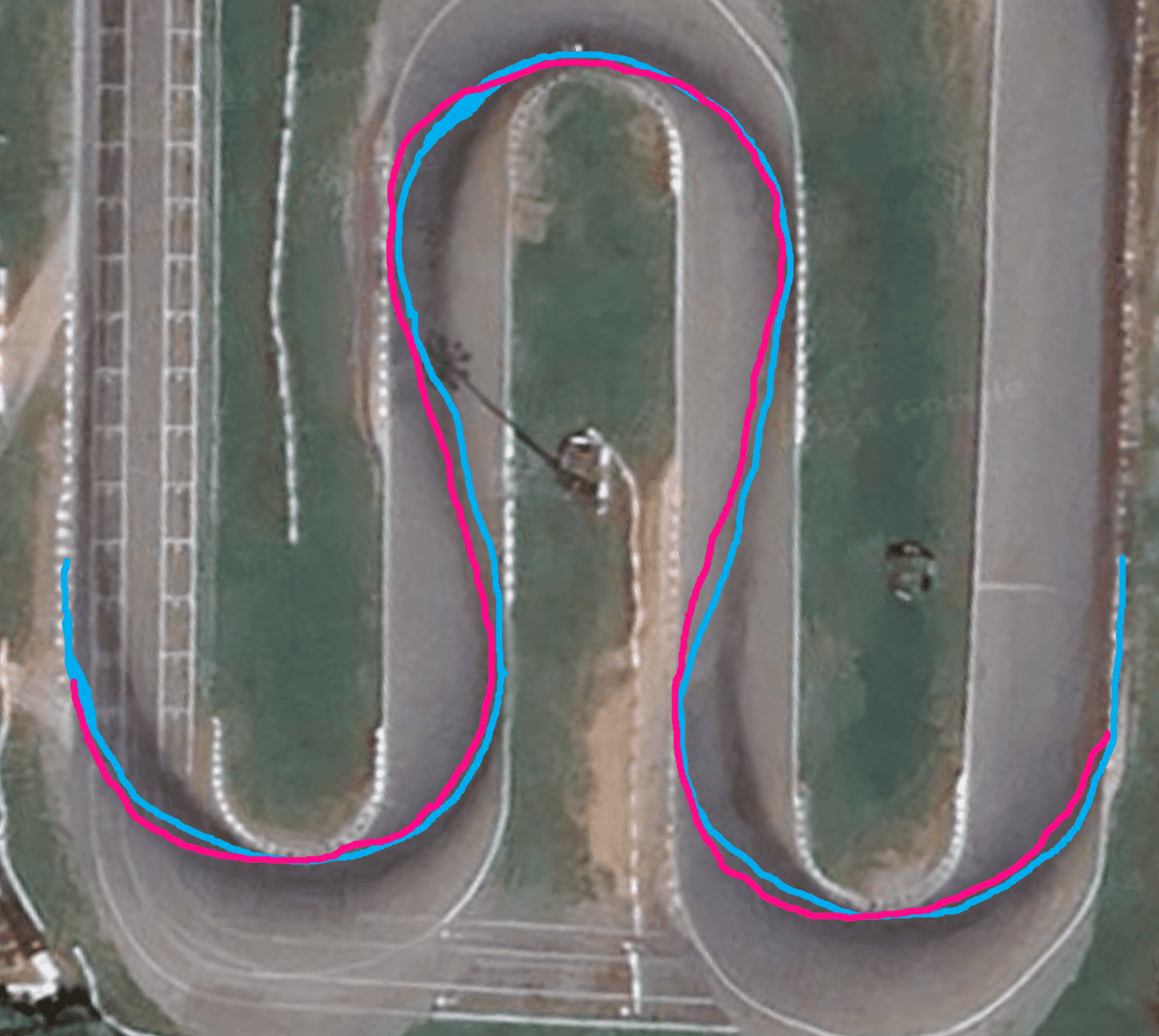
So as you can see, here’s our maximum rotation point. Forget about the GPS. It tells, it says that we are cutting the corner, but we aren’t, I hope so. Like it says that we’re doing the wet line over the curve, but we’re not. So forget about that. You know, I can change the GPS. I can go from Google to Bing, and then again, do it like that, from being to Google. But again, it’s always Google being almost, almost the best. But I guess sometimes it’s not perfect. Anyways, in this case, as you can see, I try to, yeah, I try to show you where the maximum point of rotation is, and exactly I can either click here, or I can click here, here in the data, and you can see it’s 2.28 now this is very important, guys, and that is the reason why so many drivers make mistake
if you Don’t get the maximum rotation. Remember, 50% at least 50% of the rotation on on the entry to meet you will then be forced to complete the rotation on the exit. Okay, here’s the thing. In this case, it does complete 50% of the rotation. You see, after that the rotation, it’s hard to calculate. I can’t calculate perfectly. You know. If you ask me, how can you calculate it, you can’t. So it’s just like, I mean, you would need to have some much more sophisticated data. I guess Formula One engineers can, but I can’t. I mean, they have more tools, more sensors to check I don’t. So just, yeah, as I said, the goal is that in the entry phase and in the mid phase, remember what I mentioned before. So this is like the moment we get on the gas, it’s the end of the meet, the moment we start. So the moment we come off the gas, it’s the beginning of the meet. And then the entry starts, the moment you turn in. So in this moment the entry starts. So from here to year, you do a big chunk of rotation. Actually, the most of the rotation is, is part of the entry right? Is, is part of the entry here, we’re still on the entry right. And then here we are in the mid, and we also get a lot of rotation. Now, the thing about the mid is that you get a lot of rotation, you know, because the thing about the entry, you start with a little bit rotation.
The average rotation is higher in the mid
So the the average you don’t want to make it too complicated, you’ll be like, Oh, unless you said before that, the muscle rotation you get it in mid corner. In theory, yes, you get and actually, in practice, yes, because think about it, in every like, 10th of a second that you get here, you get all this bit here, like, let me show you. So in the mid corner, I gotta want to, I don’t want to start to confuse you. But the point being is that, look, if we click this point here, that’s where I said the mid corner starts right. That’s where I said it. You see here we have such a high, such a high rotation. If we go here, from here to like here, that’s when we are the mid corner. It’s very short. It’s very little. But in this area we have very high values. Whereas from where the entry starts, you see the entry starts here at the beginning, we have very low values. So the average you see, this is where we start. This is where it starts the mid so this is the mid. So where I made this box is the is the is the mid. Here’s where the entry phase starts. As you can see, the average is higher for the for the mid, than for the in terms of rotation, for the than for the entry. Of course, the peak is on the entry here, this area, as we outline, whereas it’s where it’s it’s what is here, what it’s read. It’s part of the entry. Agree, but the average, I hope this is not too complicated for you, but the average rotation is higher in the mid and so the total rotation per, let’s say, meter. You know, if I had to go and make this like a calculation, it would be much clearer. But I don’t want to go and just complicate things for you.
The peak of rotation has to be on the entry to mid
So I said just always remember this in the mid corner, you get the most rotation in average for each meter that you spend in the mid corner, but on the entry, it’s where you get the peak rotation. Why? Because you’re holding the brakes and the brakes are creating the rotation right the brakes here that you have on that. This is the reason why I wanted to, I use this they use this data is because you can see very well. Here, got the throttle, you got the brakes. You can see the driver is stamping on the brakes. Here, pump. He’s on the brakes, and then he’s just holding on to the brakes. And if you see in this moment, it’s where he gets the peak of the rotation and that it’s where he starts to turn. This. This is the moment, yes, still almost breaking, but the goal, the thing, the reason why is is rotating so much is because he’s holding the brakes and he’s turning. He’s starting to turn. And of course, it’s not just that the speed is carrying into that corner, with the speed, with the with the initial scene that he gave he’s starting to make this the kart is starting to make this, starting to rotate. You know, he started like that. And that is exactly what what we need. If that is exactly what we need to make the corner as fast as possible, you need to get the kart to rotate. And then, of course, we’re coming off the brakes. As I mentioned. You know, we are also going to come off the brake at some point like that, right? And that’s when we are going to be then going on the gas. You see, that’s the perfect overlap, coming off the brakes and getting on the gas. That’s the perfect overlap. That’s how it should be. You see that, that’s how it should be.
Every time you go on the gas, you should have completed the most of the rotation
And you see the moment we go on the brake. Sorry, remember this, every time you go on the gas, you should have completed the most of the rotation, remember, and that is at the end of the meet, right? So pretty much at the end of the meet, that’s what we said. So it’s going on the gas at the end of the meet, basically just right before the apex. Remember, because we eat the ape with the apex is here, but we are already well past we’re already on the gas or not. So we are now. Every driver has slightly different driving style. Somebody is on the gas a little bit early on the gas, a bit later. But normally I want the drivers to be a little bit early than the apex on the gas, but not too early, of course. Otherwise it’s bad. So in this case, you can see that the driver, as I said, just managed. To get onto the gas after he got the highest rotation. But still, you can see, even though, when he’s on the gas, the rotation is still high. It’s still very high, but it’s not maximum anymore. It’s not maximum. The maximum has gone. So the maximum point of rotation is gone, and then you start to still accept you’re already well on the gas. And then the rotation starts to become less less, less, less less. And at this moment you have completed the rotation, you’re done, you’re okay. And then you’re going to start the thing for the next corner, etc. But you see from here to here we went on to make 100 180 degrees look from here to here we went from here to here to make 180 degrees rotation. Happy with that. So you’re doing these things, obviously, without thinking about, Oh, I need to do 180 degrees now. You’re just driving. But I’m just giving you the theory behind it. I don’t want to make it too complicated, I guess.
To summarize it, remember that we need to get the rotation early on
Think this is a bit of a complicated lesson, I know. I just hope you can understand so the again, to summarize it, and to make it simple for you, remember that we need to get the rotation early on. That’s why we say that we need to stop nicely on the early, rotate nice on the early, get not too early of an apex, because if you Apex too early, if you turn too early, then you have less rotation. Okay, and then on the exit, you’re gonna get pushed out wide. So that’s why you want to break turn, stop, nicely, rotate, and then you can get on the gas, and you can get a better exit. If you haven’t rotated the kart, and you try to go on the gas, you just get pushed out wide on the exit, which is the common thumb rule, thumb. And then remember from this lesson that you need to complete most of the rotation, more than 50% on the entry to the mid so in the exit, you have to complete less than 50% of the rotation. Imagine that if you didn’t complete a 50% of the rotation, your kart is going to be like that. Let’s say your your kart is facing this direction, instead of facing this direction.
You can agree with me that the
rotation is different in this moment, right? The degrees of rotations are different. And so if the kart is facing this direction, for sure, he has not completed 50% of the rotation. You know, he has not completed, in this case, 90 degrees. And so you will have to make all the work to rotate the kart on the axiom. So it’s going to take a lot of time. And so unless you have to come off the gas and in order to get back to the line, but that’s still going to make you lose a lot of time, right? So if you instead complete the rotation, the maximum rotation. So fifth, when we say maximum rotation is the peak, when I say complete the peak of rotation is, of course, the peak does never have to be on the exit. The peak has to be an entry to meet. And on top of that, in the exit, you should have less than 50% of the rotation to be done. In fact, you can see it’s all the time, yellow, green, green, yellow, whereas the orange and red is on the entry to meet you.