What a Good vs Bad Throttle Trace Looks Like
A good throttle trace drops straight to zero on the brakes and comes back once, around the apex. Here is what the bad one looks like, and how I rea…

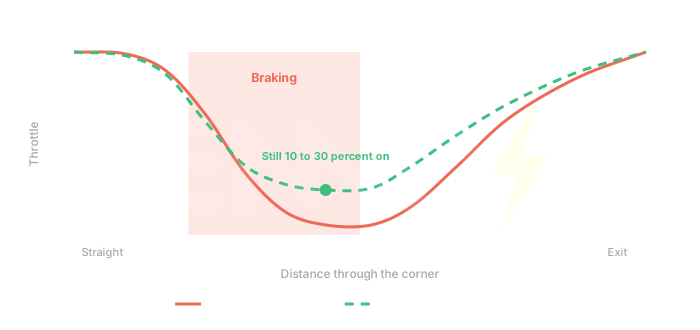
- A good throttle trace drops like a parallel line. When you brake, the throttle goes straight down to zero and it stays there.
- The bad one never reaches zero. The driver keeps 10, 20, 30% of throttle on the brakes without knowing it.
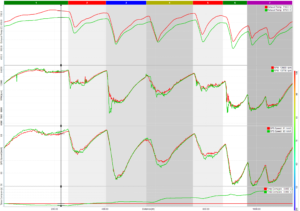
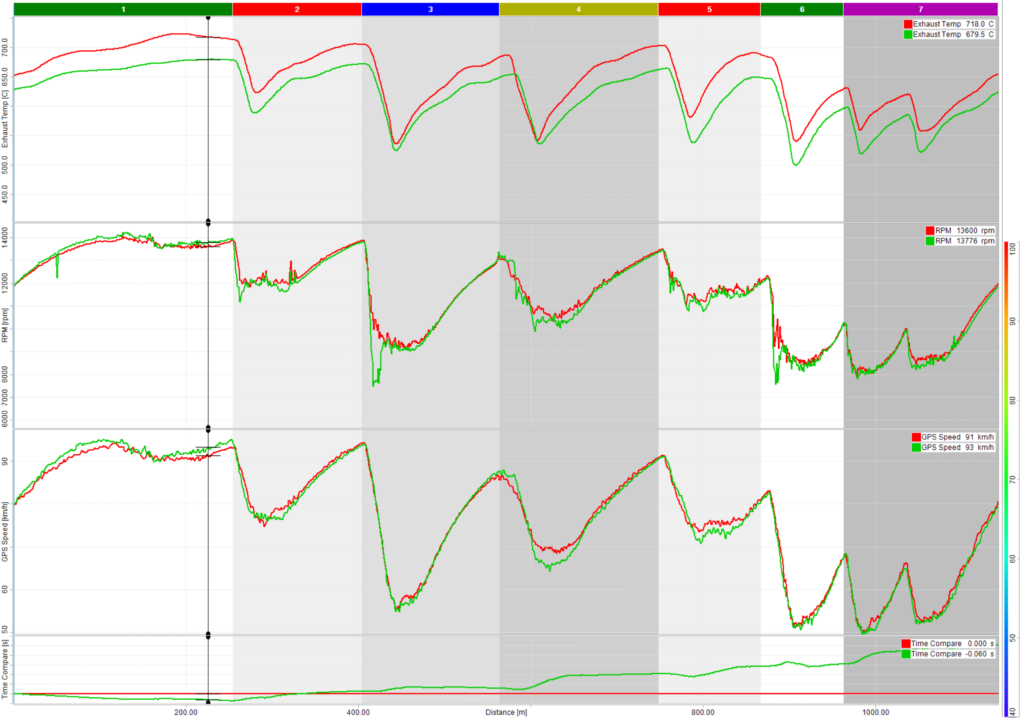
- You see it in the exhaust temperature too. At Sarno one driver had a minimum of 503 degrees in the mid corner, the other 437. The target in Mini is about 440.
- No throttle sensor? Read the exhaust temperature. It goes up when you are on the throttle and down when you are off.
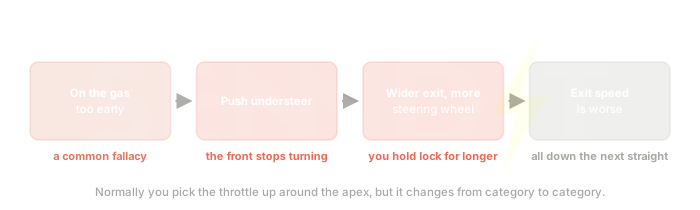
- There is no such a thing as the earlier the better. Too early on the throttle gives you push understeer and a worse exit.
- The pickup normally comes around the apex. At the apex, or one or two metres before it, when the kart has finished rotating.
- If the trace is bad in every corner, it is the driver. The engine tuner cannot fix it with the carburation.
- What is a throttle trace on a kart?
- What does a good throttle trace look like?
- What does a bad throttle trace look like?
- How does a bad throttle trace show up in the exhaust temperature?
- How do you read the throttle without a throttle sensor?
- Is going on the throttle earlier always better?
- Where should the throttle pickup be in the corner?
- Why does a slow mid corner give you an early throttle?
- Is it the engine or is it the driver?
- How do you check your own throttle trace?
- How do you fix throttle on the brakes?
- Frequently asked questions
Your driver comes in and says the engine has no bottom. Before you touch the carburettor, have you looked at what his right foot is doing?
I look at this all the time with the drivers I coach. And most of the time the answer is in one line on the screen. The throttle.
So let me show you what I look for. What the good one looks like, what the bad one looks like, and how I read it at the races where I am not even allowed to connect the sensor.
What is a throttle trace on a kart?
It is the line that shows how much throttle the driver is giving at every metre of the lap. Up is full throttle. Down is zero.
To have it you need a throttle sensor on the pedal, connected to your logger. Then you open two laps, one on top of the other, on distance. One lap alone tells you very little.
I look at two moments. The first is the release, when the driver comes off the throttle to brake. The second is the pickup, when he goes back on it.
Most people only look at the second one. They want to know who goes on the gas first. But the release matters just as much, and it is where most drivers are sloppy.
And listen, it is one channel. It does not tell you the lap time. Whatever you see on the throttle, you still benchmark it against the delta time and the speed. Was the corner faster or slower? That is the question at the end of the day.
What does a good throttle trace look like?
On the release, it needs to be a parallel line. When you brake, you come off the gas, and the line goes straight down. Not a slope. Not a shoulder. Down.
Then it stays at zero for the whole braking. Flat.
Then one pickup, around the apex, and the line goes back up and stays up.
Why does the zero matter so much? Because of how a two stroke gets its fuel. When you are full throttle the engine is burning the fuel. Where the engine picks up the most fuel is when you are off the throttle.
So on the brakes you have to let the engine breathe, as I like to call it. It absorbs like a sponge all the fuel it needs for the exit. If your foot is still a little bit on the pedal, it is not getting that fuel.
In karting there is zero reason, in any category, to keep the throttle on the brakes. The only exception is a shifter in the wet, where you make a small blip of like 10% for the downshift so the rear does not lock so much. That is it.
What does a bad throttle trace look like?
The most common bad one is on the brakes. The line starts to come down, and then it stops halfway. It sits there. And it only goes to zero in the very last phase of the braking, or never.
I had this at Sarno with two drivers on the same screen, one in green and one in red. The red was not perfect at the beginning of the release either. But the green was absolutely awful. He was not coming off the gas at all, except the last phase.
It is not full throttle on the brakes, of course. It is 10%, 20%, 30%. Enough that the engine is not breathing.
And the driver does not know. It is subconscious. Almost nobody does it on purpose. So many drivers do it. Nearly everyone I met at the beginning of their career in Mini.
Where does it come from? Sometimes from karts that reward it. I know a lot of kids in Rotax do it to preload the engine, because there is a bit of delay there. Sometimes the driver has grown and now he is too close to the pedals. I wrote the full story in the common mistake of holding some throttle under braking.
The second bad one is on the pickup. Too early, or too late. I will come to that, because too early is the one that surprises people.
How does a bad throttle trace show up in the exhaust temperature?
This is the part I like, because the engine tells you the same story as the pedal.
When you come off the throttle, the exhaust temperature goes down. If you never come off completely, it does not go down enough.
In that Sarno comparison, the green driver arrived in the mid corner with a minimum exhaust temperature of 503 degrees. The other kid had 437. The target at the bottom in Mini is about 440, and when I was driving the other categories it was about the same, 430 to 440.
So the green was 63 degrees above the target. That is too lean. He is going to feel the engine bogging on the exit, and there is nothing we can do about it from the awning.
Now look at what happens after. The red driver has a steep exhaust temperature slope at the beginning of the acceleration. Because he collected the fuel, and now the engine is burning it. The green one does not have that steep line. If you do not receive the fuel, you cannot burn it.
Over the whole lap the average exhaust temperature was 560 for the red and 574 for the green. So 14 degrees leaner overall.
But here is the interesting bit. At the end of the straights the red was actually the leaner one, 640 against 629. So the green average is not high because of the jetting. It is high because he keeps it too high in every braking zone.
And he loses on the straights too, not only in the corner. The red was going with more speed all the way up the straights.
How do you read the throttle without a throttle sensor?
In Italy, at WSK or CIK races, you cannot run the throttle and brake sensors. You can keep them fitted on the kart, but you cannot connect them. I think they do it to keep the costs down. I do not love the rule, but we stick to what they say.
So at those races I do not have a throttle trace at all. What do I use? The exhaust temperature.
The way it works is simple. When the driver goes on the throttle, the EGT goes up. When he goes off, the EGT goes down. So the bottom of each dip is more or less where he picked up the gas, and the steepness of the fall tells me how clean the release was.
At Lonato I compared the same driver in qualifying and in the final like this. Going into the chicane, one lap went on the gas at 784 metres and the other at 787. About three metres. In the first hairpin they were about the same.
Is it as precise as a real throttle trace? No. The bottom of the dip is a bit of a curve, it is not perfectly up and down. Even with the most rapid AiM EGT sensor, I cannot tell you metre by metre where he went on the throttle. You can assume. You can guess. For coaching, that is enough.
If you want to see the four channels I use together, they are in the 4 must have AiM RS3 telemetry channels.
Is going on the throttle earlier always better?
No. There is no such a thing as the earlier the better on the throttle. It is a common fallacy.
If you go too early, you generate push understeer. You go wider on the exit. You end up with too much steering wheel on the exit, and your exit speed is not good enough.
Why does it push? Because a kart has no differential. To rotate, it has to make the corner on three wheels, with the inside rear lifted.
When you go on the gas, traction picks up and you put both rear wheels back down. Now you have, let’s say, double the grip at the rear, and it pushes you out on the exit. You do not get the rotation.
It sounds like it makes no sense. We would want as many wheels on the track as possible, right? But believe me, in the mid corner it works out better to be on three wheels than on four.
There is the steering too. When you have too much steering angle on the exit, it essentially becomes drag. And in a high power kart, if you have understeer first and then you pick up the gas abruptly, it can turn into snap oversteer.
And one more. Going on the gas earlier leans the engine out earlier. When your engine is already quite lean, that is not ideal either.
So when I see on the data that one lap picked up the throttle earlier, I do not say “good”. I look at the exit speed and the delta first.
Where should the throttle pickup be in the corner?
Normally around the apex. At the apex, or one or two metres before it. It changes from category to category and from corner to corner, so take it as a rule of thumb.
My real rule is the rotation. When the kart has completed the rotation, and I know I am not going to get pushed out wide, I go on the gas. That maximum point of rotation should come in the mid corner, most of the time before the apex.
I cannot really recall a corner where you go on the throttle after the apex. If your pickup is after the apex, you probably overshot the corner.
And if you arrive at the apex and the kart has not rotated yet? Maybe you turned in too early, maybe you had to stay tight for an overtake. Then the throttle has to wait. If you go on it anyway, it pushes you out even more.
Between the brake and the throttle there should be a very small transition. Like 0.1 of a second, 0.2 max. That is the moment the chassis loads laterally, flexes, and kind of springs you out. If you go from brake to gas with zero transition, you are probably too early on the gas.
But you do not want a long one either. A lot of time rolling is what I call a dead zone, and it makes you slow.
There are exceptions. At Franciacorta, turn nine and ten, I tap the brakes and roll for more like one second, using the banking. And I do not go on the gas early there, because it goes downhill and I would get push understeer for the next left.
Why does a slow mid corner give you an early throttle?
Because you feel slow, and your foot wants to fix it.
This is the single most common thing that happens after a driver brakes too early. He arrives at the mid corner, he feels he is too slow, and he goes on the gas very early. It puts a bandage on the problem.
Does it work? A little. You may go from a three tenths loss to a one tenth loss. But it does not really compensate the mistake, and in some cases it makes it worse.
Funnily enough, if you carry low minimum speed you get an even worse exit. You go on the throttle early, you put weight on the rear, and that creates understeer on the exit. So you do not have the rotation for the next change of direction.
So an early pickup on your trace is not always a good sign. Many times it is the signature of a slow corner. Check the minimum speed first. If the speed trace is a V at that point, and the throttle comes very early, the problem started on the brakes and not on the exit.
That is why I say everything goes hand in hand. If you brake late and you trail the brakes to the apex, you load the front, you get more rotation, and that automatically lets you go on the gas earlier. The good early throttle comes from the entry. The bad one comes from the foot.
I wrote more about being smooth with your inputs in smooth is fast.
Is it the engine or is it the driver?
The driver in green at Sarno was always going to complain about the engine. He felt less speed on the straights. But the cause was his driving.
Could we fix it with the carburation? No. If we went richer to bring that minimum down, we would lose the mid range and the top. So it has to be the driver.
How do you tell on the data? Look at more than one corner. In that session there was one place where the green driver released the throttle almost like the red. And there, the exhaust temperature was almost the same. So there was nothing wrong in the kart. It was 100% the driver.
I see the same with drivers who compare the EGT against a teammate to prove their carburation is too lean or too rich. The EGT lines are so much driving style related. When two drivers go on the throttle at the same point, they have the same EGT values at the bottom and at the top.
And I have been that driver myself. In 60 Mini, at 11 or 12 years old, on a rainy test day, I kept telling my mechanic the kart was sliding on exit. I was about two seconds off. He went smaller on the sprocket, then he gave me maximum rear grip. Nothing worked.
Then he walked onto the track and stood in those corners. I was putting the power down too early and too aggressively, when the kart was not fully rotated, and right on the rubber line where there is no grip.
It took me a few sessions of trial and error. Then the traction issues were gone. Changed what on the kart? Nothing.
Don’t blame the traction. You create the traction.
How do you check your own throttle trace?
This is the order I would follow.
- Overlay two laps on distance. You against you, or you against a teammate.
- Look at the release in every braking zone. Is it a parallel line down to zero, or does it stop on the way?
- Check the exhaust temperature minimum in the slow corners. In Mini I want it around 440. If it is around 500, the engine is not breathing.
- Find the pickup point. Is it around the apex? After it? Much before it?
- Check the result. Exit speed and delta time. Earlier only counts if the corner was faster.
- Zoom out. One corner can be the corner. Every corner is the driver.
If you do not have a throttle sensor, or you cannot connect it, do steps two and four on the exhaust temperature. And if you would rather have the trace read for you, I built PURPL for exactly that: you upload the MyChron file from the session you just drove, and it hands back the three things to change next time out.
How do you fix throttle on the brakes?
First look at the pedals. I normally move them a bit further away, and I look at the position and the inclination of the footrest and the heel.
Then you go out for one session, two sessions, three sessions in a row and you think about one thing only. Braking and completely coming off the gas. It is almost like you take your leg off the pedal. Even if you are 10 seconds off the pace, it does not matter.
You do not learn this in qualifying or in the final. That is why we have testing. You do it consciously for a few sessions, and then it becomes subconscious in the good way.
And do it now. A Formula 4 engineer told me that like 80% of the kids who arrive from karting still hold throttle on the brakes, and there it locks the differential in the slow corners.
- Learn to read the other channels. Start at the karting telemetry guides.
- The throttle starts with the braking. Watch here’s what braking by feeling looks like.
- No sensors and no data? Send me your onboard and I will look at it with you in an onboard review.
You cannot expect your mechanic, your team or your coach to fix this one for you. It is your foot. Monitor it all the time, because it comes back when you grow, or when you change track.
Frequently asked questions
What should a throttle trace look like under braking?
A line that goes straight down to zero and stays there until the pickup. If it sits at 10, 20 or 30% while you are braking, you are holding throttle on the brakes and the engine is not getting the fuel it needs for the exit.
Can I see throttle on a MyChron without a throttle sensor?
Not the pedal itself. But you can read it from the exhaust temperature. The EGT goes up when the driver is on the throttle and down when he is off, so you can see roughly where he picked it up and how clean the release was.
What exhaust temperature should I see in the mid corner?
In Mini I target about 440 degrees at the bottom, and it was about the same, 430 to 440, in the other categories I drove. In one comparison at Sarno, the driver who held throttle on the brakes had a minimum of 503.
Is it faster to get on the throttle earlier in a kart?
Not automatically. Too early and both rear wheels come down, the kart pushes wide, and the exit speed is worse. Normally the pickup is around the apex, when the kart has finished rotating.
Is throttle on the brakes ever correct in karting?
Only in a shifter in the wet, where you make a small blip of about 10% for the downshift so the rear does not lock so much. In every other category there is no reason for it.
Send your onboard footage. Alessio reviews it corner-by-corner and tells you exactly what's costing you time, and how to fix it. Back within 48 hours.
Get My Onboard Reviewed → Reviewed personally by a CIK FIA World Champion, never an assistant.I promise I'll not spam you with repurposed shitty AI content but real experiences that only I, Alessio Lorandi, experienced. Written in my funny English-Italian tone of voice 😂
Alessio Lorandi is the former CIK FIA World Junior Champion, winning against Lando Norris in 2013 & F3 multiple race winner. He's helped 200+ karting drivers worldwide get faster & win WSK titles with BabyRace Driver Academy & now through Senndit, his online karting coaching platform.