
You’ve been going through chicanes, and you have realized yourself how important it is to maximize the speed in between of them.
Of course. But of course, before the speed, we have to be mindful about the line.
You know, the racing line in between the chicanes is important, very important. It’s very important, very important in individual corners, but in chicanes and in consecutive corners. It’s very, very important, but even more than individual ones, right? So you got to always be mindful about two things. So the turning point, I would say for sure, it has to come, obviously, also with the preparation. So the track usage we got on the entry. So track usage is number one turning point, and then the angle you get in between the two of them.
So here’s the thing:
Number one,is your preparation, the initial phase on the entry.
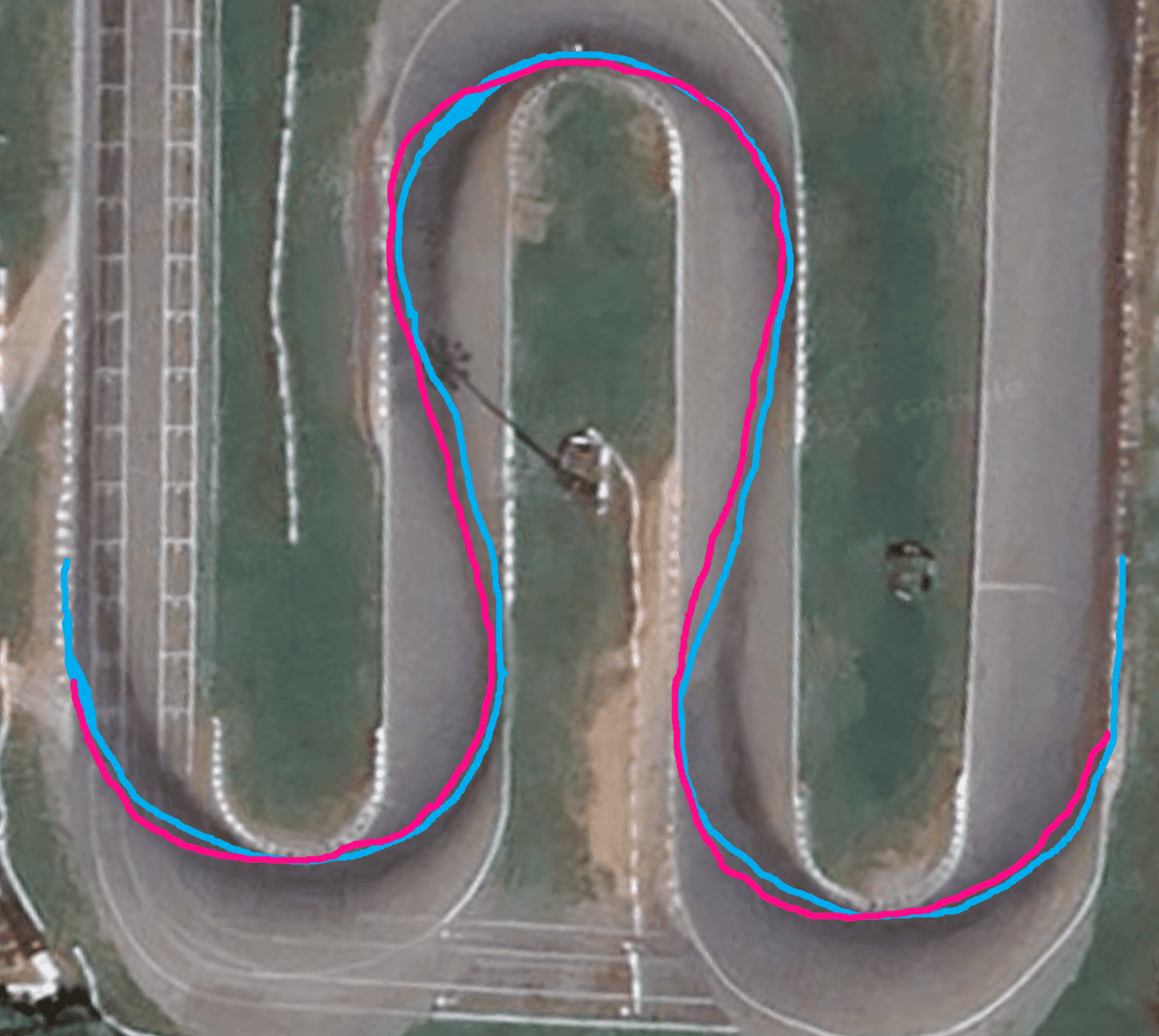
Number two, your turning point. So your first turning point and number three, your kart angle in between the two corners. So for example, so it basically comes down to your preparation in between the two corners. So this is a chicane in Cremona. We get this driver. So you can see that the entry, it’s very, very tight compared to the green. It’s not opened enough. And what this means is like you’re not being you’re not going to be able to open up and carry more speed, you know, you’re going to be nice, you’re going to be tight, which that will mean you’re not going to be able to prepare and open up nicely so that you can carry more. Imagine that you if we did the opposite, and we went super tight like that. Well, imagine what our egg, imagine our mid speed, how it would have looked like, you know, would have been really low mid speed and really and we would have been washing out in this area. So we, I think it’s all clear by now for all of you, that if we want to get this second part of the chicane rise, we need to do a really good corner like, you know, the previous corner has to be good, you know, in this case, the left hander, that’s the right hander. In this case, the left hander has to do the proper setup to get a good second phase. Of course, you don’t want to give up too much time in the first one in order to prepare the second one in a way you could be quick in the first one. Imagine that if you just open up the steering wheel here, as soon as you did the first one, let’s say you open up the steering you would go straight like that, as if there was no corners after as if there was a straight you would definitely go faster for a little bit from here to here, you would 100% go faster in this blue case. But the reason why we don’t do that is because, well, at least I hope we don’t, is because we still have to prepare for the next one, so we have to give up a little bit of exit speed by preparing more and getting ourselves back to the left so we can get a much better open line for there. Of course, there’s a trade off. Remember, there’s always a trade off. You don’t want to over prepare, because if we did like that, and we’d like go almost on the grass to prepare it, you know, there would be the other extreme. Then, yes, we would get a tiny bit better exit, but it would probably cost us. It would compromise us too much the speed of the first one in the mid exit. Maybe we’d have to actually lift this, because this is a flat corner. You know, it’s easy flat corner. You’re like, flat out, flat out. But of course, despite being a flat out corner, you can still gain or lose time if we do something bad with our lines or with our steering wheel, you know, if we turn a bit too late, of course, well, our steering wheel affects our line, but also in terms of like smoothness, and if you’re too if you’re too aggressive and not smooth enough, you’re going to create oversteer, going to make the kart slide, and you’ve got to scrub speed, because, you know, Remember, the steering wheel is a brake as well.
So yeah , we need to focus on all these things.
So we said the first part, the first goal, is to open up the entry as much as possible. Like the green is good. That’s better than the red, for sure. Maybe you can do a little bit more as as much as you can until it becomes too much. Remember, try to optimize, open up as much as you can until it becomes too much. All right? Open up. Open up. Open up. That is the goal in a chicane. The second goal is your turning point. Okay? You want to turn at the right point. If you turn too early, well, you’re gonna either bounce off the curb and you go wide, all right, or if you turn too late, you’re just gonna lose the grip. You’re going to lose the rail and you’re going to go wide. Okay? So it’s not easy, of course, but the goal is to find the optimal grip level, the optimal turning point, all right, that is the goal of racing driver at the end of the day. That’s why you need to have good vision, good speed sensing skills, etc. So we need to just have the up. Wall turning point, which I believe the Green was.
What happened with the red?
Well, the red already made a mistake from the entry by being too tight. Then he turned in a bit too late for his truck position, turning a bit too late. It pushed him wide, all right? And then what happened? He was not able or proactive enough to limit the damage and bring it back. So what happened? Well, he felt he left. He kept himself here, and this is where we are all trying to talk about in this lesson. It’s the angle, all right? The angle is basically where your kart is pointing. Is your kart pointing like that, or is your kart pointing like that, you know, or is your kart pointing like that? Sorry, it’s not clear. Is your kart pointing in this direction? Or, I hope not. I mean, by the time we get to the, I mean, by the time we get to the epics, like in this area here, how’s your kart going to point? And a little difference. Makes huge a little bit. Let me use the square like you know.
Let me try to,
no, it’s not good enough. I want to be able to. I can’t rotate it. No, I can’t rotate it. I’ll not use that. So I’ll still do it manually. So imagine you’re here, this is your kart, and this is the optimal angle. Okay, that’s good. And the red instead is going to have the wrong angle. It’s going to be like that, right? Who’s going to have the best exit of the chicane? Well, the first one, right? So you want to really find a way to open up, like to prepare the chicane, set up the chicane without losing too much time in the first one, so that you could get a much better action. Normally, you always have to prioritize the second part of the chicane without get damaging too much the first one.
So this lesson was all about the angle
Remember this, and the way you basically, measure the angle. Is like that. So, so it’s like, it’s like, it’s almost, if there’s like, a vertical axis going from your kart. So it’s like that, where it’s pointing, you know, and you can see it is pointing all the way there. Let me actually redo it. So, like, where is your kart pointing? That is your angle. It’s like that. Where is the other karts pointing? It’s like that. So if we had to prolong, if we had to project it, you would see that the red would just like point towards the defenses, the green still. I mean, you can’t get too much of a rotate if you cannot get too much of Oh, Alessio wants me to get super prepared, so I need to drive like that. No, come on, don’t be silly. You don’t want to drive like that, you know. Come on. We all know that if you drive like that. Yes, while it looks intelligent, you cannot get that much of rotation in a chicane, you know what I mean. So yeah, and you don’t need to that get that much of rotation. You need to get the right amount, but not too much. Right. Actually, it’s like this. You need to get the right amount, but not too much. So basically, this is what I was referring to. Yeah. So the green one was the proper one, the good angle that is prepared, but not, of course, not too much. But most of the times. The biggest mistake, and the most common mistake, is like the red which is too much. So it’s like not opening up the line enough. That’s very common mistake, not opening up. So like, not catching the it all starts from the entries. You see, yeah, entry is not open enough, misses the turning point goes to wide, and it doesn’t bring it back to get a good angle, all right. So this is very, very, very, very important, and keep that in the back of your mind.
That’s how you take chicanes and the consecutive corners, basically keeping the angle always in mind. Remember, try to always get your angle to point in the right direction when you get to the second phase, and you don’t want to be like that. And also, and it starts here, if here you’re not preparing like that, and you’re still focusing on, if you’re always late, that’s like, it’s like, I like to call it, if you’re late for the sequence, it’s bad. You know, if we, when we turn, you know, if we turn a little. In this case, the red turns. You should be able to be open up all the way there and open up nicely. So you prepare, you can turn nice and probably bit earlier, but you’re nice and open. If you are not like that, you’re gonna point that. So it’s like all you should, all the time, be ahead of the sequence. The green is ahead. The green is ahead. The green is ahead. You see the green is ahead of the sequence all the time. You shouldn’t behind. You shouldn’t be behind the sequence. Just keep that in the back of your mind. It’s very, very important. I’ll see you in the next one.