Wet Kart Setup and the Wet Line: What Actually Changes in the Rain
A wet kart setup is a setup for rotation, more than for rear grip. What I change on the seat, axle and pressures in the rain, and where the wet lin…

- A wet kart setup is a setup for rotation. Most of the times in the wet you are lacking front grip rather than rear grip.
- I soften up the seat a lot in the wet, mostly at the bottom, and I like it far at the front and quite high.
- The soft axle is the common belief. I tried back and forth and I did not feel a huge difference. I won many wet races with very hard axles.
- Pressures follow the water. A lot of standing water, higher. Very little water, lower. On wets on a rapidly drying track, even 0.5 or 0.6 bar.
- The wet line stays off the rubber. You brake in the middle of the track or even to the inside, and you cross the rubber already rotated.
- Kerbs or wide depends on the kart and the corner. A 60 Mini opens up the line to keep the RPMs. Juniors, seniors and KZ cut over the kerbs for less distance.
- You brake hard in the wet. At a track like Lonato you have about 15 to 20 km/h less minimum speed at the apex, so medium speed corners become heavy braking corners.
- What is a wet kart setup?
- What do I change on the seat in the wet?
- Should you run a soft axle in the wet?
- What tyre pressure do you run on wets?
- What else do you change on the kart when it rains?
- What is the wet line?
- Do you go over the kerbs or wide in the wet?
- How hard do you brake in the wet?
- Why does the kart slide on exit even with a wet setup?
- How long does it take to get fast in the rain?
- Frequently asked questions
It starts to rain. What do you actually change on the kart, and where do you put it on the track?
Everybody wants to add rear grip in the wet. But I kind of disagree. What needs to be added most is the rotation, because that is when you pick up the speed.
So this is how I see a wet setup. And then the wet line, because the two go together. You can have the right kart on the wrong piece of track, and it is not going to work.
By the way, at the beginning I was really bad in the wet. I come back to that at the end.
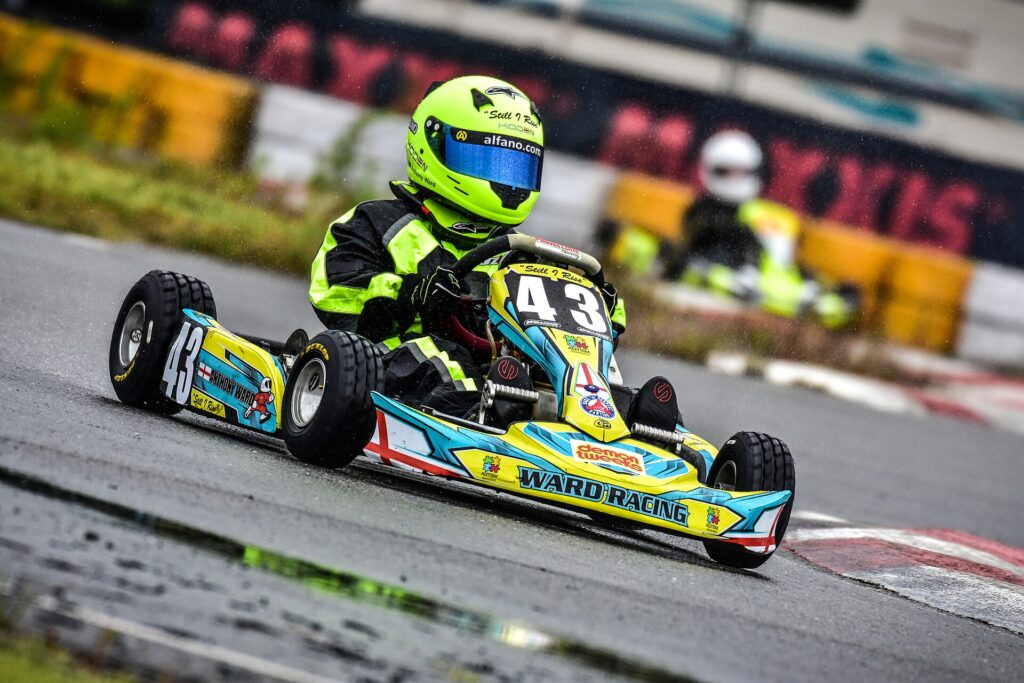
What is a wet kart setup?
A wet kart setup is a kart that still rotates when there is no grip. That is how I would define it.
There is this common fallacy in karting that it is the rear in the wet that is defining your performance. It is not really true. Because if you have too much rear and not enough front, you are not going to rotate the kart as well, and you are not going to be fast.
Most of the times in the wet we are lacking front grip rather than rear grip. Yes, we lack rear grip also. But if you get more rotation, believe me, you are going to get way faster lap times than if you had too much stability in the rear.
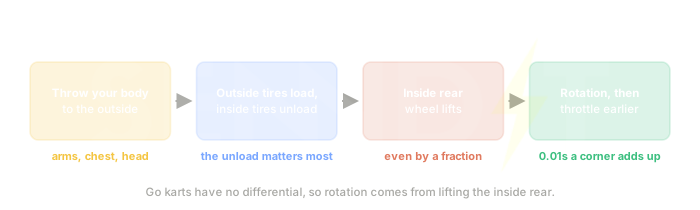
Why? Go karts have no differential. The kart rotates when the inside rear wheel lifts up, even by just a fraction. And in the wet you arrive with less speed, so the weight transfer is less and the kart does not want to rotate.
So everything I change in the rain goes in the same direction. More weight transfer, more front. My theory is that the less grip there is on track, the more rotation you need.
What do I change on the seat in the wet?
In the wet it would make sense to stiffen up the seat. Very low grip, you want more grip, right? But karting is a bit counterintuitive. If you stiffen up the seat you have less rotation.
So I actually like to soften up the seat a lot whenever I drive in the wet. Either by changing the seat completely, or by softening it up on the sides, at the bottom or at the top. Mostly I like to soften it up at the bottom.
Then the position. I love going with the seat far at the front in the wet, and actually quite high, to create some extra weight transfer and load on the tyres. You can also change the inclination of the seat, and the front geometry, caster and everything else.
And I am not saying the rear has to be free. The rear can still have some big hubs.
The goal is a kart that is almost rotating on its own. Yes, the driver still leans out in the mid corner to load the outside, and I explain that in how to master weight transfer in the wet. But I would not want a driver that has to rely only on the body to rotate the kart. That would not be a very fast kart.
Should you run a soft axle in the wet?
The common belief is yes. People go with the softer axle in the wet for the flexibility. You want the inside rear wheel to lift up and twist, and you want to absorb the shocks over the kerbs, especially with the bigger karts like juniors, seniors and shifters.
But I have tried back and forth, soft to hard, in the wet. And I will be honest with you. I just feel like there is not a huge difference between those.
Many times I have preferred to drive with a harder axle, actually. I know it goes against the common belief, but I won many races in the wet with very hard axles. In the biggest races in the world, like WSKs.
What I felt on myself is that a harder axle has more grip from the middle of the corner to the exit, and a softer axle has more stability on the entry. And by the way, 50% of the mechanics will tell you a softer axle is more rear grip, and the other 50% will tell you it is less.
So I would not fit the soft axle just because it is raining and somebody told you so. In the wet you have to be a very, very good racing driver first. The setup is still very important, but the axle is not where I would start.
What tyre pressure do you run on wets?
It depends on how much water there is. This is my rule of thumb.
A lot of standing water, you run higher pressures. Very little water on the track, you run lower pressures. And if the track is on the edge between dry and wet and you can see a drying line, then you are super low.
Say for instance you are on wets and it is drying up rapidly. You should go very low, even like 0.5 or 0.6 bar, because wet tyres don’t really like to drive in slick conditions. The tyres are going to be kind of destroyed anyway, so you look for the wet patches on the straight to cool them down.
And remember that on the grid you can always go lower. You can’t really go higher. If you are too low and it starts to rain hard, you are kind of screwed.
How do you know if you got it right? If you kept picking up grip as the session went on, maybe the pressures were a bit low at the beginning. If you kept losing grip the more you went on, maybe they were a little bit too high.
For me, nailing the pressures is what plays out the most. More than sprockets, more than setups. But it is more of an art than a science, and the perfect pressure doesn’t exist.
For the dry numbers there is my tyre pressure calculator. And the slicks or wets call is a different story: when to gamble on slicks.
What else do you change on the kart when it rains?
A few small things that people forget.
The brakes. In heavy rain the disc cools down a lot down the straight, especially with lots of standing water. And when the disc is cold it is a nightmare. I do really feel the difference. So you cover the disc. You can make the cover yourself out of the old number plates, just some plastic going around the disc. But watch out. As soon as it stops raining heavily you have to remove it right away, otherwise you cook the brakes.
The water. Normally the water gets very cold in the wet. So you close off the radiator to keep your target water temperature.
The carburation. You can’t run the same carburation between the wet and the dry. You need to lean it out massively. Because every time you brake and you wait to go on the gas, the engine gets filled with fuel that does not get burned. If you see the exhaust temperature going down too much through the lap, you are probably too rich. On an X30 it is easy, you just close it with the two screws.
The sprocket. You cannot put a smaller sprocket just to reduce the wheelspin. If you do that you just reduce the performance massively. I learned that one the hard way, and I tell you the story below.
What is the wet line?
The wet line is the line that keeps you off the rubber. In the dry, the rubber that the karts lay down is where the grip is. In the wet that rubber becomes soap.
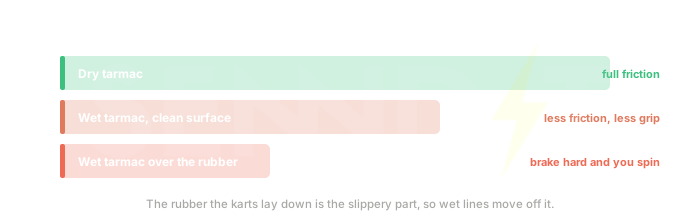
So the core thing is that you cannot brake on the rubber. If you brake on the rubber, where everybody is braking on the slicks, you are going to go straight. And if you do brake hard there, you are going to spin.
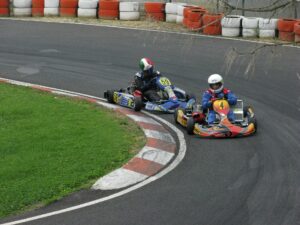
Where is the rubber? Everybody opens up the corner as much as possible in the dry, so the rubber line is going to be towards the outside edge of the track. So your goal is to brake towards the middle of the track, or even to the inside. It depends where the rubber is layered.
And this is where all the bad advice comes from. The driver brakes on the rubber, he spins, and somebody tells him to brake softer. But braking soft on the rubber is just putting a bandage. It is the right technique in the wrong place. It’s like if you’re trying to ski in an ocean. It doesn’t really work. You want to ski on the mountains.
Of course at some point you have to cross the rubber. You cannot fly over it. But ideally you are already rotated and mostly in the mid corner when you join it, and not on the brakes. And on the exit you are super smooth with the throttle when you cross it.
Do you go over the kerbs or wide in the wet?
There are two styles of driving in the wet.
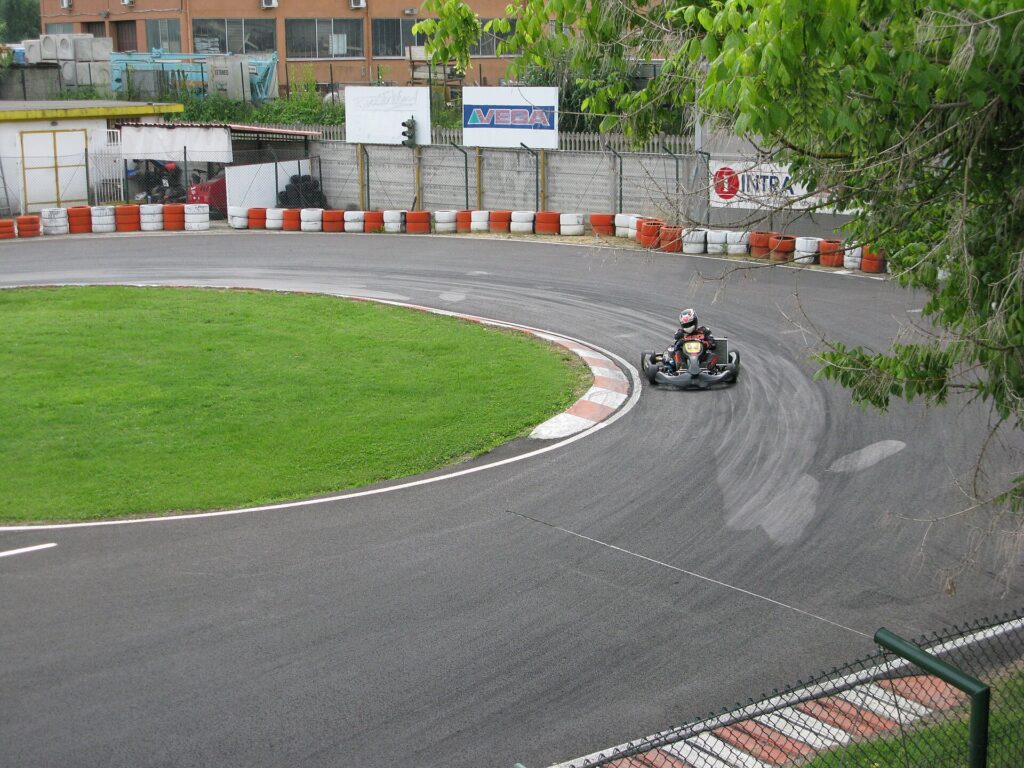
One is going tight, over the apex kerbs. With juniors and seniors, like X30 or Rotax, and with KZ, the torque is quite a lot. So you cut over the kerb and you make less distance. You may lose a little bit of minimum speed, but remember, the equation of time is distance divided by speed. It pays off the most in sequences of corners of opposite directions, like chicanes.
The second is going wide. In a 60 Mini the torque is so low that most of the times you have to open up the line in the mid corner to keep up the RPMs and the momentum.
But it really depends from track to track and from corner to corner. It is not black and white. Some corners you have to drive in between what is full wide and what is full tight.
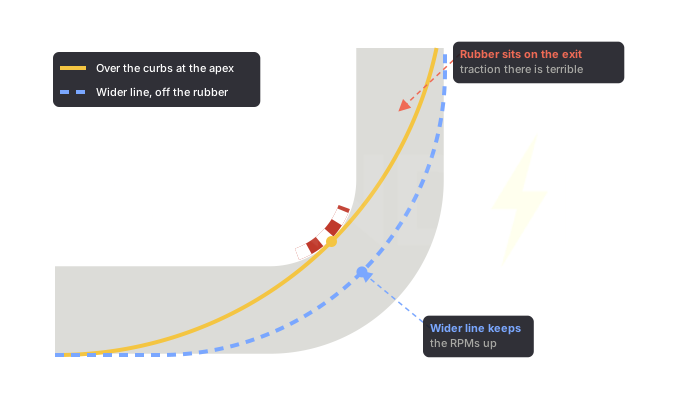
If you go for the kerb, you have to hook it in the right way. Once you hook the kerb you get more rotation and you make less distance too. If you hook it too early you get pushed out wide. If you miss the hook you go on the rubber and you lose so much time. So you hold the brakes until that kerb.
And have a look at the kerb first. If it has just rained, maybe there is a big puddle over it. In that case it makes no sense to use it.
How hard do you brake in the wet?
Hard. Everybody thinks that in the rain you have to brake very cautiously, but that couldn’t be further from the truth.
Think about it. At a track like Lonato, between wets and slicks you have about 15 to 20 km/h less minimum speed at the apex. So all those medium speed corners, where on slicks it is just a tap on the brakes, become real heavy braking corners in the wet.
And it is about how efficient you brake. You are better off braking 20% less in terms of peak, but holding it for longer and trailing the brakes into the apex. That keeps the front loaded, and that is what generates the rotation.
So if your kart is understeering in the mid corner in the wet, look at the entry before you touch the setup. Most of the times you are not using the brakes properly.
Brake a bit earlier, brake a bit softer, be careful. I keep hearing this in the paddock, and that is the way to be mediocre. You almost have to be a much better braker in the wet than in the dry. I really believe that.
Why does the kart slide on exit even with a wet setup?
Because most of the times it is you. Listen, this is how I found out.
It was a rainy test day in 60 Mini. I was probably 11 or 12. I kept telling my mechanic that the kart was sliding on exit. No traction when I picked up the throttle. I was like 2 seconds off.
So he went smaller and smaller on the sprocket to make the throttle pick up smoother. If anything it made the lap time slower. Then he gave me maximum rear grip. Slower again, because now I had to wait more for the kart to rotate at mid corner.
So at one point he walked into the track and stood in those corners. After the session he told me that I was putting the power down too early and too aggressively, when the kart was not fully rotated, and on the rubber line.
Back in the tent he drew the lines on a map. My line and the ideal wet line. My line was always a bit too tight, almost a dry line.
After a few sessions of trial and error the traction issues were gone. Changed what on the kart? Nothing. If anything, we put back the sprocket of before and we removed some rear grip for more rotation.
Don’t blame the traction. You create the traction. Complete the rotation before you pick up the throttle, and modulate it when you cross the rubber line on exit.
How long does it take to get fast in the rain?
A lot of wet days. There is no other way.
My first wet race in Juniors was at Sarno, the first round of the WSK Euro Series in 2012. In the dry practices I was storming fast. Then the rain came and it lasted the whole weekend. I qualified 49th out of 69, 2.1 seconds slower than the driver in P1. I did not even qualify for the final.
So before the second round I skipped a four day school trip to Turin and I tested all week. Nobody was on track. I was basically alone, in the pouring rain. Testing different lines, pushing the limit, spinning a few times, testing different setup adjustments.
And I have also won an Italian championship round in the wet with almost 15 or 16 seconds on the driver in P2. So it can be learned. Today the wet is my favourite thing to drive.
If you can, try to get at least 50 days of driving per year in the rain. It seems like a lot, but it is about four days a month.
- All my driving technique articles are in the karting technique guides, and the chassis side is in the kart setup guides.
- The body side of rotation, step by step: how to master weight transfer in the wet.
- Want me to look at your wet lines? Send me your onboard and I go through your laps in an onboard review.
Next time it rains, go out and stay off the rubber on the brakes. Keep sending it. Ciao.
Frequently asked questions
Should you add rear grip to a kart in the wet?
Everybody wants to, but I kind of disagree. Most of the times in the wet you are lacking front grip rather than rear grip. If you have too much rear and not enough front, the kart does not rotate. The rear does not have to be free, it can still have big hubs.
Is a soft axle better in the wet?
That is the common belief, for the flexibility over the kerbs. I tried back and forth, soft to hard, and I did not feel a huge difference. Many times I preferred a harder axle, and I won many wet races with very hard axles.
What pressure do you run on wet tyres when the track is drying?
Very low. If you are on wets and it is drying up rapidly, even like 0.5 or 0.6 bar, because wet tyres don’t like slick conditions. With a lot of standing water you go the other way and run higher pressures.
Where do you brake in the wet?
Off the rubber. Towards the middle of the track or even to the inside, depending on where the rubber is layered. If you brake hard on the rubber you go straight or you spin. You cross the rubber later, already rotated, in the mid corner.
Send your onboard footage. Alessio reviews it corner-by-corner and tells you exactly what's costing you time, and how to fix it. Back within 48 hours.
Get My Onboard Reviewed → Reviewed personally by a CIK FIA World Champion, never an assistant.I promise I'll not spam you with repurposed shitty AI content but real experiences that only I, Alessio Lorandi, experienced. Written in my funny English-Italian tone of voice 😂
Alessio Lorandi is the former CIK FIA World Junior Champion, winning against Lando Norris in 2013 & F3 multiple race winner. He's helped 200+ karting drivers worldwide get faster & win WSK titles with BabyRace Driver Academy & now through Senndit, his online karting coaching platform.