Caster and Camber on a Kart: Negative vs Positive Camber Explained
Caster and camber on a kart, from the seat: what adding caster does, negative vs positive camber, what too much front camber feels like, what to ch…

- Caster is my first move when the front is missing. It normally helps you all the way through the corner.
- More caster makes it more likely that the inside rear wheel lifts. A kart has no differential, so that lift is how it rotates.
- Too much front camber shows up as push on the exits. When I felt that, we removed some negative camber.
- A bit more camber was one of our answers for stability in the high speed corners. That was on the Tony Kart, from 2011 till 2014.
- Too much negative camber eats the inner edge of the tyre. So study the tyres after the session.
- 20 minutes before qualifying you can still slightly adjust the caster. But most of the time you end up breaking the balance.
- What is caster on a kart?
- What is negative vs positive camber on a kart?
- What does adding caster do on a kart?
- Why does more caster lift the inside rear wheel?
- What does too much front camber feel like?
- When do you add camber on a kart?
- Caster or camber: which one do you change first?
- How do you know if you have too much negative camber?
- How many degrees of caster and camber should you run?
- Do caster and camber change with the tyres and the grip?
- Can you change caster just before qualifying?
- Frequently asked questions
The front pushes on the exit. Do you touch the caster or the camber?
Listen, in karting pretty much nothing is quantified as a number. Front alignment is one of the few things that is. Camber, caster and toe.
And with my mechanic we didn’t talk much about setups. It was mainly camber, caster, axle and tyre pressures. Not much.
So these two are worth understanding properly. Let me tell you what each one did on my karts, and I’ll be straight about what I don’t have for you here.
What is caster on a kart?
Look at the front of the kart from the side.
Each front wheel steers around a pin. Caster is how much that pin leans back. More lean, more caster.
You only have it on the front. I even said it wrong once in a video: “let’s add more front caster”. Well, you can only add caster in the front.
And it is one of the things you can see from the outside. You can kind of tell what setup someone is running on. You can see their caster from the outside. You can see kind of what axle and hubs and rims, even the ride heights.
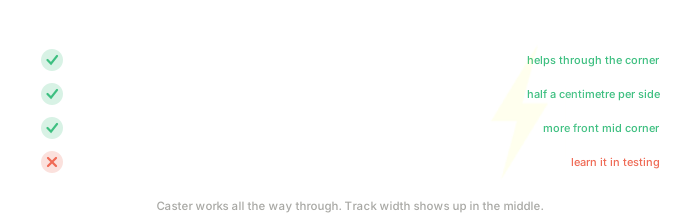
- This one line comes from the kart physics model we use at Senndit, and it is geometry on a computer, not something I measured on a kart: when you steer, caster pushes the inside front wheel down and lets the outside front wheel come up.
That is the model. What I can tell you from the seat is what it does for the driver.
What is negative vs positive camber on a kart?
Now look at the kart from the front.
If the top of the front wheels leans in towards the kart, that is negative camber. If the top leans out, that is positive camber. If the wheel stands straight up, you have zero.
When I say camber, I am talking about negative camber. So “add a bit of camber” means more negative. And “remove some camber” means less negative.
I don’t have a positive camber story for you here, and I’m not going to invent one. Everything below is about how much negative camber is on the front.
What does adding caster do on a kart?
It gives you front.
Say you feel like the front is missing. Not enough front grip, not enough rotation. What do you tell your mechanic?
If you take the responsibility together with him, you could be like: you know what, let’s try to add more caster. That’s the first thing you could do.
And you could also widen the front track. I’m talking about Mini numbers: instead of 98 centimetres we go to 99, so half a centimetre wider per side.
For sure you’re going to have more front in the middle of the corner. And the caster is normally going to help you all the way through the corner.
I was fortunate enough to be “raised” with lots of front in my driving. Full caster style, and a seat pretty far forward to free up the rear. So I can’t quite remember the last time I had to think twice about making a move because the front wasn’t enough.
I always like a front which is nice and pointy. And I play with that on the steer ratio, on the Ackermann and on the caster.
Why does more caster lift the inside rear wheel?
Remember, in a kart we don’t have a differential. So to rotate the kart as fast as possible you have to make the turn on three wheels. Which wheel has to lift up? The inside rear.
And with more caster you normally have more likelihood of lifting up the inside rear wheel. Same with a wider front track.
If you have a lot of front geometry, a lot of caster and a lot of negative camber, you are going to lift up the inside rear wheel more easily. In many cases I like to see that, because it means the kart has created more rotation.
But don’t think the setup does it for you.
How much caster and camber you have plays a big effect, yes. But most of the effect comes from the driver. Try lifting up the inside rear wheel if you’re going slow into the corner. It’s impossible. You have to carry the speed in the mid corner.
And it goes the other way too. In the wet, the driver should still push like crazy into the corner. But the geometry and the caster are there so the driver is not doing all of the work. I wouldn’t want a driver that has to only rely on the weight transfer to rotate the car. That wouldn’t be a very fast car.
If you want the full picture of that lift, read how weight transfer works in a kart.
What does too much front camber feel like?
On my kart, it felt like push on the exits.
I had a great relationship with my historic mechanic, Piero. We knew each other very well and he knew exactly what I needed. If I felt understeer in the exits of the corners, he would know that I probably had a bit too much front camber.
In my book I wrote about the same thing. With my mechanic we came to a point where I’d give him the feedback and we’d both understand what change was required.
For instance I’d be like “Il davanti mi spinge in uscita”. The front pushes me on exit.
And we both knew we had to remove some negative camber.
From 2011 till 2014 I only drove with the Tony Kart, and I knew exactly what was needed when the balance wasn’t right. If I felt it was pushing a bit on the exits of slow to medium speed corners, we would reduce some camber.
When do you add camber on a kart?
On that same Tony Kart, if I needed more stability in the high speed corners, I would go for a softer axle, or maybe we would add a bit of camber.
So for me it went both ways. More camber for stability in the fast stuff. Less camber when the front pushed on the exits of the slow and medium corners.
The tyre matters too. Whenever you have soft tyres, you may have to change the front geometry a little, and perhaps you can add more camber.
And there is one more case. Sometimes you put new tyres on and you go slower, because the kart has too much grip. That happens quite a lot in 60 Mini. The kart is stuck and the engine suffers.
Then you have to release some grip. More camber is one of the things on my list there, together with lower tyre pressures, a wider rear track and less caster. But it really depends on the balance you have in that moment. We can’t generalize too much.
Caster or camber: which one do you change first?
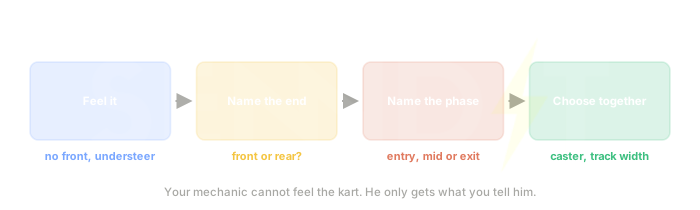
It depends on where in the corner you feel it. If I was struggling with understeer, my mechanic wouldn’t just take that. He wanted me to be very specific: slow corners or fast corners, entries, mids or exits.
This is how it went on my kart:
- The front is missing, not enough rotation. Caster first.
- Not enough front when I brake late. “We probably need to add more caster because I don’t have enough front when I brake late.”
- Pushing on the exits of slow to medium speed corners. Remove some negative camber.
- Not enough stability in the high speed corners. Softer axle, or maybe add a bit of camber.
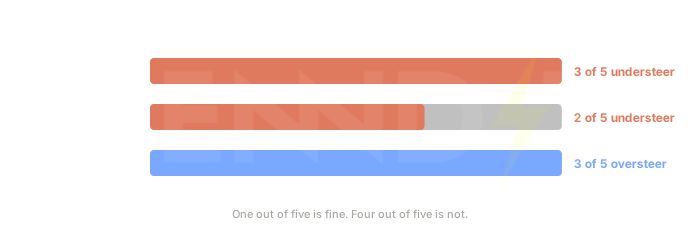
But be careful. That was my kart and my mechanic. There are so many possible changes, and most of the time only one or two things make the big difference. The others you would not even notice, or they go in the wrong direction.
And if the kart was pushing on entry under braking, on the Tony Kart I would go for a stiffer axle. So the front geometry is not always the answer. More on that in understeer vs oversteer.
How do you know if you have too much negative camber?
Study the tyres. That’s the practice I believe is the most useful thing to do.
If you have too much negative camber, you’re consuming too much the inner edge of the tyre. You see it when the kart is back on the stand.
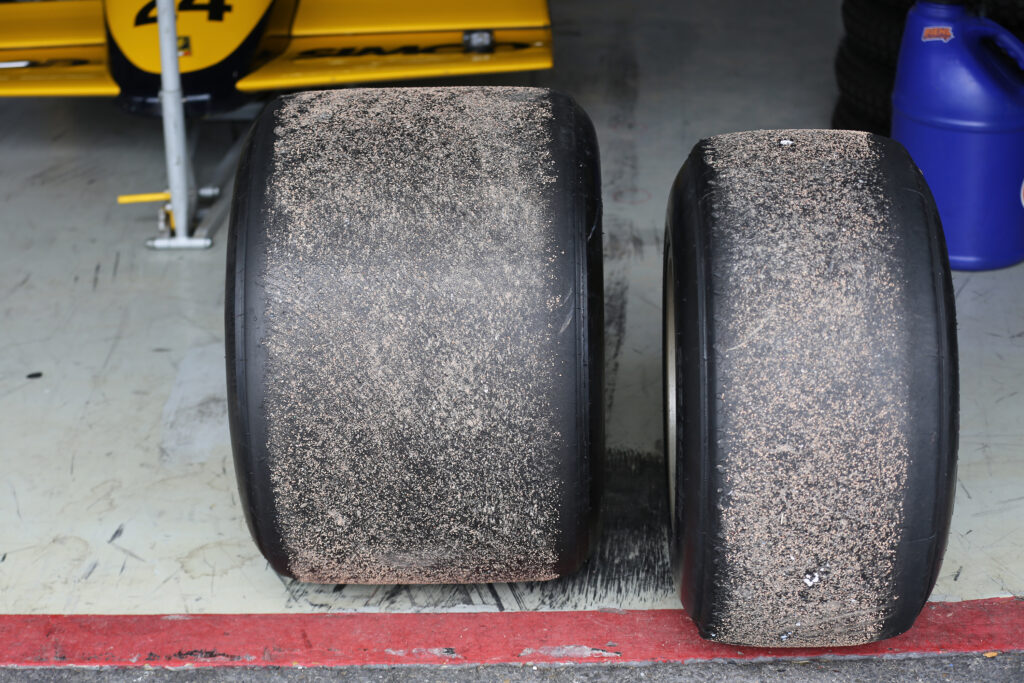
My mechanic would show me the tyres after the sessions and explain how each axle had used the tyre differently. And he told me to have a look at the competitors’ tyres too.
So do that. You feel the push on the exit, you come in, and you look at the inner edge of the fronts. Now you have the feeling and the tyre telling you the same thing.
How many degrees of caster and camber should you run?
I’m not going to give you a number in this article.
What I can tell you is this. Front alignment, ride heights and front and rear width are the only things on a kart that are quantified as a number. The tube rigidity, the axle, the rims, the hubs, the seat flexibility, they all play major roles but they are not really quantifiable.
So if caster and camber are numbers, measure them and write them down. That is the whole point of a caster camber gauge.
My mechanic would write down in his “papers” the sprockets, the tyre pressures, the axle and all the other setup adjustments. So when we were struggling with pace, he knew where to look for inspiration.
And check that the front is still what you think it is. Is the front alignment spot on? If the frame took a hit, check the height and the eccentric to make sure it’s not bent. I get paranoid about testing the alignment, friction, vibrations and lubrication of my kart on a daily basis. Even if I’m already the quickest.
Do caster and camber change with the tyres and the grip?
Yes. Setup tuning is always a moving target.
When you have very hard tyres, you may have to increase the caster massively in the front. You have to add grip and increase the load on the tyres. With soft tyres it is the opposite story: lower pressures, and perhaps a bit more camber.
In the wet you also need a lot of front grip. When you have a lot of front grip, like a lot of caster, you generate more rotation and the inside rear wheel lifts up easier.
When the grip is low and you need a planted rear, you may get a little bit of understeer. You can compensate with a huge amount of front grip, in terms of caster and front width.
And when the track has an extremely high amount of grip, I may not want to get that inside rear lift from too much front geometry. I may prefer to free up the rear with a softer seat instead.
Can you change caster just before qualifying?
Slightly, yes.
Let’s say you realize 20 minutes before your qualifying that the track has picked up lots of grip. Most of the time you’ll be queuing up in parc ferme, getting your tyres scanned. So you won’t physically have the time to change an axle or the front alignment.
You could slightly adjust the rear width, the caster, the tyre pressure, or change the rear hubs. But that’s it.
And you don’t even need to do that much. Because most of the time you end up “breaking” the balance of the kart.
That is why you practice these changes in the training days. If you have one shot in the race and you have to take one decision, you’d better know exactly what you’re talking about.
- The full order I work in, from seat position to camber and toe: Karting Setup Masterclass.
- All the setup guides in one place: kart setup guides.
- Not sure if it is the front geometry or your driving? Send me the footage: onboard reviews.
Try it in testing. Then tell your mechanic exactly what you felt.
Frequently asked questions
Is negative camber or positive camber better on a kart?
I can only speak about negative camber, because that is what I worked with. A bit more of it was one of our answers for stability in the high speed corners. Too much of it gave me push on the exits and consumed the inner edge of the tyre.
Does too much camber cause understeer?
On my Tony Kart, yes, on the exits. When I told my mechanic that the front pushed me on exit, we both knew we had to remove some negative camber.
Is more caster always better?
No. Caster is my first move when the front is missing. But when the kart has too much grip on new tyres, less caster is one of the ways to release it.
Does caster alone lift the inside rear wheel?
It makes it more likely. But most of the effect comes from the driver carrying speed in the mid corner. If you go slow into the corner, the inside rear wheel is not going to lift.
Can you add caster on the rear of a kart?
No. You can only add caster in the front.
Send your onboard footage. Alessio reviews it corner-by-corner and tells you exactly what's costing you time, and how to fix it. Back within 48 hours.
Get My Onboard Reviewed → Reviewed personally by a CIK FIA World Champion, never an assistant.I promise I'll not spam you with repurposed shitty AI content but real experiences that only I, Alessio Lorandi, experienced. Written in my funny English-Italian tone of voice 😂
Alessio Lorandi is the former CIK FIA World Junior Champion, winning against Lando Norris in 2013 & F3 multiple race winner. He's helped 200+ karting drivers worldwide get faster & win WSK titles with BabyRace Driver Academy & now through Senndit, his online karting coaching platform.