South Garda Karting, Lonato: My Track Guide After 20 Years of Laps
The first session at Lonato is two seconds off, and there is only one real braking reference on the whole track. South Garda Karting the way I know…

- South Garda Karting is 1,200 metres long. That is the circuit’s own figure. With junior or senior karts at 145 kilos we normally do a 46, 47 lap time there.
- The first session of the day is about two seconds off. The rental karts drive from 5 pm until about 10 pm and they leave very slippery rubber on the track.
- You have only three really fast sessions in a day. About session three, four and five. The others are slippery and you can’t see much in terms of setup.
- There are only two major braking zones. The mechanics corner and the first hairpin after the chicane.
- There is one real braking reference at Lonato. At the mechanics corner, Turn 4, it is the entry of the kerb on the left. Everywhere else I brake by feeling.
- In the chicane you go all four wheels outside of the exit kerb. In KZ nobody was doing it, and that line gave me about 1.5 tenths.
- In the rain Lonato is about 17, 18 seconds slower than the dry. In other tracks I have seen gaps of only 8 to 10 seconds.
- Where is South Garda Karting and how long is the track?
- Why is Lonato so important in karting?
- How does the grip change during a day at Lonato?
- When is the best time to test at Lonato?
- Where do you brake at Lonato?
- How do you drive the mechanics corner?
- How do you take the double left?
- How do you take the chicane before the hairpins?
- How do you drive the last three hairpins?
- Which kerbs do you use at Lonato?
- What setup works at Lonato?
- How slippery is Lonato in the wet?
- What is the fastest line through the Lonato chicane in KZ?
- When can you do a track walk at Lonato?
- Frequently asked questions
Why is the first session at Lonato always a disaster?
I have been at Lonato for 20 years, since I was six years old. In my early karting years I would end school at about 12:30 and then drive the rest of the afternoon there, clocking in about 80 laps per day. On pretty old tyres and a pretty slow training engine.
And still, every time you go to Lonato the first session is a disaster. You are like two seconds off the grip. So if you come here for the first time and you start changing the kart after that session, you are already lost.
Every track has its own DNA. This is the one of Lonato, the way I know it.
Where is South Garda Karting and how long is the track?
South Garda Karting is in Lonato. The address the circuit gives is Via Corte Ferrarini, 25017 Lonato (BS).
According to the circuit’s own site, the track is 1,200 metres long, with an average width of 9 to 10 metres and grandstands for 2,000 people. It was built in 1988 and it is CIK-FIA homologated.
What does that mean in speed? With senior karts, or even with junior karts that have 145 kilos of weight, we normally do a 46, 47 lap time. Juniors and seniors reach 135, 140 km/h on that track. In a rental kart you would definitely be at least 20 seconds slower, and I believe they reach about 75 km/h.
I am not going to draw the layout for you here. The circuit publishes its own track map, so keep that one open while you read the corners below.
Why is Lonato so important in karting?
Because all of the karting manufacturers are located very close to it. CRG is literally one minute away. Tony Kart is 10 minutes away. Birel is one hour away. Parolin and Kart Republic are about one and a half hours away.
So all of the factories are testing there, with their own equipment and their own professional drivers. And it becomes the place where you can benchmark yourself against them.
Then there are the races. At least 25 races a year are being held in Lonato, which is quite crazy if you think about it. Different categories, different series. And you will have at least two, three WSK races there every year, which is already like 20, 30% of the total number of races in WSK.
By the way, Franciacorta is 25 minutes away from Lonato and Cremona is about 35 minutes away. Between those three tracks there are like nine, ten WSK races every year. So knowing Lonato very well is key. I rank it against the others in the best karting tracks in Italy.
How does the grip change during a day at Lonato?
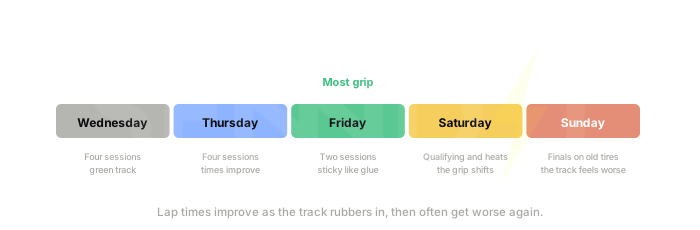
This is the number one thing you have to remember. At Lonato the grip changes quite a lot during the day, especially in the summer.
Why? Because on the testing days and in the smaller races, there are always the rental karts driving in the afternoon, from 5 pm until like 10 pm. And all those rental karts are layering very, very slippery rubber on the track.
So the next morning it goes like this. The first session is like two seconds off. The second session is like half a second off. Then session three is really fast and session four is really fast. It peaks at like midday, 1 pm maximum. And then it starts to get slower again in the afternoon, as the humidity starts to increase and the exposure to the sun starts to drop.
In the winter it tends to be more stable across the day, because there is no real major rental kart activity. Even though the first session is always going to be slippery.
And which corners go first? When the sun is going down in the winter, the first part of the track that gets cold and in the shadow is turn one and two, as well as the last two corners, because they are basically covered by the grandstand. Those are the ones that get slippery the earliest.
When is the best time to test at Lonato?
You have only three real sessions that are fast during the day. About session three, session four and session five. You can expect the peak lap times at about 11 am, or even up until the first session after lunch.
Session one and two, and session six and seven, are slippery. You can’t see very well in terms of setup tuning there. So don’t judge the kart on those.
And in the last session of the day I already know I can’t carry more speed than the session before. Maybe the same speed, but for sure not more. So I stop the kart a bit more in the middle of the corner, by holding the brakes and waiting to go on the gas.
Which day? Most of the factory teams go to test there on the Tuesday, the Wednesday or the Thursday, when there is no real rental kart activity.
One more thing I always do. At South Garda there is open pit lane for 45 minutes every hour, so you choose when to go out. I look at which tyres the other drivers are running, and I try to go out together with the ones on soft tyres. Because who you are driving with decides what rubber is being layered down on the track.
Where do you brake at Lonato?
There are only two major braking zones around Lonato. The mechanics corner, and the first hairpin after the chicane.
And in terms of reference points for braking, there are not too many. The mechanics corner is the only corner where you have a real reference point on the brakes. I have experienced it myself in all the different categories. The reference is the entry of the kerb that is to the left.
The others are pretty much inexistent. I mean, I have been there for 20 years and I didn’t find any real reference points on the braking in the other corners. So I just prefer to brake by feeling around Lonato. Don’t overthink it.
But braking by feeling does not mean braking early. When I go through the data with young drivers in a WSK weekend, I am amazed to see some of them 7 metres off the optimal braking point in a hairpin they reach at 97 km/h, say the mechanics hairpin at Lonato. In a 60 Mini, 7 metres too early at that speed is up to 2 tenths of time loss. More on this in what braking by feeling looks like.
How do you drive the mechanics corner?
The mechanics corner is Turn 4. It has a very deep and hard braking zone, which is a little bit downhill. And then in the mid to exit it picks up some altitude, so it actually goes a bit up.
So what do you do? You arrive, you smash the brakes, and you brake right over the kerb to the left, the entry kerb. You want to use it to the maximum, almost ditching a wheel into the grass. Because by using that you make the corner more open on the entry.
Then you need a nice late apex. Otherwise, because the exit is uphill, you will feel like the engine is not pulling. But the reality is that you anticipated the corner, you didn’t get a good apex point, and you are sacrificing your exit speed because of that.
And bear in mind there is also a tiny bit of positive banking at the apex. So you want to be super close to it.
How do you take the double left?
The double left is the one we call six seven. It’s quite cool, because you need to hit both the apexes, but between the first and the second apex the track goes up quite a lot in elevation. So there is a nice crest.
And if you are not hitting the apex of the first one properly, you will probably be pushed wide for the second one and you will miss the second apex.
How much brake? In Mini it’s just a lift, barely using any brakes. In juniors it’s a small tap on the brakes. In shifters it’s a bit more than that.
But still, it’s a minimum speed corner. You don’t want to focus too much on the entry and not too much on the exit. You want to keep up the minimum speed. That’s normally the secret around there.
How do you take the chicane before the hairpins?
The chicane is a left and then a right, coming up right before the three hairpins. You have to use a lot of entry speed and also carry a lot of exit speed. It’s very fast.
And you have to run outside of the track limits on the exit, because that’s the only way to go fast. You have to go all four wheels outside of the kerb. It gets quite bumpy in this part of the track, and in shifters and seniors all those bumps may be quite annoying.
Why does it matter so much? Because if you get this corner right, you will be able to overtake or pull away from the others in the hairpins. If you get it wrong, you will get overtaken.
You don’t want to focus too much on the exit, because the exit is not that long leading into the first hairpin. But it’s one of those corners that requires a lot of confidence in yourself. And in a race it’s a place where you can make big lunges down the inside, as long as you’re close and committed enough.
How do you drive the last three hairpins?
Lonato is famous for the last three corners. We call them the three hairpins. Someone even calls them the snake. They are exactly the same in terms of radius and angle, two to the right and one to the left. But they have to be approached quite differently.
The first hairpin. You arrive with a lot more speed than in the other two. So you attack the brakes, you stop the kart on the brakes, and you try to get a lot of time on the entry. Without focusing too much on the exit, because the exit is very short.
The second hairpin. You barely use the brakes. In Mini and juniors you are not really using the brakes there. You only do it a bit in senior, and in shifter quite a lot. It’s more about rolling speed, and again the exit is not too important.
The last hairpin. Here you focus on the mid to exit, because it launches you onto the main straight. Which is not a really proper straight, because there is always a bit of turning required. But it’s effectively the longest straight of the track.
And in a race, bear in mind that at Lonato it’s so hard to switch back. There are so many changes of direction that if you try the switchback, you are then on the outside for the next corner.
Which kerbs do you use at Lonato?
The rule of thumb is to use every inch of track that makes you faster. But it’s track specific and corner specific. So at Lonato:
- Apex kerbs: no. If you try to go over the apex kerbs at Lonato you’re going to lose so much time.
- Entry kerb of the mechanics corner: yes, all of it. That’s how you open up the corner.
- Exit kerb of the first and second hairpin: no. It pushes you out and it’s too hard to bring the kart back for the next corner.
- Exit kerb of the third hairpin: yes. Because it launches you onto the straight.
Then there are the kerbs that change during the day. The entry kerb of Turn 3, the ex bar corner, and the entry of the chicane are always quite slippery on the first few laps of the first session in the morning. Then they get better and better, to being fine on the last lap of that same session.
So if you felt the rear go on that kerb, next lap you use it a bit less. And towards the end of the session, when enough karts have gone through it, you try again. I go deeper on this in when to use kerbs in karting.
What setup works at Lonato?
The only thing you have to remember is that the surface is very bumpy. I really wish they are going to resurface it.
First, it’s not really good for the ribs. If you are normally suffering with rib pain, it can be a bit of a problem. I’ve had that a few times.
Second, because of the bumps you have to consider maybe running a little bit softer axles. Every time you go over those bumps it’s quite stiff, and it may unsettle the kart. So in many cases a softer setup helps a bit around Lonato. Whereas in other tracks like Franciacorta you want more of a stiffer setup.
And the grip level? It can become really, really high whenever everybody is driving on soft tyres like LeCont or Vega. For the rest of the season the grip is medium to quite high, on normal races and normal testing days.
How slippery is Lonato in the wet?
Very. It’s not the grippiest track in the wet. I think it’s because there is so much standing rubber, accumulated over the huge amount of races that happen every year. And also the tarmac is not very abrasive.
So most of the time the lap time difference from dry to wet is about 17, 18 seconds. Sometimes even 20. In other tracks I have seen gaps of only 8 to 10 seconds. In my opinion it’s one of the slipperiest tracks in Italy when it comes to rain.
What does that do to your driving? On a track like Lonato you have about 15 to 20 km/h less minimum speed at the apex between wets and slicks. And to arrive at that minimum speed you are not going to coast. You have to use the brakes, and for longer than in the dry. So the corners that are just a tap on the brakes in the dry become real braking corners.
And when the track has just dried up, the extra red tarmac beyond the exit kerb of the chicane will stay quite slippery for a couple of hours. So wait before you fully use it again.
I spent countless wet days at Lonato. My wet driving is in wet go kart driving tips.
What is the fastest line through the Lonato chicane in KZ?
This is the one thing I did differently at Lonato, and I kept it in the pocket for a while.
In KZ everyone gave it for granted that you had to stay tighter out of the chicane than the single speed categories. In a shifter you V the entries and the exits, to take advantage of the front brakes and of the power. So in KZ they were all exiting with just two wheels over the kerb. I knew 60 Mini, OKJ and OK were going wide.
Then on a testing day in January I figured it out by chance. I kept it almost flat and went super wide on exit, with four wheels off the kerb, over the extra red tarmac, bottoming pretty hard under the seat. It gave me the feeling that it was slower. But the lap time was faster than the lap before.
At the end of the day I had gained about 1.5 tenths from the tighter version, calculating the extra distance. In karting terms, 1.5 tenths is massive.
One warning. The exit kerb before the extra tarmac was pretty high. So if you don’t commit to going fully four wheels outside of it, you bottom hard and for long, and that is a time loss.
At the Winter Cup, out of 94 KZ2 drivers, I set a 46.735 in my qualifying group and ended up P2 overall, by 0.042. Then I was dumb enough to crash out in the fourth heat when it started raining.
When can you do a track walk at Lonato?
I recommend you to go for track walks around Lonato, most of the time in the morning before the activity on track.
And the reason is the rental karts again. You can’t really go for a track walk after the last session, which is a bit annoying to be honest. So the last track walk you can do is at the lunch break at 1 pm, or in the morning at 8 am.
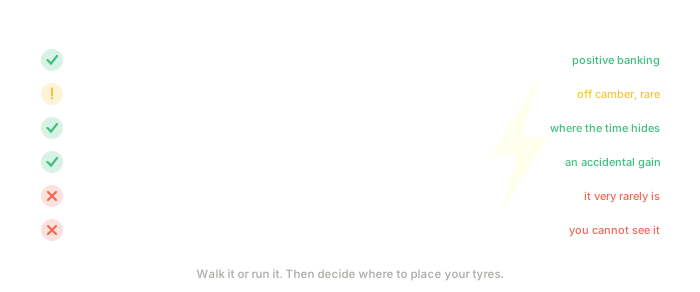
What do you look for? The crest in the double left. The banking at the apex of the mechanics corner. How high the exit kerb of the chicane is. You cannot judge those from the seat.
- My other track articles and the rest of the karting world are in the Extra guides.
- Driving at Lonato soon? Send me your onboard from there and I go through your laps in an onboard review.
- If you want to work with me for the long term, this is the 6 months program.
- Not sure a coach is worth it? Read why hire a go kart coach.
And next time you are two seconds off in the first session at Lonato, leave the kart alone and wait for session three.
Frequently asked questions
How long is the South Garda Karting track in Lonato?
The circuit’s own site gives 1,200 metres, with an average width of 9 to 10 metres. With senior or junior karts at 145 kilos we normally do a 46, 47 lap time there.
Where is the braking point for the mechanics corner at Lonato?
The reference is the entry of the kerb on the left. You brake right over that entry kerb and you use all of it, which also opens up the corner. It is the only real braking reference I use at Lonato. The others I brake by feeling.
When is the track fastest at Lonato?
About session three, four and five. The peak lap times come at about 11 am, or up until the first session after lunch. The first session is like two seconds off, because of the rubber the rental karts leave in the evening.
How much slower is Lonato in the wet?
Normally about 17, 18 seconds, sometimes even 20. In other tracks I have seen gaps of only 8 to 10 seconds. The grip in the wet is very low there.
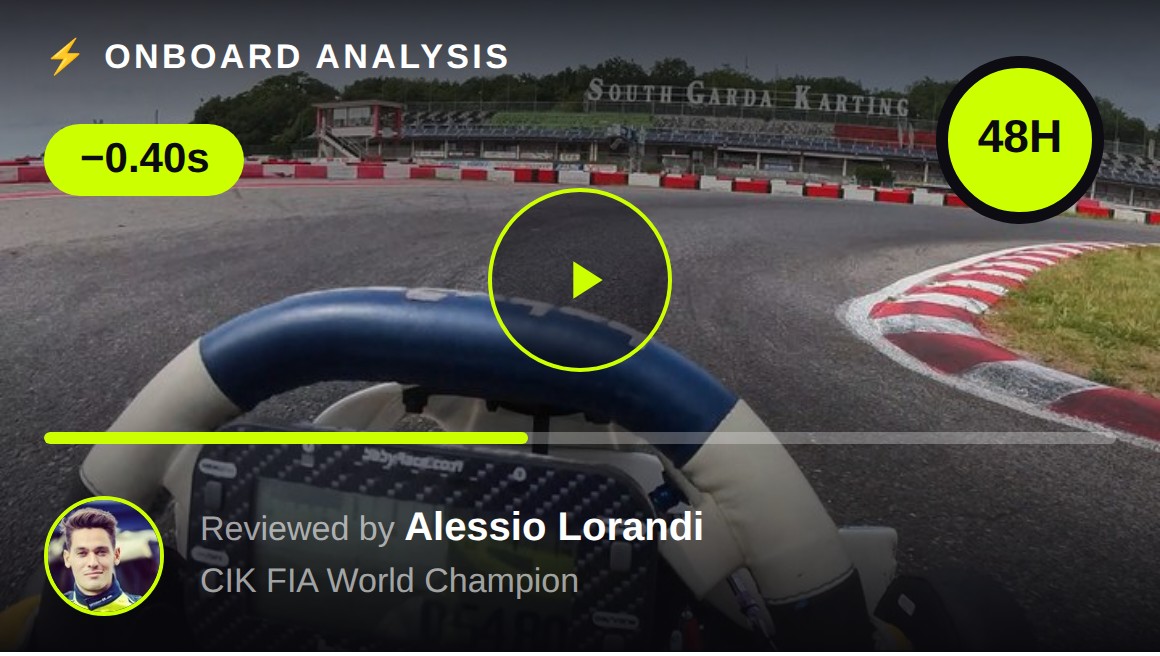
Send your onboard footage. Alessio reviews it corner-by-corner and tells you exactly what's costing you time, and how to fix it. Back within 48 hours.
Get My Onboard Reviewed → Reviewed personally by a CIK FIA World Champion, never an assistant.I promise I'll not spam you with repurposed shitty AI content but real experiences that only I, Alessio Lorandi, experienced. Written in my funny English-Italian tone of voice 😂
Alessio Lorandi is the former CIK FIA World Junior Champion, winning against Lando Norris in 2013 & F3 multiple race winner. He's helped 200+ karting drivers worldwide get faster & win WSK titles with BabyRace Driver Academy & now through Senndit, his online karting coaching platform.