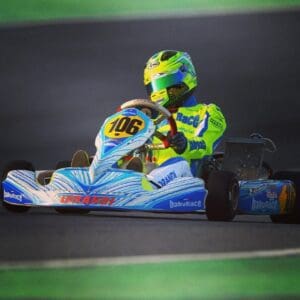
Franciacorta Karting Track: My Corner by Corner Guide in KZ
Franciacorta has three really heavy braking zones, one downhill and one uphill. Here is the track corner by corner, from my own KZ2 notes.

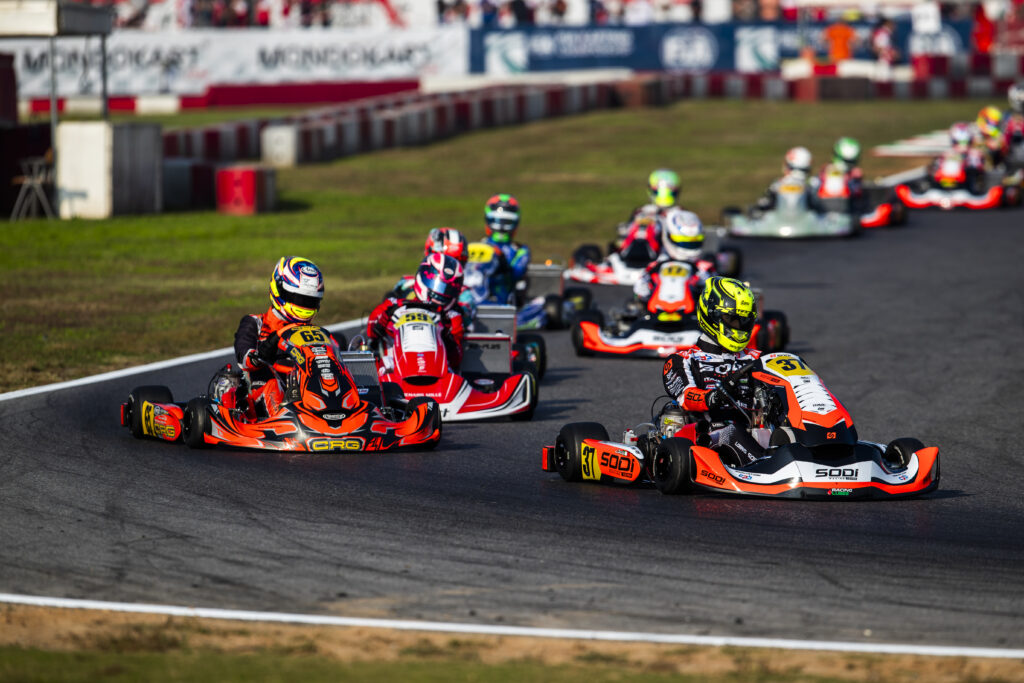
- Franciacorta is long, super fast and really smooth. The circuit gives 1,300 metres, and the elevation changes are what make it different.
- Turn 5 is a steep downhill braking. The kart doesn’t want to stop. If you don’t brake hard enough you just go straight.
- The last hairpin brakes uphill. So you can brake super, super late. I pulled 1.8 to 1.9 g there and at turn 5 in KZ.
- Turn 9 and 10 is one corner for me. Banked, double apex, a tap on the brakes and then you roll for about one second before the gas.
- You can’t play for the exit at turn 2 or in sector two. You carry entry and minimum speed, and you wait with the throttle.
- There is a lot of overtaking. So many straights, slipstream and long braking distances.
- You can still set personal bests in the afternoon. That is not the case at Lonato.
- Where is Franciacorta Karting Track and how long is it?
- What kind of track is Franciacorta?
- How many heavy braking zones does Franciacorta have?
- How do you drive turn 2 and turn 3?
- How do you brake for turn 5, the downhill one?
- What do I think about from turn 6 to turn 8?
- How do you take turn 9 and 10, the banked double right?
- What about turn 11?
- How late can you brake for the last hairpin, turn 13?
- What are my last two KZ2 notes for the end of the lap?
- Which gears do I use at Franciacorta in KZ2?
- Where can you overtake at Franciacorta?
- Does the outside move at the last hairpin work?
- When is the grip best at Franciacorta?
- What do I do differently here?
- Frequently asked questions
Do you really need the brakes at Franciacorta?
One of my drivers once told me he believed he didn’t need to use the brakes at this track.
I don’t really know what made him believe that. Franciacorta has got three really heavy braking zones. So you can guess what he was doing out there. Barely using the brakes, having to brake so early as a consequence, and still overshooting by the apex.
I know this track a lot. I have seen lots of races there, and in 2025 I raced the KZ World Championship on it. So this is Franciacorta the way I drive it, corner by corner, from my own notes.
Where is Franciacorta Karting Track and how long is it?
It is in the Brescia area, in the north of Italy. The circuit’s address is Localita Bargnana, Castrezzato, and it sits inside the Autodromo di Franciacorta complex.
The circuit’s own site describes a track of 1,300 metres with fast parts, technical parts and, above all, changes of slope that set it apart from other tracks. I agree with that last part. The uphill and the downhill change how you drive here.
It was built quite recently, so it is not one of the tracks I grew up on as a kid. In 2025 it hosted the KZ World Championship, and I was in that race.
If you are planning a trip, I put it next to the other Italian circuits in my list of the best karting tracks in Italy.

What kind of track is Franciacorta?
It’s long, super fast, and really smooth. It’s actually comparable to Sarno in terms of speed, but less bumpy and a bit more modern.
Because it is smooth, the setup goes the other way from Lonato. At Lonato the bumps make me run softer axles in many cases. At Franciacorta you want more of a stiffer setup, and that tends to work really well.
But the setup only takes you so far here. The track goes up and down, and you can’t make a variable setup that changes from corner to corner. You as a driver have to make the adjustments. And remember that an uphill or a banked section augments the balance you already have. If you have a bit of understeer, there it becomes more. I explain why in how elevation changes and banking affect grip.
So what is it good for? Chassis testing, and developing high-speed driving skills.
How many heavy braking zones does Franciacorta have?
Three really heavy ones.
Two of them I can give you with numbers. At the 2025 World Championship I pulled 1.8 to 1.9 g on the braking for turn 5 and for the last hairpin. That’s pretty high. When the track is not grippy and the tires are not grippy, you probably won’t get above 1.6 or 1.7 g.
And these two are opposite. Turn 5 brakes downhill, where the kart doesn’t want to stop. The last hairpin brakes uphill, where there is so much grip that you can go super late. So you have to treat them differently.
If braking that late is new to you, start with the science behind late braking.
How do you drive turn 2 and turn 3?
You go up into turn 2. And this is a corner where you can’t really plan too much for the exit. Instead, you have to drive so hard into the corner and carry lots of entry, but mostly minimum speed.
Why? Because if your minimum speed is low, you will want to go early on the throttle to make up for it. That puts the weight on the rear, you get understeer on the exit, and you have no rotation for the change of direction that comes right after.
In KZ2 my notes for this part are:
- Turn 2: arrive more straight. Brake the latest without locking the fronts and bouncing off. Get early on the gas, but make sure you can get back to turn 3 flat out.
- Turn 3: keep it flat and don’t clip the inside kerb.
The line logic behind this is in mastering the racing line.
How do you brake for turn 5, the downhill one?
Turn 5 is a very steep downhill braking. You gotta make sure you stop the kart on the brakes in a place where the kart doesn’t want to stop, because it goes downhill.
So brake hard. If you don’t brake hard enough, the kart is just going to go straight.
Then on the exit it actually turns into an uphill section. That is the tricky part. If you get the entry wrong, the exit is going to be hard, and the exit is what launches you onto the mini straight that follows.
My KZ2 note for turn 5 is this: brake so late that you almost miss the apex. It’s okay to miss it a bit.
What do I think about from turn 6 to turn 8?
This is the fast part, and here the notes are short because there is no time to think.
- Turn 6: touch the white line on entry, and keep your left foot away. Make only half a lift and back to full throttle.
- Turn 7: flat. Just keep the steering smooth and apex perfectly. Run full wide over the exit kerb and stay there.
- Turn 8: don’t turn in too late or the entry kerb will pull you out. Almost no brakes. In KZ2 I try to stop the kart with just the engine brake of the two downshifts.
Notice how much of this is about kerbs. Which one you use, which one you stay away from. I go deeper on that in when to use kerbs in karting.
How do you take turn 9 and 10, the banked double right?
People call it nine and ten. I really like to call it a single corner. It is a double apex, it is kind of banked, and turn 10 goes downhill.
In a single speed kart you go into turn 9 flat out and you just make a tap on the brakes. Then you roll, carrying lots of speed and using the banking. In a normal corner the transition from brake to gas is like 0.1. Here it’s going to be like one second of transition.
And don’t go on the gas too early. Because it goes downhill, early throttle is going to create push understeer on the exit, and then you will have a really bad change of direction for turn 11, the left-hander.
The whole sector two is like this. Lots of mid-speed corners where you can’t really play for the exit. You have to carry a crazy amount of mid-speed.
In KZ2 I split it into two notes:
- Turn 9: don’t be too early on the gas. Let the kart grip and rotate, so you get a better exit while not running wide. If you’re wide on exit you are in trouble for turn 10 and you’ll have to go down to 2nd gear. You don’t want to do that.
- Turn 10: open up the entry a bit, use the engine brake early in 3rd, let the kart settle, and pick up the throttle pretty early so you don’t go under torque below 9,800 RPM.
What about turn 11?
Turn 11 is the left-hander right after the double right. So it depends on what you did before it. Early gas at turn 10 means understeer, and understeer means a bad change of direction into here.
My KZ2 note: get all the way back to the white line, keep it flat, and let it run wide all the way through the exit kerb. If there’s too much marble, make sure you use less exit kerb.
Then head down right away after engaging 6th.
How late can you brake for the last hairpin, turn 13?
Super, super late.
The last hairpin is turn 13. There’s a long straight before it and then a heavy braking zone. But this time the braking zone goes uphill, and that allows you to brake so late because there’s just so much grip.
The hairpin itself is really wide, about 10 metres. So there is room to get it wrong in many ways.
I know how much this corner is worth. In qualifying at the World Championship my lap was the same as my theoretical. I was P2. And I still feel I made a small mistake into the last corner that would have put me on pole.
What are my last two KZ2 notes for the end of the lap?
The last two notes on my KZ2 list are for the final braking and the flat part after it.
The track is banked in there. So you’ll want to brake quite diagonal, even if you’d like to open up the entry.
Make sure you stop so late that you are barely making the apex. That way you can be certain you were on the limit and gained all the time under braking. Then get on the gas early in 2nd without running too wide, because that would hurt the next one.
And the next one: keep it flat, super smooth steering, get 5th and 6th spot on, and then head down right away, below the steering wheel.
Which gears do I use at Franciacorta in KZ2?
From my own notes, for the lap above:
- Two downshifts for turn 8, and almost no brakes.
- 3rd for turn 10. I don’t want to drop to 2nd there, and I don’t want to fall below 9,800 RPM.
- 6th after turn 11.
- 2nd out of the final braking, then 5th and 6th spot on.
How to turn that into a sprocket choice for a track is in how to choose sprockets for a track.
And one thing about power. Even in a shifter with 52 horsepower, at Franciacorta I could see in the data that whenever I had understeer, the speed was picking up less on the exit of the corners. So gears don’t save you from a kart that doesn’t rotate.
Where can you overtake at Franciacorta?
In a lot of places. This track has a lot of overtaking spots because there are so many straights.
Think about what a straight does. Before it, you are preparing for it, so you open up the corner on the entry. That gives the driver behind a chance. On it, you may catch a slipstream. And at the end of it you have a long braking distance to close up and make the move, even a dive bomb.
The slipstream is worth lap time too. At tracks like Sarno, Franciacorta or Zuera you can pick up 2 to 3 tenths from it.
But there is one thing I have noticed here. Normally dirty air doesn’t affect performance in karting. At Franciacorta, in KZ, in the summer, with a lot of track temperature, it does. I did some races there where it was really hard to follow, because every time you got close you would get massive understeer in the fast corners.
More on the moves themselves in how to overtake like a pro.
Does the outside move at the last hairpin work?
Rarely. I normally stand at that corner on top of my ladder. And I see drivers try to brake later and go around the outside, or resist around the outside of the driver who is overtaking them. Every single race. Sometimes every single lap.
I believe there are two chances it can pay off. One, the driver in front is fast but doesn’t fight for the position. Maybe one out of 20 is like that. Two, you both have a big gap behind, more than a full second, so in the worst case you keep the same position.
And there is one more exception, going around the outside of a whole group. It can work, but very rarely does. Only when all of this is true:
- It’s a 180 degree hairpin coming at high speed with a wide entry. The last corner of Franciacorta is exactly that.
- You have at least 5 kart lengths behind you, about one full second.
- You are the last of the train.
Then you outbrake yourself completely, later than in qualifying, wide open to the edge of the track. You aim to get alongside the 2nd or 3rd last driver of the group, because they all brake early and tight to cover the inside. You power up early and stay full throttle around the outside, over the full exit kerb.
But if the grass is wet, back off earlier. Otherwise, ciao ciao.
It works particularly well in KZ2. And if you follow all of it, maybe you make up one or two positions.
When is the grip best at Franciacorta?
Every track has its own DNA. At Lonato the best laps of the day come in session three and four. At Franciacorta you may still set fastest laps and personal bests in the afternoon, which is quite surprising.
So don’t give up on the last sessions here. And every time you go out, figure out right away where the grip is and how it changed from the session before. I explain that skill in how to read grip as the track evolves.
Then there is the rubber. At the World Championship everybody was running on LeCont, the softest tires you can run. The track was layered with that rubber and it was exceptionally fast. Even at 50% of the effort you would go faster than on the same track when it is slippery.
That is why, when I prepared for that race, I tested on days when it was all LeCont on the track. If you test on a Sunday with random tires around you, it tells you nothing about the setup you will need. More on this in soft vs hard kart tires.
What do I do differently here?
I drive it with mental sticky notes. Everything you read above from turn 2 to the end of the lap is my list for Franciacorta in KZ2. Which gear, where the apex is, when to make the downshifts, how much kerb to use.
They are track specific notes, but they stay in my head while I drive. Remembering them can make all the difference. And it is super valuable when you are discovering the grip on a new tires run in qualifying.
Did it work? At the 2025 World Championship we were the quickest all week. I qualified P2, I was P2 in the super heat, and we set the fastest lap in every single heat. I got crashed out at the start of one heat, so I started fifth in the final. And then I got collected in a crash at the first corner of lap one. That’s racing.
So make your own list for this track. Start with the three braking zones.
- More track and karting world guides are in the Extra guides hub.
- Send me your onboard from Franciacorta and I will tell you where the time is: onboard reviews.
- If you want me next to you for a full season, that is the 6 months transformation.
- Not sure a coach is worth it? Read why you need to hire a go kart coach.
Brake hard downhill, brake late uphill, and wait with the gas in nine and ten.
Frequently asked questions
How long is Franciacorta Karting Track?
The circuit’s own site describes a track of 1,300 metres, with fast parts, technical parts and changes of slope.
Where is Franciacorta Karting Track?
In Localita Bargnana, Castrezzato, in the Brescia area of northern Italy, inside the Autodromo di Franciacorta complex.
Is Franciacorta a good track for overtaking?
Yes. There are so many straights, so you get slipstream and long braking distances, and drivers open up the entry to prepare each straight, which leaves room for the kart behind.
What is the hardest braking zone at Franciacorta?
For me the two that stand out are turn 5, which brakes steeply downhill, and the last hairpin, which brakes uphill. In KZ I pulled 1.8 to 1.9 g in both.
Send your onboard footage. Alessio reviews it corner-by-corner and tells you exactly what's costing you time, and how to fix it. Back within 48 hours.
Get My Onboard Reviewed → Reviewed personally by a CIK FIA World Champion, never an assistant.I promise I'll not spam you with repurposed shitty AI content but real experiences that only I, Alessio Lorandi, experienced. Written in my funny English-Italian tone of voice 😂
Alessio Lorandi is the former CIK FIA World Junior Champion, winning against Lando Norris in 2013 & F3 multiple race winner. He's helped 200+ karting drivers worldwide get faster & win WSK titles with BabyRace Driver Academy & now through Senndit, his online karting coaching platform.