How to Place Your Tires Exactly Where You Want Them (Every Single Lap)
Knowing where to put your tires is the easy part. Placing them there at the limit, every lap, is what makes a great kart driver. How to train it an…

- Knowing where you want to place your tires is the easy part. Actually managing to place them there is the hard part, and the one that matters.
- Doing it once is not enough. Out of 15 or 20 laps, hitting your marks two or three times will never hold the pace of a driver who hits them every lap.
- Anybody can place a kart at half the speed. The skill is doing it at the limit of the tire grip, the chassis grip and the traction.
- Nobody is born with it. Precision comes from training: hand-eye coordination, muscle memory and a lot of focused laps.
- Time out of the kart costs you precision first. After a year away I was dropping wheels in the grass at Lonato and Franciacorta, on tracks I know by heart.
- It comes back, but only with deliberate, focused practice and the will to make mistakes while you push past your limits.
Why can some drivers put the kart on the same inch of kerb every lap, and you can’t?
One of the most challenging, yet rewarding, parts of a driver’s job is to actually manage to place the kart’s tires exactly where he wants to.
Because as I say to my drivers, and also as I say to myself, there are two things.
Knowing where to go is the easy part
Number one, which is probably the easiest part, is knowing where you want to place your tires. Knowing exactly where you want to go. But number two, which is the most important and the trickiest of the two, is actually managing to place the tires there, exactly where you want.
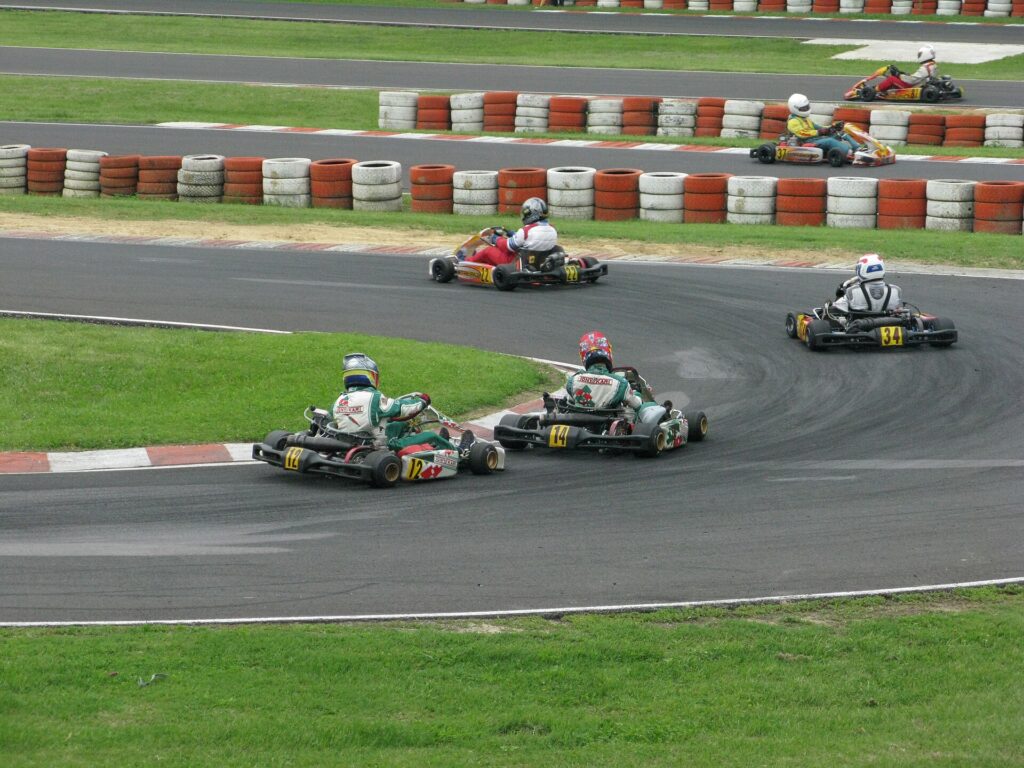
For example, you want to perfectly kiss that apex kerb with your rear tire, in order to get the rotation and get the highest amount of grip. But you don’t want to bounce on the kerb, because then you would lose a lot of time.
Or another one would be using the full width of the kerb on the entry of the corner. Using all of it, in order to carry more entry speed by keeping a wider arc, so that again you can have a higher minimum speed and a better exit out of the corner.
But in order to do so you will need to push the limits. And that’s maybe going to mean you go into the grass every once in a while. That’s part of it.
Once is not enough: every single lap
The point being is that, even after nailing that and placing the tires exactly where you want the first time, well, then you’ve got to make sure you do it every single lap.
That’s where the difference emerges between a good driver and a great driver. The one that ultimately can become a world champion.
Out of 15 laps or 20 laps, if you can place the tires exactly where you want only two or three times, there’s no way you can maintain the pace of an ultimate beast like Verstappen in a Formula 1 race of 65 laps or so.
You’ve got to be just like a hammer. Like Lewis Hamilton’s engineer at Mercedes used to tell him: “It’s hammer time, Lewis.” You’ve got to be like that. You’ve got to be able to repeatedly place the tires exactly where you want, again and again.
After your next session, don’t only look at the fastest lap. Ask yourself on how many laps the tires went exactly where you wanted at the key corner. It’s the same rule I use when I go through the post-session questions with my drivers: a late braking point you can excuse, but line repeatability you can’t. Even if you don’t have the grip, you should have the line as close as possible.
Anybody can do it at half speed
And you have to do it at the high speed. Because being able to place the tires exactly where you want in slow motion, going half the speed? Well, everybody can really do that.
The difficult part is being able to place the tires exactly where you want, but at the highest speed, driving at the limit of the tire grip, the chassis grip, as well as the traction.
So it’s really about driving to the absolute limit and placing the tires exactly where you want. Both at the same time.
At very fast speeds, whatever decision you take is going to affect your racing line massively. Just a millisecond earlier or later turning in. Earlier or later braking. Earlier or later throttle. It’s going to change the kart’s behavior massively, and at the same time your line and your lap time.
Nobody is born with it
I’ve noticed through the years that this is not really something that you’re born with. Like, either you’re able to place the tires where you want or not. No. Nobody is born able to place the tires of his kart exactly where he wants from day one.
It comes down to precision. It comes down to training. And with training comes precision, and comes coordination.
Because I do believe there’s a lot to do with hand-eye coordination, but also with muscle memory. Obviously, the more days you spend on the track, and the more high quality track time you get, the better coordination you will get. And the easier it’s going to be to place the tires where you want. It’s the base of all car control.
If you have a driver that’s spending 15 days a month on the track, for sure he’s going to be beating the one who’s spending just one day or two per month on the track. So quantity has a huge impact.
If you’re focused on every single session, on every single lap you’re doing, you’re going to get to that level of elite driving way earlier in your career than by driving unfocused, empty laps, as I like to call them. If you’re not focused, you’re not able to improve your precision the way you would be if you were fully focused. That’s why I spend so much time on training focus with my drivers.
What time away from the kart did to my precision
This is really something I notice when I go back to driving after a few years. Because sometimes I do have periods of breaks. For example, I just came back from a full year of break, and before that I had five years of break.
And what I noticed is that, even though I still have the skills within myself, if I spend a lot of time away from my kart I naturally just lose the muscle memory that I had in my golden years as a teenager.
Between 2011 and 2015, those were my golden years. I could do exactly what I wanted with the kart, every single day. If I wanted to place the kart there, perfect, I would be able to place it there.
Now, I’m still able to. But I notice that when I’m not driving for a long time, even though I have a lot of experience and a lot of laps behind my back, the muscle memory and all the automations that you build as a racing driver, you kind of temporarily lose them.
So to get them back you need to get back in the kart and just spend a lot of time focusing and building back that muscle memory. Almost like you’re taking the rust off.
And the first times I get back in the kart after a long time of inactivity, I mean, it’s really painful. Really upsetting and frustrating. Because I know where I want to place my kart, especially on a track I’ve been very familiar with. Tracks like Lonato or Franciacorta.
Driving back on those tracks after a very long time has been really painful, because I just didn’t have the pace. And it was not really about pure lap time. It was just not being able to place the tires where I wanted.
For example, if I wanted to use the full entry kerb, I would drop a wheel on the grass more easily than when I was at my peak. Or I would not use the kerb fully and would just use a tiny bit of it, because I thought I was going to use it all, but I didn’t manage to.
It’s one of the most frustrating feelings in the world when I’m not able to place the kart where I want to, even though I know that I can do it, and I know where I want to place it.
That’s when I realized: this sport is really for elite drivers. And I am one of those, I have always been one of those. But the moment I pause my training, for whatever reason, because I’m very busy with Babyrace and working day to day with Senndit and PURPL, and I’m not training for at least a few months? When I get back, I’m rusty. I make mistakes. I can’t place the tires where I want to.
I get discouraged too. I’m like, oh, maybe I’m not good enough, have I lost it, am I still going to be able to perform at my peak? But what I realize every time is that it’s just temporary. Your knowledge is still there. It’s the muscle memory and the reactions that need time to come back, and I know I need to spend more days in a row to get back to where I want to be.
It is your neck and your eyes too
But it’s also not just about pure technique and muscle memory. It’s also just the muscles, that really need to build up the endurance and the strength to do multiple laps and multiple sessions in a row without getting fatigued and costing you lap time.
For example, if you start losing the neck after a long time of inactivity, you start getting worse lap times. Because you can’t see straight. You can’t hold your head exactly where you want. And your eyes don’t look at the right targets, whether it’s the apex, the entry point or the exit.
So if you’ve been away for a while, the karting fitness side is part of getting your precision back too.
How to get it back
So I strongly recommend that, if you want to become the ultimate driving and winning machine, you’ve got to build that connection with your kart. And really that muscle memory.
You do shape your skills, you do get better with time, just like wine. But if you stop practicing for a long time, you kind of lose those skills for a moment.
You may still have the experience in the back of your mind. You may know exactly what you want to do. But your reaction times and your muscle memory are literally not going to let you do it in that specific moment.
Maybe your mind wants you to brake in a certain place. Maybe your mind wants you to carry a certain amount of speed in a corner. But if you’re not trained up, and up to form, because you haven’t spent enough time training? Well, you’re going to be left very disappointed.
And when I start to train back and get myself into shape, by building back that muscle memory, by building that repetition, by building that connection with my kart and removing the dust of all those days, weeks or months without driving, then I get back to my form. And that’s really what makes me enjoy driving.
When you’re able to be fully in control of your kart, when it’s you driving the kart and not the kart driving you, well, that’s the best feeling in the world.
I can’t emphasize enough how important it is to have deliberate and focused practice sessions. Those are the ones that get you closer to that connection with your kart, and to that repeatability. Not many drivers are able to do it. And as I said, it’s not just about doing it once. It’s about doing it every single lap, ideally every single session, at such a high speed into the corners, driving at the absolute limit.
If you’re still at beginner level, wondering what line to take or whether you should brake or throttle at a specific moment, start lower down: go back to the episodes where we break down the specific driving techniques. This one is for the almost elite, advanced driver trying to make that final step.
And if you are at that level, be nice to yourself. Listen, it’s all possible. We all can do it, I believe.
Yeah, a few may have a little more natural talent, by having started very early in their career and built some sort of car control with a bit of an unfair advantage. In that case, of course, they may have a slight edge. But I still believe that every single one of us has the chance of reaching that pure connection with the kart, and being able to place the tires exactly where we want.
But in order to do so it requires a lot of focused practice. And just being willing to make mistakes, and pushing your limits. Only when you get past your limits are you going to get truly great.
So with that said, make sure you keep sending it. And if you want to find the lap time that’s already in yourself, you can do that with your own data on PURPL.
Frequently asked questions
Why can’t I hit the same apex every lap in karting?
Because knowing where to place your tires and actually placing them there are two different skills, and the second one is built by training. It comes from hand-eye coordination and muscle memory, and it only gets precise with a lot of high quality, focused laps. Driving at the limit makes it harder: a millisecond earlier or later on the turn in, the brake or the throttle changes the line massively.
Is tire placement a natural talent or can it be trained?
Nobody is born able to place a kart’s tires exactly where he wants from day one. Drivers who started very young may have a slight edge, but every driver can reach that connection with the kart. It takes a lot of focused practice, a willingness to make mistakes and pushing past your limits.
Why am I slower after a long break from karting?
You keep the experience and you still know where you want to go, but you temporarily lose the muscle memory and the automations. After a year away I was dropping wheels in the grass on entry kerbs and not using kerbs fully at Lonato and Franciacorta, tracks I know very well. Your neck also loses strength, so your head and eyes stop holding the right targets. It comes back with several days of focused driving in a row.
How many days a month do you need to drive to be precise?
There is no magic number, but quantity has a huge impact: a driver on track 15 days a month will beat one who drives one or two days a month. Quality matters just as much. Focused sessions, where every lap has a purpose, build precision much faster than empty laps.
Want me to review your onboard video personally? Send me your footage and I’ll deliver a full corner-by-corner analysis within 48 hours.
Want the full system? The 6-Month Training Program covers everything: racecraft, technique, mindset, fitness, and more. 550+ lessons, weekly live coaching, 100% money-back guarantee.
Send your onboard footage. Alessio reviews it corner-by-corner and tells you exactly what's costing you time, and how to fix it. Back within 48 hours.
Get My Onboard Reviewed → Reviewed personally by a CIK FIA World Champion, never an assistant.I promise I'll not spam you with repurposed shitty AI content but real experiences that only I, Alessio Lorandi, experienced. Written in my funny English-Italian tone of voice 😂
Alessio Lorandi is the former CIK FIA World Junior Champion, winning against Lando Norris in 2013 & F3 multiple race winner. He's helped 200+ karting drivers worldwide get faster & win WSK titles with BabyRace Driver Academy & now through Senndit, his online karting coaching platform.