Kart Gear Ratio: How to Choose Sprockets for a Track
What the gear ratio is on a kart and how I choose the sprocket: minimum RPM in the slowest corners, meters on the limiter, the tyres and your driving.


- The gear ratio is the pinion, the sprocket and the tyre. The final drive ratio comes from those three together, so a tyre with a different circumference changes it too.
- A bigger sprocket gives you more bottom and less middle to top. A smaller one does the opposite. You rarely get both.
- Two numbers tell you if the sprocket is right. The minimum RPM in the slowest corners, and how many meters you sit on the limiter.
- For Mini and OKJ I see the minimum RPM somewhere between 7000 and 8000. It is track specific and driver specific, so I can’t give you a north star value.
- The sprocket moves with the track. If the track suddenly gets 1 second faster, you go one sprocket down, and the driver should be the first one to say it.
- The better the driver, the longer he can run. The best drivers manage to run one sprocket down from everybody else, because they keep up the RPMs in the middle of the corner.
- Check your feedback before you ask for a sprocket. You always get gapped on the exit by the driver in front. That is the concertina effect, and it can send you the wrong way.
- What is the gear ratio on a kart?
- What does a bigger or a smaller sprocket do?
- How do you choose a sprocket for a track?
- What minimum RPM should you look for?
- How do you use the limiter to pick the sprocket?
- When should you change the sprocket during a weekend?
- How does the tyre circumference change your gear ratio?
- Why do the best drivers run one sprocket down?
- Is it the sprocket, or is it your feedback?
- Can a different sprocket fix a traction problem?
- Should you go shorter in the wet?
- What can the tuner change if you keep the same sprocket?
- What do you tell your mechanic or tuner?
- How often should you change the chain and the sprocket?
- Frequently asked questions
You come in after the session and you say “I need one more tooth”. Based on what?
Most of the times it is based on a feeling. And that feeling can be wrong. So let me tell you what I look at before I touch the sprocket, and why the answer depends a lot on how you drive.
What is the gear ratio on a kart?
The gear ratio connects your engine to your wheels. It is all about the number of teeth on the front sprocket on the engine, the pinion, and the number of teeth on the rear sprocket on the axle.
But I want you to think a bit wider than that. When we talk about the engine, we need to include the whole power delivery. The power is not just made by the engine. It is made also by the final drive ratio, which is calculated between the pinion, the sprocket, and actually even the dimension of your wheels.
If your tyres are very large, you have a certain final drive ratio. If your tyres are very small, you have a completely different one. Same pinion, same sprocket.
And why does it matter so much? Because with an engine it is quite rare to have more bottom and more top at the same time. I like the example of a blanket that is a bit too short. You pull it up to your head and your feet stay cold. You keep your feet warm and your head stays cold. The sprocket is the easiest way to decide where you put that blanket.

What does a bigger or a smaller sprocket do?
If you need more bottom, you can go on a larger sprocket. You go from, let’s say, 71 to 72. The numbers are just an example. It is going to give you more bottom and less middle to top.
A smaller sprocket does the opposite. You give up acceleration to gain top speed.
In the paddock you will hear “short” and “long”. Short is the bigger sprocket: more bottom, higher RPMs in general. Long is the smaller one: you get to the limiter later, but you may lose a bit of bottom end.
| Bigger sprocket (shorter) | Smaller sprocket (longer) | |
|---|---|---|
| What you get | More bottom, higher RPMs in general | More top speed, you reach the limiter later |
| What you give up | Middle to top. The top end “dies” halfway through the straight | Acceleration out of the corners |
| When I go that way | The track gets slippery, the tyres have less grip, the tyre circumference is larger | The track gets faster, the tyre circumference is shorter |
| What it asks from the driver | Less. It forgives a low minimum speed | A high minimum speed, to keep up the RPMs mid corner |
So which one is better? There isn’t such a thing as a better sprocket. It really depends on the track, on the grip, on the engine and on you.
How do you choose a sprocket for a track?
The operating window of the sprocket is a bit tricky to find. With the tyres you may know the temperature range. With the pressures you know the target. With the sprocket you have to look at two things on the data.
First, the minimum RPM in the slowest corners of the track. Second, how many meters you are sitting on the limiter, if your category has one, like 60 Mini, OKJ and OK.
Let me give you an example, and the numbers are only there to explain the idea. Say the minimum RPM window is between 7000 and 7200, with 60 to 80 meters of total time on the limiter. Now you look at your data. Your minimum RPM is 6800 and you are on the limiter for only 30 meters. Then the mechanic or the engine tuner knows he has to go shorter, and shift the gear ratio to more bottom and higher RPMs in general.
But careful. That 6800 could also be because the driver is not driving properly and is not carrying as much speed, while the sprocket might be good. We come back to this.
This is how I would go through it:
- Open the data and find the slowest corners of the lap.
- Read the minimum RPM there. Ignore the ultra low peaks from a lock up on the brakes.
- If you have a limiter, check for how many meters you are hitting it.
- Compare with what you had on that track in the past, and with your other sessions.
- Low minimum RPM and almost no limiter: go shorter. Too long on the limiter: go longer.
- Do it again every time the track or the tyres change.
What minimum RPM should you look for?
If you only take part in club races with 20 to 25 drivers, you’ll be fine just optimizing tyre pressure, water temp and the RPM to find the optimal sprocket. For international races the bar is a lot higher.
But which RPM? I can’t give you a north star target value. It really depends from category to category.
What I see is that for Mini and OKJ it’s somewhere between 7000 and 8000 RPM. But again, it’s so track specific and driver specific.
Scrappy drivers will struggle to keep the minimum RPM above 7000. Fast drivers will be able to raise it to 8000 or more with the same sprocket. Same kart, same sprocket, same corner.
How? Thanks to a more opened corner. They maximize the track on entry, mid and exit, so they scrub less speed and keep the engine up at the apex.
One thing when you read the trace. Exclude the ultra low peak values below 5000 RPM. Those normally come from a lock up on the brakes, and they tell you nothing about the sprocket.
Monitoring the minimum RPM is super useful to understand whether your sprocket is on point for the track conditions or not. And if you don’t have a team mate to compare with, compare with yourself. Benchmark the RPMs against your other sessions and your other days on that track. I go through the channels I use in the 4 must have AiM RS3 telemetry channels. And if you want the data read for you, upload the MyChron file from the session you just drove to PURPL, the app I built, and it hands back the three things to change next time out.

How do you use the limiter to pick the sprocket?
I’ve been racing with limiter restricted engines for most of my career, be it 14,000 or 15,000 RPM. I also raced in Mini Rok without limiter when I was little, and I drive shifters, as I still do these days.
And when you’re constrained by the limiter, it’s actually a bit easier to find the optimal sprocket. You can monitor how many meters you’re sitting on it, and then decide based on your past experience on that track.
If you hit the limiter for too long, you run a smaller sprocket. That normally happens when the track gets faster, or when the tyre circumference is shorter, which shortens the gear ratio.
If you barely hit the limiter, you run a bigger sprocket. That is normally when the track gets more slippery, the tyres have less grip, or the tyre circumference is larger.
Which categories have it? In Italy we have a limiter of 13,000, 14,000 or 15,000 RPM, depending on the category and on the year of the regulation. Most of the CIK-FIA homologated categories have it, and it is done through the coil. In shifters there is no limiter.
This methodical approach works, even though it always has to be mixed with experience on track. And when you can’t tell what the target window is, go out on track for a couple of days and test. Testing removes the guesswork.
When should you change the sprocket during a weekend?
The track conditions keep changing, and the driver should be the first one to tell when the sprocket needs to be changed.
If the track suddenly gets 1 second faster, it’s not the tuner’s job to tell you to go one sprocket down. It is yours. And the other way around if it gets super slippery.
Think also about the race itself. If you run a short sprocket, with lots of bottom compared to the top, you’ll be faster than most drivers in the first few laps. Everybody is sliding around in search of grip, the tyres are cold, the minimum speeds are low. You can make up a couple of places.
But then the grip comes. And you’re struggling big time, because your top end “dies” halfway through the straight.
So nobody is the fastest on track at every moment of the race. You decide where you want to be strong. I wrote about how the grip moves in how to read track evolution.
And don’t forget what is under the sprocket. Before you change anything, is the pinion and sprocket alignment spot on? Even 1 mm of difference in alignment creates extra tension on the chain.
How does the tyre circumference change your gear ratio?
In Italian we say “non tutte le ciambelle escono col buco”. Not all doughnuts come out with a hole. It’s the same with tyres. You’ll rarely find tyres with the same circumference.
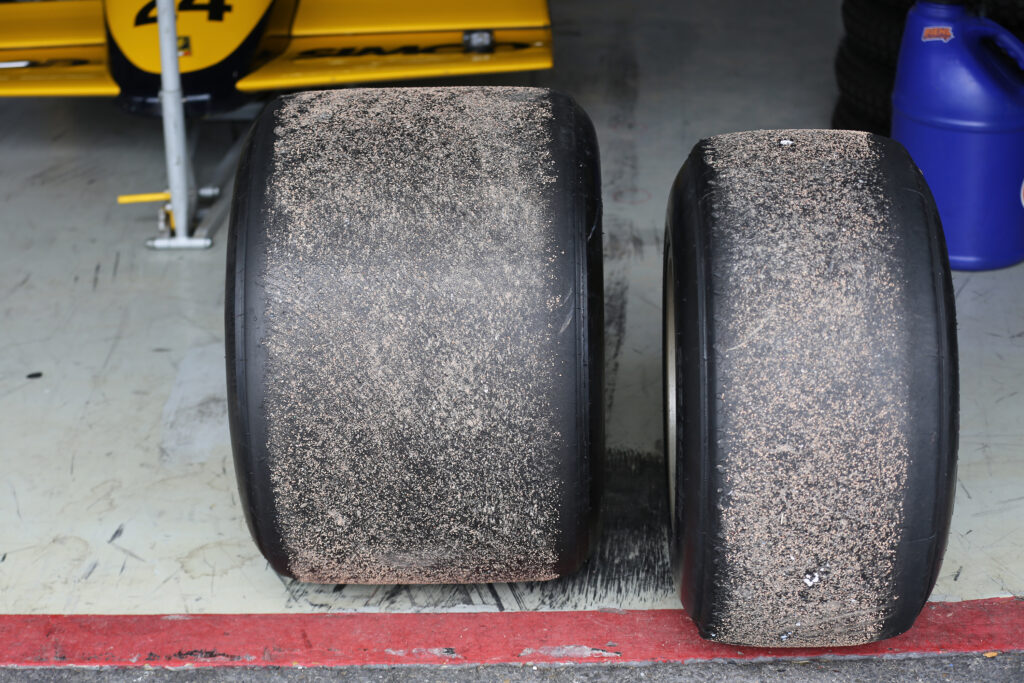
And this changes the final drive ratio. When the tyres are high in circumference, the RPMs get lower. It’s like having a smaller sprocket. With a small circumference it is the opposite, like a bigger sprocket, so more exit and less top.
Take one tyre with a circumference of 83 centimeters and another with 85 centimeters. That is going to change the final drive ratio a lot.
So a new set of tyres can move your RPMs even if nobody touched the sprocket. If your minimum RPM dropped from one session to the next, check the circumference before you blame the engine.
There is a second problem. If you have 1 cm of difference between the two rears, the kart pulls to the lower side on the straight, and it also affects the rear ride height. No bueno.
Why do the best drivers run one sprocket down?
The sprocket choice is driving related. As a rule of thumb, the better the driver, the longer he can run on the sprocket.
Based on my experience, the best drivers are the ones that always manage to run one sprocket down from everybody else. Let’s say 90% of the drivers go with 75 and you manage to go on 74. Most of the times you’re going to be the winning driver.
Why? Because when the grip picks up for qualifying and the track gets a little bit faster, you naturally gain an advantage.
But there is only one way to do it. You need a higher minimum speed, so you keep up the RPMs in the middle of the corner. If you can’t do that, you’re going to struggle out of the corners and you will not get the benefit at the top.
And this comes from track usage. The whole goal of track usage is to keep up your RPMs. The drivers who do it are not geniuses. They’re just using the track more than you. I explain it in my guide to the racing line.
At times I ran longer sprockets on purpose, by 1 or 2 teeth. The exits became very challenging, and normally the top speed I gained didn’t compensate at all for what I lost on the exits. But it taught me how to drive fast while clean, so that I could run longer sprockets than most drivers.
There is a full article on this: driving with one sprocket down.
Is it the sprocket, or is it your feedback?
Imagine you come back after a session and you say “I’m losing on the exits of the corners”. So the tuner gives you more bottom.
But maybe you didn’t lose anything on the exits. You always get gapped on the exit by the driver in front. As speed expands, distance expands. He goes on the throttle earlier in time just because he is ahead, so the gap opens. I call it the concertina effect, or the rubber band effect.
And the reality is probably the opposite. You’re probably struggling at the top, because your sprocket is already towards the bottom. If you give that wrong feedback, you go slower. More on this in the concertina effect.

Can a different sprocket fix a traction problem?
Not if the problem is you. It happened to me. I was 11 or 12, in 60 Mini, on a rainy day. I kept telling my mechanic that the kart was sliding on exit. I was like 2 seconds off.
So he went smaller and smaller on the sprocket, to make the throttle pick up smoother. It didn’t help. If anything the lap time got slower.
Then he walked into the track and watched me. I was putting the power down too early and too aggressively, on the rubber line, where in the wet there is no grip. My line was too tight, almost a dry line.
After a few sessions I figured it out. And then we put back the sprocket of before, for more bottom. Traction issues? Gone, with more acceleration than before.
So before you say “my sprocket was too small, the engine had no bottom”, ask yourself if you used enough track to keep up the RPMs mid corner. And if you’re half a second off in your driving, don’t go looking for one tenth in the engine. You lose credibility with the people around you.
Should you go shorter in the wet?
It depends on what the data shows you.
In the wet you can look at the RPMs and get an idea of how your final drive ratio is working. The data won’t tell you what to do. But it shows you what you did in other sessions, maybe with different sprockets, and the difference is quite clear.
Maybe you notice that going shorter for more acceleration is not needed, because right now you already have a lot of wheel spin.
Or maybe you see that you are controlling the wheel spin really well, your bottom is not so strong and your top is too strong. Then it’s better to go on a shorter sprocket.
And remember my story from before. That day in the wet, a different sprocket didn’t fix my traction. My line and my throttle did.
One more thing. When the conditions are changing and you have to gamble, it is mostly the sprocket and the tyre pressure that you play with. I talk about that in when to gamble on slicks.
What can the tuner change if you keep the same sprocket?
The sprocket is the first and the easiest thing to change. But it’s not the only one.
Back in 2012 and 2013, my engine tuner kept asking me what I felt and what I needed. And I was always trying to understand if we were on the same sprockets as the other fast drivers. Were we a bit too short, with more bottom and not enough top? Or a bit too long, getting to the limiter later but losing some bottom end?
Because sometimes you want to keep that longer sprocket and find the bottom somewhere else.
The tuner can put a longer exhaust, for example from 60 to 60.2 or 60.4. Normally the longer the exhaust, the more bottom and a little bit less top. A shorter exhaust is the opposite. He can also play with the timing. With lower timing you have less bottom but more middle to top.
The carburation is another story. You can’t move the power between bottom and top with the carburation in the way you can with the sprocket. You need it right for other reasons, and I cover those in my carburation tips.
All the detail on this side is in how to set up your engine.
What do you tell your mechanic or tuner?
I always ask my drivers the same question. “What do you need?”
I expect something like “I need more rear”, or “I need more front”, or “we probably need one extra sprocket for more bottom”. The feedback needs to be specific. I hate when drivers say “the engine is not good”.
How do you get there? Look at where you’re missing. If you’re missing in the corners, there is probably something with your setup or your tyres. If you’re missing on the straights, it may be the carburation, the sprocket or the engine.
Then say where on the straight. “I feel like I’m on the limiter here and they get there a bit later, and they’re gapping me at the top.” With that, the tuner knows what to do. You try a smaller sprocket, and maybe he does something with the exhaust to compensate.
If you have team mates, even better. At BabyRace we have many drivers in the same category, so you can compare the data. If you’re alone, your mechanic watching from the side of the track can tell you if it’s more the bottom or the top that is missing.
More on this in the driver and mechanic relationship.
How often should you change the chain and the sprocket?
It depends a lot on the quality of the chain and of the sprocket, and on how you treat them.
As a fair estimate, I’d say you change the chain about every 1,000 laps. If you lube it properly it lasts way longer than if you forget the chain lube every session.
The sprocket lasts longer than that. It’s almost indestructible. But if you really want that last bit of performance, you may have to change it every 500 or 600 laps.
And if you’re going to a race where every millisecond counts, you want a new chain and a new sprocket every three or four races.
What we do as a team at BabyRace is to always have a chain and sprocket for testing, and a chain and sprocket for the races. So you save the best material for when it counts.
On a used and quite old kart, one of the easiest and fastest ways to find lap time is to put a new chain, a new sprocket and new bearings. Less friction, so more speed on the straights. The rest is in karting maintenance basics.
- All my setup articles are in the karting setup guides.
- To read the RPM trace properly, start from the karting telemetry guides.
- Not sure if it’s the sprocket or you? Send me your onboard and I go through your laps in an onboard review.
- I teach all of this in my six month training program.
Next time you’re at the track, write down the sprocket, the minimum RPM in the slowest corner and the meters on the limiter after every session. After a few days you’ll have your own numbers for that track.
Frequently asked questions
What is the gear ratio on a kart?
It is what connects the engine to the wheels: the number of teeth on the pinion on the engine and on the sprocket on the rear axle. The final drive ratio also includes the dimension of the tyres, so a different tyre circumference changes it.
Does a bigger sprocket make a kart faster?
A bigger sprocket gives you more bottom and less middle to top. You accelerate better out of the corners and you lose top speed. A smaller sprocket gives up acceleration to gain top speed.
How do I know if my sprocket is right for the track?
Look at the minimum RPM in the slowest corners and, if you have a limiter, at how many meters you sit on it. If you hit the limiter for too long, run a smaller sprocket. If you barely hit it, run a bigger one.
What minimum RPM should a Mini or OKJ kart have in the slowest corner?
I can’t give a north star value. What I see for Mini and OKJ is somewhere between 7000 and 8000 RPM, and it is track specific and driver specific. Exclude the peaks below 5000 RPM that come from a lock up on the brakes.
How often should I change the kart chain and sprocket?
As a fair estimate, the chain about every 1,000 laps. A sprocket lasts longer, but for full performance you may change it every 500 or 600 laps. For races where every millisecond counts, a new chain and sprocket every three or four races.
Send your onboard footage. Alessio reviews it corner-by-corner and tells you exactly what's costing you time, and how to fix it. Back within 48 hours.
Get My Onboard Reviewed → Reviewed personally by a CIK FIA World Champion, never an assistant.I promise I'll not spam you with repurposed shitty AI content but real experiences that only I, Alessio Lorandi, experienced. Written in my funny English-Italian tone of voice 😂
Alessio Lorandi is the former CIK FIA World Junior Champion, winning against Lando Norris in 2013 & F3 multiple race winner. He's helped 200+ karting drivers worldwide get faster & win WSK titles with BabyRace Driver Academy & now through Senndit, his online karting coaching platform.