Adaptability: The Real Skill Every Driver Needs
Track conditions shift constantly, the drivers who adapt win. Here's what separates the fast from the rest.


- No two karting sessions ever feel the same: track conditions change constantly
- Read the grip on the first lap out. Slippery means stop the kart more, grippy means brake later and carry more speed
- Every track has its own DNA. Learn which sessions and which corners go slippery first, and write it down
- The perfect setup does not exist. Get it close, then adapt your driving to make up the rest
- Before blaming the kart, get within two tenths of your theoretical and string laps within one tenth
- Great drivers can perform at 99% potential even when the kart is only 90% perfect
- Adaptability is a trainable skill: practice in different conditions and with imperfect setups
- Why does no karting session ever feel the same?
- How do you read the grip on your first lap out?
- Does every track change in its own way?
- Why can’t the setup keep up with a changing track?
- Does the perfect kart setup exist?
- What do great drivers do with a 90% kart?
- What can you change from the seat when the kart is off?
- Is it the kart, or is it you?
- Why is karting harder to adapt to than car racing?
- How do you adapt your driving in the wet?
- How do you train adaptability?
- So what separates good drivers from great ones?
- What do drivers ask most about adaptability?
Why does no karting session ever feel the same?
If you’ve raced long enough, you know this already: no 2 sessions in karting ever feel the same.
They never do!
The track changes all the time. Grip comes and goes. Rubber builds up. Temperatures rise and drop.
It changes ALL THE TIME!
You can start on Wednesday with a green track, barely any grip. By Friday, it’s sticky like glue. Then Sunday comes, everyone’s on old tires, and the track feels worse again. That’s because with each heat cycle a tire gets a little bit harder, brand new tires are way softer than the same set after 30 sessions, I explain why old kart tires are slower.
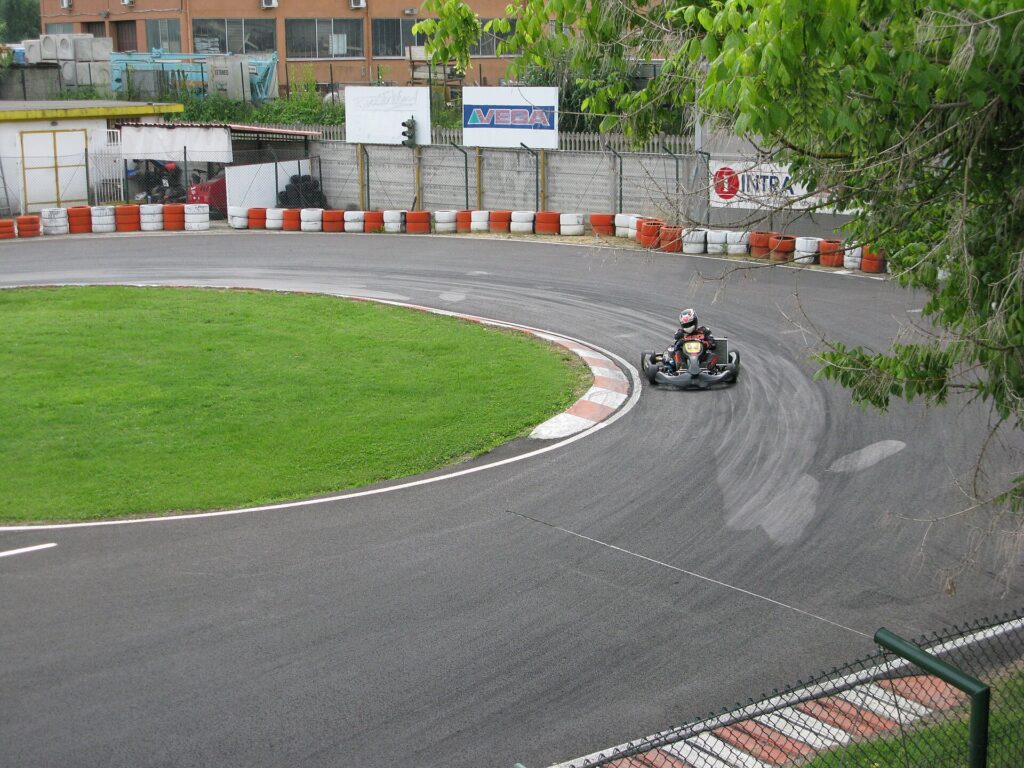
I go through the whole weekend, day by day, in how track evolution works and how to read the grip. Here I want to talk about you, the driver, and what you do with it.
Because it’s not only the weekend. Every time you go out on track, the track feels a little bit different. The grip feels a little bit different in every corner, or maybe in some corners only. It’s either going to be a little bit grippier or a little bit slipperier.
Every lap, every session, the conditions shift.
That’s why adaptability is the real key.
The best drivers aren’t the ones who complain about a sliding kart, they’re the ones who adapt and still deliver fast laps no matter what.
How do you read the grip on your first lap out?
I call it “grip discovery”. Every time you go out on track, you have to figure out right away where the grip is and how the grip changed from the previous session. I mean, that’s it.
It’s really the core skill a driver needs to have, because you can’t always rely on the grip from the previous session.
So say lap one feels a bit more slippery than usual. Okay, I need to make sure that I stop the kart a little bit more, and I can’t carry as much speed into the corners. Maybe I still have to brake in the same place, but instead of releasing the brakes and carrying the speed I wanted when the track was faster, I have to stop a bit more. Or maybe brake a tiny bit earlier. Or maybe wait a little bit on the gas.
Vice versa. You go out and lap one already feels grippier than lap 4 or lap 5 of the previous session, when the tires were up to temperature. Then you can imagine lap 4 and 5 of this one. That already gives you an idea: I should push more compared to the previous session. You can brake later. You can release the brakes and carry more speed into the apex. You can get on the throttle earlier.
How do you feel it? If the kart feels stuck, the track got grippier. That’s always great news if you like driving with a lot of grip. If you go out of the pits and the steering feels super light, everything feels light, you’re not on rails anymore, it’s almost like you’re on ice, then it’s the opposite. The track is a lot more slippery.
How many laps should it take you?
The best drivers are able to adapt massively from session to session, from day to day and from track to track. So they get up to pace a lot sooner. They are not going to take 15 laps to get to a quick lap.
If it normally takes you 15 laps in a session to adapt to the track and the kart, you need to take that down to two, three, four laps.
Drivers like Verstappen, Leclerc, Schumacher, Hamilton, they can adapt super fast. And I’m sure they weren’t like that on day one when they started out. They developed that adaptability.
Does every track change in its own way?
Yes. Every track has its own DNA, I like to call it.
At Lonato the best sessions of the day are session three and four, out of six. Session one is always quite a bit slippery, and the last session of the evening is also quite slippery. So normally you get the best laps of the day in session three and four.
Whereas if you go to a track like Franciacorta or Cremona, you may still set your fastest laps and personal bests in the afternoon, which is quite surprising. And at some tracks you may set the fastest laps in the first session of the morning.
When you drive in the UK you may feel even more of a difference. In the morning the track can be very frosty, very slippery, almost like wet. Then it gets more and more grippy towards the middle of the day, like 1 or 2 pm.
And it even changes corner by corner. At Lonato in the winter, when the sun is going down at the back of the grandstand, the first part of the track that gets cold and goes into the shadow is turn one and two, as well as the last two corners. So those are the corners that get slippery the earliest.
That’s why, when I go to a racetrack, especially testing, I always note it down, mentally or on paper. Where does the track get slippery, and at what point of the day?
So in the last session at Lonato I already know: I can’t carry more speed than the session before. Maybe I can carry the same speed, but I’m sure I can’t carry more. So I know I’ll have to stop the kart a bit more in the middle of the corner, by holding the brakes, waiting to go on the gas.
Memorising stuff, writing down stuff, noticing stuff. It’s hard work. But it gives you an unfair advantage.
Why can’t the setup keep up with a changing track?
That’s why I say karting is a moving target.
It’s easy to fix the setup for what already happened.
But the real challenge is predicting what’s coming next.
And you’ll never be 100% right, that’s why you, as a driver, must be adaptable. How to set up for the session ahead, and not for the one you just had, is in how to set up for a changing track.
And even with the right setup, the grip change is not going to be the same everywhere on track. Not the same in every corner, and even in the same corner it may change from entry to mid to exit.
The mechanic can’t just make a kart that has little grip in the grippy sections and more grip in the slippery parts. No chance.
Same with elevation and banking. If you go through an uphill and banked section, you’ll pick up a lot of grip. And you can’t make a variable setup that changes from corner to corner. You as a driver instead have to make the adjustments to your driving, and anticipate the grip level. I explain where that grip comes from in how elevation changes and banking affect grip.
The driver ALWAYS ends up making the difference.
Does the perfect kart setup exist?
No. I’m not going to fool you into thinking the kart is always going to be perfect. It’s not going to be perfect. Most of the times probably never.
The goal is to get the setup as close to perfect as possible, and then you have to adapt. Let’s say the setup is 99, you need to adapt your driving to make that become 100. Maybe the kart is a little bit oversteery, so you control it by being a little bit smoother.
Not even if AI had the chance to tune up the setup would it manage to make a perfect one. It would be impossible. The conditions of the track change so much in terms of grip level, temperature, humidity. The carburation changes all the time. You’ll never really have the grip level you had the session before, because you’ll have either more or less.
And that’s the same in F1. Think about it. One race Mercedes wins, next race Ferrari wins, next race McLaren wins. Even there it’s really hard to stay at the peak of performance and nail the sweet spot all the time.
My belief is that only one driver out of 36 will have that feeling of driving the kart “on rails” throughout the whole race, and it doesn’t necessarily mean he’ll be the one winning the race.
So the best drivers are not the drivers who get the best setups all the time. They’re the ones who are able to live with it and get really good lap times no matter the setup.
What do great drivers do with a 90% kart?
Here’s a rule I live by:
If you ever get one session in a weekend where the kart feels perfect, that’s gold.
It never lasts.
Most of the time, you’re working with 90% of an ideal setup. The great drivers can still deliver at 99% of their potential even when the kart is off.
That’s what makes them great.
Even for the pros winning world championships, like it was my case in 2013, you may not change anything on the kart the whole day. You just adjust the tire pressures to the tire and track temperature, maybe put new tires on at some point. And still the lap times are different every session, because you never have the same grip.
What can you change from the seat when the kart is off?
There’s a point where the kart is out of your control.
You can tweak the setup, narrow the rear width, adjust the camber a bit, but when you’re sitting in the seat, it’s up to you.
That’s when adaptability matters most.
Maybe your kart is sliding. Maybe it’s got too much front or not enough rear. It doesn’t matter. You still have to make it work.
Here’s how I think about it:
- Too much front grip? Drive smoother, be gentler with steering inputs.
- Not enough front grip? Carry more speed on entry, use braking to rotate the kart.
- Rear is loose? Stay calm, lean back slightly, and keep the weight balanced.
- Rear is too planted? Be aggressive, create more rotation through weight transfer.
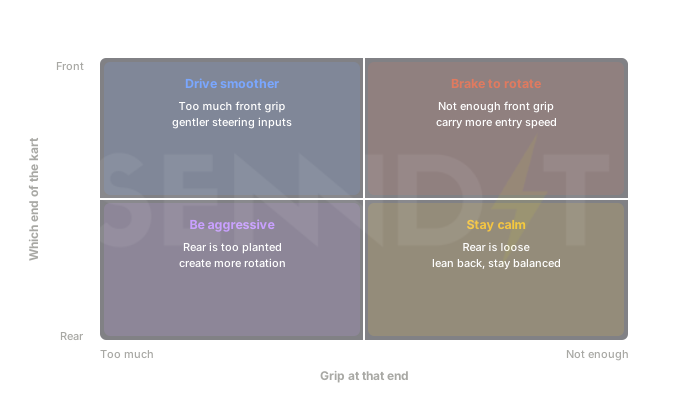
If I have understeer, I try to find a way to rotate the kart anyway, by using more brakes, carrying more speed, clipping the apex kerb if needed. If I have oversteer, I try to get the kart to rotate just a bit less than usual, so I can control it. If you’re not sure which one you have, start with understeer vs oversteer.
Some things you can fix yourself. In Juniors or Seniors you can tune the carburation yourself during the session. In 60 Mini or KZ you can’t, you do it after the session together with your engine tuner. So out there, it’s you.
You can’t just come back to the tent and say, “The kart was bad.” Everyone’s kart is a bit off at some point. The difference is how well you adapt.
And adapting your driving to the kart you have that day can be learned. It is one of the things I teach in my six month training program, together with wet weather driving.
Is it the kart, or is it you?
I’ve been on the racetrack for about 22 years. And what I notice a lot of times is that drivers struggle to identify whether a mistake is happening because of their driving or because of their kart. As I see it, about 80% of the times it’s the driver. Even making it feel like the kart is behaving wrong.
The way you drive affects the kart balance massively. You want to be super aggressive with your brakes in the slow corners, in the hairpins, but super smooth with the steering. Many times drivers get it the other way around. Very smooth with the brake pedal, very aggressive with their hands. That results in oversteer, and it feels like the kart is set up badly. But most of the times the driver makes it slide.
So before we even talk about chassis or engine, I look at your theoretical time. If your theoretical is three tenths faster than your real lap and you’re two tenths off pole, we shouldn’t even discuss it. Drive all your best sectors together and you’re on pole position.
My prerequisite is that you are at least within two tenths of your theoretical. That’s not world class. World class is within half a tenth, session by session, not once in a lifetime.
And I want to see two, three, four laps within one tenth. If the second best lap is three tenths from the fastest, and the kart doesn’t really change during the session, then we have a driver problem before blaming the kart.
Your theoretical time, your braking point repeatability and your lines lap by lap are all things you can check in your data, and that is what lap time analysis on PURPL is for.
Once you’re consistent and close to your theoretical, and the lap time still isn’t coming, then we change something. What do you need, more front or more rear? We try what you say. If you improve, perfect. If you get worse, we try the other way around.
But be seriously aware of what you’re saying. If you say the kart is bad once and you’re wrong, twice and you’re wrong, three times and you’re wrong, then guess what the team is going to think. They’re not going to trust your feedback anymore.
I’ve seen that many times in racing. A driver complaining, complaining, complaining, and it was never right. Then eventually he was right, and the team didn’t really follow him. He created that situation himself.
The worst drivers focus outward first. The best drivers focus inward first. I told my own story of blaming the traction on a rainy day in 60 Mini in why you should stop blaming the kart.
Why is karting harder to adapt to than car racing?
I’ve raced both karts and cars (both Formulas and GT3s), and I’ll tell you this: karting demands more adaptability.
In cars, the grip evolution is more predictable. You start with oversteer on a green track, and by the end of the weekend, you have understeer as the grip builds up. Teams can tune for that.
But in karting, it’s chaotic. You can go from sliding to stuck to sliding again, in one day. The rubber build-up sometimes helps, sometimes makes it worse.
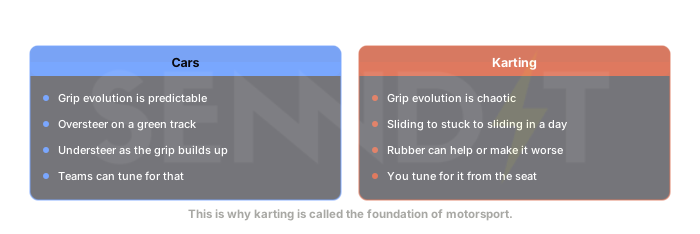
So when people say karting is the foundation of motorsport, this is why. It teaches you to feel every change and react instantly.
How do you adapt your driving in the wet?
If there’s one scenario where adaptability is tested to the limit, it’s the rain.
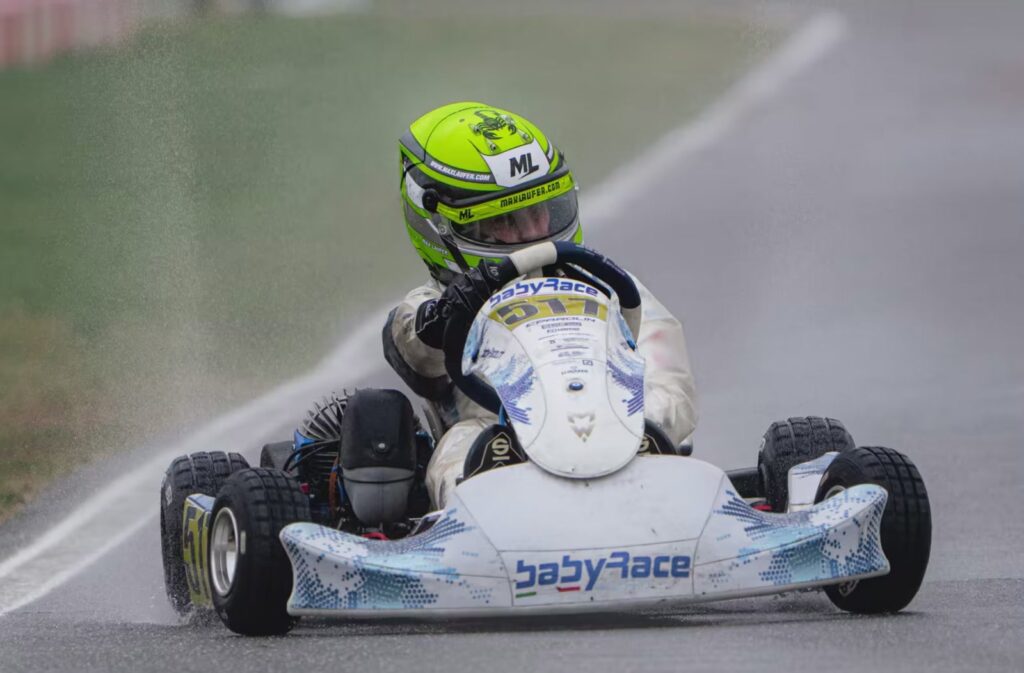
In the wet, the track can change from lap to lap. You need to:
- Brake a little earlier.
- Find the dry patches.
- Avoid the rubbered-in line.
- Adjust your throttle and shifting rhythm.
You even have to use your eyes differently, watch the raindrops on your visor, figure out where it’s heaviest, and adapt your approach corner by corner.
Every lap becomes a puzzle.
And no two wet sessions are the same either. A bit more rain or a bit less rain. A bit more standing water or a bit less. A bit more rubber on the track, which becomes soap, or a bit less rubber, which is actually better in the rain, because there’s more grip available.
And when the track starts drying, the call on slicks is its own gamble. I go through it in when to gamble on slicks.
How do you train adaptability?
Adaptability isn’t something you magically develop, it’s a skill. You train it like anything else.
Here’s how:
- Drive Different Conditions.
Test in the cold, the heat, in the rain. Don’t only drive when the grip is good. - Learn With Bad Setups.
Ask your mechanic to give you a setup that’s not perfect. Too much oversteer? Too little front? Learn to make it work. - Study Data and Feel Together.
After every session, compare your data with how the kart felt. This builds awareness. - Stay Calm When It Feels Wrong.
Don’t panic when the kart doesn’t react as expected. The best drivers keep their cool.
And don’t change the setup for the warm-up. I always let the drivers adapt in the warm-up and get used to the kart control of sliding. I don’t care if the first session they’re sliding. I care that we are fast in the middle of the day, when there’s most of the action that matters.
You can even prepare for one race months before. Say for instance I was planning to race the SKUSA SuperNationals in Las Vegas. That track is in a parking lot, so the grip is going to be extremely low. So three months before the race, I planned to go and practise on the tracks in northern Italy with very low grip, do many laps, and build that muscle memory of driving in low grip conditions.
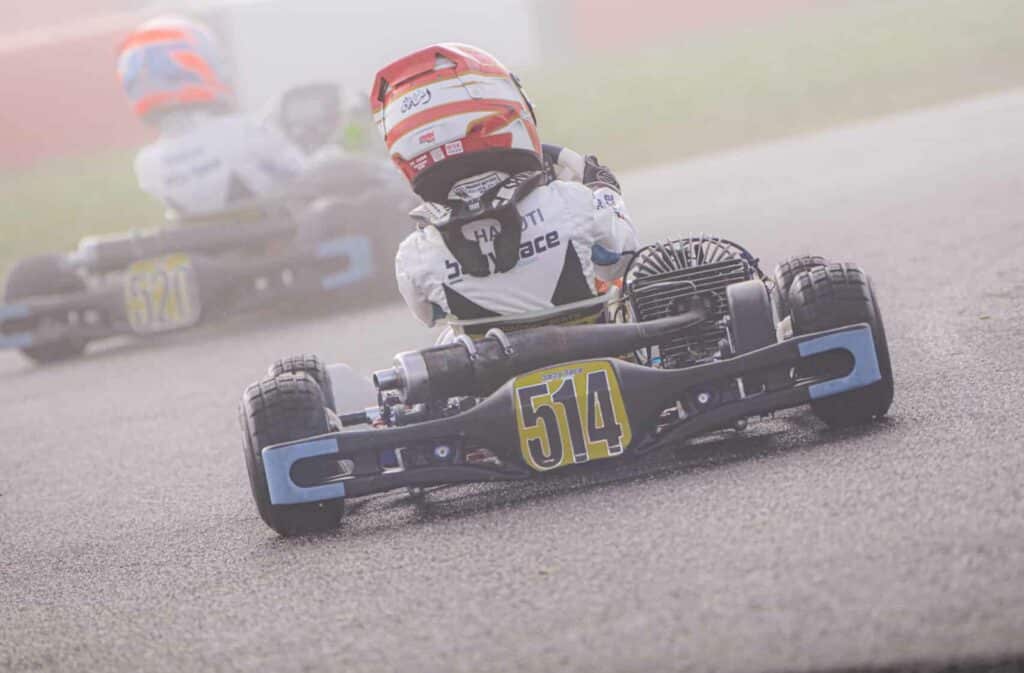
And you can’t blame your mechanic or your dad or your team manager or your coach for not having changed the grip. You can’t cry about it like a spoiled kid. It’s like that for everybody.
That’s why drivers like Verstappen can adapt better in extreme weather and changing grip than most of the other drivers. He developed that from an early age, and he hasn’t really complained about it.
So what separates good drivers from great ones?
Karting isn’t about being perfect. Nope, it’s about being adaptable.
You can’t predict how the track will feel, but you can control how you respond to it.
The driver has to be as adaptable as a chameleon.
There’s no better skill you can develop than adaptability. Racing is really about adaptability, because you’re never driving in the same place, with the same grip, on the same track, in the same kart. Everything’s changing.
So next time the kart feels off, don’t complain. Smile. That’s your opportunity to get better.
If you want me to look at where you’re losing time when the kart is not perfect, send me your onboard for an onboard review. And if you want to build this skill with me week after week, that is what I do in the 6 month training program.
What do drivers ask most about adaptability?
What is adaptability in karting?
Adaptability is changing your driving to the grip and the kart you have right now, instead of waiting for a setup fix. The track, the tires and the kart balance change every session, so the driver who adapts the fastest gets to the lap time first.
Does the perfect kart setup exist?
No. The grip level, the temperature, the humidity and the carburation change all the time, so a setup that was right one session is a bit off the next. The goal is to get the setup as close as possible and then adapt your driving to make up the rest.
How do I know if it is the kart or my driving?
Check yourself first. Get within two tenths of your theoretical time and string two to four laps within one tenth of each other. If you can do that and the lap time is still not there, then it is time to work on the kart.
How many laps should it take to get up to pace in a session?
The best drivers need two, three or four laps to adapt to the grip in a session. If it takes you 15 laps, that is the number to bring down.
How do you train adaptability in karting?
Drive in the cold, the heat and the rain, ask your mechanic for a setup that is not perfect and learn to make it work, and do not change the setup for the warm-up. Every session you drive in bad grip builds the skill.
Want me to review your onboard video personally? Send me your footage and I’ll deliver a full corner-by-corner analysis within 48 hours.
Want the full system? The 6-Month Training Program covers everything, racecraft, technique, mindset, fitness, and more. 550+ lessons, weekly live coaching, 100% money-back guarantee.
Send your onboard footage. Alessio reviews it corner-by-corner and tells you exactly what's costing you time, and how to fix it. Back within 48 hours.
Get My Onboard Reviewed → Reviewed personally by a CIK FIA World Champion, never an assistant.I promise I'll not spam you with repurposed shitty AI content but real experiences that only I, Alessio Lorandi, experienced. Written in my funny English-Italian tone of voice 😂
Alessio Lorandi is the former CIK FIA World Junior Champion, winning against Lando Norris in 2013 & F3 multiple race winner. He's helped 200+ karting drivers worldwide get faster & win WSK titles with BabyRace Driver Academy & now through Senndit, his online karting coaching platform.