Karting Fuel & Oil Basics Explained Simply
Most karters get fuel and oil wrong. Here's what actually matters on track.


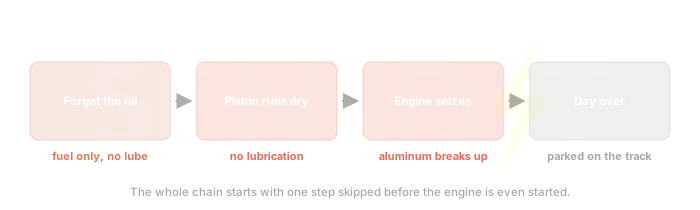
- Kart engines run on fuel with the oil mixed in. Fuel alone and the aluminum parts of the engine have no lubrication. At some point it seizes.
- The normal oil mixture is 4 to 5 percent. Some engine tuners want 4, some want 5. With a very good oil you can stay as low as 4, with a less oily one 5 to 6.
- If you have no clue, start at 5 percent. In one litre that is about 50 grams of oil, against 40 grams at 4 percent.
- 1 or 2 percent is a high chance of seizing. Too much oil is not good either, the carburation will not be right.
- Higher octane is faster, but it changes the jetting. At BabyRace we lean the carburation for a high octane fuel and go richer for a low octane one.
- At WSK and CIK-FIA events you do not choose the fuel. You buy it from the supplier of the organization, so everybody drives with the same fuel.
- The number one beginner mistake is forgetting the oil. No oil, the piston runs dry in the cylinder and the engine seizes.
- Consistency beats experimentation. Same fuel, same oil, same ratio, every tank, until you know your engine.
- What fuel is used in karting?
- Why do you mix oil into kart fuel?
- What is a safe oil mixture ratio for a kart engine?
- How much oil do you put in a litre of kart fuel?
- What happens if the oil mixture is wrong?
- Does higher octane fuel make a kart faster?
- Can bad fuel damage a kart engine?
- How do you know your engine is running too lean?
- How should you store kart fuel?
- What is the most common beginner mistake with fuel and oil?
- How much does fuel cost for a day of karting?
- Can you tune the fuel in karting?
- Is your lap time in the fuel or in your driving?
- Frequently asked questions
Why does everyone in karting obsess about fuel and oil? And does it actually matter for a beginner?
Yes, it matters a lot. Not only for your performance, but also for your maintenance.
Because if you leave your engine without any lube, just fuel and no oil, all the aluminum components of the engine have no proper lubrication. At some point it breaks up, it seizes, and you are parked on the racetrack with no running engine.
So let me go through what you actually need to know. I will try to keep it as basic as possible.
What fuel is used in karting?
It depends on the category and on the country.
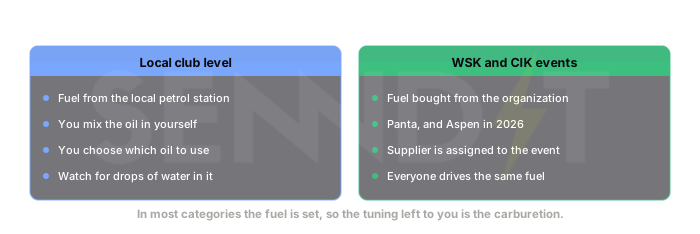
If you race at a local club level, most of the times you get the fuel from the local petrol station and then you mix it with oil yourself.
If you compete at WSK or at the CIK-FIA events, it is different. There you have to buy the fuel right from the organization, from the supplier the organization has been assigned. Most of the time that was Panta. In 2026 it is Aspen.
So at that level everyone drives with the same fuel. The fuel stops being a variable.
Why do you mix oil into kart fuel?
Because the oil in the fuel is what lubricates the engine.
The oil goes in with the fuel and lubricates between the piston, the cylinder and the crankshaft. Without it the piston runs dry inside the cylinder. And that is a seized engine.
The amount of oil you put in the fuel is what we call the oil mixture. And it does not only protect the engine. The oil mixture also affects the performance of your engine, because it affects the carburation.
More oil, more lubrication inside the engine. Less oil, less lubrication and more fuel for the same litre of mixture. Change one and the carburation changes with it.
What is a safe oil mixture ratio for a kart engine?
A safe mixture is about 4 to 5 percent. That is what you see in most categories and on most engines.
Of course it depends on the engine tuner. Some engine tuners want the engine at 5 percent, other engine tuners want it at 4 percent. So it kind of depends, but most of the times you will see between 4 and 5 percent.
It also depends on the oil you use. With a very good oil you can stay as low as 4 percent. With a less oily lubricant you stay at about 5 to 6 percent.
And if you are starting out and you have no clue? Just start with 5 percent. I would suggest a good oil like the Elf 909. Then keep it there.
How much oil do you put in a litre of kart fuel?
Let me put it in numbers, because the percentage alone does not tell you much.
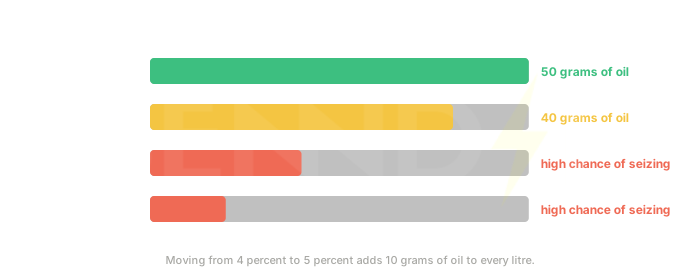
In one litre of fuel at 4 percent you have about 40 grams of oil. At 5 percent you have about 50 grams. So going from 4 to 5 percent is 10 grams more oil in every litre.
That is the whole difference between the two ratios most tuners ask for. Ten grams. And those ten grams mean more lubrication between piston and crankshaft, and a slightly different carburation.
At 1 or 2 percent you are in a completely different place. There is a high chance of seizing.
What happens if the oil mixture is wrong?
If it is too low you can seize. With 1 or 2 percent of oil there is a high chance of seizing.
It depends on many things, of course. Some engines are more likely to seize, other engines less. But for sure, if the mixture is wrong for that specific engine at that specific time, the performance gets worse.
Either there is too much lubrication, and the carburation is probably not going to be perfect. Or there is not enough lubrication, and the carburation is going to be even worse.
So it is not “more oil is always safer”. The right mixture is the one your engine was set up for. And if you change it, remember the carburation has to follow.
Does higher octane fuel make a kart faster?
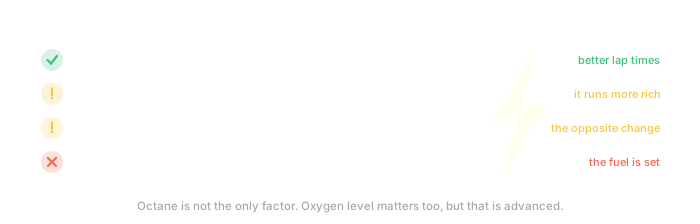
Yes. The octane of a fuel changes the performance quite a lot. Normally a higher octane fuel is a higher performing fuel. Better lap times, and the engine just delivers better power. With a low octane fuel the performance is less.
But here is the thing nobody tells you. It changes your carburation.
One of the things we noticed at BabyRace: when we run with a high octane fuel, we have to make the carburation a little bit leaner. The higher octane makes it run a bit more rich, so we go leaner on the jets. When we run with a lower octane fuel we do the opposite. We go up on the jets to make it a bit richer and compensate.
And it is not only about octane. Other things in a fuel have a big role in performance too, the oxygen level for example. But that is advanced stuff, so let me keep it basic.
If the regulations let you choose the fuel, and in most categories they do not, a higher octane is better. Just remember it will need a different carburation from a low octane one.
Can bad fuel damage a kart engine?
I think more than the fuel itself, the thing that hurts the most is water in the fuel. That can happen when you buy from the petrol station. Sometimes you find some drops of water in it. Not ideal in a high performance engine.
But at the end of the day, what really decides whether an engine gets damaged or not is the carburation. The fuel, the oil mixture you choose, the quality of the oil and the quality of the fuel all end up there.
If all of these things are a good combination, you have no problems. If some of them are wrong and the carburation ends up wrong, there is a chance you damage the engine. Especially if it is way too lean.
Dirt is the other one. Clean your fuel tank and the fuel filters that go to the pump, and clean your air box. You do not want sand, grass or small stones going through the carburetor into the engine. That can seize it too.
How do you know your engine is running too lean?
You can kind of feel it a few laps before it seizes. At the end of the straight the engine starts to misfire, almost like it is shooting. It feels too lean. It is giving you a signal that it is about to give up.
Your ears tell you too. So many times I noticed the engine sound shifting a bit, getting just a bit too loud, and that told me it needed some extra fuel. It saved my races a lot of times.
What can you do in the kart?
- If you have a membrane carburetor, open the carburation and give it some extra fuel.
- Put your hand over the air box down the straight. Less air, richer carburation.
- In the last laps, if nobody is pushing from behind, wait a tiny bit longer before going on the throttle. More fuel goes into the engine.
- In a shifter, if it is really about to seize, pull the clutch and come back to the pits.
And know when it happens. When it gets very cold the carburation gets very lean, so you have to adjust it. In the wet it is the opposite, you need to lean it out massively, because every time you wait to go on the gas the engine fills up with fuel that does not get burned. More on that in how to drive a kart in the wet.
How should you store kart fuel?
Listen, there is not much you have to do here.
Keep it at ambient temperature, away from too much heat. Keep the fuel containers closed and stored as safely as possible, so that ideally no air and no water get in.
And that is it. At the end of the day it is not going to make a big difference. So do not think about it too much.
What is the most common beginner mistake with fuel and oil?
Simply forgetting to add the oil.
Yes, you have heard me well. It is the number one mistake. You forget the oil, the piston runs without any lubrication inside the cylinder, and you seize the engine.
The second mistake is adding too much oil or too little oil. But those are the major ones. Not too much more to say.
So make sure you add new oil every time you buy new fuel. And always with the proper oil mixture ratio.
How much does fuel cost for a day of karting?
For a full testing day of about 100 laps, the fuel is going to be about 50 euros.
Add the entry ticket for the track, about 60 to 70 euros, and a used set of tires, and you are at about 150 to 170 euros for the day if you are your own mechanic. That is the cheapest way to get proper track time with your own kart.
So the fuel is one of the smaller costs of the day. The engine is a different story. Last year, in 2025, I was racing the shifter world championship and we literally replaced the piston after every single heat, about 15 laps. That is if you want everything at maximum performance. If you just drive for fun as a hobby and your carburation is quite rich, you will not have to change the piston that often.
The full numbers are in how much karting costs per year and in the cheapest way to start kart racing.
Can you tune the fuel in karting?
In karting you are not really allowed to tune the fuel.
Unless you drive a specific category in a specific country where the fuel is open, in most countries and in most series at international level you get the fuel from the supplier at the racetrack. Then you use the oil you selected, and that is it. You cannot change the properties of the fuel or use fuels with different octanes.
What you play with is the carburation. And the oil mixture, a bit. If you want a little more oil for the engine temperature and the carburation, you can do that, just be aware it changes things. Same if you reduce it.
Check the regulations of your own championship before you change anything on the fuel side.
And at the beginning keep it simple. Consistency beats experimentation. Yes, you can experiment. But if you are a beginner, first be consistent. Do not try random stuff.
Is your lap time in the fuel or in your driving?
In your driving. Almost always.
Carburation, sprocket and setup are very important. But let your team and your engine tuner take care of them. Your job is to give them the right feedback: the engine feels lean, it feels rich, it needs more bottom, more top.
I see so many drivers looking at data to blame the carburation. They show me the exhaust temperature to prove they are too lean or too rich. Then I show them a lap where they went on the throttle at the same moment as the reference driver, and the values are exactly the same. It was the driving.
If you are still half a second off, do not talk to me about one tenth in the engine. First the driving. Then the engine.
Fuel and oil are only part of the story of engine health. For what the temperature sensors are really telling you, read CHT versus water temperature on PURPL. The rest of what I wrote on the kart and the engine is in the setup guides.
And if you want me to look at where your lap time really is, there is the onboard review and there is the 6 months transformation.
Frequently asked questions
What is the oil mix ratio for a 2 stroke kart engine?
About 4 to 5 percent in most categories. Some engine tuners want 4 percent and some want 5. With a very good oil you can stay as low as 4 percent; with a less oily lubricant about 5 to 6. If you are starting out, use 5 percent.
How many grams of oil go in a litre of kart fuel?
About 40 grams at 4 percent and about 50 grams at 5 percent. Going from 4 to 5 percent adds 10 grams of oil to every litre.
What fuel do kart racers use?
At local club level, fuel from the petrol station mixed with oil. At WSK and CIK-FIA events, fuel bought from the supplier assigned by the organization, Panta in the past and Aspen in 2026, so everyone drives with the same fuel.
Does octane matter in karting?
Yes. A higher octane fuel performs better, but it needs a leaner carburation, and a lower octane fuel needs richer jetting. In most categories the fuel is set by the regulations, so you cannot choose it.
What happens if you forget to put oil in kart fuel?
The piston runs without lubrication inside the cylinder and the engine seizes. It is the most common beginner mistake with fuel.
Send your onboard footage. Alessio reviews it corner-by-corner and tells you exactly what's costing you time, and how to fix it. Back within 48 hours.
Get My Onboard Reviewed → Reviewed personally by a CIK FIA World Champion, never an assistant.I promise I'll not spam you with repurposed shitty AI content but real experiences that only I, Alessio Lorandi, experienced. Written in my funny English-Italian tone of voice 😂
Alessio Lorandi is the former CIK FIA World Junior Champion, winning against Lando Norris in 2013 & F3 multiple race winner. He's helped 200+ karting drivers worldwide get faster & win WSK titles with BabyRace Driver Academy & now through Senndit, his online karting coaching platform.