X30 vs KA100 vs Rotax vs LO206: Karting Classes Explained
X30, KA100, Rotax and LO206 side by side: the power, ages and weights the makers and federations publish, and what a single speed kart punishes in …

- X30 Senior and Rotax Senior are published at the same power. IAME Series UAE lists the X30 Senior at 30 Hp. Rotax lists the 125 Senior MAX evo at 30 hp.
- The KA100 sits below them. Karting Australia describes a 100cc air cooled engine with around 22hp in the unrestricted specification.
- The LO206 is a different animal. Briggs & Stratton list the 206 at 204cc and 8.8 hp, limited to 6,100 RPM, with a factory sealed short block.
- All four are single speed. A single speed kart is all about keeping up the momentum, with the RPM as high as possible in the middle of the corner.
- An 11 year old does not need the bigger class yet. If the kid is not too tall or too heavy, it is almost better to stay in Mini for one year more.
- Laps matter more than the name of the series. In an IAME Series race week in Italy my drivers do roughly 100 laps per day. At a WSK, if you are lucky, 30 to 35.
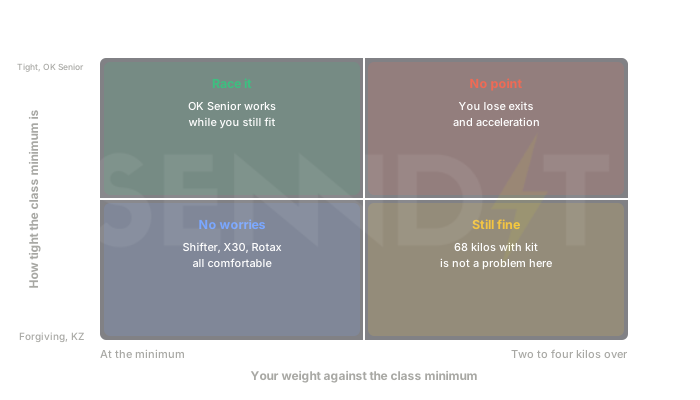
- Weight decides the senior class. I am about 68 kilos with kit and I am too heavy for OK. X30 and Rotax are more flexible on minimum weight.
- What are the X30, KA100, Rotax and LO206?
- What is the IAME X30 and how do you race it?
- How does Rotax Max compare with the X30?
- What is the KA100?
- What is the LO206?
- Where does a shifter kart fit against these four?
- What does a single speed engine punish in your driving?
- Which class do I put an 11 year old in?
- Which class fits a heavier or an adult driver?
- How often do you rebuild these engines?
- X30, KA100, Rotax or LO206: which one do you pick?
- Frequently asked questions
Four engines, four names on the entry list. Which one is the right class for you or for your kid?
First thing. You probably cannot choose between all four.
In the U.S. there may be categories that we do not even have in Europe. And the other way around. So before you compare horsepower, look at what actually races at your track.
I already wrote about how to choose a first class in best beginner kart classes. This one is different. Here I put the four engines side by side, with the numbers their makers publish, and then I tell you what a single speed kart does to a driver.
What are the X30, KA100, Rotax and LO206?
They are four engine packages. Each one is a class, or a full ladder of classes, built around one engine. Everybody on the grid has the same one.
| Engine | Maker | What it is | Published power |
|---|---|---|---|
| X30 Senior | IAME | 123.67cc two stroke, water cooled, 16,000 RPM limit | 30 Hp (IAME Series UAE) |
| 125 Senior MAX evo | BRP-Rotax | Electronically controlled exhaust valve, 21 Nm at 9,000 rpm | 30 hp at 11,500 rpm (Rotax) |
| KA100 | IAME, for Karting Australia | 100cc, air cooled, electric start, clutch | Around 22hp unrestricted (Karting Australia) |
| 206 | Briggs & Stratton | 204cc, 6,100 RPM limiter, 87 octane fuel | 8.8 hp (Briggs & Stratton Racing) |
Look at the last column. From 8.8 to 30. These are not four versions of the same thing.
But they have one thing in common. No gearbox. One gear, a clutch, and you. That matters more for your driving than the number in the table, and I come back to it below.
What is the IAME X30 and how do you race it?
The X30 is IAME’s own engine family. IAME says the X30 engines are popular in more than 30 countries, from a 60cc for the small kids up to a shifter.
The numbers, as IAME Series UAE lists them:
- X30 Senior: single cylinder two stroke, 123.67cc, water cooled, electric start, dry centrifugal clutch, 30 Hp, 16,000 RPM limit.
- X30 Junior: the same engine at 21 Hp.
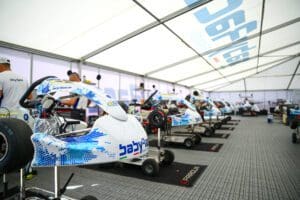
Now the part I know from the paddock. At BabyRace the first racing step after our camps is the IAME Series in Italy. Six rounds.
Why there? Because the engines are a lottery. Every driver gets a lottery engine, which creates a very fair playing field. The only thing you tune is the carburation. And the fuel itself you are not really allowed to tune, I explain what you can play with in tuning the fuel in karting.
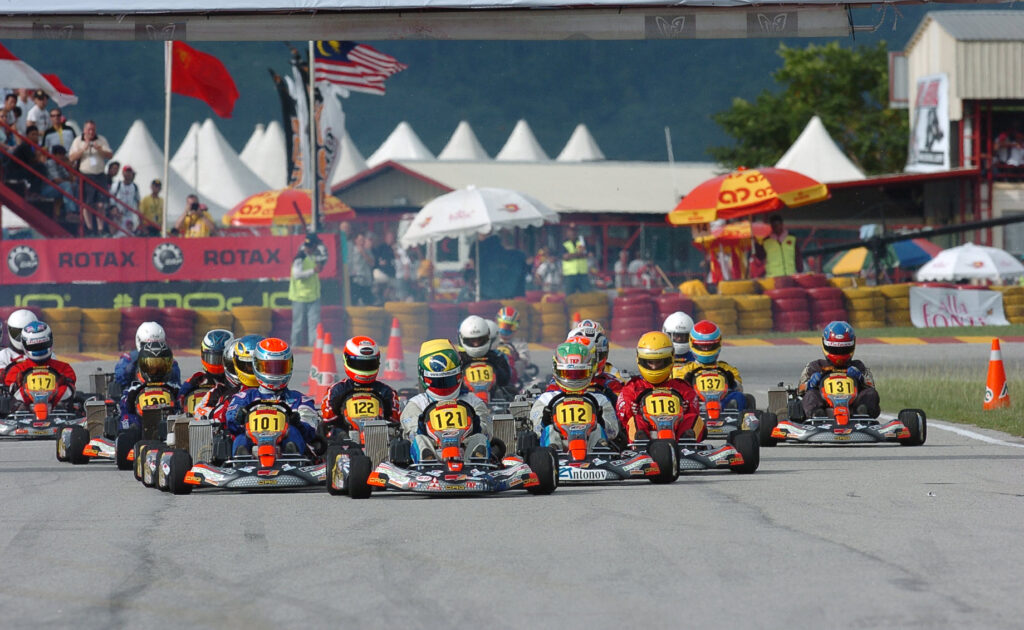
And the track time. In a race week my drivers do roughly 100 laps per day on average. That is three times as much as what you get in a WSK, where if you are lucky you get to do 30 to 35 laps per day.
Is it as prestigious as a WSK championship? No. But it is actually very educational.
One honest thing. X30 and Rotax are less competitive than CIK or WSK level. But they are more affordable.
How does Rotax Max compare with the X30?
On the senior engine, the published power is the same number. Rotax lists the 125 Senior MAX evo at 22 kW, 30 hp, at 11,500 rpm, with an electronically controlled exhaust valve. The X30 Senior is listed at 30 Hp.
The junior engines are close too. Rotax lists the 125 Junior MAX evo at 23 hp, with a junior cylinder without the exhaust valve. The X30 Junior is listed at 21 Hp.
Where Rotax is very clear is the ladder. One family from 8 years old up. Power is from the Rotax product pages, ages and weights from the 2026 Rotax MAX Challenge global sporting regulation:
- Micro MAX: 9.5 hp. 8th birthday during the year. Minimum weight 105 kg.
- Mini MAX: 13 hp. 10th birthday during the year. 115 kg.
- Junior MAX: 23 hp. 12th birthday during the year. 145 kg.
- Senior MAX: 30 hp. 14th birthday during the year. 162 kg.
- DD2: 34 hp, with a 2 speed gearbox. 15th birthday during the year. 175 kg.
The weights are kart plus driver plus all the safety equipment. Your national series can run different numbers, so check your own rulebook.
So which one, X30 or Rotax? On my ladder they sit on the same step, with Rok next to them. I would not choose on the engine. Look at which one actually races near you.
What is the KA100?
The KA100 is a 100cc engine that IAME built for the Australian federation. Karting Australia announced it in November 2014, for junior and senior classes at club and state level from 1 January 2015, in place of the Yamaha engines.
What Karting Australia says about it:
- 100cc, air cooled. No radiator, no water pump, no belts.
- Electric start and a clutch.
- Around 22hp in the unrestricted specification.
And this is how Karting Australia lists it today:
- KA3 Junior: 13 to 15 years old, KA100 with a 22mm restrictor, top speed 100 km/h. Minimum weight 132 kg in the light division and 150 kg in the heavy one. A driver can move up from Cadet 12 from the 11th birthday and must move from the 13th.
- KA3 Senior: a new driver from 15 years old, KA100 unrestricted, top speed 120 km/h. Minimum weight 150, 170 or 190 kg depending on the division.
Karting Australia calls these the junior and the senior starting point.
For this engine I give you the published numbers and I stop there. The driving part further down is built on the karts I work with.
What is the LO206?
Briggs & Stratton call it simply the 206. Their numbers:
- 204cc, 8.8 hp and 10 ft. lbs. of torque.
- Digital ignition with a built in 6,100 RPM rev limiter.
- 87 octane fuel.
- Assembled by hand in Milwaukee, with a factory sealed short block.
- Listed at 759 dollars on the Briggs page on 3 October 2026.
The 2026 rule set talks about valve springs, push rods and a camshaft. So this is a four stroke, not a two stroke like the X30.
Then the ladder. It is one engine. Briggs say a complete racing ladder can be developed by simply changing a carburetor slide. The kid kart class runs the smallest slide with a 4,100 RPM limiter. Cadet and junior run bigger ones. Then come the 206 Senior and the Masters.
Each engine comes with two orange security seals from the factory. Tamper with a seal and the engine is no longer eligible to race.
Ages and weights? Briggs leave that to the sanctioning body. So ask your club.
Same as the KA100. Published numbers, and I stop there.
Where does a shifter kart fit against these four?
A shifter is the opposite of all four. Gears, front brakes, and a lot more speed.
I preferred single speed karts back then. Now I prefer the shifter.
Some numbers so you understand the gap:
- At Lonato a KZ is about half a second faster than an OK senior.
- At the 2025 CIK-FIA World Championship at Franciacorta I was pulling 1.8 to 1.9 G on the brakes into turn 5 and turn 13.
- Minimum weight is 175 kilos in KZ2 and 170 in KZ. A junior is 145 and a senior 150.
And the Rotax DD2? Rotax list it at 34 hp with a 2 speed gearbox that you shift from a paddle on the steering wheel. I have never tried that one. I have heard it is fun, almost in between a single speed and a shifter.
If you come from an X30 or a Rotax senior into a shifter, the big change is the braking. In the hairpins you make a V shaped line on the brakes. I go through it in my shifter kart driving tips.
But do not start there. A single speed kart teaches you the fundamentals first. And as an adult nobody stops you, but the jump is quite shocking, I explain why in going straight into a shifter as a beginner.
What does a single speed engine punish in your driving?
It punishes every moment you kill the speed.
A single speed kart is all about keeping up the momentum. You want the RPM as high as possible in the middle of the corner. You have no gear to save you on the exit.
So what does that look like?
- Overslowing. On a Rotax or an X30 the speed trace in a corner should look like a U. Round at the bottom.
- A tight line. Round and wide keeps the RPM up. Tight and early drops it.
- Slow in, fast out. I hate that sentence. These karts live on momentum.
- Defending. In a KZ a defensive line costs you about half a tenth, a tenth. In a junior, a senior or a Mini it costs you three, four tenths, even half a second.
How small is the margin? At Franciacorta in turn two, 9,000 RPM against 9,400 at the minimum is huge. That is 400 RPM.
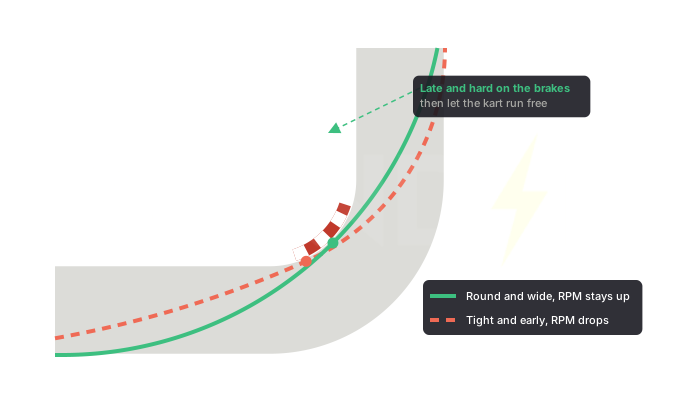
The KA100 and the 206 are single speed karts with a clutch too. But what I describe here comes from the karts above.
Which class do I put an 11 year old in?
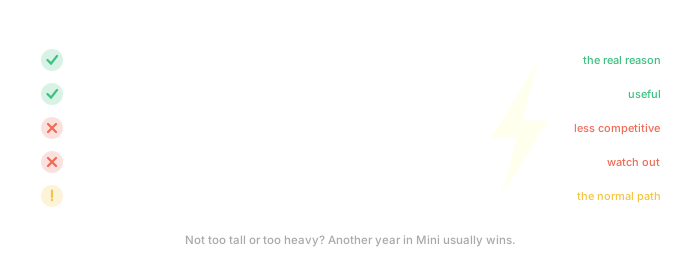
In Europe, where I work, my answer is often one more year in Mini.
In Europe the normal step to OK Junior is at 12, sometimes 11. There is also OKNJ, which is for the kids who at 11 are already too tall or too heavy for a 60 Mini.
But listen. If your kid is not too tall and not too heavy, it is almost better to stay in Mini for one year more. Why? Because the level in OKNJ actually gets lower than in Mini Gr.3.
Now put that next to the rulebooks:
- Rotax: Junior MAX starts in the year of the 12th birthday. Mini MAX, on 13 hp, starts in the year of the 10th.
- Karting Australia: a driver can move from Cadet 12 into the junior class from the 11th birthday. Can, not must. The must is at 13.
- Briggs 206: the sanctioning body decides.
The biggest mistake I see from families is putting the kid in a category above his level. The wrong class builds frustration.
So at 11, look at the size of the kid and at the level of the grid before you look at the horsepower. The full path by age is in the karting ladder from 6 to 16.
Which class fits a heavier or an adult driver?
Weight closes the door before age does.
Take me. I am only about 68 kilos with kit, and I am too heavy for OK. If you are two to four kilos over the minimum, there is no point racing.
X30 and Rotax are more flexible in terms of minimum weight. And look at the published numbers. The Rotax Senior MAX minimum is 162 kg in the 2026 global regulation. Karting Australia lists the KA100 senior class in three weight divisions, 150, 170 and 190 kg.
For an adult starting now, I point to a senior single speed class. Senior Rotax, X30 or Rok. Rotax also has a Masters class from the year of your 32nd birthday.
And before you enter anything, check the paperwork. I explain it in do you need a license for karting.
How often do you rebuild these engines?
This is where these classes win.
At international level you change piston and rings every race. In the shifter at the 2025 World Championship the piston was replaced every heat. That is about 15 laps.
On an X30 or a Rotax or a Rok? The piston maybe after 10 hours of work or so. The engines are way simpler, so the maintenance is way lower. You get many hours for your money.
For the other two I can only read you what is published. Karting Australia say the KA100 is well under stressed, which they link to a long bottom end life. And the Briggs 206 short block is sealed at the factory.
X30, KA100, Rotax or LO206: which one do you pick?
Start from what actually races at your track. Countries do not run the same categories, so that already cuts the list.
Then the size and the level of the driver. Not the power.
The right class at the right time builds skills and shapes your driving abilities, whereas the wrong class actually builds frustration.
And whatever engine is behind your back, the homework is the same. Carry the speed. Keep the RPM up in the middle of the corner.
- New to all this? Start from the beginner guides.
- Still choosing a first class? Read best beginner kart classes.
- Not sure a coach is worth it? Here is why you need a go kart coach.
- Want me to work with you on your driving, whatever the class? Look at the 6 months transformation.
Frequently asked questions
Is the X30 faster than a Rotax?
On the published numbers the senior engines are level. IAME Series UAE lists the X30 Senior at 30 Hp and Rotax lists the 125 Senior MAX evo at 30 hp. The juniors are listed at 21 Hp for the X30 and 23 hp for the Rotax. Look at which one actually races near you before you compare engines.
How much horsepower does an LO206 have?
Briggs & Stratton list the 206 at 8.8 hp and 10 ft. lbs. of torque, from 204cc, with a digital ignition limited to 6,100 RPM. The short block is sealed at the factory.
How much horsepower does a KA100 have?
Karting Australia describes the KA100 as a 100cc air cooled engine with around 22hp in the unrestricted specification. Its junior class runs the same engine with a 22mm restrictor.
Should a beginner start in a shifter kart?
No. A single speed kart teaches you the fundamentals first: keeping the momentum and the RPM high in the middle of the corner. At Lonato a KZ is about half a second faster than an OK senior, with front brakes and gears on top.
Send your onboard footage. Alessio reviews it corner-by-corner and tells you exactly what's costing you time, and how to fix it. Back within 48 hours.
Get My Onboard Reviewed → Reviewed personally by a CIK FIA World Champion, never an assistant.I promise I'll not spam you with repurposed shitty AI content but real experiences that only I, Alessio Lorandi, experienced. Written in my funny English-Italian tone of voice 😂
Alessio Lorandi is the former CIK FIA World Junior Champion, winning against Lando Norris in 2013 & F3 multiple race winner. He's helped 200+ karting drivers worldwide get faster & win WSK titles with BabyRace Driver Academy & now through Senndit, his online karting coaching platform.